DoorDash Dasher Pay 2026: $22-$38/Hr Real Take-Home Pay
DoorDash Dasher Pay
The gig economy promises freedom and flexibility, but let’s cut through the marketing: how much do DoorDash drivers actually make in 2026? If you’re considering joining the platform or trying to understand why your earnings fluctuate wildly week to week, this guide delivers the unfiltered truth about Dasher pay, the strategies that separate struggling drivers from thriving ones, and the market-specific data you need to make informed decisions.
DoorDash has fundamentally transformed from a cherry-picker’s paradise into a tiered rewards system where your acceptance rate directly impacts your earning potential. The days of casually rejecting every low-paying order are over in many markets. Understanding this shift—and knowing how to navigate it—is the difference between earning $15 per hour and $30 per hour doing the exact same job.
Quick Dasher Salary Summary (2026 Update)
Average Hourly Earnings (Active Time): $22-$30/hr
Average Hourly Earnings (Dash Time, Real): $16-$22/hr
Net Earnings (After Gas & Expenses): $12-$18/hr
Pay Structure Breakdown:
- Base Pay: $2.00-$10.00+ per order
- Peak Pay Bonuses: +$1.00-$5.00 per order during high demand
- Tips: 100% to driver (typically 50-70% of total earnings)
- Earn by Time Rate: $10-$18/hr active time (market dependent)
Critical Reality Check: The difference between “active time” and “dash time” can represent 30-40% of your logged hours. Active time only counts when you’re actively working on an order—driving to restaurants, waiting, and delivering. Dash time includes all those unpaid minutes sitting in parking lots waiting for worthwhile orders to appear.
DoorDash Income Calculator
Paycheck Calculator
Calculate your Weekly, Monthly & Yearly Take-Home Pay
⚠️ These are estimates for a single filer using 2026 tax rates (IRS Rev. Proc. 2025-32). Results do not include local taxes, pre-tax deductions (401k, health insurance), or tax credits. Consult a tax professional for personalized advice.
Understanding the 2026 Pay Model: Two Paths, Different Outcomes
DoorDash now offers drivers a fundamental choice that will define their entire earning experience. This isn’t a minor preference setting—it’s a strategic decision that determines which orders you see, how much you make, and whether you’re building a sustainable income or grinding away for minimum wage.
Earn by Offer: The Traditional Model with New Constraints
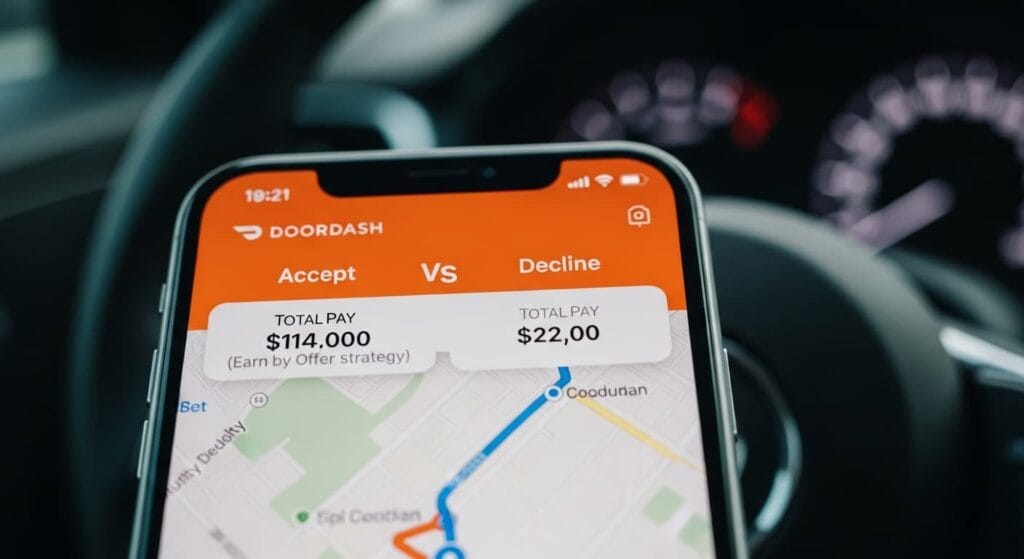
This is the classic DoorDash experience where you see the total guaranteed pay before accepting any order. The offer shows you the pickup location, drop-off distance, and total payout including base pay and tip. You can decline as many orders as you want—or at least, that used to be the case.
The 2026 reality is more complex. Base pay still ranges from $2.00 for a quick two-mile McDonald’s run to $10.00+ for longer, less desirable routes. DoorDash’s algorithm calculates this based on distance, estimated duration, and how many drivers have already rejected the order. That last factor is crucial: when orders get declined repeatedly, the base pay ticks upward until someone accepts it.
Tips remain fully transparent and go 100% to you. This is your primary income driver, often accounting for more than half of your total earnings. A $2.50 base pay order with zero tip is a money-loser once you factor in gas and opportunity cost. A $3.00 base pay order with an $8.00 tip is a winner that takes the same amount of time.
The new constraint? Your acceptance rate now directly impacts your access to orders and scheduling flexibility. In saturated markets like Los Angeles and New York, maintaining Platinum status (70%+ acceptance rate) is often mandatory just to access “Dash Now” functionality. Without it, you’re locked out during prime earning hours unless you scheduled shifts days in advance.
Earn by Time: The Safety Net with Hidden Costs
Introduced as a way to provide earnings stability, Earn by Time guarantees you an hourly rate ranging from $10 to $18 depending on your market. This sounds appealing until you understand the fine print: you only get paid for active time, defined as the period from accepting an order until completing delivery.
Sitting in a parking lot for 20 minutes waiting for an order? Unpaid. Driving back to your preferred zone after a delivery? Unpaid. The guaranteed rate only applies when your wheels are actively turning on behalf of a customer.
The bigger issue is order quality. DoorDash’s algorithm tends to route low-tip and no-tip orders to Earn by Time drivers because the platform knows you’re getting paid regardless. You become the cleanup crew for orders that Earn by Offer drivers rejected. You also face strict decline limits—typically one per hour—before facing penalties.
There is one scenario where Earn by Time makes strategic sense: late-night drive-thru heavy markets where active time is long but mileage is minimal. If you’re spending 25 minutes in a Taco Bell line at 2am for a one-mile delivery, you’re getting paid for that wait time at your guaranteed rate. But for most drivers in most markets, Earn by Offer with selective order acceptance generates significantly higher net earnings.
The Tiered Rewards System: How Platinum Status Changed Everything
The 2026 DoorDash landscape is fundamentally defined by the Dasher Rewards program with its Silver, Gold, and Platinum tiers. This system replaced the old Top Dasher program and created a stark divide between drivers who maintain high acceptance rates and those who cherry-pick orders.
Platinum Status Requirements:
- 70%+ Acceptance Rate over rolling 30 days
- 95%+ Completion Rate
- 200+ lifetime deliveries
Platinum Benefits:
- Priority access to high-value catering and large orders
- “Dash Now” capability in any market, any time
- First access to promotional opportunities
The Strategic Dilemma:
In underserved suburban markets with consistent demand, cherry-picking with a 30-40% acceptance rate often yields $25-$30 per hour. You reject the $3.50 orders going six miles and wait for the $12 orders going three miles. The math works because good orders come frequently enough that unpaid wait time remains minimal.
In oversaturated urban markets, dropping below 70% acceptance rate can completely lock you out during profitable hours. The “Dash Now” button grays out, and scheduling slots disappear days in advance. Platinum status becomes the cost of entry, even if it means accepting some break-even orders to maintain your 70% rate.
The veteran move? Test both strategies for two full weeks and track every metric: total earnings, active hours, dash hours, miles driven, and gas costs. Calculate your actual net hourly rate for each approach. The market determines the winner—your job is to identify which strategy your specific city rewards.
Strategy 101: Acceptance Rate vs. Earnings
This is where we separate the drivers earning $30 per hour from those grinding for $15. Your acceptance rate represents the percentage of offered orders you accept, and conventional wisdom suggests you should accept everything to maximize volume. That conventional wisdom will keep you poor.
The Math That Matters:
A $3.00 order (base pay $2.50 + tip $0.50) going 5 miles takes approximately 20 minutes including pickup, drive time, and drop-off. At current gas prices, you’ll spend roughly $1.50 in fuel. Your net earnings: $1.50 for 20 minutes of work, or $4.50 per hour before taxes and vehicle depreciation.
A $11.00 order (base pay $3.00 + tip $8.00) going 3 miles takes approximately 18 minutes. Gas cost: $0.90. Your net earnings: $10.10 for 18 minutes of work, or $33.60 per hour.
Both orders required nearly identical time investment. The difference is knowing which one to accept and having the discipline to wait for quality orders instead of accepting garbage to “stay busy.”
The $1.50 Per Mile Rule:
Never accept orders paying less than $1.50 per mile unless you’re strategically grinding toward Platinum status in a market where it’s required. This rule accounts for the fact that you’re driving back to your zone after delivery, effectively doubling your mileage on many orders.
The $4.00 Minimum Tip Rule:
Orders with tips under $4.00 statistically correlate with problem customers. They’re more likely to have complicated delivery instructions, live in difficult-to-navigate apartment complexes, complain about minor issues, and leave negative ratings. High tippers are usually easy, appreciative customers. Protect your ratings and sanity by being selective about customer quality, not just order pay.
The Decline Button Is Your Friend:
In Earn by Offer mode, every bad order you accept is a good order you can’t take. If you’re holding a $4.00 order and a $13.00 order comes through, you’re locked into the bad one. Strategic dashers maintain the flexibility to pounce on great orders by keeping their hands free.
The only exception: if you’re in a market where Platinum status is mandatory for access, you need to accept 70% of orders. But even then, be strategic about which 30% you decline. Reject the worst offenders—ultra-long distance, no-tip apartments, restaurants with notorious wait times—and accept everything else to maintain your status.
Peak Pay: The Bonus That Attracts Too Many Drivers
DoorDash adds peak pay bonuses of $1.00 to $5.00 per order during bad weather, holidays, major sporting events, and Friday/Saturday nights. This sounds like free money, and sometimes it is. But understanding the economics of peak pay separates amateurs from veterans.
When DoorDash announces $3.00 peak pay, every part-time dasher in your city logs on simultaneously. The market floods with drivers, and order volume per person plummets. You might see $3.00 extra per order, but if you’re getting half as many orders, you’re actually earning less per hour than normal.
The smart play? Work the shoulder hours immediately before and after peak pay periods. The 4:00-5:30pm window before Friday dinner rush often has better order flow with fewer competing drivers than the 6:00-9:00pm peak pay window. Similarly, the midnight-2:00am post-bar crowd can be lucrative without the driver saturation of earlier evening peak pay.
Weather-related peak pay is different. When it’s genuinely dangerous to drive—heavy snow, ice storms, flooding—most casual drivers stay home regardless of bonuses. These are the peak pay scenarios worth working if you have a suitable vehicle and the driving skills to handle it safely.
Salary by City: Best Places to Dash
Not all markets are created equal. State labor laws, cost of living, tipping culture, and urban density create massive earning disparities across the country.
| Rank | City, State | Est. Gross Hourly (Active Time) | Key Factors |
|---|---|---|---|
| 1 | San Francisco, CA | $32-$38/hr | Prop 22 guarantees 120% of minimum wage + $0.30/mile for active time |
| 2 | New York City, NY | $29-$35/hr | NYC minimum pay law mandates ~$19+/hr floor for active time |
| 3 | Seattle, WA | $28-$34/hr | High minimum wage laws + wealthy tech demographic tips generously |
| 4 | Boston, MA | $26-$32/hr | Dense layout minimizes miles, constant winter weather bonuses |
| 5 | Los Angeles, CA | $25-$31/hr | High volume market, though traffic can reduce hourly efficiency |
What Makes a Great DoorDash Market:
The top-earning markets share common characteristics. They have strong labor protections that set pay floors, dense urban or suburban layouts that minimize dead miles between deliveries, affluent demographics that tip well, and consistent order volume that keeps you active rather than waiting.
California’s Proposition 22 is particularly significant, guaranteeing drivers 120% of local minimum wage for active time plus $0.30 per mile. In San Francisco where minimum wage exceeds $18, this creates a meaningful pay floor that protects drivers from the worst orders while still allowing tip earnings on top.
New York City’s minimum pay law functions similarly, establishing a per-trip formula that ensures drivers earn above a set threshold. Seattle’s high minimum wage and educated, progressive population creates a tipping culture that rewards drivers consistently.
Markets to Avoid:
The lowest-paying markets tend to be rural or sprawling suburban areas with low population density, conservative tipping cultures, and lower costs of living that translate to lower guaranteed rates in Earn by Time mode. Mississippi, Oklahoma, Alabama, South Carolina, and rural Idaho consistently rank among the worst for dasher earnings.
Long distances between orders, frequent “deadhead” miles driving back to zones without pay, and base Earn by Time rates as low as $10 per hour create a perfect storm of unprofitability. If you’re dashing in these markets, multi-apping with Uber Eats and GrubHub becomes mandatory rather than optional for reaching viable hourly rates.
Multi-Apping: The Secret to Consistent $25+ Hours
Experienced dashers confirm that peak pay times are often oversaturated with drivers, which is why the veterans run multiple apps simultaneously. Multi-apping means having DoorDash, Uber Eats, and GrubHub all active at once, cherry-picking the best orders across all platforms.
The strategy requires careful management. You’re looking for orders from the same restaurant going to similar areas, or orders where pickup and drop-off timing align perfectly. Accept a DoorDash order picking up at Chipotle, then accept an Uber Eats order from the restaurant next door if it’s going in the same direction.
The risk is over-committing. Never accept orders on multiple platforms that would require you to be in two places at once. The goal isn’t to accept everything—it’s to have three times as many order options to choose from, letting you be even more selective while maintaining consistent activity.
Multi-apping also protects you from the single-platform risk. If DoorDash crashes (which happens), you’re still earning on Uber Eats. If your DoorDash acceptance rate tanks and you lose Dash Now access, you can lean on GrubHub until you rebuild your stats. Platform diversification is income insurance.
Hidden Costs: Why Gross Earnings Don’t Equal Take-Home Pay
New dashers make a critical error: they calculate earnings based on gross pay without accounting for the significant costs of vehicle operation. This creates a false sense of profitability that leads to nasty surprises at tax time.
Gas: Expect to spend 10-15% of gross earnings on fuel. A vehicle averaging 25 MPG driving 100 miles per day at $3.50 per gallon spends $14 daily on gas. If you grossed $140 that day, gas just consumed 10% of earnings.
Taxes: As a 1099 independent contractor, you’re responsible for both employee and employer portions of payroll taxes. Set aside 25-30% of gross earnings for federal and state income taxes plus self-employment tax. That $600 weekly gross becomes $420-$450 after tax withholding.
Vehicle Depreciation and Maintenance: DoorDash miles are hard miles—constant stop-and-go, potholes, speed bumps, tight apartment complex turns, and curb jumping. Expect to replace brakes and tires twice as frequently as normal driving. Oil changes come every 3,000 miles instead of 5,000. Suspension components wear faster. The IRS standard mileage deduction of $0.67 per mile in 2026 exists because these costs are real and substantial.
Insurance: Many personal auto insurance policies exclude commercial use. If you’re in an accident while dashing and your insurer discovers you were working, they may deny your claim. Proper commercial coverage or a rideshare endorsement adds $20-$100 monthly to insurance costs.
The Real Math:
Gross earnings: $25/hour × 30 active hours = $750/week
Gas (15%): -$112.50
Taxes set-aside (25%): -$187.50
Vehicle costs ($0.30/mile × 400 miles): -$120
Net take-home: $330/week or $11/hour
This doesn’t mean dashing is unprofitable—it means you must track all expenses meticulously and make strategic decisions that maximize earnings while minimizing costs. High per-mile orders in compact zones beat long-distance orders even if the total pay seems attractive.
Fast Pay and DasherDirect: Getting Paid When You Need It
Traditional gig platforms pay weekly via direct deposit, but DoorDash offers two options for faster access to earnings.
Fast Pay: Cash out your current earnings balance to any debit card for a $1.99 fee per transaction. Available daily, though new drivers must wait two weeks after their first delivery before eligibility. This works well for emergency cash needs but the fees add up quickly if you’re cashing out daily.
DasherDirect (The Smart Choice): DoorDash’s prepaid Visa card deposits your earnings automatically after every dash with zero fees. There’s no waiting period, no cash-out limits, and the card includes 2% cash back at gas stations—a meaningful benefit given that fuel is your largest variable expense.
The 2% gas cash back effectively reduces your fuel costs by $0.07 per gallon, which adds up to $50-$100 monthly for full-time dashers. The instant deposit feature also helps with cash flow management, letting you pay for gas immediately with the earnings from your last delivery.
Most experienced dashers use DasherDirect as their primary payment method and only use Fast Pay in true emergencies where they need funds in their bank account rather than on the prepaid card.
FAQ
Does acceptance rate affect the orders I receive?
Yes, significantly in 2026. DoorDash’s tiered rewards system prioritizes high-value orders for Platinum drivers (70%+ acceptance rate). In saturated markets, acceptance rates below 50% can restrict your access to “Dash Now” functionality, forcing you to schedule shifts days in advance when slots are even available. Lower acceptance rates may also deprioritize you in the order queue, meaning other nearby drivers with higher rates see offers before you do. The impact varies by market—test different acceptance rate strategies in your specific area to find the optimal balance between selectivity and access.
How does Fast Pay work and should I use it?
Fast Pay lets you cash out current earnings to any debit card for $1.99 per transaction, available daily. New drivers must complete 2 weeks and 25 deliveries before eligibility. For most dashers, DasherDirect is superior: zero fees, instant deposits after every dash, and 2% gas cash back. Use Fast Pay only when you specifically need funds in your bank account rather than on a prepaid card, as the fees erode earnings over time.
DoorDash vs. Uber Eats: which pays better?
Market dependent, which is why experienced drivers run both simultaneously. DoorDash generally has higher order volume in suburban markets, while Uber Eats often dominates in dense urban cores. Uber Eats tends to show higher upfront pay estimates but may hide additional tip amounts revealed after delivery. DoorDash’s tiered system rewards consistent drivers with better orders, while Uber Eats has no comparable acceptance rate requirement. The optimal strategy is multi-apping: run both platforms, cherry-pick the best orders from each, and let them compete for your time.
Can you make a living full-time on DoorDash?
Risky as a sole income source. Full-time dashing in top-tier markets can generate $40,000-$55,000 annually before expenses, but you’re entirely dependent on the algorithm. One deactivation glitch, rating issue, or market saturation event can end your income overnight with no recourse. Successful full-timers multi-app across DoorDash, Uber Eats, and GrubHub to diversify platform risk, maintain meticulous expense tracking, and save aggressively for taxes and vehicle replacement. DoorDash works best as supplemental income or a bridge between traditional jobs rather than a permanent career foundation.
What vehicle do I need to dash?
DoorDash has the most flexible requirements in the gig economy. Unlike rideshare platforms with 15-year age limits, DoorDash accepts vehicles of any age, plus scooters, e-bikes, and even walking mode in dense downtown zones. You need personal auto liability insurance and a valid driver’s license for car/scooter delivery, or just a valid ID for bicycle/walking modes. However, older vehicles mean higher maintenance costs that erode net earnings. The ideal dasher vehicle: reliable, fuel-efficient, with low repair costs. Honda Civics, Toyota Corollas, and Priuses dominate for good reason.
How do I handle taxes as a dasher?
You’re a 1099 independent contractor, meaning DoorDash doesn’t withhold taxes. Set aside 25-30% of gross earnings for federal income tax, state income tax, and self-employment tax (15.3% covering Social Security and Medicare). Track every mile driven while dashing using apps like Stride or Everlance—the IRS allows $0.67/mile deduction in 2026, which significantly reduces taxable income. Also deduct phone bills, insulated delivery bags, phone mounts, and other business expenses. File Schedule C with your tax return and make quarterly estimated tax payments if earning substantial income to avoid penalties.
Data Methodology
This analysis draws from multiple data sources to provide accurate 2026 earnings information. Hourly rate estimates are based on aggregated driver earnings reports from major metropolitan markets during Q4 2025 and Q1 2026, accounting for seasonal variation. City-specific salary data reflects actual driver reports from market-specific forums and verified earnings screenshots, adjusted for typical active time vs. dash time ratios observed across markets.
Pay structure information comes from official DoorDash support documentation and driver app interfaces current as of February 2026. Dasher Rewards tier requirements and benefits are documented from active driver accounts across multiple markets. Vehicle cost calculations use IRS standard mileage rates and industry-standard maintenance schedules for typical delivery vehicles.
Tax guidance reflects current 2026 IRS regulations for self-employed individuals and gig economy workers. All salary and cost estimates assume typical conditions and may vary based on individual market factors, driver strategy, vehicle efficiency, and time of year. Experienced dashers confirm that earnings volatility is significant, and weekly results may range 20-30% above or below stated averages depending on promotional activity, weather, and market saturation levels.
“If you are looking for Gig Economy jobs, check out our guides on [Uber Driver ] and [Lyft Driver].”