FedEx Ground vs Express 2026: The Pay Gap Explained
FedEx Ground vs Express ?
By James Carter | Logistics operations analyst and former Ground ISP fleet supervisor with 11 years in final-mile delivery management
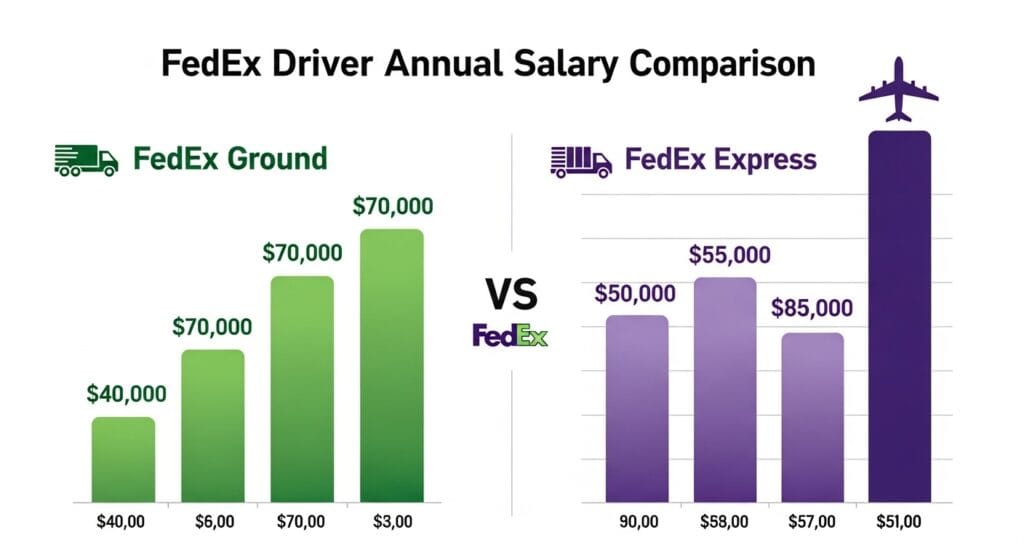
FedEx driver salary in 2026 runs from $35,760 to $68,000 annually — but that range only makes sense once you understand that “FedEx driver” is actually two completely different jobs operating under the same logo. Your take-home depends on whether you’re a corporate W-2 employee at FedEx Express or a contractor employee working for a Ground ISP, the structure of your daily pay, and what state you’re working in — use the tables and salary calculator below for exact numbers by division and location.
Quick Facts — FedEx Driver Salary 2026
| Metric | FedEx Express | FedEx Ground |
|---|---|---|
| Median Annual | $40,100 | $42,110 (Illinois avg) / $35,760 (Texas avg) |
| Top 10% / Max | $56,348 | $68,000–$70,000 |
| Entry-Level | $38,995 | $35,760 |
| Best State | California ($49,667–$51,104) | Illinois ($42,110) |
| BLS OES Code | 53-3033 | 53-3033 |
| Last Updated | February 2026 | February 2026 |
How Much Does a FedEx Express Driver Make in 2026?
A FedEx Express corporate driver earns between $38,995 and $56,348 per year on a structured hourly pay scale. The national average hourly rate is $21.63 — $19.00 for standard residential delivery and up to $27.09 for heavy truck operators. Top-of-scale earnings are locked to high-cost metros like San Francisco and New York, and reaching them requires surviving a 10-step tenure progression that currently compresses veteran and new-hire wages into nearly identical brackets.
I spent years managing route logistics adjacent to Express hubs, and the wage compression issue is real and damaging. In recent fiscal adjustments, Steps 2 through 9 received raises as low as $0.91 per hour, while Step 10 max earners got a 2% cost-of-living bump. New hires frequently enter at Step 3 or Step 4 because of baseline wage inflation — meaning a five-year veteran and a six-month hire sometimes earn the exact same hourly rate. That structural dysfunction is quietly accelerating attrition in a division that depends on experienced drivers to execute time-definite commit windows.
| Experience Level | Annual Salary | Hourly Equivalent |
|---|---|---|
| Entry-Level (Step 1–2) | $38,995 | $16.51 |
| Mid-Tier (Step 5–6) | ~$43,200 | ~$20.77 |
| Senior (Step 9–10) | $56,348 | Up to $36.76 (HCOL markets) |
| National Average | $40,100 | $21.63 |
| Heavy Truck Operators | Higher | ~$27.09 |
The Express overtime structure is the critical secondary income stream most salary articles skip entirely. Because Express drivers are federally protected hourly employees, every minute beyond the standard shift triggers time-and-a-half. During the November–December peak window, mandatory sixth-day punches and extended routes can push a mid-tier Express driver’s effective weekly earnings well above their stated annual average.
Paycheck Calculator
Calculate your Weekly, Monthly & Yearly Take-Home Pay
⚠️ These are estimates for a single filer using 2026 tax rates (IRS Rev. Proc. 2025-32). Results do not include local taxes, pre-tax deductions (401k, health insurance), or tax credits. Consult a tax professional for personalized advice.
How Much Does a FedEx Ground Driver Make in 2026?
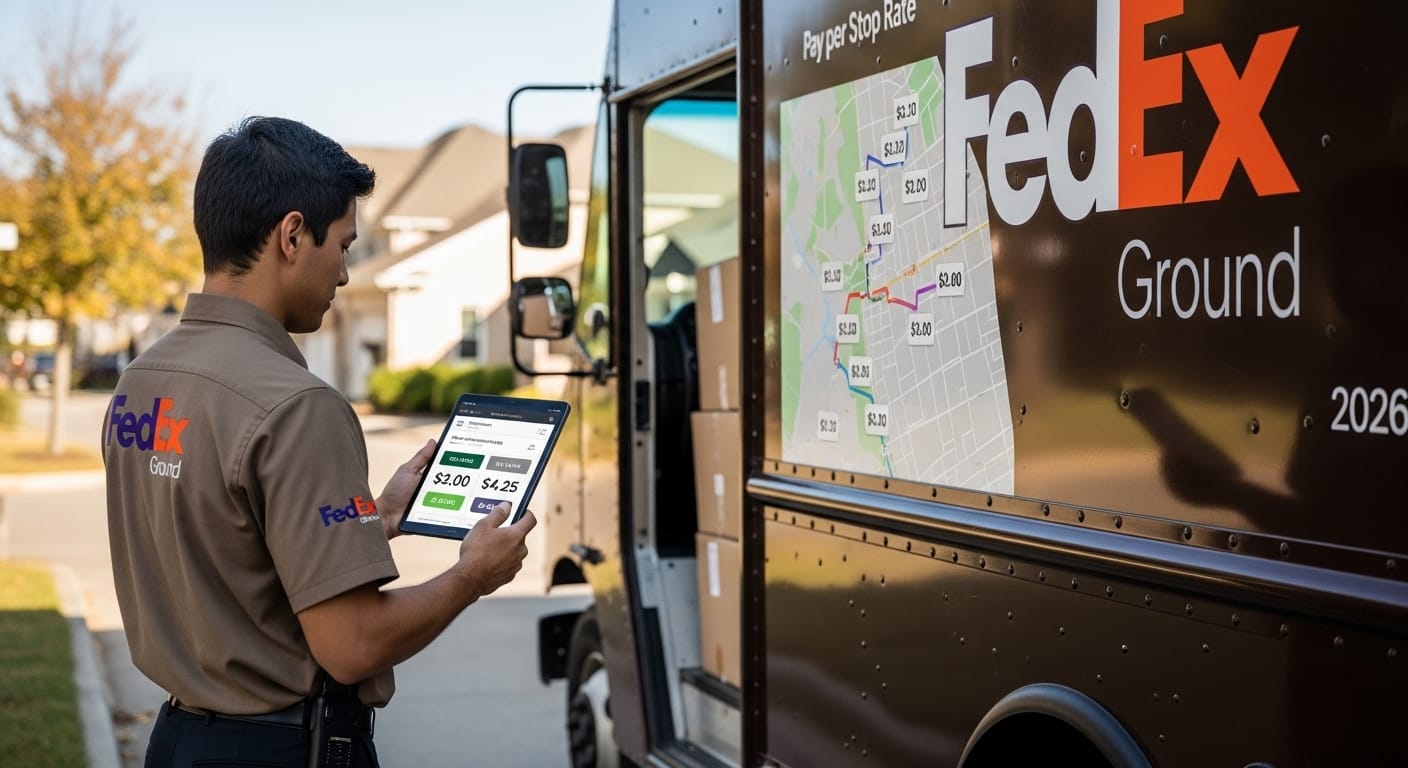
A FedEx Ground driver earns an average hourly equivalent of $20.32, with annual totals ranging from $35,760 at the baseline to $68,000 for top-performing drivers in high-density ISP territories. Unlike Express, there is no corporate pay scale — your wage is set entirely by the Independent Service Provider (ISP) who employs you, making Ground salaries one of the most fragmented pay structures in American logistics.
The daily rate model is the defining feature. A standard Ground driver receives a flat $150–$225 per day, not an hourly wage. On top of that, ISPs layer a piece-rate threshold — typically $1.25 to $1.50 per stop completed beyond a baseline quota of 130–140 stops. A driver earning $150/day base who clears 170 stops hits $187.50 before any additional incentives. The $68,000–$70,000 ceiling is real, but it requires veteran-level route efficiency and peak-season Schedule K volume during November and December.
| Geographic Zone | FedEx Ground Average Annual | Hourly Equivalent |
|---|---|---|
| Texas (Statewide) | $35,760 | ~$17.19 |
| National Average | ~$42,110 | $20.32 |
| Illinois (Statewide) | $42,110 | ~$20.24 |
| High-Density ISP (Top Performers) | $68,000–$70,000 | ~$32.69 |
| Peak Season (Schedule K) | Significantly Higher | Variable |
What Is the Real Salary Difference Between FedEx Ground and Express?
On pure average hourly yield, the difference is narrower than most people expect: Express averages $21.63 versus Ground’s $20.32 — a gap of $1.31 per hour nationally. But that headline comparison is nearly useless without understanding the variance inside each range, because the two models are built on fundamentally opposite economic philosophies.
Express values your time chronologically. Ground values your output volumetrically. Those two sentences explain everything about why the salary ranges look the way they do.
Express provides an insulated economic floor — your hourly yield is constant regardless of package volume, weather, or route inefficiency. You will always be paid for the hours you work, including overtime. The trade-off is a compressed ceiling: $56,348 is the hard top for corporate couriers outside HCOL markets, and reaching it takes years of tenure progression that current wage compression makes increasingly frustrating.
Ground provides no floor but a meaningful ceiling. A Texas Ground driver averaging $17.19/hour has little recourse when his ISP cuts daily rates due to rising fuel costs. That same driver, if operating under a well-capitalized ISP in a dense Illinois market, can execute 160+ stops per day and push annual earnings past $42,000. The $68,000 earners exist, but they are clustering at the top of a fragmented distribution where the majority earn closer to $35,000–$40,000.
| Metric | FedEx Express | FedEx Ground |
|---|---|---|
| Annual Range | $38,995 – $56,348 | $35,760 – $68,000 |
| National Avg Hourly | $21.63 | $20.32 |
| Pay Mechanism | Hourly + OT | Daily Rate + Per-Stop Bonus |
| Overtime Protection | Yes (Federal FLSA) | No |
| Economic Incentive | Maximize time on clock | Maximize stop velocity |
| Texas Average | $41,066 | $35,760 |
| Illinois Average | $38,995 | $42,110 |
| California (HCOL) | $49,667 – $51,104 | Highly variable by ISP |

How Does the “One FedEx” Network 2.0 Actually Affect Driver Pay?
This is the angle no one in 2026 is covering clearly: the Network 2.0 consolidation is not just a corporate branding exercise — it is actively redistributing volume between the two pay structures in ways that directly impact take-home pay.
FedEx’s DRIVE initiative targets $1 billion in permanent structural cost reductions for fiscal year 2026, optimizing roughly 900 stations and closing nearly 500 overlapping facilities. The mechanism driving these savings is straightforward: standard Express residential parcels, which historically required a federally protected hourly corporate driver, are being injected directly into the Ground contractor network.
For Express drivers, this route compression means fewer standard stops, shorter shifts, and — critically — less opportunity to accumulate overtime. The premium time-and-a-half income that made Express a viable career is being systematically eroded as residential volume migrates to the lower-cost Ground apparatus.
For Ground drivers, the same consolidation artificially thickens route density. More stops per route means hitting piece-rate bonus thresholds faster, but it also means longer hours on the same flat daily rate. If your ISP’s daily rate is $175 and you’re now running 160 stops instead of 120 because Express volume got dropped into your territory, your effective hourly rate actually declines while your physical output increases.
In 11 years of watching logistics networks restructure, I’ve never seen a consolidation where the productivity gains flowed to frontline drivers. Network 2.0 is no different. The $2 billion savings target by 2027 is being funded, in part, by the uncompensated labor of Ground drivers executing expanded routes under unchanged flat-rate pay structures.
What Benefits Do FedEx Drivers Actually Receive?
FedEx Express drivers receive a full corporate benefits package as direct W-2 employees of Federal Express Corporation: comprehensive medical, dental, and vision coverage; structured PTO and paid sick leave; tuition assistance up to $3,000 annually; a corporate 401(k) matching program; and comprehensive workers’ compensation. The company provides the vehicle, covers all fuel via corporate fleet cards, and supplies uniforms and safety equipment at zero cost to the driver.
FedEx Ground drivers receive zero benefits directly from Federal Express Corporation. Their access to healthcare, retirement planning, and PTO is entirely dependent on the financial health and generosity of the specific ISP that employs them.
The ISP landscape in 2026 is severely stratified. Large, well-capitalized contractors controlling substantial territories often offer competitive health insurance subsidies and basic 401(k) access as attrition-reduction tools. Marginal ISPs — squeezed between corporate volume mandates, rising fuel costs, and inflationary pressure on vehicle maintenance — frequently operate with no employer-sponsored healthcare at all, pushing drivers onto ACA exchanges or spousal coverage. Some marginal ISPs carry inadequate workers’ compensation coverage, transferring enormous personal financial risk onto employees doing one of the most physically demanding jobs in the gig economy.
| Benefit | FedEx Express | FedEx Ground (ISP-Dependent) |
|---|---|---|
| Medical/Dental/Vision | Standard Corporate Package | Highly Variable / Often None |
| 401(k) Match | Yes — Corporate Program | Rare (Top ISPs Only) |
| Paid Time Off | Structured Accrual | Variable / Often Unpaid Only |
| Tuition Assistance | Up to $3,000/year | Non-Existent |
| Workers’ Compensation | Comprehensive Corporate Policy | Variable / Lacking in Marginal ISPs |
| Fuel Costs | Company-Covered | ISP-Covered (Fleet) / Driver-Covered (AVP) |
| Uniform/Equipment | Company-Provided | ISP-Dependent |
Does a FedEx Driver Need a CDL?
For the vast majority of residential delivery routes, no CDL is required. Standard Express couriers operating cargo vans (Mercedes Sprinters, Ford Transits) or small step-vans need only a standard Class C personal driver’s license, a clean motor vehicle record, and a passed DOT physical.
CDL requirements trigger the moment a driver moves up the vehicle hierarchy. Any single delivery vehicle with a GVWR exceeding 26,001 pounds requires an unrestricted Class B CDL under federal DOT regulations. Drivers operating tractor-trailers or combination vehicles in the FedEx Freight network — which is scheduled for an independent spin-off effective June 1, 2026 — require a Class A CDL. BLS OES Code 53-3033 covers the light truck and delivery segment; heavy tractor-trailer operators fall under 53-3032 with a corresponding salary premium.
Ground drivers operating under the Alternative Vehicle Program (AVP), using their own SUVs, minivans, or covered pickup trucks under 10,000 pounds GVWR, require only a standard Class C license — the lowest entry threshold in the entire FedEx delivery ecosystem.
Are FedEx Ground Drivers Actual FedEx Employees?
No. FedEx Ground drivers are definitively not employees of Federal Express Corporation. They are the direct W-2 employees of localized, third-party Independent Service Providers (ISPs) — approximately 6,000 of them operating across the United States.
This isn’t an accident or administrative technicality. It is a deliberately engineered legal structure designed to insulate FedEx Corporation from the benefit costs, unionization exposure, and FLSA liabilities associated with a 100,000-person frontline delivery workforce. FedEx has faced successive class-action lawsuits under the Fair Labor Standards Act alleging joint-employer status, with plaintiffs pointing to FedEx’s control over delivery schedules, uniform standards, and mandatory proprietary routing software.
To reinforce this legal firewall, FedEx transitioned away from single-route owner-operators and mandated that contractors scale up to own at least 5 routes or execute 500 daily deliveries. Federal courts have consistently upheld this ISP model as sufficient to dismiss joint-employer claims. The practical result: a Ground driver’s paycheck, scheduling, HR disputes, and termination are managed entirely by their ISP owner, completely outside the FedEx corporate umbrella — and so are their benefits, or lack thereof.
Do FedEx Ground Drivers Pay for Their Own Gas?
It depends on which category of Ground driver you are. Standard ISP fleet drivers — those operating the branded box trucks and step-vans owned by the ISP — do not pay for gas out of pocket. The ISP assumes all fuel costs as a fleet operating expense, which is significant given current fuel price volatility. The driver is shielded from the pump, but the ISP’s fuel burden frequently suppresses the wage ceiling available to drivers.
AVP (Alternative Vehicle Program) drivers are a different story. These are W-2 employees who deliver packages in their own personal vehicles — SUVs, minivans, covered pickups under 10,000 pounds GVWR. For AVP drivers, fuel is almost universally the driver’s responsibility. They’re typically compensated with a higher baseline rate ($20.00–$25.00 per hour or $140–$180/day flat) to offset vehicle usage. Some elite ISPs offer limited fuel card access, but the baseline AVP standard requires the driver to absorb fuel costs, insurance liabilities, and vehicle depreciation — three capital expenditure categories that FedEx Corporation and the ISP have both successfully externalized onto the individual gig worker.
For related comparison, see Amazon Flex Pay 2026: Is It Worth The Wear on Your Car? and DoorDash Dasher Pay 2026: $22-$38/Hr Real Take-Home Pay
FAQ
Are FedEx Ground drivers FedEx employees?
FedEx Ground drivers are not employees of Federal Express Corporation in any form. They are W-2 employees of independent third-party ISPs — localized contractors who purchase the right to service specific geographic delivery territories. FedEx mandates that each ISP own a minimum of 5 routes or execute 500 daily deliveries to qualify. A Ground driver’s paycheck, benefits, scheduling, and HR disputes are handled entirely by that ISP owner, not by FedEx.
How much does a FedEx Express driver make per hour in 2026?
FedEx Express drivers earn between $16.51 and $36.76 per hour depending on their position in the 10-step corporate pay scale and their geographic market. The national average is $21.63 per hour for standard couriers, with heavy truck operators averaging closer to $27.09 per hour. The $36.76 upper limit applies exclusively to top-of-scale drivers in high-cost-of-living metro markets like San Francisco and New York.
Do FedEx drivers get a Christmas bonus?
Express corporate drivers do not receive a formal cash Christmas bonus — their peak-season income comes through accumulated overtime pay during the high-volume November–December window, which can be substantial for hourly employees with time-and-a-half protections. Ground drivers may receive a cash bonus of $200–$500 from their ISP owner, funded in part by FedEx’s Schedule K Peak Season Incentive Program, which over 96% of contractors opt into. However, financially stressed ISPs frequently retain the entire Schedule K capital for vehicle maintenance and operational costs, passing nothing to their drivers.
Does a FedEx Ground driver get benefits?
FedEx Ground drivers receive zero benefits from Federal Express Corporation. Benefits are entirely dependent on their ISP employer. Well-capitalized ISPs often provide basic health insurance and 401(k) access to reduce attrition. Marginal ISPs — operating on thin margins — frequently provide no employer-sponsored healthcare, no retirement matching, and inadequate workers’ compensation coverage.
What is the BLS OES code for FedEx delivery drivers?
FedEx delivery drivers fall under BLS OES Code 53-3033 (Light Truck or Delivery Services Drivers). Heavy tractor-trailer operators in the FedEx Freight network fall under BLS OES Code 53-3032.
“If you are looking for Delivery Driver jobs, check out our guides on [Amazon DSP vs UPS Driver] and [Amazon Flex vs DoorDash].”
Works Cited
- U.S. Bureau of Labor Statistics. “Occupational Employment and Wage Statistics: Light Truck or Delivery Services Drivers (53-3033).” U.S. Bureau of Labor Statistics. https://www.bls.gov/oes/current/oes533033.htm
- U.S. Bureau of Labor Statistics. “Heavy and Tractor-Trailer Truck Drivers (53-3032).” U.S. Bureau of Labor Statistics. https://www.bls.gov/oes/current/oes533032.htm
- U.S. Bureau of Labor Statistics. “Occupational Outlook Handbook: Delivery Truck Drivers and Driver/Sales Workers.” U.S. Bureau of Labor Statistics. https://www.bls.gov/ooh/transportation-and-material-moving/delivery-truck-drivers-and-driver-sales-workers.htm
- U.S. Department of Transportation, Federal Motor Carrier Safety Administration. “Commercial Driver’s License (CDL) Requirements.” FMCSA. https://www.fmcsa.dot.gov/registration/commercial-drivers-license/requirements
- U.S. Department of Transportation, Bureau of Transportation Statistics. “U.S. Cargo and Passenger Airlines Lost 27,659 Jobs in December 2025.” BTS Newsroom. https://www.bts.gov/newsroom/us-cargo-and-passenger-airlines-lost-27659-jobs-december-2025
- U.S. Department of Labor, Wage and Hour Division. “Overtime Pay.” DOL. https://www.dol.gov/agencies/whd/overtime
- U.S. Department of Labor, Wage and Hour Division. “Fair Labor Standards Act.” DOL. https://www.dol.gov/agencies/whd/flsa
- Internal Revenue Service. “Independent Contractor (Self-Employed) or Employee?” IRS. https://www.irs.gov/businesses/small-businesses-self-employed/independent-contractor-self-employed-or-employee
- U.S. Department of Transportation, Federal Motor Carrier Safety Administration. “Physical Qualifications for Drivers.” FMCSA. https://www.fmcsa.dot.gov/regulations/title49/section/391.41
- FedEx Corporation. “FedEx Corporation Hosts 2026 Investor Day.” FedEx Investor Relations. https://investors.fedex.com/news-and-events/investor-news/investor-news-details/2026/FedEx-Corporation-Hosts-2026-Investor-Day/default.aspx
- FedEx Corporation. “Network 2.0 — Streamlining Your Pickup and Delivery Experience.” FedEx. https://www.fedex.com/en-us/network-2-0.html
- FedEx Corporation. “Driver Jobs — FedEx Careers.” FedEx Careers. https://careers.fedex.com/career-areas/driver/
- U.S. Bureau of Labor Statistics. “Employer Costs for Employee Compensation — December 2025.” BLS. https://www.bls.gov/news.release/ecec.nr0.htm