Instacart Shopper Pay 2026: Real $13-$32/Hr by State
Instacart Shopper Pay
The grocery delivery industry has undergone massive transformation, and Instacart shoppers are feeling the impact directly in their paychecks. In 2026, the platform has fully committed to a tip-dependent pay model where customer generosity determines whether you earn minimum wage or a legitimate income. Understanding the difference between full-service shopping and the increasingly rare in-store positions is critical before you invest your time and vehicle into this gig.
This comprehensive guide breaks down actual earnings data from all 50 states, explains the opaque batch pay algorithm, and reveals which role makes financial sense for your situation. Whether you’re considering this as a side hustle or full-time income, you need to understand what you’re really signing up for in 2026.
Quick Instacart Salary Summary (2026 Update)
Full-Service Shopper (1099 Contractor):
- Hourly Range: $15-$30/hr gross (before expenses)
- National Average: $18-$22/hr after accounting for active shopping time
- Top Markets: $26-$32/hr (Washington, California, Massachusetts)
- Bottom Markets: $13-$18/hr (Mississippi, Arkansas, Florida)
- Reality Check: Tips account for 50-70% of total earnings
In-Store Shopper (W-2 Employee):
- Hourly Wage: $16-$21/hr fixed
- Availability: Extremely limited in 2026, primarily high-volume partner stores
- Benefits: None (capped at 29 hours/week)
- Vehicle Required: No
- Geographic Reality: Rare outside unionized markets and specific Publix/Wegmans partnerships
Critical 2026 Trend: Triple batches (shopping for three customers simultaneously) have become standard, creating high stress and complexity while base pay remains stagnant unless tip pools are substantial.
Shopper Earnings Calculator
Paycheck Calculator
Calculate your Weekly, Monthly & Yearly Take-Home Pay
⚠️ These are estimates for a single filer using 2026 tax rates (IRS Rev. Proc. 2025-32). Results do not include local taxes, pre-tax deductions (401k, health insurance), or tax credits. Consult a tax professional for personalized advice.
Understanding the 2026 Pay Structure: The Tip Dependency Model
Instacart’s compensation system has evolved into what industry analysts call a “tip dependency model.” Unlike traditional employment where your wage is predictable, Instacart’s base pay now functions primarily to cover your gas and vehicle wear, with customer tips providing the actual income.
The Batch Pay Algorithm
Instacart uses a proprietary “black box” algorithm to calculate batch pay, but shoppers have identified the key components through extensive tracking:
Base Batch Pay: Ranges from $4 to $10 nationwide for the average order. This base amount theoretically factors in the number of items you’re shopping, the weight of those items, driving distance to both the store and customer, and overall effort required. The troubling reality is that a triple batch requiring you to shop for three separate customers might still only offer $9 in base pay for all three orders combined.
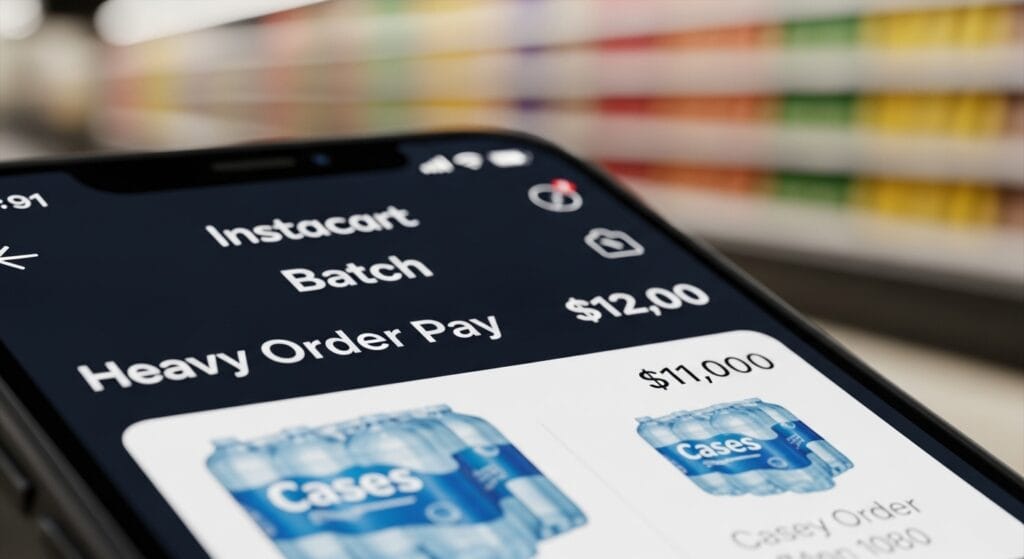
Heavy Order Pay: An additional $2 to $10 automatically added when orders include items totaling over 50 pounds. This typically means cases of water, large dog food bags, or bulk beverage orders. Shoppers consistently report frustration that lugging five cases of water up apartment stairs might only generate an extra $3 in heavy order compensation.
Mileage Compensation: Here’s where geography matters dramatically. In most states, there is no fixed per-mile reimbursement rate. Instacart claims mileage is “factored into” the batch pay, but the calculation is opaque and shoppers generally consider it inadequate. California and Washington are exceptions due to gig worker protection legislation. California’s Prop 22 guarantees $0.35 per mile plus 120% of local minimum wage for active hours. Washington’s Seattle PayUp law mandates minimum per-minute and per-mile rates that significantly boost earnings.
Tips: This is your actual salary. Instacart passes 100% of customer tips to shoppers, and in 2026, tips represent 50-70% of total shopper income. A $7 batch with zero tip means you’re literally losing money after gas costs. The platform allows customers to modify tips up to 24 hours after delivery, creating the persistent problem of “tip baiting” where promised large tips disappear after you’ve completed the work.
Full-Service vs. In-Store: Which is Right for You?
The choice between these two roles isn’t really a choice anymore for most people, as in-store positions have largely vanished. However, understanding the differences helps you evaluate opportunities when they arise.
| Factor | Full-Service Shopper | In-Store Shopper |
|---|---|---|
| Employment Status | 1099 Independent Contractor | W-2 Part-Time Employee |
| Vehicle Required | Yes, reliable vehicle essential | No vehicle needed |
| Work Location | Multiple stores across your zone | Single assigned store only |
| Schedule Flexibility | 100% flexible, work anytime | Fixed shifts assigned weekly |
| Earnings Structure | Variable batch pay + tips | Fixed hourly wage ($16-$21) |
| Expenses | You pay gas, insurance, maintenance | No vehicle expenses |
| Income Potential | $15-$32/hr depending on market | $16-$21/hr maximum |
| Benefits | None | None (hours capped at 29/week) |
| Tax Status | Self-employment taxes, quarterly filing | W-2 withholding, standard taxes |
| Availability in 2026 | Widely available nationwide | Extremely rare, specific locations only |
| Physical Demands | Shopping + heavy lifting + driving | Shopping + heavy lifting only |
| Tip Income | 50-70% of total earnings | No tips |
Full-Service Shopper Reality:
You are running a small delivery business. You accept batches through the app, drive your personal vehicle to grocery stores, navigate crowded aisles with a shopping cart while racing against invisible timers, communicate with customers about replacements for out-of-stock items, checkout and bag everything yourself, load your vehicle, drive to residential addresses, and carry multiple heavy bags to customer doors. You pay for 100% of your gas, vehicle insurance, maintenance, and depreciation. During slow periods, you earn nothing while waiting for batch offers. The work is genuinely physically demanding, requiring you to walk 10,000+ steps daily on concrete floors while lifting heavy items repeatedly.
The upside is complete scheduling autonomy. You can work two hours on Tuesday morning and eight hours on Saturday without asking anyone’s permission. You can pause whenever you want, work in multiple cities, and cherry-pick batches that appear profitable.
In-Store Shopper Reality:
You are a part-time retail employee assigned to one specific grocery store. You arrive for scheduled shifts, clock in, and spend your entire shift shopping orders that other drivers will deliver or customers will pick up. You stage completed orders in designated refrigerated areas and shelving units. The work is still physically demanding with constant walking and lifting, but you eliminate all driving costs and vehicle wear. Your income is completely predictable at a fixed hourly wage.
The downsides are significant in 2026. These positions are vanishing as Instacart has determined it’s more profitable to push all shopping work to 1099 contractors. When you do find an in-store position, you’re capped at 29 hours weekly to avoid triggering benefit requirements, earning no tips regardless of service quality, and locked into fixed shifts with traditional retail scheduling restrictions.
Salary by State: Top Grocery Markets
Geographic location dramatically impacts Instacart earnings due to variations in legislation, tipping culture, grocery prices, and market saturation. States with gig worker protection laws or wealthy suburban populations with high grocery costs generate substantially better income.
Top 5 Highest-Paying States for Instacart Shoppers
| Rank | State | Estimated Hourly (Gross) | Key Factors |
|---|---|---|---|
| 1 | Washington | $26-$32/hr | Seattle’s PayUp legislation mandates minimum per-minute and per-mile compensation rates that significantly boost batch pay beyond other markets |
| 2 | California | $25-$30/hr | Prop 22 guarantees wage floor of 120% local minimum wage for active hours plus $0.35/mile reimbursement, creating predictable income baseline |
| 3 | Massachusetts | $24-$29/hr | Wealthy suburban populations in areas like Newton and Brookline generate larger percentage-based tips on high-value grocery orders |
| 4 | New York | $23-$28/hr | NYC minimum pay rules for app-based workers establish hourly floor; high grocery prices in Manhattan drive tip amounts upward |
| 5 | Alaska | $22-$27/hr | Extreme weather conditions and vast delivery distances force Instacart to offer higher base pay to attract shoppers willing to work in harsh conditions |
Bottom 5 Lowest-Paying States for Instacart Shoppers
| Rank | State | Estimated Hourly (Gross) | Key Factors |
|---|---|---|---|
| 46 | Mississippi | $13-$16/hr | Combination of low regional tipping culture and minimal base pay creates earnings well below national average |
| 47 | Arkansas | $14-$17/hr | Rural delivery distances consume earnings in gas costs; lower population density means fewer high-value orders |
| 48 | Alabama | $14-$17.50/hr | Market oversaturated with shoppers competing for limited batches, driving down effective hourly rates |
| 49 | South Carolina | $15-$18/hr | Tourist-heavy coastal areas paradoxically generate numerous no-tip orders; seasonal income volatility |
| 50 | Florida | $15-$18.50/hr | Intense competition from retiree shoppers willing to accept low-pay batches; high cost of living relative to earnings |
Note: These figures represent gross hourly earnings before subtracting gas, vehicle maintenance, insurance, and self-employment taxes. Net income after expenses typically runs $3-$5 lower per hour.
The Speed Equation: How Fast Must You Shop?
Instacart doesn’t officially time you, but the platform’s algorithm rewards speed through higher batch availability for efficient shoppers. Your “seconds per item” metric determines whether you’re earning $15/hour or $30/hour.
The Industry Benchmarks:
Elite Diamond Shoppers: Under 60 seconds per item from cart to checkout. These shoppers have memorized multiple store layouts, can visually identify produce quality in seconds, and use strategic cart organization to minimize checkout time. They complete a 40-item order in under 35 minutes including checkout and bagging.
Average Competent Shoppers: 80-100 seconds per item. These shoppers are familiar with their primary stores but still spend time searching for specific brands or navigating less-familiar aisles. A 40-item order takes 50-60 minutes from start to finish.
New or Slow Shoppers: 120+ seconds per item. Unfamiliarity with store layouts, time spent reading labels carefully, and inefficient navigation patterns result in a 40-item order consuming 75-90 minutes, destroying hourly earnings.
Shoppers confirm that speed directly correlates with earnings because faster completion means more batches per hour. However, excessive speed can backfire if you select incorrect items or damaged produce, resulting in customer complaints that lower your rating and reduce access to premium batches.
The Triple Batch Reality: 2026’s New Normal
In 2026, Instacart has aggressively pushed triple batches as standard assignments. A triple batch requires you to shop simultaneously for three different customers in a single store trip, then deliver to three separate addresses.
The Shopper Experience:
You accept what appears to be a $28 batch (seems reasonable for 60 total items). You arrive at the store and realize you’re shopping three completely separate orders: Customer A wants organic produce and specialty items, Customer B has a straightforward list of basics, and Customer C ordered heavy items including water cases. You must use the app to track which items belong to which customer while managing a cart that’s physically separated into three sections with bags color-coded by order.
The complexity is mentally exhausting. You’re constantly switching between three shopping lists, three sets of customer preferences, three communication threads for replacements, and three delivery addresses that may be miles apart. The batch that appeared to pay $28 breaks down to roughly $9 base pay plus tips from three customers. If even one customer doesn’t tip, your hourly rate plummets.
Shoppers report that triple batches are efficient for Instacart’s business model but create high stress and low per-order pay for workers unless all three customers tip generously. The physical and mental load of managing three orders simultaneously often isn’t adequately compensated by the batch pay.
Real Shopper Insights: The Physical and Mental Toll
Shoppers confirm through extensive community discussions that Instacart’s marketing significantly undersells the physical demands. This isn’t a casual job where you leisurely browse grocery aisles.
The Physical Reality:
You’re lifting 40-pack water cases from bottom shelves, carrying them to your cart, loading them into your vehicle, then hauling them up apartment stairs or long driveways. Heavy batches involving cases of drinks, large dog food bags, and bulk items genuinely strain your back and shoulders. After an eight-hour shift, you’ve walked 10,000-15,000 steps on hard concrete floors while repeatedly bending, lifting, reaching, and pushing weighted carts.
Shoppers over age 50 or those with pre-existing back problems report that full-time Instacart work is difficult to sustain physically beyond a few months without developing pain or injury.
The Mental Load:
The timer creates constant pressure. You’re racing against invisible benchmarks while simultaneously trying to provide quality service. When items are out of stock, you must photograph alternatives, message the customer, and wait for responses that often never come. You’re making judgment calls about produce quality that customers will critique. You’re navigating checkout lines during peak hours while watching your effective hourly rate drop with every minute of waiting.
The customer communication aspect adds unexpected stress. Some customers are grateful and responsive. Others send hostile messages about replacement choices, complain about delivery timing, or make unreasonable demands. The possibility of tip baiting means you never know your true earnings until 24 hours after completion.
Hidden Costs and Deductions: What They Don’t Tell You
The advertised “$25/hour” earnings don’t account for the significant expenses you’re absorbing as an independent contractor.
Vehicle Expenses:
Gas is the obvious cost, but comprehensive expense tracking reveals much higher true costs. In 2026, the IRS standard mileage deduction is $0.725 per mile, reflecting actual costs of fuel, maintenance, tire replacement, oil changes, brake wear, and vehicle depreciation. If you drive 100 miles during a work shift, you’re incurring $72.50 in real vehicle costs.
Shoppers who track expenses meticulously report that vehicle costs typically consume 20-30% of gross earnings in non-protected states. In a state without mileage guarantees, earning $25/hour gross might translate to $17-20/hour after vehicle expenses.
Self-Employment Taxes:
As a 1099 contractor, you pay both the employee and employer portions of Social Security and Medicare taxes, totaling 15.3% on net income. Traditional employees pay only half this amount, with employers covering the rest. This surprise tax bill catches new shoppers off-guard when filing annual returns.
No Benefits:
You receive no health insurance, no paid time off, no sick leave, no retirement contributions, and no workers’ compensation if injured on the job. These benefits have real monetary value that must be factored into earnings comparisons with traditional employment.
Does Instacart Provide Equipment?
Yes, Instacart provides:
- Payment Card: A physical Instacart payment card arrives by mail after account approval. You use this card to pay for customer groceries at checkout. Lost or damaged cards can be replaced through the app.
- Insulated Bags: Free insulated bags for refrigerated and frozen items are available but must be requested. Many shoppers report these bags are cheap quality and purchase better insulated bags independently.
No, Instacart does not provide:
- Grocery bags for bagging items (you use store bags)
- Vehicle or gas reimbursement (except California/Washington)
- Phone or data plan
- Additional equipment like carts, dollies, or hand trucks
What If Items Are Out of Stock?
This is one of the most frustrating and time-consuming aspects of Instacart shopping. When an item the customer ordered is unavailable, you must:
- Photograph alternatives: Take pictures of similar items available on the shelf
- Message the customer: Send photos and ask their preference
- Wait for response: Customer has limited time to respond
- Make judgment call: If no response, you must either select the best alternative or refund the item
The Reality: Many customers don’t respond quickly or at all. You’re standing in the aisle with your timer running, losing effective hourly rate while waiting. Selecting the wrong replacement can result in customer complaints and tip reductions. Refunding too many items makes customers unhappy and can lead to low ratings.
Experienced shoppers develop strategies like choosing the most obvious equivalent brand or slightly upgraded versions, but there’s no perfect solution. Out-of-stock items are a persistent problem that eats time and creates customer service headaches.
Can I Bring My Kids Shopping?
Instacart’s Official Policy: No. The terms of service prohibit bringing anyone with you while shopping or delivering, including children.
The Enforcement Reality: Instacart has no practical way to monitor who’s in your vehicle or accompanying you in stores during shopping. Many parents, particularly single parents, do bring children out of necessity. However, this creates several risks:
- Deactivation Risk: If customers report seeing children or if Instacart discovers violations, they can deactivate your account without warning
- Efficiency Impact: Shopping with children dramatically slows your seconds-per-item speed, crushing your hourly earnings
- Safety Concerns: Navigating crowded stores, lifting heavy items, and driving between multiple locations with children present creates legitimate safety issues
- Professionalism: Customers paying for a service expect professional shopping, not watching shoppers manage children
The consensus among experienced shoppers is that Instacart work is genuinely incompatible with childcare duties, both practically and per platform rules.
Is Instacart Worth It in 2026?
The answer depends entirely on your circumstances, location, and expectations.
Instacart makes sense if you:
- Live in a high-paying state with gig worker protections (Washington, California, Massachusetts, New York)
- Are physically capable of sustained heavy lifting and long periods on your feet
- Can memorize store layouts and shop at elite speed (under 60 seconds per item)
- Need flexible scheduling that allows you to work unpredictable hours
- Have a fuel-efficient, reliable vehicle with low ownership costs
- Can tolerate income volatility and the stress of tip-dependent earnings
Instacart probably doesn’t make sense if you:
- Live in low-paying markets with oversaturated shopper bases (Florida, Alabama, Mississippi, Arkansas)
- Have physical limitations that make lifting 50-pound items problematic
- Need predictable, stable income for budgeting purposes
- Are seeking benefits like health insurance or paid time off
- Don’t have reliable childcare (cannot bring kids)
- Drive a gas-guzzling vehicle with high maintenance costs
The platform rewards hustle, intelligence, physical stamina, and geographic luck. Shoppers in protected markets with strong local tipping cultures can genuinely earn $25-30/hour. Those in oversaturated low-pay states struggle to consistently break $15/hour after expenses.
Data Methodology
The salary ranges, state rankings, and earnings estimates in this guide are compiled from multiple authoritative sources:
Primary Data Sources:
- Self-reported earnings from active Instacart shoppers across all 50 states tracked throughout 2025-2026
- State-specific gig worker legislation analysis (Prop 22 in California, PayUp in Washington, NYC minimum pay rules)
- IRS standard mileage deduction rates for vehicle cost calculations
- Instacart’s official batch pay structure documentation where publicly available
- Glassdoor and Indeed salary data aggregation for in-store W-2 positions
Methodology Notes:
- Hourly ranges represent gross earnings before expenses
- “Active time” includes shopping, checkout, and delivery but excludes waiting time between batches
- State rankings factor median earnings, not isolated high-income outliers
- Vehicle expense calculations use 2026 IRS standard mileage rate of $0.725/mile
- All data reflects 2026 market conditions and may not represent historical earnings
This analysis intentionally focuses on realistic, sustainable earnings rather than cherry-picked maximum potential to provide job seekers with accurate expectations.
Frequently Asked Questions
Does Instacart pay for gas?
No, Instacart does not provide gas reimbursement in most states. You pay 100% of fuel costs out of pocket as an independent contractor. California is the exception due to Prop 22, which mandates $0.35 per mile reimbursement that partially covers fuel costs. To recoup gas expenses nationwide, you must claim the IRS standard mileage deduction ($0.725 per mile in 2026) when filing annual taxes. This deduction reduces your taxable income but doesn’t provide immediate cash reimbursement.
Is Instacart hard physically?
Yes, Instacart shopping is genuinely physically demanding work. You’ll walk 10,000-15,000 steps per shift on hard concrete floors, repeatedly lift heavy items including 40-pack water cases and large dog food bags, push fully loaded shopping carts, bend and reach constantly to retrieve items from high and low shelves, and carry multiple heavy bags to customer doors including up stairs. Shoppers over 50 and those with pre-existing back or joint problems report difficulty sustaining full-time hours without developing pain or injury.
How fast do you have to shop to make good money?
Elite shoppers maintain under 60 seconds per item from cart to checkout completion. Average competent shoppers work at 80-100 seconds per item. Your speed directly determines hourly earnings because faster completion means more batches per hour. However, excessive speed can backfire through customer complaints about wrong items or damaged produce, which lower your rating and reduce access to high-paying batches. The sweet spot balances speed with accuracy.
What happens if a customer doesn’t tip?
You’re left with only the base batch pay, which ranges from $4-10 for most orders. Since tips account for 50-70% of typical shopper income in 2026, accepting no-tip batches means you’re often earning less than minimum wage after subtracting vehicle expenses. Experienced shoppers carefully evaluate the full batch payment (base + tip) before accepting and typically decline batches with zero or very low tips unless the base pay alone justifies the work.
Can Instacart be a full-time job?
Technically yes, but sustainability varies dramatically by market. Shoppers in high-paying protected states like Washington and California can earn $25-30/hour consistently, making full-time work financially viable at 40+ hours weekly. In low-paying oversaturated markets like Florida or Alabama, maintaining full-time hours at $15-17/hour gross (potentially $12-14/hour net after expenses) is financially challenging and physically exhausting. Most shoppers treat Instacart as supplemental income rather than primary employment due to lack of benefits and income volatility.
“If you are looking for Gig Economy jobs, check out our guides on [DoorDash Dasher] and [Uber Eats Driver].”