
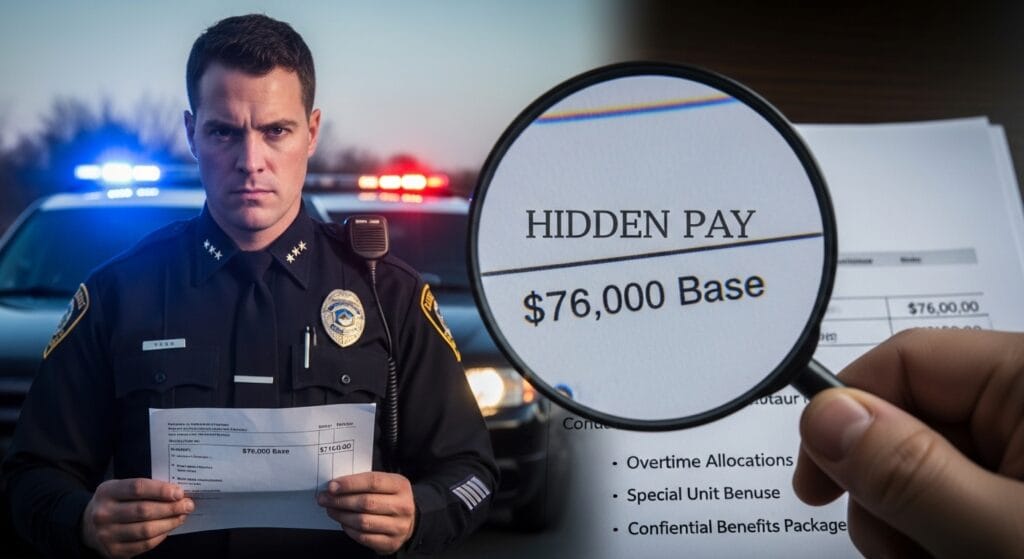
Police Officer Salary 2026: $76K Base + Hidden Pay
The Answer Box: What Police Officer Salary in 2026
Let me be straight with you. The number on the recruitment flyer is the floor, not the ceiling. I spent 22 years on the job, and I can tell you that the officers on my shift who understood every line of their pay stub — the differentials, the detail pay, the court time — consistently took home 30% to 40% more than their base salary suggested. The ones who didn’t? They were always broke and always bitter.
Here is where the national numbers stand for 2026 planning purposes, based on the most recent verified Bureau of Labor Statistics release:
The national median base salary for a Police Officer is $76,290 per year, or $36.67 per hour. Entry-level recruits start near $47,640, and experienced Sergeants and Detectives push past $115,280. But those numbers alone don’t tell the full story, and that’s exactly what this guide is for.
Quick Overview — Police Officer Pay by Level (2026)
| Career Stage | Annual Base Salary | Hourly Rate | What Pushes It Higher |
|---|---|---|---|
| Rookie / Academy Grad | $47,640 | ~$22.90 | Shift differential, field training pay |
| Patrol Officer (Median) | $76,290 | $36.67 | Overtime, court pay, off-duty details |
| Sergeant / Detective | $115,280+ | $55.42+ | Supervisory premium, specialty assignments |
That middle column — the hourly rate — is what I want you to focus on for the rest of this article. Because when overtime kicks in at time-and-a-half, and when a Saturday night detail at a stadium pays $65 an hour cash, that $36.67 base rate becomes a launching pad, not a ceiling.
Estimate Your Base + OT + Detail Income
Want to know what your actual annual take-home could look like with overtime and off-duty details factored in? Use the calculator below to model your real earning potential as a police officer based on your state, experience level, and estimated overtime hours.
Paycheck Calculator
Calculate your Weekly, Monthly & Yearly Take-Home Pay
⚠️ These are estimates for a single filer using 2026 tax rates (IRS Rev. Proc. 2025-32). Results do not include local taxes, pre-tax deductions (401k, health insurance), or tax credits. Consult a tax professional for personalized advice.
Rookie to Sergeant: The Step Increases
Here is something most career guides won’t tell you plainly: in a union department, your annual raise is guaranteed by contract, not by your boss’s mood. I worked in a state with a strong police union, and every year — whether the mayor liked me or not — I moved up a step on the pay scale. No performance review could take that away. That is the single most underrated financial feature of a law enforcement career.
Step increases typically run between 2.5% and 5% per year for the first eight to ten years of service. In some major metropolitan contracts — Chicago, New York, Los Angeles — those steps are codified in 3-year collective bargaining agreements and include retroactive pay provisions. That means if contract negotiations run late, you receive a lump-sum back-payment for the months you waited. I once received a $4,200 retroactive check simply because contract talks dragged on.
The Experience Ladder — How Pay Grows Over a Career
| Years of Service | Approximate Annual Base | Key Financial Milestones |
|---|---|---|
| Year 1–2 (Recruit/Probation) | $47,640 – $54,000 | Academy training wage, no specialty pay yet |
| Year 3–7 (Patrol Officer) | $58,000 – $72,000 | Union step increases kick in fully; detail eligibility begins |
| Year 8–14 (Senior Officer) | $72,000 – $88,000 | Specialty assignments (K9, SWAT, Traffic) add $3,000–$8,000/yr |
| Year 15–20 (Veteran Officer) | $88,000 – $105,000 | Longevity bonuses, shift commander eligibility |
| Sergeant / Detective (Any Point Post-Year 5) | $95,000 – $115,280+ | Supervisory differential typically adds 12%–18% over Officer base |
The promotion to Sergeant is where the math gets interesting. In most departments, a Sergeant’s base is set at a fixed percentage above the top Officer step — usually 12% to 18%. Combined with continued overtime eligibility in many jurisdictions, experienced Sergeants routinely see total compensation packages — base, OT, details, benefits — exceeding $140,000 in mid-to-large departments. I know because I lived it.
A word on night differential: Most contracts pay an additional $0.75 to $2.50 per hour for evening and overnight shifts. Work a 12-hour overnight five days a week, and that adds up to $2,000 to $6,000 extra per year before you’ve worked a single minute of overtime. It’s automatic. It’s invisible to most people reading salary guides. Don’t overlook it.

Best States for Law Enforcement: Where the Money Is
Geography is the single biggest variable in your earning potential. A patrol officer in rural Mississippi and a patrol officer in San Jose, California carry the same badge, face similar dangers, and work comparable hours. One earns $42,000. The other earns $140,000. That’s not an exaggeration — that is the documented reality from BLS geographic data.
Top 5 Highest-Paying States for Police Officers (2026)
| Rank | State | Average Annual Salary | Net Income Note |
|---|---|---|---|
| 1 | California | $115,400+ | Highest gross, but steep state income tax (up to 13.3%) and CalPERS contributions of 9%–12% reduce take-home |
| 2 | Washington | $102,640+ | No state income tax — the best net-income state for law enforcement in the country |
| 3 | Illinois | $101,530+ | Driven by Chicago’s massive union contracts; flat 4.95% state income tax is favorable |
| 4 | Alaska | $100,300+ | No state income tax plus an annual Permanent Fund Dividend; remote hardship adds to total comp |
| 5 | New Jersey | $94,070+ | High gross, but combined state and property tax burden is punishing; net income is misleading |
My honest recommendation based on net income analysis: Washington State is the sweet spot. You get a top-3 salary with zero state income tax. An officer in Bellevue or Seattle takes home dramatically more of their gross than a counterpart earning $15,000 more in California after tax obligations are factored in. The numbers don’t lie.
For officers willing to consider relocation, this table should drive that decision as much as any other factor. A $15,000 gross salary difference can evaporate completely — or even reverse — depending on state tax policy.
Police vs Corrections Officer: A Direct Comparison
I have enormous respect for corrections officers. Working inside a locked facility, unarmed, surrounded by a population that has nothing to lose — that is a specific kind of courage. But the compensation gap is real, and it reflects the broader liability burden that street patrol officers carry.
Law Enforcement Career Comparison
| Factor | Police Officer | Corrections Officer |
|---|---|---|
| National Median Salary | $76,290 | $57,950 |
| Primary Hazard | Unpredictable street danger, split-second legal liability | Confined environment, daily inmate confrontation |
| Overtime Structure | Mandatory OT + court pay + off-duty details | Mandatory OT common; fewer detail opportunities |
| Pension Typical Vesting | 20–25 years | 20–25 years (some states 30) |
| Public Scrutiny | Extremely high; every use-of-force reviewed publicly | Lower public profile |
| Union Strength | Strong in most major jurisdictions | Moderate to strong |
| Starting Pay Range | $47,640 – $55,000 | $38,000 – $48,000 |
The $18,340 median gap between these two careers is not accidental. It reflects the hiring crisis that law enforcement is experiencing nationwide, the legal exposure every patrol officer accepts the moment they strap on a vest, and the unrelenting demands of shift work in public-facing, high-consequence environments.
FAQ
Is the police academy paid?
In the vast majority of municipal and state departments, yes — and this surprises people. You are hired as a Police Recruit before you ever set foot in the academy. You receive a training wage (typically the bottom-of-scale rate, around $45,000 to $50,000 annualized) plus full health benefits while you’re in training. You are an employee from day one.
The exception is the “self-sponsored” cadet model used in parts of California and Florida. In those states, individuals pay their own way through a community college police academy — sometimes $3,000 to $8,000 in tuition — to earn state certification before applying to an agency. You earn zero during those six months. Check your target department’s hiring process before assuming which model applies to you.
Is there an age limit for becoming a police officer?
Most departments require applicants to be at least 21 years old, though some accept 18-year-olds into cadet programs. On the upper end, the practical limiting factor is the pension math. If a department requires 20 years of service to collect a full pension, and they won’t hire anyone over 45, you need to do the arithmetic carefully. Some federal law enforcement agencies maintain a mandatory retirement age of 57. Municipal departments vary widely — call the department directly.
What about the 20-year pension? Is it real?
The pension is absolutely real, and it is the most undervalued part of the compensation package. Here’s how it typically works: after 20 to 25 years of service (depending on your state’s retirement system), you receive a guaranteed monthly payment — often 50% to 65% of your final average salary — for the rest of your life. In states like California (CalPERS), New York (NYSLRS), and Illinois (IMRF), these pensions are constitutionally protected. No stock market crash can eliminate them.
Let’s run the actual math. A California officer retiring after 25 years with a final salary of $110,000 might receive $66,000 to $77,000 per year in pension income — indexed for inflation — starting at age 50 or 55. That is the equivalent of having a $1.5 million to $2 million retirement account generating guaranteed income, except the government holds all the market risk, not you.
The catch? You contribute 8% to 12% of your gross salary toward that pension every single paycheck, for your entire career. It is the mandatory deduction that confuses new officers reviewing their first pay stub. It is not discretionary. It is not a 401(k). It comes out before you see the money. But when you retire at 52 with a $5,500 monthly check arriving for the next 30 years, you will never regret a single one of those contributions.
What is “detail pay” and why does it matter so much?
Off-duty detail work is the salary multiplier that nobody talks about in recruitment materials. Departments in most states allow officers — sometimes require them — to work private security assignments in uniform and in a police capacity. Construction companies, stadiums, hospitals, casinos, nightclubs, and event venues pay the department (or the officer directly, depending on the arrangement) at rates ranging from $50 to $80+ per hour. The minimum callout is typically 3 to 4 hours regardless of how long the job actually runs.
A motivated officer working one or two detail shifts per week — on top of their regular schedule — can add $15,000 to $30,000 to their annual income. I have seen officers clear $160,000 in a year on a $90,000 base salary purely through selective detail work. It is physically demanding. It requires discipline to balance with your health and family. But the opportunity is there, and it is consistent.
Does overtime actually matter that much?
Enormously. Staffing shortages are severe across American law enforcement right now. Mandatory overtime is not optional in most departments — if your shift ends and there is no relief officer, you stay. At time-and-a-half. In many cities, officers are working 60 to 70 hours per week during short-staffed stretches, and every extra hour beyond 40 is paid at 1.5x their base rate. Court appearances — which happen on your days off, at inconvenient hours — carry a minimum 3- to 4-hour guaranteed pay at time-and-a-half. A single court appearance on a day off can generate $165 to $250 for two hours of actual courtroom time.
When you combine mandatory overtime, voluntary overtime, court pay, detail work, night differential, and specialty assignment pay, the gap between “base salary” and “actual W-2 income” routinely reaches $20,000 to $40,000 per year for a motivated, experienced officer.
Sources & Methodology
All base salary figures in this guide are drawn from the Bureau of Labor Statistics Occupational Employment and Wage Statistics (OEWS) survey, OES Code 33-3051: Police and Sheriff’s Patrol Officers, May 2024 release — the most recent official data available for 2026 planning purposes. State-level figures are sourced from BLS state occupational employment estimates. Pension structure details reflect publicly available documents from CalPERS (California), NYSLRS (New York), and IMRF (Illinois).
Overtime and detail pay estimates are based on documented industry norms and do not represent guaranteed earnings. Individual results will vary by department, union contract, and jurisdiction.
This guide was prepared using verified federal labor data and firsthand career experience. For department-specific pay scales, contact your local department’s recruiting division or review their current collective bargaining agreement, which is typically a public document.
“If you are looking for Government & USPS jobs, check out our guides on [Correctional Officer] and [911 Dispatcher].