
RN Salary 2026: Real Hourly Pay, $98K Avg + $148K CA
RN Salary
By a Nursing Career Mentor | Updated: 2026 | Data Source: BLS 2026 Projections & 2026 Healthcare Compensation Analysis
Nursing has always been a calling. But in 2026, it’s also one of the smartest financial decisions you can make. Whether you’re a pre-nursing student weighing your degree options, a floor nurse wondering if travel nursing is worth the leap, or a seasoned ICU RN eyeing CRNA school — this guide gives you the complete, unfiltered picture of what registered nurses actually earn in 2026.
The numbers are compelling. The opportunities are real. And the decisions you make over the next few years will shape your financial trajectory for decades. Let’s get into it.
Quick RN Salary Summary (2026 Update)
At a glance — 2026 registered nurse compensation benchmarks:
- New Grad Staff RN: $68,000 – $78,000/year ($34–$40/hr)
- Experienced Staff RN: $93,600 – $135,000/year ($45–$65/hr)
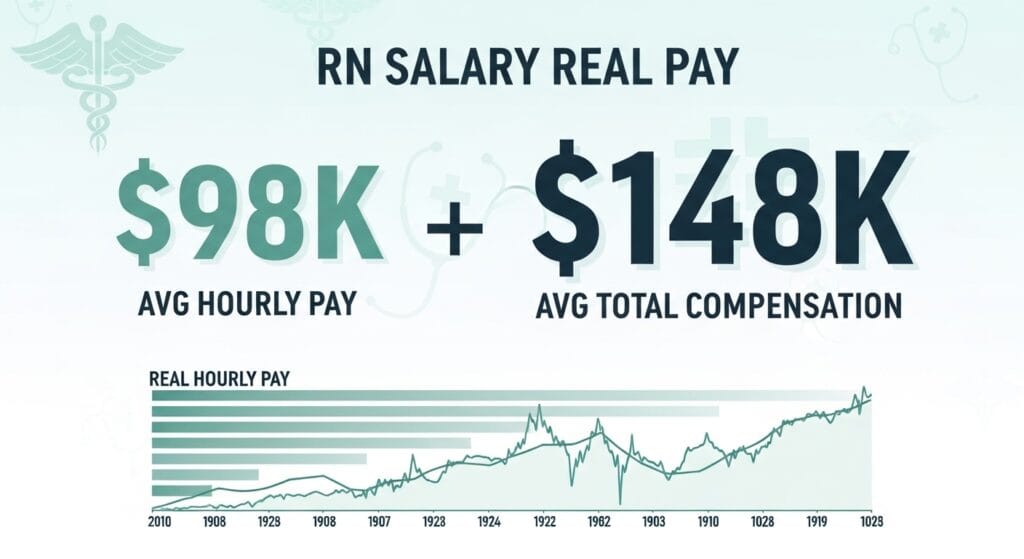
- National Average RN Salary: $98,430/year ($47.32/hr)
- Travel Nurse (Standard Contract): $105,000 – $145,000/year ($2,100–$3,000/week)
- Travel Nurse (Crisis Contract): $160,000+/year ($3,500–$5,000/week)
- California Staff RN (Top State): $137,000 – $160,000/year
- ADN Average Salary: $81,000/year
- BSN Average Salary: $99,000/year (+$18,000 premium)
- CRNA (Nurse Anesthetist): $223,000 – $260,000+/year
According to Bureau of Labor Statistics (BLS) 2026 projections, registered nursing continues to outpace inflation in wage growth, with a 5.1% increase from the 2024 median of $93,600.
RN Paycheck Calculator (Hourly & Overtime)
Understanding your base salary is only the beginning. Your real take-home pay depends on shift differentials, overtime, tax-free stipends (for travelers), and state income tax rates. Use the calculator below to model your actual net earnings.
Paycheck Calculator
Calculate your Weekly, Monthly & Yearly Take-Home Pay
⚠️ These are estimates for a single filer using 2026 tax rates (IRS Rev. Proc. 2025-32). Results do not include local taxes, pre-tax deductions (401k, health insurance), or tax credits. Consult a tax professional for personalized advice.
Pro tip: Night-shift and weekend differentials typically add 15–30% to your base hourly rate. An experienced RN earning $50/hr on days can effectively earn $65/hr working three 12-hour night shifts — without a promotion or new credential.
The Foundation: What Drives RN Salary in 2026?
Before diving into specific numbers, it’s critical to understand the four forces that determine where your salary lands on the spectrum:
1. Geographic Location remains the single most powerful variable. A staff RN in California can earn more than double the salary of a counterpart in Alabama — for performing identical clinical work. This isn’t merely a cost-of-living adjustment; it reflects union density, state legislation, and hospital system wealth.
2. Educational Credentials create a persistent and widening pay gap. The $18,000 annual premium for a BSN over an ADN has hardened from a preference into an effective hiring requirement at most high-paying facilities. Over a 30-year career, that gap compounds into a difference exceeding $540,000 in lifetime earnings.
3. Clinical Specialty directly correlates with compensation. The more technically demanding and high-acuity the unit, the higher the pay — both in base salary and travel contract rates. An ICU nurse and a Med-Surg nurse hold the same RN license but operate in vastly different compensation brackets.
4. Employment Model — staff versus travel — can create a 30–50% income differential for the same nurse with the same skills. Understanding when and how to leverage travel contracts is one of the most impactful financial decisions a mid-career nurse can make.

Staff Nurse vs. Travel Nurse: The Pay Gap
This is the question every nurse with two or more years of experience eventually asks: should I go travel? The honest answer is nuanced — but the financial case for strategic travel nursing remains strong in 2026.
The Numbers Side by Side
| Role | Median Hourly | Weekly Income | Annual Income |
|---|---|---|---|
| Staff RN (New Grad) | $34.00 – $40.00 | $1,280 – $1,500 | $68,000 – $78,000 |
| Staff RN (Experienced) | $45.00 – $65.00 | $1,800 – $2,600 | $93,600 – $135,000 |
| Travel Nurse (Standard) | $55 – $75 (blended) | $2,100 – $3,000 | $105,000 – $145,000 |
| Travel Nurse (Crisis) | $90 – $120 (blended) | $3,500 – $5,000 | $160,000+ |
Important note on travel pay structure: Travel rates are quoted as “blended” rates, combining a lower taxable hourly wage (typically $22–$28/hr) with a tax-free housing stipend (commonly $1,200–$1,800/week) and meal allowances. This structure means a travel nurse’s take-home pay is significantly higher than a staff nurse with the same gross income, because a substantial portion is never taxed.
The Case FOR Travel Nursing
The financial upside is real and significant. A specialized ICU travel nurse working 48 weeks annually at $3,000/week grosses $144,000 — often $30,000–$50,000 more than a comparable staff position. Crisis contracts in underserved regions or high-demand specialties can push that to $160,000–$200,000+.
Beyond income, travel nursing offers geographic flexibility that allows nurses to experience different healthcare systems, build diverse clinical skills, and — crucially — test-drive regions before relocating permanently. Many nurses use travel contracts strategically to accelerate debt repayment, fund graduate school, or build a home down payment in two to three years.
The Case FOR Staying Staff
The post-pandemic travel nursing market has normalized considerably. The $10,000-per-week crisis rates of 2021–2022 are gone. What remains is a sustainable but smaller premium — typically 30–50% over staff positions.
Stability carries real value. Staff positions offer consistent scheduling, benefiting from accruing retirement contributions (often with employer matching of 3–6%), health insurance, paid time off, and the ability to build relationships and advance within a single institution. Many staff nurses who excel clinically are positioned for charge nurse roles, clinical education, and management tracks that travel nursing makes difficult.
The critical requirement: Travel nursing is not available to new graduates. Agencies universally require 12–24 months of staff experience in your specialty before placement. This means your first priority is building a strong clinical foundation — travel nursing is a tool for mid-career financial optimization, not an entry point.
Specialty Travel Contracts: Where the Real Premium Lives
The 2026 travel nursing market has pivoted away from general staffing shortages toward specialty-specific demand. Agencies are paying premiums for nurses with proven high-acuity skills:
| Specialty | Staff Salary (Avg) | Travel Contract (Weekly) |
|---|---|---|
| Med-Surg | $78k – $88k | $2,000 – $2,700 |
| ER / ICU | $85k – $98k | $2,700 – $3,500 |
| Labor & Delivery | $88k – $105k | $2,800 – $3,800 |
| OR / Surgery | $90k – $108k | $2,900 – $3,600 |
| CRNA | $223k – $260k+ | $5,000 – $9,000+ |
The message is clear: if you’re a new nurse choosing a specialty with an eye toward eventual travel nursing, ICU, OR, and L&D offer the strongest long-term contract premiums.
Salary by State: Why California Nurses Earn More
Geographic location isn’t just a variable — it’s a multiplier. Nurses in the top-paying states don’t simply earn “a little more.” They often earn 70–100% more than counterparts in the lowest-paying states for identical clinical work.
Top 5 Highest-Paying States (2026)
| Rank | State | Avg. RN Salary | Key Driver |
|---|---|---|---|
| 🥇 1 | California (CA) | $137,000 – $160,000 | Mandated nurse-to-patient ratios + California Nurses Association (CNA) union power |
| 🥈 2 | Hawaii (HI) | $119,000 – $130,000 | Geographic isolation creates labor scarcity; high cost-of-living adjustments |
| 🥉 3 | Oregon (OR) | $113,000 – $125,000 | Strong NNU union presence; competes with CA/WA for experienced talent |
| 4 | Washington (WA) | $111,000 – $122,000 | Zero state income tax + Seattle’s competitive healthcare market |
| 5 | Alaska (AK) | $109,000 – $120,000 | “Frontier” pay premiums to attract and retain staff in remote hospitals |
The Union Effect: Why California Is in a League of Its Own
California’s extraordinary nurse compensation is not accidental. Two policy mechanisms create a structural floor for nurse wages that simply doesn’t exist in most other states.
Mandated Nurse-to-Patient Ratios: California is the only state with legally enforceable minimum nurse staffing ratios. In an ICU, hospitals cannot assign more than two patients per nurse — period. This legislative mandate creates genuine scarcity. Hospitals must hire sufficient nursing staff to meet ratios, which drives demand and, consequently, wages upward across the entire state market.
Union Density: The California Nurses Association (CNA) and National Nurses United (NNU) represent tens of thousands of California RNs. Union contracts establish minimum wages, mandate shift differentials, protect nurses from mandatory overtime, and create grievance procedures that give nurses real negotiating power. Oregon nurses benefit from similar NNU representation, which explains that state’s consistently strong compensation relative to the national average.
For nurses with geographic flexibility, California represents an extraordinary financial opportunity. Even accounting for the state’s higher cost of living, many nurses report substantially better financial outcomes — particularly outside of the Bay Area and Los Angeles — than they experienced in lower-paying states.
Lowest-Paying States (2026 Context)
For completeness and informed decision-making, nurses should understand the full spectrum. The lowest-paying states — West Virginia ($75k–$79k average), South Dakota ($60k–$69k), Alabama ($65k–$71k), Arkansas ($66k–$72k), and Mississippi ($69k–$75k) — share common characteristics: low union density, non-Magnet-heavy hospital systems, lower hospital reimbursement rates, and limited legislative protection for nursing ratios. These markets can be appropriate for nurses prioritizing low cost of living, proximity to family, or specific lifestyle factors — but they require clear-eyed awareness of the financial trade-off.
The CRNA Ceiling: Nursing’s $230,000+ Career Path
No honest guide to nursing compensation is complete without an in-depth look at Certified Registered Nurse Anesthetists. While the baseline registered nurse salary is genuinely strong, the CRNA pathway can more than double — and in some markets, triple — a staff nurse’s income.
According to 2026 data, CRNAs earn an average of $223,000 – $260,000+ annually in staff positions, with travel CRNA contracts reaching $5,000 – $9,000+ per week in high-demand regions. These earnings rival Family Medicine Physicians and in some markets exceed them — while requiring significantly less training time and debt than medical school.
The pathway requires serious commitment:
- BSN (or ADN with bridge) + RN licensure
- Minimum 1–2 years of critical care (ICU) nursing experience — non-negotiable for CRNA program admission
- Doctor of Nursing Practice (DNP) degree: typically 3–4 years of full-time graduate education
- National certification examination (NBCRNA)
The ROI is extraordinary. A nurse who invests three years in CRNA training at age 30 and practices until 65 will likely earn $2.5–$4 million more over their career than a staff nurse colleague — even after accounting for graduate school costs and the income gap during training. For nurses who are clinically excellent, intellectually driven, and willing to invest in the journey, CRNA represents one of the highest-returning educational investments in all of healthcare.
FAQ
Do I need a BSN to be an RN? (ADN vs BSN Salary Reality)
Technically, no — both ADN and BSN graduates sit for the identical NCLEX-RN licensing examination and become licensed registered nurses. However, the financial and career implications of this choice have become increasingly consequential in 2026.
The salary gap is $10,000–$18,000 annually, with ADN holders averaging approximately $81,000 and BSN holders averaging $99,000. More critically, approximately 80% of Magnet-status hospitals — the most prestigious, highest-paying facilities — now either require a BSN at hire or mandate completion within a set timeframe. Many high-paying specialty units (ICU, OR, L&D) in competitive markets have effectively made the BSN a non-negotiable prerequisite.
For students just beginning: the BSN pathway is strongly recommended if you have access to it. For working ADN nurses: many hospitals offer tuition reimbursement ($3,000–$7,000/year) for RN-to-BSN bridge programs. These accredited online programs typically require 12–18 months part-time and unlock both the salary premium and career advancement opportunities that the ADN increasingly cannot access.
How much does a CRNA make?
Certified Registered Nurse Anesthetists are the highest-compensated nurses in the profession. In 2026, staff CRNA positions average $223,000 – $260,000+ annually, with experienced CRNAs in high-cost states or private practice settings exceeding $300,000. Travel CRNA contracts reach $5,000 – $9,000+ per week — creating potential annual earnings above $400,000 for nurses willing to take contract work. The CRNA requires a DNP degree and is classified as an Advanced Practice Registered Nurse (APRN), a distinction that confers both higher compensation and greater clinical autonomy.
What is the highest-paying state for nurses?
California is definitively the highest-paying state for registered nurses in 2026, with average salaries ranging from $137,000 to $160,000 annually — approximately $71.30 per hour. This is driven by the state’s legally mandated nurse-to-patient ratios and the concentrated power of nursing unions (CNA/NNU), which have successfully negotiated wage floors that far exceed national averages. Hawaii ($119,000–$130,000), Oregon ($113,000–$125,000), Washington ($111,000–$122,000), and Alaska ($109,000–$120,000) round out the top five.
Can a new graduate become a travel nurse?
No. Travel nursing agencies universally require a minimum of 12–24 months of staff nursing experience in your specialty before offering placements. New graduate travel nursing programs exist but are limited, highly competitive, and offer lower contract rates than experienced traveler programs. The established path remains: secure a staff position in your desired specialty, build clinical competence and confidence for 1–2 years, then leverage that experience to enter the travel market with a competitive specialty profile.
What shift differentials can nurses expect?
Evening, night, weekend, and holiday differentials add meaningful income for nurses who work non-traditional schedules. Most hospital systems offer 15–25% premiums for evening shifts (3pm–11pm), 20–35% for overnight shifts (7pm–7am or 11pm–7am), and 10–20% for weekend differentials. A nurse earning $50/hr on day shift may effectively earn $62–$67/hr on nights — without any change in title, credentials, or unit. Strategic shift selection is one of the most underutilized income optimization tools for staff nurses.
Your Action Plan: Next Steps by Career Stage
If you’re a pre-nursing student: Pursue your BSN. The $18,000 annual premium and access to Magnet facilities make it the financially superior path. Consider your desired specialty early — ICU, OR, and L&D offer the strongest long-term earning curves.
If you’re a new ADN nurse: Start your RN-to-BSN bridge immediately, ideally using employer tuition reimbursement. Target high-acuity units (ICU, ED) to build the clinical profile that unlocks travel nursing and CRNA school in 2–5 years.
If you’re an experienced staff nurse (2–5 years): Evaluate travel nursing seriously. Run your numbers with the calculator above. If your specialty is ICU, OR, or L&D, you are positioned to earn $30,000–$60,000 more annually with a standard travel contract.
If you’re a high-acuity ICU nurse considering CRNA: The investment case is clear. Research DNP programs, connect with CRNA mentors through the American Association of Nurse Anesthesiology (AANA), and build the academic and clinical portfolio for a competitive application.
The nursing profession in 2026 rewards those who plan strategically. The income potential is extraordinary — but it doesn’t happen by accident. Make intentional decisions about your degree, your specialty, your geography, and your employment model, and nursing will reward you with both financial security and a career of profound meaning.
Data Methodology
The salary figures presented in this guide are derived from multiple authoritative sources synthesized to reflect 2026 market conditions. Primary data sources include Bureau of Labor Statistics (BLS) Occupational Employment and Wage Statistics (OEWS) 2024 data with 2026 forward projections based on reported 5.1% year-over-year wage growth trends in the registered nursing profession.
Specialty and travel nursing compensation data reflect 2026 Healthcare Compensation Analysis figures compiled from agency contract databases, hospital system compensation surveys, and union contract disclosures from the California Nurses Association (CNA) and National Nurses United (NNU). State-level salary ranges represent composite averages incorporating metropolitan statistical area (MSA) data to account for intrastate variation. Travel nursing blended rate calculations reflect standard agency compensation structures including taxable base hourly wages and IRS-compliant tax-free stipend components.
All figures represent averages and ranges; individual compensation will vary based on facility type, years of experience, shift selection, overtime utilization, and collective bargaining agreements. This guide is intended for informational and career planning purposes. Readers are encouraged to verify current compensation figures with prospective employers, state nursing associations, and licensed recruiters before making major career decisions.
“If you are looking for Gig Economy jobs, check out our guides on [Roadie Driver] and [Shipt Shopper].”