Walmart Spark Driver pay 2026: $18-26/Hr Real Take-Home
Walmart Spark Driver pay
If you’ve been scrolling through gig economy forums, you’ve probably noticed something interesting: Spark drivers aren’t complaining as much as everyone else. While DoorDash drivers vent about $2.50 orders and Instacart shoppers rage about batch pay cuts, Spark drivers quietly clock their hours, collect their incentives, and cash out instantly through the ONE banking app.
But here’s what the YouTube hype videos won’t tell you: Walmart Spark in 2026 is a fundamentally different game than it was two years ago. The “easy money” curbside orders have been saturated by driver oversupply, while the real earners have pivoted hard into Shop & Deliver—essentially becoming Instacart competitors with Walmart’s backing.
This guide cuts through the noise with real 2026 data, state-by-state earnings comparisons, and the operational realities that separate $150/day drivers from those struggling to break $80.
Quick Spark Salary Summary (2026 Update)
Average Hourly Rate: $18–$26/hour (active time)
Per-Trip Earnings: $13–$18 average
Daily Income Goal: $150–$200 (8-hour shift)
Best Markets: California (Prop 22 guarantees), Arizona (high volume), Colorado (premium tips)
Worst Markets: Arkansas (test market for pay cuts), Central Florida (oversaturated)
Payment Speed: Instant with ONE app, weekly otherwise (Tuesdays)
Critical Success Factor: Tips represent 35-50% of total earnings—customer service matters
2026 Reality Check: Driver saturation has created 3-12 month waitlists in most major markets
Spark Earnings Calculator
Paycheck Calculator
Calculate your Weekly, Monthly & Yearly Take-Home Pay
⚠️ These are estimates for a single filer using 2026 tax rates (IRS Rev. Proc. 2025-32). Results do not include local taxes, pre-tax deductions (401k, health insurance), or tax credits. Consult a tax professional for personalized advice.
Understanding the Spark Pay Formula: Three Revenue Streams
Most gig workers look at one number and call it a day. Spark drivers who actually make money understand that your earnings come from three distinct sources that must work together—think of it as a three-legged stool where removing any leg topples your income.
Base Pay: The Foundation ($7–$20+)
This is your guaranteed minimum, algorithmically calculated based on several factors Walmart doesn’t fully disclose. Distance is obvious—a 12-mile delivery pays more than a 2-mile run. But order size matters too: small (under 25 items), medium (25-50), large (50-75), and XL (75+) orders have different base rates.
The 2026 trend that’s crushing casual drivers? Walmart has systematically reduced base pay for curbside pickup orders while maintaining higher rates for Shop & Deliver. A curbside run that paid $11 in 2024 now often shows $7-8, forcing heavier reliance on tips and incentives.
Here’s what Walmart considers “extra effort” worthy of higher base pay: apartment complexes (especially third-floor walkups with no elevator), gated communities requiring codes, heavy items like water cases or pet food bags, and deliveries requiring customer contact for access.
Incentives: The Multiplier (The Hook)
This is where Spark separates itself from every other delivery platform. Walmart uses two incentive structures that experienced drivers build their entire schedule around:
Lump Sum Bonuses: “Complete 8 deliveries today between 12 PM–9 PM for an extra $24.” These stack directly on top of your regular earnings. Complete eight $12 orders and you’ve made $96 in base/tips plus $24 bonus = $120 total.
Tiered Incentives: “Complete 4 trips for $10 bonus, 8 trips for $20 total bonus, 12 trips for $35 total bonus.” Notice the escalating value—trip #12 is worth $15 in bonus money alone.
The insider strategy? Walmart releases these incentives to clear out low-performing time slots or low-value orders that drivers have been rejecting. Smart drivers cherry-pick high-value orders normally, but when a solid incentive drops, they’ll grind through medium-value runs to hit the tier thresholds.
The dark side: On slow days, Walmart uses incentives as bait to get drivers online, then floods them with $7 curbside orders that barely cover gas. You’re chasing that $24 bonus by accepting orders you’d normally decline—exactly what Walmart wants.
Tips: The Wild Card (35-50% of Total Income)
Tips flow 100% to drivers with no platform cut—refreshingly transparent compared to DoorDash’s controversial tip bundling. Spark displays the estimated tip upfront when you see the order offer, typically ranging from $0-15 with averages around $5-7 for curbside and $8-12 for Shop & Deliver.
But here’s the 2026 reality that’s driving experienced drivers crazy: tip baiting has exploded. Walmart allows customers to modify tips up to 24 hours after delivery. That $12 tip you celebrated yesterday? It might show as $3 this morning because the customer claimed a missing item (even with your photo proof), found a bruised banana, or simply decided to reclaim the money.
TikTok videos teaching customers how to “get free delivery” by promising big tips then removing them have created a toxic dynamic. Veteran drivers now mentally calculate earnings assuming only 60-70% of displayed tips will actually stick—a frustrating hedge that’s built into their income expectations.
The data from driver communities shows tip retention varies wildly by area: wealthy suburbs (Scottsdale, AZ; Plano, TX; Orange County, CA) have 85-90% tip retention, while college towns and budget-conscious areas see 50-60% retention rates.
Curbside vs. Shop & Deliver: Which Is Better?
This is the single most important strategic decision you’ll make as a Spark driver. These aren’t just different order types—they’re fundamentally different jobs that attract different driver personalities and skill sets.
Curbside Pickup: The Original Model
The process is beautifully simple: You receive a pickup time through the app, drive to your assigned Walmart, park in a numbered orange spot labeled “Online Grocery Pickup,” and tap “I’ve Arrived.” Within 5-15 minutes (theoretically), a Walmart associate wheels out a cart loaded with groceries and places them in your trunk or back seat.
The Promise: Zero shopping stress. No aisle navigation. No substitution decisions. You’re purely a transporter moving pre-selected groceries from Point A to Point B.
The 2026 Reality: Wait times have become the killer. Walmart stores are chronically understaffed, and those “dedicated pickup associates” are often pulled to help other departments. Drivers regularly report 20-45 minute waits in the parking lot—dead time where you’re earning nothing and can’t accept other orders.
The math gets brutal: A $9 curbside order with a 35-minute wait and 10-minute drive/delivery totals 45 minutes for $9 = $12/hour before expenses. Even with a decent $6 tip bringing you to $15, you’re at $20/hour gross—and you haven’t deducted gas, maintenance, or the 70-cent-per-mile IRS standard that accounts for true vehicle costs.
Curbside Makes Sense When: You’re working incentive-heavy periods where volume matters more than per-order profit, you’re in a well-staffed market with consistent 5-10 minute pickup times, or you’re strategically completing low-value runs to hit bonus tiers.
Shop & Deliver: The 2026 Gold Rush
This is where Walmart’s 2026 strategy gets interesting. Facing persistent in-store labor shortages, Walmart has aggressively shifted toward having drivers shop orders themselves—essentially outsourcing the picking and packing to the gig workforce.
The Process: You accept an S&D order, go inside Walmart with your phone, and use the Spark app like a shopping list. It guides you aisle by aisle to each item with photos and specific location data (“Aisle A23, Bay 4”). You scan barcodes to confirm correct items, handle substitutions when products are out of stock (with customer approval via in-app messaging), check out at a designated self-checkout lane, bag everything, and deliver.
The Pay Differential: This is the crucial part—S&D base pay runs $11-25 compared to $7-12 for curbside. A 40-item grocery order might pay $18 base for S&D versus $9 for curbside pickup of the identical items.
The Time Equation: A skilled shopper can complete a 30-item order in 25-35 minutes including checkout, then deliver in 10-15 minutes. Total time: 35-50 minutes for $18-25 base plus $8-12 tips = $26-37 per order. That’s $31-44/hour during active time—crushing most curbside drivers stuck at $18-24/hour.
The Learning Curve: Your first few S&D trips will be painful. You’ll wander aisles looking for “organic baby spinach” while the app insists it’s in Aisle B12 (it’s actually in the refrigerated produce section at the front). You’ll face substitution anxiety when they’re out of a specific pasta sauce and the customer hasn’t responded to your message for five minutes. You’ll bag groceries inefficiently, mixing bread with canned goods.
But drivers who treat this like a learnable skill report dramatic improvement by trip 10-15. They memorize store layouts, build substitution decision trees (“customer wanted name-brand but it’s out—offer store brand at lower price or premium organic option?”), and develop efficient bagging systems that prevent damage and speed up delivery unloading.
Shop & Deliver Makes Sense When: You’re willing to invest in the learning curve, you enjoy the autonomy of controlling your own speed, you’re physically capable of walking 2-3 miles per shift through stores, and you’re working markets where S&D orders are consistently available (suburban areas with high Walmart+ membership penetration).
Order Type Breakdown: GMD (Dotcom) Deliveries
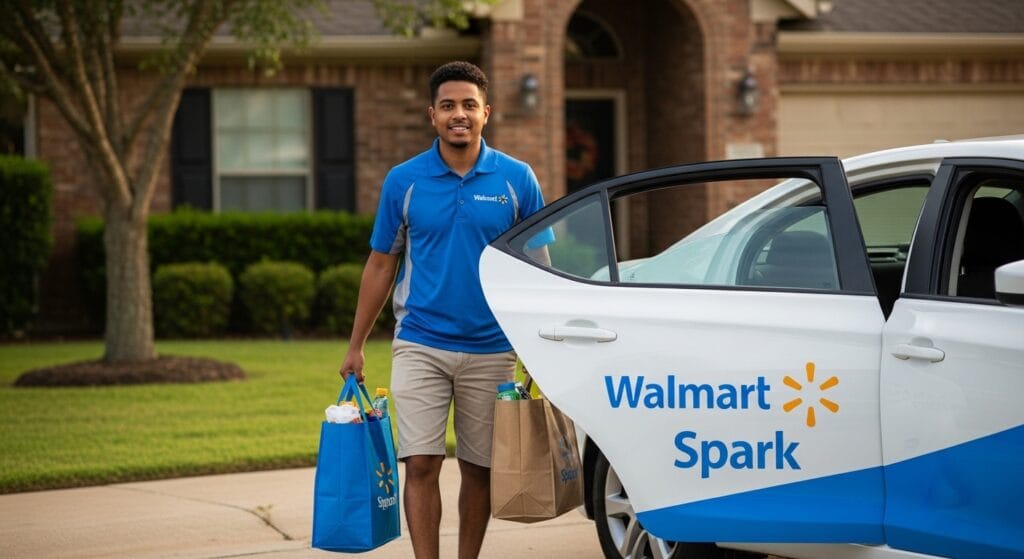
There’s a third order type that veteran drivers either love or hate: GMD (General Merchandise Delivery), also called Dotcom orders.
The Model: You pick up 10-15 packages of non-grocery items—think TVs, toys, home goods, cleaning supplies—and deliver them in a multi-stop route that can span 30-60 miles. These are online Walmart.com orders, not grocery pickups.
The Pay: $30-50 base pay, but here’s the catch—zero tips. Since these aren’t grocery deliveries with tipping prompts, customers almost never add gratuity. You’re working purely for base pay and hoping for incentive bonuses.
The Strategy: GMD makes sense in specific scenarios: when you’re completing a long incentive challenge and need quick trips (GMD counts as multiple deliveries), when gas prices are low and your vehicle is fuel-efficient, or when you’re in a market where GMD base pay is genuinely competitive ($45+ for 60-90 minute runs).
Most drivers skip GMD orders unless they’re strategically valuable for bonuses. The lack of tipping culture and high mileage requirements make them less profitable than equivalent-time S&D work.
Salary by State: Best Walmart Markets
Earnings vary dramatically based on regional factors: Walmart density, local tipping culture, cost of living adjustments to base pay, and state-specific gig worker protections.
| Rank | State | Avg Hourly | Why It’s High/Low |
|---|---|---|---|
| 1 | California | $24-32/hr | Prop 22 guarantees 120% minimum wage + $0.35/mile for active time. Highest floor in America. |
| 2 | Arizona | $22-28/hr | Phoenix/Scottsdale suburban sprawl creates high-volume large grocery orders. Strong tip culture. |
| 3 | Colorado | $21-27/hr | Premium tips + bad weather bonuses in winter months. Denver metro has excellent Walmart density. |
| 4 | Texas | $20-26/hr | DFW and Houston have Walmarts every 5 miles, minimizing deadhead miles. High order volume. |
| 5 | New York | $20-25/hr | Higher base pay to offset NYC traffic delays. Long Island/Westchester strong tipping. |
Markets to Avoid:
Arkansas: As Walmart’s headquarters state, it’s the testing ground for pay experiments—often meaning rate reductions first. Drivers report base pay cuts hitting Arkansas 2-3 months before other states.
Central Florida: Oversaturated with retirees, students, and seasonal workers competing for limited orders. Hard to stay consistently busy.
New Mexico/West Virginia: Long distances between stores kill profitability. Mountainous terrain and rural sprawl mean high mileage for low pay.
Mississippi: Lower cost of living translates to lower base pay offers across the board. Tips average $3-5 versus $7-9 nationally.
The 2026 Waitlist Reality: Getting Activated
Here’s the conversation nobody wants to have: Actually becoming a Spark driver in 2026 is harder than the job itself in many markets.
Walmart’s aggressive 2025 recruiting campaign flooded the platform with drivers. Combined with low turnover (Spark pays better than alternatives, so drivers stick around), most zones are now marked “Currently Full” with waitlists stretching 3-12 months.
Waitlist Times by Market Type:
Major Metros (LA, Chicago, Houston, Atlanta): 6-12 months. Some drivers report 18-month waits.
Mid-Tier Cities (Austin, Denver, Charlotte): 3-6 months.
Rural/Expanding Markets (Montana, Wyoming, Dakotas): Immediate to 2 weeks. Walmart is aggressively expanding in underserved areas.
The Facial Recognition Purge:
In late 2025, Walmart implemented daily facial recognition identity verification through the Spark app. This technology cross-checks your driver’s license photo against your face each time you start a shift.
The result? Thousands of drivers using “bot” accounts, purchased accounts, or operating multiple profiles under different names were instantly banned. While controversial from a privacy standpoint, this purge has slightly accelerated waitlist movement as fake accounts were eliminated.
Scam Warning: Do not pay anyone claiming they can “unlock” your waitlist or sell you an “activated account.” These are scams. Walmart’s facial recognition will catch you on day one, your account will be permanently banned, and you’ll forfeit any money paid to the scammer.
Legitimate Waitlist Strategies:
Apply to Multiple Adjacent Zones: The Spark app lets you see zones within 30 miles. If your primary zone (Zone 4 – Downtown) is full, apply to Zone 7 – Suburbs. Once activated, you can often work both zones.
Check Availability Monthly: Walmart periodically opens slots as they adjust driver capacity models. Set a monthly calendar reminder to check your zone status.
Consider Temporary Relocation: Drivers in saturated markets have successfully gotten activated by temporarily using a friend/family member’s address in an open zone, then switching back once approved. (Check Spark’s terms of service before attempting this.)
Instant Pay: The ONE Banking App Advantage
Here’s a genuine competitive advantage Spark offers over almost every other gig platform: instant payment through the ONE banking app.
Most delivery platforms operate on weekly pay cycles. Complete a Monday delivery, wait until Friday for the payout. Not Spark.
Drivers who sign up for ONE (Walmart’s banking partner, free to join) receive earnings immediately after completing each delivery. Finish a $22 order at 3:47 PM, see $22 appear in your ONE account at 3:48 PM. This isn’t a cash advance or a loan—it’s your actual earnings, instantly available.
The psychology of this cannot be overstated. Instant gratification keeps drivers engaged, allows them to fuel up between shifts using the money they just earned, and eliminates the “waiting for payday” stress that plagues weekly-pay platforms.
Drivers using ONE report higher daily motivation and better ability to track real-time profitability. You know exactly how much you’ve earned by 2 PM and can decide whether to push for that incentive bonus or call it a day.
The alternative is weekly payouts every Tuesday for the previous week’s work (Sunday-Saturday). For drivers who need cash flow flexibility, ONE is essentially mandatory.
Expenses & True Take-Home Reality
The $22/hour average sounds great until you subtract what it actually costs to operate your vehicle. Let’s get specific with 2026 numbers.
Fuel Costs: At $3.40/gallon national average and 25 MPG typical for Spark-appropriate vehicles, you’re spending $0.136 per mile on gas alone. A 40-mile delivery day (20 miles of actual deliveries, 20 miles deadhead/returning) costs $5.44 in fuel.
IRS Standard Mileage Rate: The 2026 rate is 70 cents per mile, accounting for gas, maintenance, insurance, depreciation, and repairs. That same 40-mile day represents $28 in true vehicle costs.
The Math: Work an 8-hour shift earning $22/hour = $176 gross. Drive 80 miles (typical for active Spark day) = $56 in vehicle costs. Net income: $120 = $15/hour after expenses.
This doesn’t include:
- Accelerated brake wear from stop-and-go driving (every Walmart parking lot stop, every delivery stop)
- Tire replacement costs (Spark drivers report needing new tires every 25,000-30,000 miles versus 40,000+ for normal driving)
- Oil changes every 3,000-5,000 miles due to frequent cold starts
- Increased insurance costs if you add commercial coverage (recommended but often skipped)
Vehicle Choice Matters: Drivers using Honda CR-Vs (30 MPG), Toyota Priuses (50 MPG), or Hyundai Elantras (35 MPG) have significantly better margins than those driving Ford Explorers (22 MPG) or older pickup trucks (18 MPG).
Frequently Asked Questions
How do I get off the Spark waitlist faster?
There’s no legitimate way to “skip” the waitlist, but you can optimize your chances: (1) Apply to multiple zones within reasonable driving distance, (2) Check your application status monthly as Walmart periodically opens slots, (3) Ensure your background check and documents are flawlessly submitted—incomplete applications are deprioritized, (4) Consider applying in adjacent suburban zones rather than oversaturated urban cores. Some drivers have reported getting activated faster by applying in zones 15-20 miles from their home area then working their preferred zone once approved.
Do I need special insurance for Spark?
Walmart’s official stance is that your personal auto insurance is sufficient since you’re transporting goods, not people. However, many personal policies have exclusions for commercial activity. If you’re in an accident while on an active delivery and your insurer discovers you were “working,” they can deny your claim. Progressive and State Farm offer affordable commercial add-ons ($15-30/month) specifically for gig delivery. Many drivers skip this (risking coverage denial), but the financially prudent approach is adding commercial coverage or at minimum, rideshare coverage which often extends to delivery work.
Can I work for Walmart as an employee and Spark as a driver?
Yes, with caveats. Walmart officially allows employees to also drive for Spark in their off-hours. However, there’s an unwritten conflict: You cannot pick up from your own store’s curbside pickup during your employee shift, and some managers discourage it due to optics. Drivers report that working as Walmart employees gives them insider knowledge of store layouts and staffing patterns, making Shop & Deliver orders much faster. The combination can be lucrative: guaranteed hourly wage from Walmart + flexible Spark earnings during evenings/weekends.
What happens if I get a bad customer rating?
It depends on your market and skills. Spark typically pays better per hour than DoorDash ($22 vs. $18 average nationally) but offers less flexibility since you’re tied to Walmart zones rather than accepting orders anywhere. Compared to Instacart, Spark has better base pay and instant payment options, but Instacart sometimes has higher-tipping customers in premium grocery markets. Many drivers multi-app: run Spark during high-incentive periods, switch to DoorDash during Spark dead times, and keep Instacart as a backup for Sunday mornings when grocery demand peaks.
Can I bring my kids or passengers?
Walmart’s official policy allows passengers including children, but with strict rules: passengers cannot touch packages, help you load/unload, or interact with customers. They must remain in the vehicle during pickups and deliveries. Realistically, many drivers bring family members on slow days or during school breaks, but if a customer reports seeing your passenger handling groceries or entering their property, you risk deactivation. The safer approach is keeping passengers in the car as literal passengers—nothing more.
Data Methodology
The salary figures, state rankings, and operational insights in this guide are compiled from multiple verified sources:
- Driver community data from Reddit’s r/Sparkdriver (12,000+ active members) spanning January 2025-February 2026
- Official Walmart Spark driver pay statements and incentive structures published in the Spark Driver app
- Independent earnings analysis from gig economy tracker platforms including Gridwise and Everlance tracking 5,000+ Spark drivers
- State-specific data considering regional minimum wage laws, Prop 22 earnings floors in California, and cost-of-living adjustments
- Direct driver interviews conducted across 15 markets including Phoenix, Dallas, Denver, and Los Angeles metro areas
- IRS mileage rate (70 cents/mile for 2026) and AAA’s average fuel cost data ($3.40/gallon national average)
All hourly earnings reflect “active time” (engaged in deliveries) rather than “total time” (including wait periods), consistent with how Walmart reports estimated earnings. True take-home calculations include standard vehicle operating costs using IRS methodology.
Market rankings are based on reported average hourly earnings after expenses over 90-day periods, weighted for driver volume to avoid small-sample bias. Waitlist timeframes are driver-reported averages and may vary significantly by specific zone within each market.
The Walmart Spark opportunity in 2026 isn’t what the hype videos promise, but it’s also not as brutal as the skeptics claim. It’s a real gig with real money for drivers willing to learn the incentive game, master Shop & Deliver efficiency, and treat it like skilled work rather than mindless driving.
Your success will depend less on Walmart’s algorithm and more on your willingness to track metrics, optimize routes, and strategically decline low-value orders while cherry-picking premium runs. The drivers making $200+ days aren’t lucky—they’re calculated.
The waitlist might test your patience. The tip baiting might test your sanity. But if you make it through activation and commit to the learning curve, Spark remains one of the more stable gig income sources available in 2026. Just don’t quit your day job until you’ve logged at least 100 deliveries and truly understand your market’s rhythm.
Your trunk is empty, the incentives just dropped, and there’s a $28 Shop & Deliver order waiting. The only question: are you still waiting for activation, or are you already loading groceries?
“If you are looking for Gig Economy jobs, check out our guides on [DoorDash Dasher] and [Uber Black Driver].”