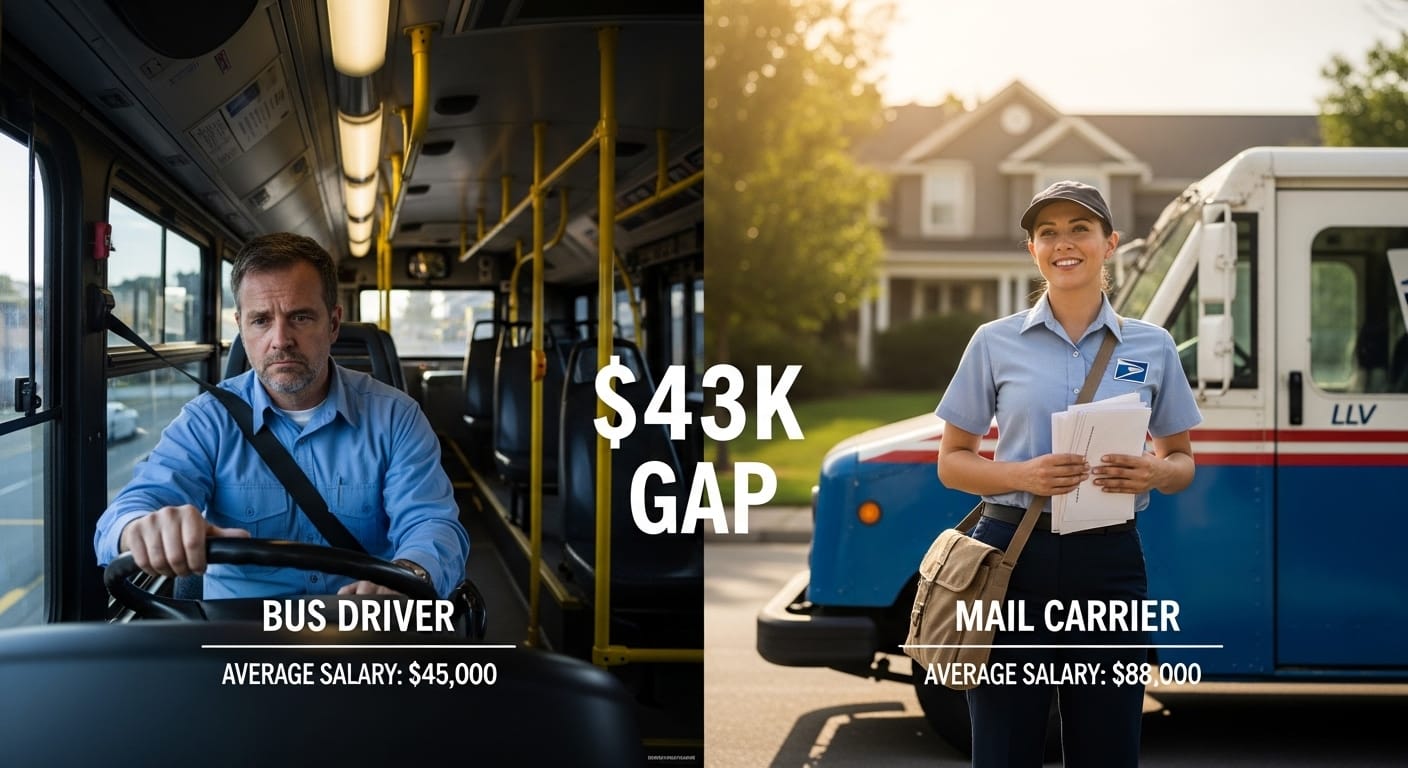
Bus Driver vs USPS Mail Carrier: The $43K Gap in 2026
School Bus Driver vs USPS Mail Carrier Salary 2026: What You Actually Take Home?
By David Park | Federal Employment Analyst, 18 years covering USPS labor contracts and public sector pay structures
School bus drivers earn $28,000–$76,700 annually depending on district, state, and seniority, while USPS city mail carriers earn $71,143–$82,759 in base pay before overtime pushes totals well past $100,000. The school bus driver vs. USPS mail carrier salary gap is structural — not just numerical — driven by split-shift scheduling, summer layoffs, and federally negotiated overtime rules. Use the tables and calculator below for your exact take-home.
Quick Facts — School Bus Driver vs USPS Mail Carrier Salary 2026
| School Bus Driver | USPS City Mail Carrier | |
|---|---|---|
| Median Annual | $48,370 (all bus drivers, BLS) | $55,000+ (postal average, BLS) |
| Entry-Level | $28,000–$36,134 | $71,143 (Step C, NALC contract) |
| Top 10% | $50,585–$76,700 | $82,759 (Carrier Tech, Step P) |
| Net Take-Home (Single Filer) | ~$33,800/yr on $40K gross | ~$67,700/yr on $85K gross |
| Best State (Bus Driver) | Massachusetts / Wyoming | Federal (nationwide uniform) |
| BLS Growth (2024–2034) | +1% | −5% |
| Last Updated | February 2026 | February 2026 |
Table of Contents
- School Bus Driver vs USPS Mail Carrier Salary 2026: What You Actually Take Home?
- Who earns more in 2026: a school bus driver or a USPS mail carrier?
- What do you actually take home after taxes and union dues in 2026?
- Which job offers better benefits and retirement security?
- How do split shifts and summer layoffs compare to USPS mandatory overtime?
- Which job is actually easier to get?
- FAQ
- Works Cited
Who earns more in 2026: a school bus driver or a USPS mail carrier?
A USPS city mail carrier earns more — and it isn’t close. The average school bus driver grosses $37,607 on roughly 30 hours per week across a 180-day school year. A career USPS carrier starts at $71,143 and senior carriers regularly gross $100,000–$120,000 once mandatory penalty overtime is factored in. The federal collective bargaining agreement makes that floor non-negotiable.
The school bus driver’s pay is fragmented by design. Entry-level drivers in Kansas or Missouri earn $28,000–$29,000 annually. Top earners in Massachusetts or Wyoming push $46,000 at baseline. Only drivers in heavily unionized urban districts — and only with maximum seniority — approach $76,700. Even then, that number requires overtime that most district budgets actively restrict.
The USPS carrier’s base pay, codified in the 2023–2026 NALC National Agreement, runs from Step C ($71,143) to Step P maximum ($81,057), with Carrier Technician premium adding another $1,702 at top step. That base is the floor. Article 8 of the Joint Contract Administration Manual mandates penalty overtime at 200% of base pay for hours exceeding 10 in a scheduled day or any work on a non-scheduled day. A mid-career carrier routinely accumulates those hours — not by choice, but by management mandate. The gross income of a USPS carrier is structurally inflated by institutional understaffing.
| 2026 Salary Comparison | School Bus Driver | USPS City Mail Carrier |
|---|---|---|
| Entry-Level | $28,000–$36,134 | $71,143 (Step C) |
| Mid-Career / Average | $37,607–$40,488 | $75,823 (Step H) |
| Top Step / Senior | $76,700 | $81,057–$82,759 |
| With OT (realistic annual) | $40,000–$50,000 | $90,000–$120,000+ |
USPS Mail Carrier Salary | government job salary
Paycheck Calculator
Calculate your Weekly, Monthly & Yearly Take-Home Pay
⚠️ These are estimates for a single filer using 2026 tax rates (IRS Rev. Proc. 2025-32). Results do not include local taxes, pre-tax deductions (401k, health insurance), or tax credits. Consult a tax professional for personalized advice.
What do you actually take home after taxes and union dues in 2026?
On $40,000 gross, a bus driver takes home approximately $33,800. On $85,000 gross, a USPS carrier takes home approximately $67,700. The 2026 federal standard deduction for single filers is $16,100; FICA taxes an additional 7.65% on both incomes. After union dues, the gap is $33,900 in favor of the postal carrier on these scenarios.
2026 Tax Breakdown — Single Filer
| Bus Driver ($40K gross) | USPS Carrier ($85K gross) | |
|---|---|---|
| Standard Deduction | −$16,100 | −$16,100 |
| Taxable Income | $23,900 | $68,900 |
| 10% bracket (up to $12,400) | $1,240 | $1,240 |
| 12% bracket ($12,401–$50,400) | $1,380 | $4,560 |
| 22% bracket ($50,401–$105,700) | — | $4,070 |
| Total Federal Income Tax | $2,620 | $9,870 |
| FICA (7.65%) | $3,060 | $6,502 |
| Union Dues (annual) | $542 (Teamsters/AFSCME) | $880 (NALC) |
| Estimated Net Take-Home | ~$33,778 | ~$67,748 |
The NALC dues structure is a fixed $33.84 per biweekly pay period — $879.84 annually as of the January 2, 2026 paycheck. Teamster and AFSCME dues for bus drivers typically calculate at 2.5× the base hourly rate per month — approximately $45.20/month or $542 annually at the $18.08 average wage.
The USPS carrier pays proportionally more in federal tax but takes home nearly double the net income. State and local taxes are not included in this table — bus driver pay is more exposed to state income tax variance given the geographic patchwork of district wages.
Which job offers better benefits and retirement security?
USPS benefits are federally guaranteed and apply uniformly to every career employee nationwide. School bus driver benefits are district-dependent — some are excellent, many are nonexistent. In 14 years covering federal employment, I’ve seen bus drivers in privatized districts go without pension access entirely while their suburban colleagues enjoy CalPERS or PERA.
USPS career employees receive the Federal Employees Retirement System (FERS) — a three-tier package combining a defined pension, Social Security, and the Thrift Savings Plan (TSP) with up to 5% employer match. The 2026 TSP contribution limit is $24,500, with an $8,000 catch-up for employees 50+ and an $11,250 catch-up limit for those aged 60–63 under SECURE 2.0. The USPS also fully funds Basic FEGLI life insurance and provides access to the Federal Employees Health Benefits (FEHB) program with government-subsidized premiums. Leave accrual reaches 26 days of annual vacation after 15 years, plus 104 hours of sick leave annually.
Bus drivers employed directly by well-funded municipal districts access state pension systems like CalPERS or PERA. But when a district outsources transit operations to contractors like First Student, those pensions vanish. Drivers land in high-deductible health plans with zero 401(k) match. Worse, the 30-hour split-shift structure often prevents drivers from meeting minimum hour thresholds required to qualify for full-time health benefits — even while working for the same district all year.
How do split shifts and summer layoffs compare to USPS mandatory overtime?
Both schedules are disruptive — but in opposite directions. Bus drivers are underpaid for time they can’t use. USPS carriers are overworked past the point of physical recovery. Neither schedule reflects a 40-hour week with predictable evenings and weekends.
The Split Shift Reality A school bus driver’s day runs 5:30 AM pre-trip inspection through a 9:00 AM release, then a mandatory return at 1:30 PM for the afternoon dismissal, finishing around 5:00 PM. That’s 11.5 chronological hours for 6–7 compensable hours. The midday gap is too short to leave the area in suburban districts, too long to sit idle productively. Total compensable hours land around 30 per week — $18.08 × 30 × 36 weeks = roughly $19,526 in raw school-year wages before any summer proration.
Summer is where the structure becomes financially ruinous. Schools run on 180-day calendars. Drivers are furloughed 10–12 weeks. The “Reasonable Assurance” legal doctrine bars most states from granting unemployment benefits during this period — New Jersey, California, and Illinois all trigger automatic disqualification when an educational support employee holds a return offer. Bus drivers are not unemployed; they are simply unpaid.
The USPS Mandatory Overtime Reality Carriers operate under chronic staffing shortages. Article 8 provisions allow management to mandate carriers beyond 8-hour shifts, onto days off, and into 10- and 12-hour routes. Penalty overtime at double-time (200%) for hours over 10 in a day inflates gross pay significantly — but it comes at severe physical cost. Sunday Amazon delivery routes have eliminated the last universal day of rest for junior carriers (CCAs and PTFs). The 55% first-year attrition rate at USPS is not coincidental.
Which job is actually easier to get?
Getting hired as a school bus driver is harder. Keeping the USPS job long enough to reach career status is harder. These are different challenges that separate most candidates before they ever face the real question of long-term viability.
A school bus driver must obtain a Class B or Class C CDL with Air Brakes, a Passenger (P) endorsement, and the School Bus (S) endorsement — the most restrictive CDL endorsement combination for civilian drivers. That requires multiple written exams, state-mandated behind-the-wheel training, FBI/DOJ criminal background checks, recurring DOT physicals, and mastery of railroad crossing safety protocols. Any driving record blemish or medical disqualifier ends the process.
A USPS city carrier requires only a standard state driver’s license and a clean driving record. The primary barrier is the 474 Virtual Entry Assessment and a federal background check. The 55% first-year attrition rate reflects how difficult the job is to sustain — not how difficult it is to enter.
FAQ
Do school bus drivers get paid during the summer?
No — drivers are furloughed during the 10-to-12-week summer recess. The “Reasonable Assurance” doctrine bars most states from granting unemployment benefits during this period because drivers hold an implied agreement to return in fall. New Jersey, California, and Illinois all trigger automatic disqualification under this clause. The bus driver is legally classified as employed but receives zero income for a quarter of the year.
What is USPS penalty overtime and how much does it pay?
Penalty overtime under Article 8 of the JCAM pays 200% of the base hourly rate — double time — for any hours exceeding 10 on a scheduled workday or for all hours worked on a non-scheduled day. Standard overtime at 150% applies for hours over 8 in a day or 40 in a week. A Step H carrier at $36.45/hour earns $72.90/hour under penalty overtime. This is why senior USPS carriers consistently gross $100,000–$120,000 annually despite a base salary of $75,823.
Can a school bus driver ever out-earn a USPS mail carrier?
Rarely, and only under extreme conditions — maximum seniority in a high-cost unionized district, approved overtime for charter runs and athletic events, and a district that doesn’t outsource transportation. The Richmond, Virginia example of a driver grossing $124,000 in a single year circulated widely online; it involved extensive overtime manipulation that most districts actively prohibit. For the median driver in a median district, matching even the USPS Step C entry rate of $71,143 is structurally impossible.
“If you are looking for Government & USPS jobs, check out our guides on [Substitute Teacher] and [Librarian Salary].
Works Cited
- U.S. Bureau of Labor Statistics. “Bus Drivers: Occupational Outlook Handbook.” BLS.gov. https://www.bls.gov/ooh/transportation-and-material-moving/bus-drivers.htm. Accessed February 2026.
- U.S. Bureau of Labor Statistics. “Postal Service Workers: Occupational Outlook Handbook.” BLS.gov. https://www.bls.gov/ooh/office-and-administrative-support/postal-service-workers.htm. Accessed February 2026.
- U.S. Bureau of Labor Statistics. “Postal Service: NAICS 491.” BLS.gov. https://www.bls.gov/iag/tgs/iag491.htm. Accessed February 2026.
- U.S. Bureau of Labor Statistics. “Occupational Projections and Worker Characteristics.” BLS.gov. https://www.bls.gov/emp/tables/occupational-projections-and-characteristics.htm. Accessed February 2026.
- National Association of Letter Carriers. “Letter Carrier Pay Schedule.” NALC.org. https://www.nalc.org/news/research-and-economics/body/paychart-06-14-25.pdf. Accessed February 2026.
- National Association of Letter Carriers. “Sixth COLA is $250.” NALC.org. https://www.nalc.org/news/nalc-updates/sixth-cola-is-250. Accessed February 2026.
- National Association of Letter Carriers. “Summary of Tentative Agreement.” NALC.org. https://www.nalc.org/workplace-issues/resources/body/Summary.pdf. Accessed February 2026.
- National Association of Letter Carriers. “Minimum Dues Increase.” NALC.org. https://www.nalc.org/news/the-postal-record/2025/december-2025/document/S-T.pdf. Accessed February 2026.
- Internal Revenue Service. “IRS Releases Tax Inflation Adjustments for Tax Year 2026.” IRS.gov. https://www.irs.gov/newsroom/irs-releases-tax-inflation-adjustments-for-tax-year-2026-including-amendments-from-the-one-big-beautiful-bill. Accessed February 2026.
- U.S. Postal Service. “Compensation and Benefits.” About.USPS.com. https://about.usps.com/careers/working-usps/benefits.htm. Accessed February 2026.
- U.S. Postal Service. “Article 8 Overtime and Work Hours — ELM 434.” About.USPS.com. https://about.usps.com/manuals/elm/html/elmc4_015.htm. Accessed February 2026.
- U.S. Postal Service. “USPS Strengthening Requirements for Contracted Trucking Providers.” About.USPS.com. https://about.usps.com/newsroom/national-releases/2026/0105-usps-is-strengthening-requirements-for-contracted-trucking-providers.htm. Accessed February 2026.
- U.S. Postal Service. “Dog Bite National Rankings 2024.” About.USPS.com. https://about.usps.com/newsroom/national-releases/2024/0530-usps-releases-dog-bite-national-rankings.htm. Accessed February 2026.
- New Jersey Department of Labor. “Information for Teachers and Other School Employees.” NJ.gov. https://www.nj.gov/labor/myunemployment/before/about/who/schoolemployees.shtml. Accessed February 2026.
- California Employment Development Department. “School Employee Claims.” EDD.CA.gov. https://edd.ca.gov/en/unemployment/school_employee/. Accessed February 2026.
- Federal Motor Carrier Safety Administration. “Non-Domiciled CDL 2026 Final Rule FAQs.” FMCSA.DOT.gov. https://www.fmcsa.dot.gov/regulations/non-domiciled-cdl-2026-final-rule-faqs. Accessed February 2026.
- Commonwealth of Pennsylvania, DMV. “School Bus Safety: Driver and Vehicle Services.” PA.gov. https://www.pa.gov/agencies/dmv/driver-services/school-bus-drivers/school-bus-safety. Accessed February 2026.
- Colorado PERA. “IRS Releases 2026 Tax Brackets, Contribution Limits, Other Tax Updates.” COPERA.org. https://copera.org/pera-on-the-issues/irs-releases-2026-tax-brackets-contribution-limits-other-tax-updates. Accessed February 2026.