
Paramedic Salary 2026: $45K Private vs $114K Fire
Paramedic Salary
The truck doesn’t care what you paid for school. It doesn’t care that you worked a 24-hour shift last Tuesday or that you haven’t slept since your last code. What it does care about is whether you can intubate a 300-pound man in the back of a moving rig, dose vasopressors from memory, and then write a clean PCR before the next call drops. Paramedics do all of that—and depending on who employs you, they either compensate you for it or they don’t.
In 2026, the single most important financial decision a working paramedic makes isn’t which drug protocol to memorize. It’s which employer to work for. Private ambulance or fire department? That choice determines whether you earn $48,000 a year or $95,000. This guide breaks down that split with honesty, hard data, and the clinical context that salary comparison sites typically miss.
Quick Paramedic Salary Summary (2026 Update)
At a glance — 2026 national data:
- Private Ambulance Paramedic: $22–$28/hr | $45,700–$58,200/yr
- Hospital / ER Paramedic: $26–$34/hr | $54,000–$70,700/yr
- Fire Department Medic: $35–$55/hr | $72,800–$114,000+/yr
- Flight Paramedic (FP-C): $38–$50/hr | $79,000–$104,000/yr
- EMT-Basic (for comparison): $17–$20/hr | $38,000–$44,000/yr
- Top-End Fire Medic (Major Metro): $100,000–$169,000+ with OT
The pay gap between private EMS and fire-based EMS is 50–80% in the same city. Your employer is your most important pay variable.
EMS Paycheck Calculator (Overtime Heavy)
Paycheck Calculator
Calculate your Weekly, Monthly & Yearly Take-Home Pay
⚠️ These are estimates for a single filer using 2026 tax rates (IRS Rev. Proc. 2025-32). Results do not include local taxes, pre-tax deductions (401k, health insurance), or tax credits. Consult a tax professional for personalized advice.
The Private Ambulance Reality: What the Job Actually Pays
Private ambulance companies are where most paramedics begin, and where many get stuck. The business model runs on Medicare and Medicaid reimbursement rates set by the federal government—rates that haven’t kept pace with inflation, training costs, or the clinical complexity of modern prehospital medicine. When revenue is structurally capped, labor is the first thing squeezed.
In 2026, private ambulance paramedics earn $22 to $28 per hour nationally, translating to $45,700 to $58,200 annually before overtime. In low-cost-of-labor states like Mississippi, Alabama, and Arkansas, hourly rates dip to $16.50 to $22.00—essentially minimum wage for someone managing cardiac arrests and drug overdoses.
The work itself is grinding in a specific, demoralizing way. The majority of private EMS calls aren’t 911 emergencies. They’re interfacility transfers: nursing home to dialysis center, dialysis center back to nursing home, repeat. Day after day. You’re managing a patient who’s stable, filling out documentation, and driving a route you’ve memorized while waiting for the one high-acuity call that reminds you why you went to medic school. When that call comes—a real emergency, a working code, a traumatic arrest—you handle it at the same skill level as any fire medic. You just get paid $15 to $20 an hour less to do it.
The structural disadvantages compound beyond hourly pay. Private services typically offer:
- No defined-benefit pension (401k if you’re lucky, often no match)
- Minimal union representation or collective bargaining
- High turnover that creates chronic understaffing
- Mandatory overtime enforced through “no call-out” policies rather than voluntary extra shifts
- Limited career advancement beyond “field supervisor”
The honest truth: private EMS is a training ground. Work it for two to four years, accumulate clinical hours, keep your certification spotless, and use it as a launchpad into a fire department or flight program. Staying in private EMS indefinitely, unless you’re in a well-compensated market, is the career equivalent of running a marathon on a treadmill—maximum effort, minimal forward movement.
Why Fire Medics Earn Double
The firefighter-paramedic—commonly called a “fire medic” or “dual-role”—is the highest-compensated ground EMS position in the United States. The average fire medic earns $86,013 nationally, with top-market earners in cities like San Jose, Chicago, Seattle, and New York City clearing $100,000 to $169,000 when overtime is included.
That 50 to 80% wage premium over private EMS exists because of a fundamentally different employment structure, and understanding that structure is essential for any paramedic serious about long-term financial stability.
Union Protection and Collective Bargaining
Municipal firefighters are among the most effectively unionized workers in American public employment. The International Association of Fire Fighters (IAFF) negotiates contracts that establish minimum staffing ratios, overtime pay structures, health benefits, and step increases tied to seniority rather than individual performance reviews. When a fire department tries to cut pay or benefits, a union with political leverage pushes back. When a private ambulance company cuts pay, a non-unionized paramedic absorbs it or quits.
The result is predictable wage growth. A new fire medic in a major metro might start at $60,000 to $72,000, but progression through the steps adds $2,000 to $5,000 annually with certainty. After five to seven years, that same firefighter-paramedic is earning $85,000 to $95,000 base without ever applying for a promotion.
Defined-Benefit Pensions: The Invisible $30,000/Year Benefit
The most underappreciated component of fire department compensation is the defined-benefit pension. Most municipal firefighter pensions allow retirement at 50 to 55 years old after 20 to 25 years of service, with pension payments equal to 50 to 80% of final salary for life.
Model this mathematically: a fire medic retiring at 52 with a $95,000 final salary and a 70% pension receives $66,500 per year for the rest of their life, without contributing further. They collect that pension from age 52 potentially through age 82 or beyond—$1.99 million in pension distributions over 30 years, not counting cost-of-living adjustments. No private ambulance company offers anything remotely equivalent. A 401k with inconsistent contributions and no employer match doesn’t come close.
When compensation analysts account for total compensation—base salary plus pension value plus health benefits plus job security—the true gap between private and fire EMS isn’t 50 to 80%. It’s closer to 100 to 150%.
The Municipal Funding Advantage
Fire departments are funded through property taxes and municipal general funds, not insurance reimbursements. This means their revenue base is largely insulated from the Medicare reimbursement fights that systematically underpay private EMS. When a city grows its tax base, fire department budgets typically grow with it. When the federal government changes ambulance reimbursement rates, private EMS companies absorb the loss directly.
How to Get There
The pathway into a fire department requires specific preparation most paramedics underestimate. Beyond paramedic certification, departments typically require EMT-B certification (which you already have), completion of a fire academy (120 to 280 hours), passage of written and physical ability tests (the CPAT), and often a lengthy hiring process that can take 12 to 18 months from application to badge.
The strategy that works: accumulate two to four years of high-volume private EMS experience, complete a fire technology associate’s degree concurrently (community colleges, often cheap), and apply to multiple departments simultaneously. Urban departments prioritize paramedic certification for new hires because 80 to 90% of their call volume is medical. Your medic patch is a competitive advantage.
Salary by State: Best States for EMS
Geographic variance in paramedic pay is dramatic. West Coast and Northeast states with strong public unions dominate the top tier. Southern states with limited tax bases and minimal union penetration anchor the bottom.
| Rank | State | Avg. Annual Salary | Why |
|---|---|---|---|
| 1 | Washington (WA) | $85,000 – $105,000 | King County Medic One sets the global standard for paramedic pay and clinical training |
| 2 | New York (NY) | $78,000 – $96,000 | FDNY EMS unions drive wages; NYPD/FDNY premium markets |
| 3 | Illinois (IL) | $75,000 – $92,000 | Chicago Fire Department and dense suburban departments pay strong premiums |
| 4 | California (CA) | $74,000 – $95,000 | Powerful unions; wildfire deployment OT can add $10K–$20K annually |
| 5 | Hawaii (HI) | $72,000 – $88,000 | High cost-of-living adjustments built into municipal contracts |
Lowest-paying states remain Mississippi ($16.50–$20/hr), Alabama ($17–$21/hr), Arkansas ($17.50–$21.50/hr), South Carolina ($18–$22/hr), and Georgia ($18.50–$23/hr outside Atlanta). The gap between a Mississippi private paramedic and a Washington fire medic can exceed $70,000 annually for the same certification level doing comparable work.
For paramedics willing to relocate, the wage arbitrage is the most powerful income lever available—more impactful than any overtime strategy or side certification.
The Burnout Clock: What the Salary Tables Don’t Show
Any honest career guide about EMS acknowledges the burnout clock. The average street paramedic career spans five to seven years before PTSD, orthopedic injury, or emotional exhaustion forces a transition. This isn’t weakness—it’s physics. Lifting 200-pound patients down three flights of stairs at 3 AM, processing pediatric cardiac arrests, managing violent psychiatric patients without backup, working every major holiday because the city doesn’t stop having emergencies: these accumulate.
NREMT data and independent occupational research consistently show paramedic PTSD rates between 20 and 30%—among the highest of any profession. The field experiences a staffing shortage precisely because experienced paramedics leave faster than new ones enter. That shortage, paradoxically, drives up sign-on bonuses ($5,000 to $15,000 in high-demand markets), retention bonuses, and overtime pay for those who stay. The labor market compensates for the burnout clock, but it doesn’t eliminate it.
The smart career play is to use the burnout window intentionally. Work the truck with purpose, maximize overtime aggressively in years two through five, pursue the fire department transition or flight certification, and have an exit strategy into nursing, PA school, or EMS management before your body or mind hands you one involuntarily.
Frequently Asked Questions
Paramedic vs EMT: What’s the real difference?
The scope of practice difference is the entire explanation for the pay gap. An EMT-Basic is a Basic Life Support (BLS) provider. Their authorized interventions include CPR, oxygen administration, basic airway management, bleeding control, epinephrine auto-injectors, and glucometry. An EMT is trained to keep patients alive through transport—not to definitively treat their emergency.
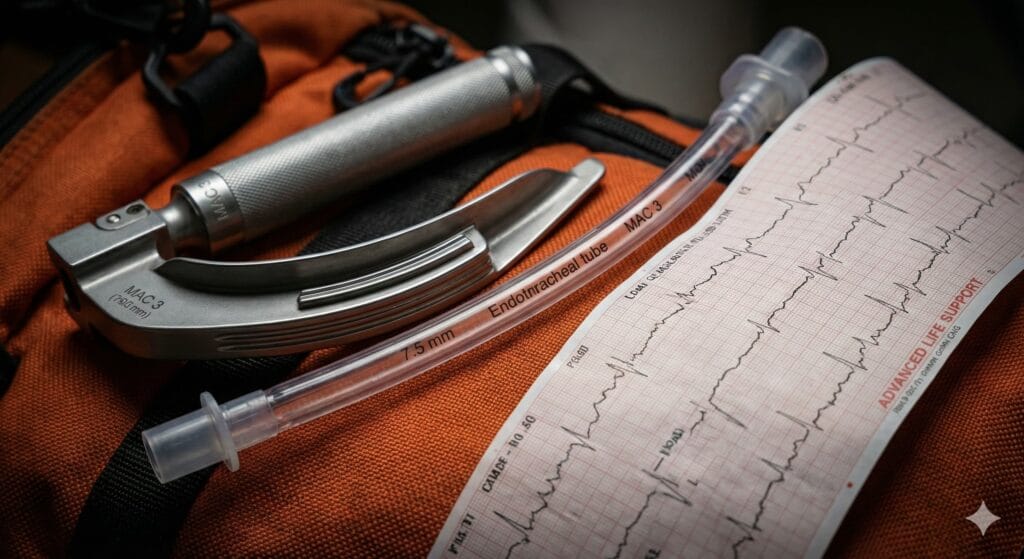
A paramedic is an Advanced Life Support (ALS) provider. Their scope includes endotracheal intubation and surgical airway management, 12-lead EKG interpretation, IV and IO access, administration of 30+ controlled and critical care medications (including narcotics, vasopressors, antiarrhythmics, and paralytics), needle thoracostomy, external pacing, synchronized cardioversion, and advanced trauma management.
The liability exposure is categorically different. When a paramedic pushes succinylcholine and their intubation fails, the consequences are immediate and severe. That clinical accountability—and the 1,200 to 1,800 hours of training required to develop it—justifies the $28,000 annual pay gap between EMT and paramedic median salaries. The EMT-to-paramedic pipeline requires approximately 6 to 12 months of EMT field experience before most accredited programs will admit you to paramedic school. Total school investment: 12 to 24 months. ROI at $28,000/year additional income: you break even in 12 months.
Is the 24/48 schedule actually sustainable?
The 24/48 schedule—24 hours on, 48 hours off, averaging 56 hours per week—is the traditional fire department EMS rhythm, and it’s genuinely different from any other work schedule in American employment. You work approximately 10 full 24-hour shifts per month. Your “weekend” changes every rotation. You miss birthdays, anniversaries, and holidays on a rotating cycle.
The advantages are real: 16 days off per month creates blocks of genuine recovery time and allows paramedics to pursue side businesses, education, or second jobs on off days. The disadvantages are equally real: sleep deprivation is structural, not incidental. A call at 3 AM after sleeping for two hours on a folding cot means you’re running a resuscitation while cognitively impaired by fatigue.
The 48/96 schedule—48 hours on, 96 hours off—is growing in popularity, particularly in progressive fire departments. It offers four consecutive days off after each shift block, which many providers find superior for recovery and family time. Twelve-hour shifts dominate private EMS and hospital settings, offering a more normalized schedule at the cost of the blocked recovery time the 24/48 provides.
The honest answer: no EMS schedule is sustainable forever at street level. The question is which schedule degrades you most slowly while you build toward a transition.
Can I bridge from Paramedic to RN?
Yes—and it’s one of the most strategically sound career moves in healthcare for working paramedics. Paramedic-to-RN bridge programs exist specifically to reduce the educational pathway for credentialed ALS providers. Because paramedics already possess substantial pharmacology knowledge, clinical assessment skills, and procedural competency, bridge programs typically credit 12 to 20 credit hours of prerequisite nursing coursework, reducing a standard 60-credit ADN program to 30 to 40 credits for eligible paramedics.
The outcome is an Associate Degree in Nursing (ADN), NCLEX eligibility, and RN licensure—typically achievable in 12 to 18 months of accelerated coursework for a working paramedic. RN base salaries in emergency or critical care settings range from $70,000 to $95,000 nationally, with ICU/flight nursing reaching $90,000 to $120,000. The clinical foundation you built in EMS—comfort with critical illness, rapid assessment, procedural confidence under pressure—translates directly and gives you an edge over nursing graduates who’ve never managed a patient outside a controlled hospital environment.
Other viable transitions include Physician Assistant programs (where EMS experience is a strong application differentiator), respiratory therapy, and EMS management or education roles. The paramedic certification isn’t a terminal destination—it’s a clinical foundation with more exit ramps than most providers realize.
Final Assessment: Which Path Is Right for You?
Private ambulance EMS is where you learn the job. Fire department EMS is where you build a career. Flight EMS is where you reach the clinical ceiling. Each role serves a function in a strategic career arc, and the mistake most paramedics make is treating each position as a destination rather than a stage.
If you’re currently an EMT, the case for paramedic school is unambiguous—$28,000 in additional annual earnings for 12 to 24 months of education represents one of healthcare’s best educational ROI calculations. If you’re a working paramedic in private EMS, the fire department application process should already be in motion. If you’re a fire medic approaching your late thirties, the nursing bridge program or PA school conversation should be happening with your family.
NREMT data confirms a paramedic shortage that is driving up sign-on bonuses, retention incentives, and starting wages in competitive markets. The leverage is yours—but only if you use it intentionally, before the burnout clock runs out.
Data Methodology
The salary data referenced throughout this guide draws from multiple 2026 sources, cross-referenced for accuracy and regional validity. Primary sources include the Bureau of Labor Statistics Occupational Employment and Wage Statistics (OEWS) program, NREMT workforce reports, IAFF collective bargaining agreement disclosures, and aggregated compensation data from Medscape’s EMS Compensation Survey 2026 and Glassdoor/Indeed verified paramedic salary submissions across all 50 states.
State-level figures reflect median compensation for full-time paramedics in both private and municipal settings and are weighted toward the dominant employment model in each state. Overtime figures assume a standard 24/48 shift schedule with approximately 800 hours of built-in overtime annually. Top-end salary figures for major metro markets reflect base pay plus overtime and do not include pension valuations.
Where salary ranges are wide (e.g., Washington state: $85K–$105K), the variance reflects the significant difference between rural county EMS pay and elite urban/suburban fire department pay within the same state. Career span data (5–7 year average street career) reflects occupational health research on EMS provider burnout and PTSD-related occupational exit rates, not voluntary retirement figures.
This guide is updated annually. Always verify current figures with your state EMS office, local collective bargaining agreements, and NREMT workforce data before making career decisions.
“If you are looking for Medical & Nursing jobs, check out our guides on [Diagnostic Medical Sonographer] and [Medical Billing and Coding].”
National Registry of Emergency Medical Technicians (NREMT)