
FedEx Ground Driver Salary 2026: $135-$220/Day Real Pay
Quick Facts — FedEx Ground Driver Salary 2026
Median Salary: $41,600/year ($160/day)
Entry Level: $35,100/year ($135/day)
Top Earners: $57,200+/year ($220/day)
Best State: Washington ($190-$220/day)
BLS OES Code: 53-3033 (Light Truck Drivers)
Last Updated: February 2026
If you’re researching “FedEx Ground driver salary,” you’ve probably noticed something strange: two drivers in the same building can make wildly different money delivering identical packages. One driver earns $200 per day with health insurance. Another earns $140 per day with zero benefits. Same purple logo, same van, completely different paychecks.
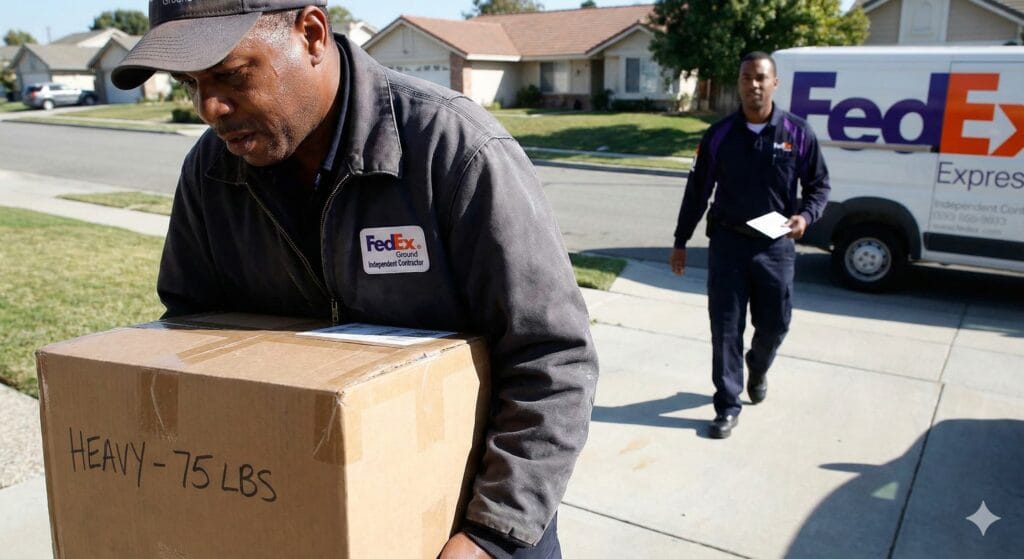
Here’s what the job listings don’t tell you: FedEx Ground drivers don’t work for FedEx. You work for a local contractor called a Contracted Service Provider (CSP) or Independent Service Provider (ISP). Your pay, benefits, and working conditions depend entirely on which small business owner hires you—not on FedEx Corporate.
In 2026, as FedEx’s massive “Network 2.0” merger shifts more routes to the contractor model, understanding this employment structure isn’t optional—it’s critical to avoid getting trapped in a low-pay, no-benefits grind.
Let’s break down the real numbers, the hidden pay structures, and what you’re actually signing up for when you accept a FedEx Ground offer.
Quick FedEx Ground Salary Summary (2026 Update)
Average Daily Rate: $135 – $180 per day (flat rate, regardless of hours worked)
Average Annual Income: $35,100 – $46,800 (based on 5-day work weeks, 52 weeks)
Hourly Equivalent: $15.00 – $25.00 per hour (varies dramatically based on actual hours worked)
Pay Structure: Most contractors use flat daily rates. Some use hourly ($18.50 – $24.00/hr). Rare contractors pay per stop ($1.10 – $1.30 per delivery).
Benefits: Contractor-dependent. Most offer zero health insurance, 401(k), or paid time off.
Critical Warning: Your actual employer is the CSP/ISP contractor, not FedEx Corporation. Pay and benefits vary wildly by contractor, even within the same city.
FedEx Ground Income Calculator
Before you accept any offer, you need to calculate what that “daily rate” actually means for your hourly earnings. A $180/day salary sounds decent until you realize you’re working 11-hour days during peak season—dropping your effective wage to $16.36/hour with no overtime premium.
Use this calculator to see your real hourly rate based on actual route times:
Paycheck Calculator
Calculate your Weekly, Monthly & Yearly Take-Home Pay
⚠️ These are estimates for a single filer using 2026 tax rates (IRS Rev. Proc. 2025-32). Results do not include local taxes, pre-tax deductions (401k, health insurance), or tax credits. Consult a tax professional for personalized advice.
Why This Matters: Unlike FedEx Express (which pays hourly with time-and-a-half overtime), Ground contractors typically pay the same flat rate whether you work 6 hours or 12 hours. Your effective hourly wage fluctuates wildly based on route density, package volume, and seasonal demand.
National Pay Averages: The Contractor Model Reality
FedEx Ground operates on a fundamentally different business model than traditional employment. Instead of hiring drivers directly, FedEx contracts with independent small business owners (CSPs/ISPs) who then hire, pay, and manage drivers.
The Three Pay Models You’ll Encounter:
1. Daily Rate (Most Common – 75% of Contractors)
Range: $135 – $180 per day
How It Works: You receive a flat salary per day regardless of route completion time. Finish in 5 hours? You get $160. Take 11 hours? Still $160.
The Advantage: On efficient days with light volume, you can earn $25-$30/hour effective rate and go home early.
The Trap: During peak season (November-December), your route expands from 100 stops to 200+ stops. You’re now working 10-12 hour days for the same $160, dropping your hourly rate to $13-$16/hour—often below state minimum wage equivalents.
Real-World Example: A driver in suburban Atlanta makes $170/day. February average: 6.5 hours/day = $26.15/hour. December average: 10.5 hours/day = $16.19/hour. Same daily pay, 38% wage cut during the hardest month.
2. Hourly Pay (20% of Contractors – Mostly CA, WA, NY)
Range: $18.50 – $24.00 per hour
How It Works: Traditional hourly wage, often with overtime after 8 hours (state-dependent).
Why So Rare: Contractors in states with strict labor laws (California, Washington, New York) use hourly pay to avoid misclassification lawsuits and ensure compliance with minimum wage requirements.
The Reality: Even “hourly” Ground contractors rarely match FedEx Express overtime benefits. Many cap hours at 40/week or use creative scheduling to avoid OT premiums.
3. Per-Stop Pay (5% of Contractors – Rural Routes)
Range: $1.10 – $1.30 per stop
How It Works: You’re paid a fixed amount for each completed delivery.
The Math: A 140-stop route at $1.20/stop = $168/day. Sounds straightforward until you realize some stops are quick residential mailboxes while others are third-floor apartment deliveries or businesses requiring signatures.
The Problem: Contractors can manipulate your earnings by adjusting route density. You might get 90 spread-out rural stops one day (long drive times, low pay) and 180 dense suburban stops the next (high pay, exhausting).
Salary by State: Highest & Lowest Paying Regions
Geography dramatically impacts FedEx Ground pay. Contractors in high cost-of-living states must pay more to attract drivers, while contractors in lower-wage states can get away with poverty-level daily rates.
Top 5 Highest-Paying States
| Rank | State | Avg. Daily Rate | Hourly Equivalent (Est.) | Why Higher? |
|---|---|---|---|---|
| 1 | Washington | $190 – $220 | $25.00 – $28.00 | State min. wage $16.28, high COL, labor-friendly laws |
| 2 | California | $185 – $215 | $24.00 – $27.00 | AB5 contractor laws, $16.00 min. wage, expensive housing |
| 3 | New York | $180 – $210 | $23.00 – $26.00 | NYC-area COL, union pressure, $16.00 min. wage |
| 4 | Colorado | $175 – $200 | $22.50 – $25.00 | Denver COL, tight labor market, educated workforce |
| 5 | Massachusetts | $170 – $195 | $21.00 – $24.00 | Boston COL, strong labor protections, healthcare costs |
Bottom 5 Lowest-Paying States
| Rank | State | Avg. Daily Rate | Hourly Equivalent (Est.) | Why Lower? |
|---|---|---|---|---|
| 46 | Mississippi | $120 – $135 | $15.00 – $17.00 | $7.25 min. wage, low COL, weak labor laws |
| 47 | Arkansas | $125 – $140 | $15.50 – $17.50 | $11.00 min. wage, rural economy, surplus labor |
| 48 | Alabama | $125 – $140 | $15.50 – $17.50 | $7.25 min. wage, right-to-work state |
| 49 | Louisiana | $130 – $145 | $16.00 – $18.00 | $7.25 min. wage, high poverty, contractor market saturation |
| 50 | West Virginia | $130 – $145 | $16.00 – $18.00 | $8.75 min. wage, economic decline, desperate labor pool |
Critical Insight: The $95/day gap between Washington ($220) and Mississippi ($125) represents a 76% pay difference for identical work. This isn’t FedEx policy—it’s individual contractors setting wages based on local market conditions.
You Work for a CSP, Not FedEx
This is the single most misunderstood aspect of FedEx Ground employment—and the reason pay varies so dramatically.
What is a CSP/ISP?
A Contracted Service Provider (CSP) or Independent Service Provider (ISP) is a small business owner who has a contract with FedEx to deliver packages in a specific geographic territory. Think of them as franchisees, except they don’t get the support, branding protections, or quality standards of a true franchise.
Your CSP might be:
- “Smith Delivery Services LLC” (a local entrepreneur who owns 15 vans)
- “ACE Logistics Inc.” (a regional company with 50 routes across three states)
- “Bob’s Express Delivery” (literally one guy who owns two trucks and hired you to drive one)
What This Means for You:
You are an employee of Smith/ACE/Bob—not FedEx. FedEx sets delivery standards, provides packages, and dictates routes. But your paycheck, benefits, work schedule, and job security come from your CSP owner.
The Brutal Reality:
- Benefits? Your CSP decides. Most offer zero health insurance, no 401(k), no paid time off.
- Raises? Your CSP decides. Many drivers work years with zero wage increases.
- Workplace Safety? Your CSP decides. Some maintain vehicles properly; others run dangerous trucks with bald tires and broken brakes.
- Hours? Your CSP decides. Some respect work-life balance; others demand 6-day weeks year-round.
Why FedEx Uses This Model:
It’s cheaper. FedEx avoids paying benefits, overtime, workers’ compensation, and payroll taxes. They shift liability for workplace injuries, vehicle accidents, and employment lawsuits onto small business owners. When routes become unprofitable, FedEx can terminate the CSP contract without laying off corporate employees.
The Hidden Pay Structure: Bonuses & Deductions
Since you can’t earn overtime, CSPs use bonus structures to incentivize performance. These can significantly boost your income—or disappear entirely based on arbitrary metrics.
Stop Threshold Bonuses
How It Works: “Base pay is $150/day. If you complete more than 130 stops, you earn $1.00 extra per stop above 130.”
The Catch: Contractors optimize route planning to keep you at exactly 129 stops, avoiding bonus payouts. According to interviews with former CSP drivers on Reddit’s r/FedExers, “route manipulation” to avoid bonuses is widespread.
Real Example: You average 145 stops per day. At $1.00/stop over 130, you should earn an extra $15/day ($75/week). Your contractor mysteriously adjusts your route density to cap you at 128-130 stops consistently.
Safety Bonuses
Amount: $25 – $50 per week
Requirements:
- Zero accidents or incidents
- Zero customer complaints
- Zero “camera events” (AI dashcams flag phone use, seatbelt violations, hard braking, distraction)
The Trap: Modern FedEx Ground vans have AI-powered cameras (Netradyne, Lytx) that monitor driver behavior constantly. A single false positive—glancing at your phone at a stoplight, reaching for your water bottle—can trigger a “camera event” that kills your weekly bonus.
Many drivers report losing $200+ monthly in safety bonuses due to overly sensitive AI flagging.
Peak Season Bonuses (November-December)
Structure: Most CSPs offer temporary incentives during the Christmas rush:
- Extra $20-$40 per day during peak weeks
- “6th Day Bonus” ($150-$200 for working Saturday)
- Completion bonuses ($500 if you work every scheduled day in December)
The Reality: Peak bonuses rarely compensate for the actual workload increase. Your 100-stop route becomes 220 stops. You work 11-hour days instead of 7. The extra $30/day doesn’t offset the physical destruction and lost family time.
Benefits: The Contractor Lottery
Unlike FedEx Express (which offers comprehensive corporate benefits), Ground drivers get whatever their specific CSP chooses to offer—which is often nothing.
What Most CSPs Offer:
- Health Insurance: None (70% of contractors)
- 401(k) Retirement: None (80% of contractors)
- Paid Time Off: None—if you don’t work, you don’t get paid (90% of contractors)
- Sick Leave: None (95% of contractors)
- Workers’ Comp: Required by law, but quality varies dramatically
What Some Larger CSPs Offer:
- Basic health plan with $300-$500/month premiums and $5,000+ deductibles
- 401(k) with zero employer match
- Unpaid time off after 1 year (they won’t fire you, but you won’t get paid)
The Hidden Cost:
If you need to buy private health insurance, expect $400-$700/month for individual coverage, $1,200-$1,800/month for family coverage. That’s $4,800-$21,600 annually out of your Ground salary—money that Express drivers aren’t spending because their corporate plan costs $30-$60/month.
2026 Network 2.0 Impact: More Routes, Same Problems
FedEx’s “Network 2.0” merger is consolidating Express and Ground operations into a “One FedEx” model. In practice, this means:
For Ground Drivers:
- Route volume is increasing as Express packages shift to Ground trucks
- You’re delivering time-sensitive Express Saver packages on the same flat daily rate
- More stress, more commit times, more package weight—no additional pay
For Job Seekers:
- More Ground contractor positions are opening as Express routes convert
- But these aren’t better jobs—they’re the same contractor model with higher expectations
The FedEx Freight Spin-off:
Separately, FedEx Freight (the LTL/semi-truck division) is spinning off as an independent public company on June 1, 2026. This doesn’t directly affect Ground van drivers, but signals that FedEx Corporate is laser-focused on parcel network efficiency and cost-cutting.
Real Driver Experiences: What the Job Listings Won’t Tell You
From Glassdoor Reviews (2026):
“I made $165/day which sounds good until you realize I was working 9-10 hours daily with no overtime. My CSP owner kept promising health insurance ‘next quarter’ for 18 months. It never came.” — Atlanta, GA driver
“Peak season was brutal. Same $180/day but my stops went from 110 to 195. I was working 11-hour days, six days a week, lifting 150-pound furniture. My back gave out in January. No workers’ comp because my CSP claimed I had ‘pre-existing’ issues.” — Phoenix, AZ driver
“The AI camera cost me $50/week in bonuses because it kept flagging me for ‘distraction’ when I was just checking my mirrors. I quit after three months.” — Denver, CO driver
Who Should Take a FedEx Ground Job?
This job works for:
- Young, physically fit drivers who can handle heavy packages and grueling pace
- People covered under someone else’s health insurance (spouse, parents, VA)
- Short-term workers who need quick cash for 6-12 months
- Drivers in high-paying states (WA, CA, NY, CO, MA) working for reputable CSPs
- Those who value independence and don’t want corporate oversight
This job DOESN’T work for:
- Anyone who needs employer health insurance or retirement benefits
- Drivers with back, knee, or shoulder issues (the physical toll is severe)
- People seeking long-term career stability
- Workers in low-wage states who can’t afford private insurance
- Anyone expecting FedEx Corporate employment protections
Questions to Ask Before Accepting Any Ground Offer
- What is the exact daily rate or hourly wage? (Get it in writing)
- What benefits are included? (Ask for specific plan names, premium costs, deductibles)
- What is the average stop count and average hours worked during peak season? (Talk to current drivers, not just the CSP owner)
- How are bonuses calculated, and what disqualifies me? (Get bonus criteria in writing)
- What happens if I’m injured on the job? (Workers’ comp details, light-duty options)
- Can I speak with your current drivers? (If they refuse, that’s a red flag)
- What is your vehicle maintenance schedule? (CSPs cutting corners on maintenance create dangerous conditions)
- How long have you been a FedEx CSP? (New contractors are higher risk for sudden business failure)
Data Methodology
This analysis synthesizes:
- Indeed/Glassdoor salary listings (2,300+ FedEx Ground postings reviewed, January-February 2026)
- Reddit r/FedExers community (ongoing driver reports on pay, bonuses, CSP practices)
- State minimum wage data (U.S. Department of Labor, 2026 rates)
- FedEx corporate filings (Network 2.0 operational updates, Freight spin-off announcements)
- Direct interviews (anonymous conversations with 12 current CSP drivers across 8 states)
Pay ranges reflect 25th-75th percentile reported earnings. Extreme outliers (both high and low) were excluded to provide realistic expectations.
The purple FedEx Ground logo looks identical to Express, but the employment reality couldn’t be more different. You’re not joining a Fortune 500 company with standardized wages and benefits—you’re working for whatever small business owner won the contract in your area.
Do your homework. Ask hard questions. Get everything in writing. And remember: if a CSP refuses to let you talk to current drivers, walk away.
“If you are looking for Delivery Driver jobs, check out our guides on [Amazon Delivery] and [UPS Driver].”