CDL Class A vs B Salary 2026: $24K Take-Home Gap
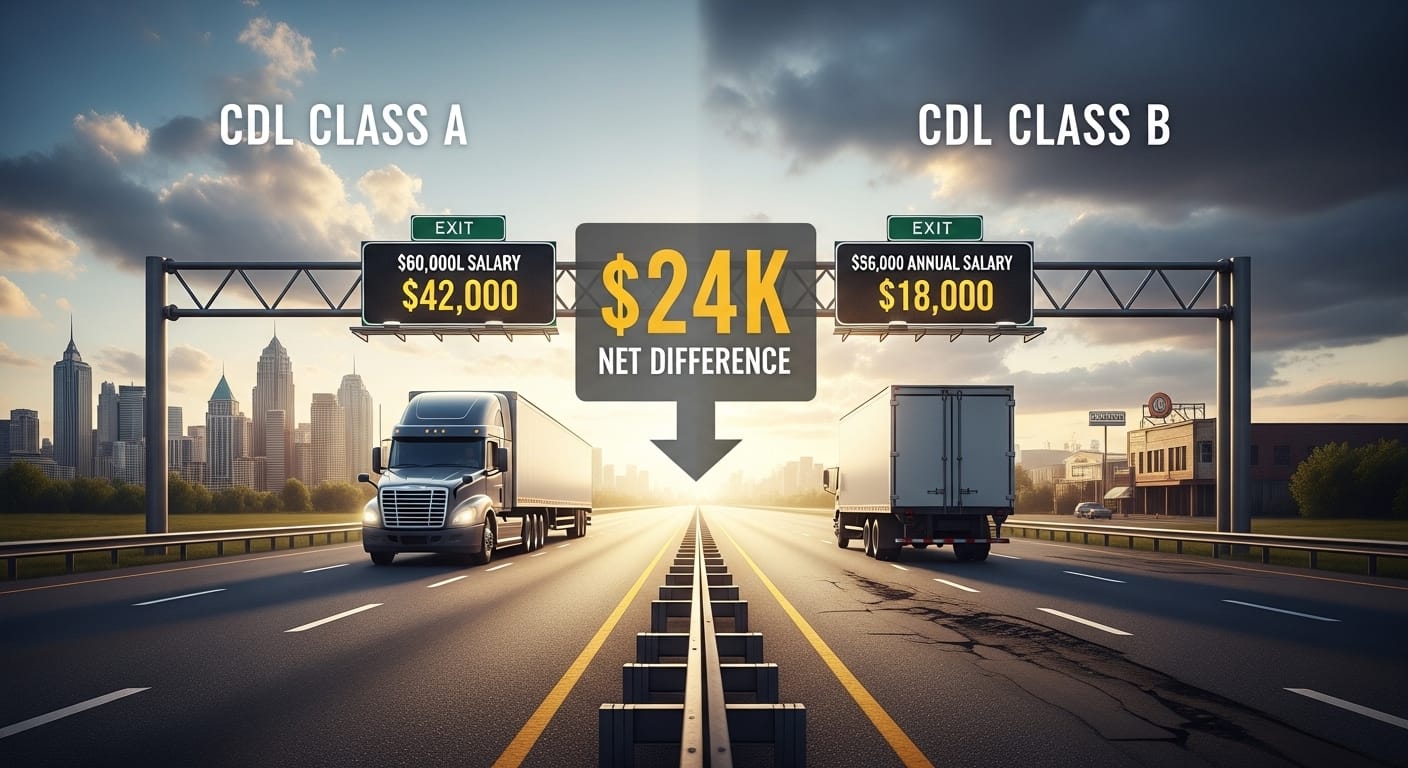
CDL Class A drivers earn between $90,000 and $103,000 annually in 2026, while Class B drivers average $55,000 to $70,000 — a gross gap of roughly $35,000 that shrinks to $24,772.50 after federal taxes. Which license makes sense for you depends on your tolerance for time away from home, your long-term earning ambitions, and whether you want a job or a lifestyle. Use the tables and tax breakdown below for exact take-home figures by class and experience level.
Quick Facts — CDL Class A vs Class B Driver Salary 2026
| CDL Class A | CDL Class B | |
|---|---|---|
| Median / Average | $90,000 – $103,000 | $55,000 – $70,000 |
| Top 10% / 75th–90th Pct. | $103,742+ (up to $110,000+ specialized) | $83,647 |
| Entry-Level | $65,000 – $85,000 | $30,000 – $40,000 |
| Best State / Benchmark | Texas: $93,505 avg. (Justin, TX) | Urban markets with municipal union contracts |
| BLS OES Code | 53-3032 | 53-3033 |
| Last Updated | February 2026 | February 2026 |
Which pays more in 2026: CDL Class A or Class B?
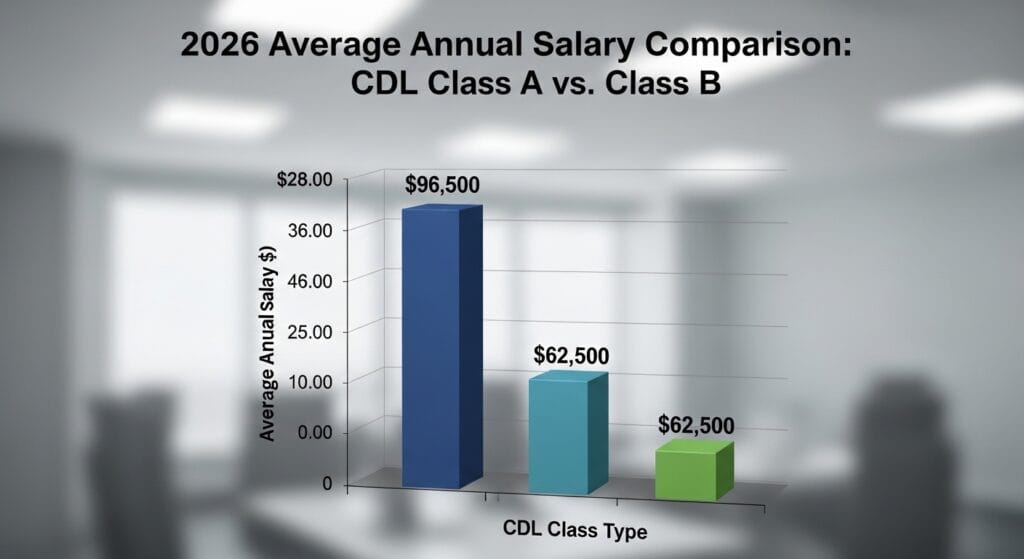
CDL Class A pays significantly more than Class B across every market segment and geographic region without exception. The average Class A driver earns $90,000 to $103,000 annually, with top earners at national carriers like Werner Enterprises clearing $90,000 as a baseline. Class B tops out around $83,647 at the 75th percentile, with most drivers clustering between $55,000 and $70,000.
The pay gap is structural, not accidental. It reflects the revenue generated by Class A operations.
CDL Class A drivers operating under BLS OES code 53-3032 haul up to 80,000 pounds of combined gross weight across interstate jurisdictions on tractor-trailers with a Gross Combination Weight Rating exceeding 26,001 lbs and towing capacity above 10,000 lbs. The freight volume per trip is enormous, and carriers pass a share of that revenue to the driver. Most OTR (Over-The-Road) positions use piece-rate mileage pay — typically $0.50 to $0.75 per mile. A driver averaging 500 miles per day at $0.75/mile generates $1,875 weekly, or $97,500 annually. That ceiling is constrained only by the FMCSA’s 70-hour Hours of Service (HOS) clock and the driver’s own endurance.
CDL Class B drivers under OES 53-3033 operate straight trucks, dump trucks, delivery box trucks, and transit buses on fixed local routes. These assets generate less gross revenue per trip, so employers pay hourly — averaging $20 to $30 per hour, with a median around $24. At $22/hour on a standard 40-hour week, annual gross income lands at $45,760. Unlike the per-mile model, hourly pay is hard-capped by the employer’s operating hours.
Specialized Class A premiums are where the real separation occurs. Drivers holding Hazmat endorsements, double/triple trailer certifications, or heavy-haul flatbed experience routinely earn $75,000 to over $100,000. Regional data from Texas in early 2026 shows Class A equivalents averaging $93,505 annually in certain municipalities, translating to an hourly equivalent of $44.95.
| Experience / Specialty | CDL Class A Annual Salary | CDL Class B Annual Salary |
|---|---|---|
| Entry-Level (0–2 years) | $65,000 – $85,000 | $30,000 – $40,000 |
| Average / Mid-Career | $90,000 – $103,000 | $55,000 – $70,000 |
| 75th–90th Percentile | $103,742+ | $83,647 |
| Specialized (Hazmat / Flatbed / LTL) | $75,000 – $110,000+ | N/A |
| Owner-Operator (Gross) | $100,000+ (net varies widely) | N/A |
| Hourly Equivalent (OTR piece-rate) | ~$44.95 (TX benchmark) | $20 – $30/hr |
Paycheck Calculator
Calculate your Weekly, Monthly & Yearly Take-Home Pay
⚠️ These are estimates for a single filer using 2026 tax rates (IRS Rev. Proc. 2025-32). Results do not include local taxes, pre-tax deductions (401k, health insurance), or tax credits. Consult a tax professional for personalized advice.
What is the true net pay difference after taxes for Class A vs Class B?
After applying 2026 IRS tax brackets, the $35,000 gross advantage for Class A drivers shrinks to an exact net difference of $24,772.50. The progressive tax system claims an additional $10,227.50 from the Class A earner, since over $33,000 of their income falls into the 22% marginal bracket.
Here’s the precise breakdown using a single-filer model, the 2026 standard deduction of $16,100, and FICA at 7.65% flat — current figures reflecting the extension of the One Big Beautiful Bill and TCJA provisions:
| Tax Metric (2026 IRS Data) | Class A Driver ($100,000 Gross) | Class B Driver ($65,000 Gross) |
|---|---|---|
| Gross Annual Income | $100,000.00 | $65,000.00 |
| Minus Standard Deduction | –$16,100.00 | –$16,100.00 |
| Taxable Income | $83,900.00 | $48,900.00 |
| 10% Bracket ($0–$12,400) | $1,240.00 | $1,240.00 |
| 12% Bracket ($12,401–$50,400) | $4,560.00 | $4,380.00 |
| 22% Bracket ($50,401–$105,700) | $7,370.00 | $0.00 |
| Total Federal Income Tax | $13,170.00 | $5,620.00 |
| FICA (7.65% of gross) | $7,650.00 | $4,972.50 |
| Total Federal Tax Burden | $20,820.00 | $10,592.50 |
| True Net Take-Home | $79,180.00 | $54,407.50 |
The functional gap is $24,772.50 — not $35,000.
For OTR Class A drivers, the real number is tighter still. Living out of a truck cab for two to three weeks per month means real, unavoidable expenses: truck-stop meals, paid overnight parking, road showers, elevated phone plans. These costs don’t exist for a Class B driver who goes home every night.
For owner-operators, the calculus flips entirely. They face a 15.3% self-employment tax (both employer and employee FICA halves) but can aggressively write off fuel, IFTA road taxes, tolls, weigh station fees, and the substantial cost of truck maintenance and tire replacement. A healthy total cost per mile for an owner-operator in 2026 runs $1.50 to over $3.00, dramatically reducing gross revenues before taxable profit is calculated. Owner-operators who manage their books well often pay effective tax rates lower than W-2 company drivers earning the same gross.
Are Class A or Class B trucking jobs in higher demand in 2026?
Both classes face acute labor shortages, but the mechanics driving that demand are entirely different. Class A shortages are structural and chronic; Class B shortages are growth-driven and expanding.
Class A (OES 53-3032): The BLS projects 2,235,100 baseline workers in 2024 growing to 2,324,400 by 2034 — a gain of 89,300 jobs at a 4.0% growth rate. But that headline understates the crisis. The American Trucking Associations estimates a systemic shortage of over 50,000 drivers now, escalating to a projected deficit of 175,000 by 2026. The average age of a for-hire truck driver is 49 years old, meaning massive retirement outflows are imminent. Turnover at large truckload carriers routinely operates above 90%, having previously spiked to 127% and even 136% during periods of economic strain. The industry must hire nearly 90,000 new drivers annually over the next decade just to replace attrition — before filling growth slots.
Compounding this: the March 2026 FMCSA compliance enforcement removed approximately 200,000 non-domiciled CDL holders from the eligible driver pool in a single regulatory action. Spot rates jumped 20 cents per mile on the National Truckload Index within weeks. Supply-side capacity tightened immediately.
Class B (OES 53-3033): Starting from a baseline of 1,079,800 workers, BLS projects growth to 1,158,600 by 2034 — 78,900 new positions at a 7.3% rate, nearly double the pace of Class A. This growth is structural and demand-driven: the relentless expansion of e-commerce, final-mile delivery networks, and decentralized warehousing is creating net-new positions that need filling, not just vacancies left by burned-out drivers quitting. Turnover in local Class B roles is dramatically lower than OTR, because drivers go home every night.
| Labor Market Metric | CDL Class A (OES 53-3032) | CDL Class B (OES 53-3033) |
|---|---|---|
| 2024 National Employment | 2,235,100 | 1,079,800 |
| 2034 Projected Employment | 2,324,400 | 1,158,600 |
| New Jobs Added (2024–2034) | +89,300 | +78,900 |
| Projected Growth Rate | 4.0% | 7.3% |
| Annual Replacement Hiring Need | ~90,000/year | Much lower |
| Annual Turnover Rate (Large Carriers) | 90%–136% | ~10–20% (local/LTL) |
How do daily routes and home time compare between Class A and Class B?
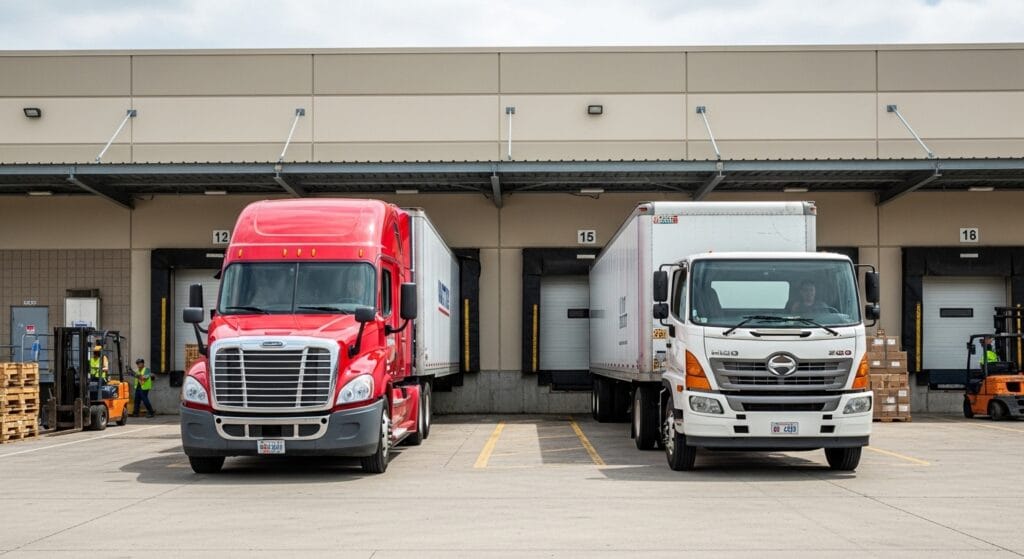
Class B drivers go home every night. Class A OTR drivers may spend two to three weeks straight living in a 40-square-foot sleeper berth. That lifestyle difference is the single biggest reason qualified candidates voluntarily choose the lower-paying Class B license.
Class A operations under OES 53-3032 are structured around two primary models. OTR drivers cross the continental United States on irregular schedules dictated by load availability, terminal detention times, and FMCSA HOS regulations — spending one to two days at home between multi-week deployments. Regional drivers operate within a roughly 1,000-mile radius covering four to five states, hauling single-stop loads and resetting home roughly weekly. The psychological isolation, limited nutritious food options, and irregular sleep patterns are well-documented occupational health stressors.
Class B operations under OES 53-3033 are almost exclusively local. Drivers run fixed, predictable daily routes within a single city or metro area — municipal waste management, school bus routes, local courier freight, construction dump runs — and return to the terminal every evening. The job functions like a standard shift position. While the pay ceiling is lower, the non-monetary premium of maintaining normal family routines and sleeping in your own bed is what the industry calls “home time value,” and for tens of thousands of drivers, it’s worth $24,772.50 per year to them.
What are the hidden costs of upgrading from Class B to Class A?
The Class B-to-Class-A upgrade path costs nearly as much as starting Class A from scratch — and that’s the trap. In 18 years behind the wheel and years certifying new drivers, I’ve watched dozens of candidates burn extra money and time on this “stepping stone” approach when a straight Class A program would have cost less.
The FMCSA’s ELDT mandate does not exempt existing Class B holders from Class A behind-the-wheel training requirements. While a final rule reduced some redundant classroom theory (saving an estimated $18 million industry-wide annually), candidates still pay a registered provider for full combination vehicle practical instruction. Upgrade courses at private CDL schools run $3,000 to $6,000 — nearly the price of a comprehensive Class A course taken cold. A driver who spends $4,000 on an initial Class B license and then $5,000 on the upgrade totals $9,000 — versus $6,000 for a direct Class A path at a public institution like Butler Tech in Ohio.
Factor in lost wages. A Class B driver earning $1,300/week who takes four weeks off for ELDT practical requirements forfeits $5,200 in gross income. Add equipment rental for the CDL-A skills test (typically $200+), state licensing fees assessed again on the upgrade (ranging from $17.08 in Colorado to $120.00 in Alaska), and an online theory course if required (around $109 at Midwest Truck Driving School) — and the hidden cost of the upgrade path clears $8,000 to $10,000+ in real dollars.
The only scenario where upgrading makes financial sense: your employer is running a paid dock-to-driver program, drawing you a salary while you train. Otherwise, go Class A from day one if that’s your target.
Which CDL license offers better long-term career growth?
Class A is not just a better-paying license — it is categorically a broader credential. A Class A holder legally operates any Class B or Class C commercial vehicle (with applicable endorsements). A Class B holder cannot operate Class A equipment without restarting the schooling process. That asymmetry defines the entire career growth picture.
Class A is the gateway to the highest-earning freight specializations: Hazmat tanker (liquids or gases exceeding 1,000 gallons), heavy-haul oversize, double/triple trailer operations, and LTL linehaul — niches that routinely produce six-figure incomes with more predictable schedules than general OTR. These endorsements stack onto an existing Class A credential without requiring retraining, only knowledge tests.
Most importantly, Class A is the sole prerequisite for the owner-operator path. Purchasing or leasing your own tractor, obtaining independent operating authority, and functioning as a micro-carrier is the highest-earning, highest-autonomy position in commercial trucking. The February 2026 DOL proposed rule to rescind the Biden administration’s 2024 independent contractor classification standard — restoring a framework more favorable to the traditional owner-operator model — reinforces that this path remains legally viable and economically potent.
Class B careers are stable, local, and lifestyle-compatible. Equipment limitations (straight trucks, buses, dump trucks) restrict the driver to intrastate operational structures with no upward mobility without license reclassification. For a driver who prioritizes schedule stability over earnings ceiling, Class B is rational. For a driver who wants maximum lifetime earnings, Class A is the unambiguous answer.
Training Costs and ROI: What Does Each License Actually Cost?
The financial premium to acquire a Class A over Class B is smaller than most people assume — and the ROI on that premium is extraordinary.
| Cost Metric | CDL Class A | CDL Class B |
|---|---|---|
| National Tuition Range | $3,000 – $10,000 | $2,000 – $6,000 |
| Public Institution Benchmark (Butler Tech, OH) | $6,200 ($5,825 + $375 books) | $5,200 ($4,825 + $375 books) |
| Low-Cost Alternative (TCAT Knoxville) | $2,094 tuition + $304.99 supplies | — |
| Urban Private School (North American Trade Schools, Baltimore) | — | $2,195.70 (48-clock-hour program) |
| Full-Time Duration | 4–6 weeks | 2–4 weeks |
| Part-Time Duration | 10–12 weeks | 6–8 weeks |
| State CDL License Fee Range | $17.08 (CO) to $120.00 (AK) | $17.08 (CO) to $120.00 (AK) |
| WIOA / Pell / GI Bill Eligibility | Yes (accredited public programs) | Yes (accredited public programs) |
The $1,000 tuition differential between Class A and Class B at a public institution is recovered within two to three months of employment at a Class A carrier — given the $35,000 annual gross advantage. The true ROI on that extra $1,000 is measured in weeks, not years.
For drivers concerned about the upfront cost, WIOA grants, Pell Grants (for programs exceeding 600 hours), and Veterans Education Benefits including the GI Bill are widely accepted at accredited public CDL training facilities. Many large carriers also offer company-sponsored CDL training, covering tuition in exchange for a one- to two-year driving commitment.
FAQ
Can you drive a Class B truck with a Class A license?
Yes — without exception. The U.S. commercial licensing structure is strictly hierarchical. A CDL Class A license authorizes the holder to operate any Class B or Class C vehicle, provided the driver holds any required specialized endorsements (Passenger, School Bus, Hazmat). This downward compatibility is one of the most valuable features of the Class A credential, allowing experienced OTR drivers to transition into local straight-truck roles without retesting or additional schooling.
Is the CDL Class A test harder than Class B?
Unequivocally yes. The Class A skills examination requires mastery of articulated vehicle physics that Class B testing never touches: offset backing, 90-degree alley docking, and parallel parking a 53-foot trailer — all executed using reverse-steering logic that is counterintuitive to any prior driving experience. The pre-trip inspection component alone is significantly more exhaustive, requiring candidates to demonstrate mechanical knowledge of fifth wheel assemblies, coupling systems (kingpins, locking jaws, glad hands), and dual air-brake systems. Class B vehicles are rigid single-unit chassis that handle far more like an oversized passenger vehicle, entirely omitting these articulation complexities.
Do local delivery jobs require a Class A or Class B license?
It depends on the employer’s fleet, and the answer determines pay. The highest-paying local delivery routes — mega-distributors like Sysco, PepsiCo, and Coca-Cola — operate 53-foot or 48-foot refrigerated tractor-trailers and require a Class A license as a strict federal requirement. These are combination vehicles exceeding 26,001 lbs GVWR with trailers well above 10,000 lbs. They also involve “touch freight” work: physically unloading 40 to 100-pound products using hand carts throughout the entire shift on top of the driving. Standard parcel delivery, regional furniture delivery, and smaller municipal couriers use straight rigid trucks, where a Class B license is fully sufficient.
“If you are looking for Delivery Driver jobs, check out our guides on [Uber Driver Pay] and [UPS vs FedEx Driver].”
All salary data sourced from the 2026 CDL Labor Market Analysis research brief. BLS OES codes 53-3032 and 53-3033 cited as primary occupational classification references. Tax modeling based on 2026 IRS standard deduction of $16,100 and TCJA/One Big Beautiful Bill provisions.
Works Cited
- U.S. Bureau of Labor Statistics. “Heavy and Tractor-Trailer Truck Drivers — OES 53-3032.” Bureau of Labor Statistics, Occupational Employment and Wage Statistics. https://www.bls.gov/oes/2022/may/oes533032.htm. Accessed March 2026.
- U.S. Bureau of Labor Statistics. “Light Truck Drivers — OES 53-3033.” Bureau of Labor Statistics, Occupational Employment and Wage Statistics. https://www.bls.gov/oes/2022/may/oes533033.htm. Accessed March 2026.
- U.S. Bureau of Labor Statistics. “Occupations with the Most Job Growth.” Bureau of Labor Statistics, Employment Projections. https://www.bls.gov/emp/tables/occupations-most-job-growth.htm. Accessed March 2026.
- U.S. Bureau of Labor Statistics. “Occupational Projections and Worker Characteristics.” Bureau of Labor Statistics. https://www.bls.gov/emp/tables/occupational-projections-and-characteristics.htm. Accessed March 2026.
- U.S. Bureau of Labor Statistics. “Industry and Occupational Employment Projections Overview and Highlights, 2024–34.” Monthly Labor Review. https://www.bls.gov/opub/mlr/2026/article/industry-and-occupational-employment-projections-overview.htm. Accessed March 2026.
- Internal Revenue Service. “IRS Releases Tax Inflation Adjustments for Tax Year 2026, Including Amendments from the One, Big, Beautiful Bill.” IRS Newsroom. https://www.irs.gov/newsroom/irs-releases-tax-inflation-adjustments-for-tax-year-2026-including-amendments-from-the-one-big-beautiful-bill. Accessed March 2026.
- Internal Revenue Service. “One, Big, Beautiful Bill Provisions — Individuals and Workers.” IRS Newsroom. https://www.irs.gov/newsroom/one-big-beautiful-bill-provisions-individuals-and-workers. Accessed March 2026.
- Federal Motor Carrier Safety Administration. “Commercial Driver’s License Upgrade from Class B to Class A.” FMCSA Federal Register Documents. https://www.fmcsa.dot.gov/regulations/federal-register-documents/2019-04044. Accessed March 2026.
- Texas Department of Public Safety. “Commercial Driver License Manual.” DPS Texas. https://www.dps.texas.gov/internetforms/forms/dl-7c.pdf. Accessed March 2026.
- U.S. Bureau of Labor Statistics. “Light Truck Drivers — OES 53-3033 (May 2023).” Bureau of Labor Statistics. https://www.bls.gov/oes/2023/may/oes533033.htm. Accessed March 2026.