Grubhub Driver Pay 2026: Real $38/hr Possible?
Grubhub Driver Pay
If you’ve ever sat in a parking lot with the Grubhub app open, watching the minutes tick by while a driver two miles away stays consistently busy, you’ve already felt the consequences of not understanding the block system. Grubhub is not DoorDash. You cannot simply toggle on, wait for orders to flood in, and call it a shift. In 2026, Grubhub operates more like a shift-based job than a free-roaming gig platform—and the drivers who treat it that way earn considerably more than those who don’t.
This guide breaks down exactly what Grubhub pays, how the scheduling hierarchy works, which cities still make the platform worth your fuel costs, and how to avoid the contribution pay trap that has quietly ended thousands of driver accounts.
Quick Grubhub Salary Summary (2026 Update)
A fast-reference snapshot for experienced drivers and newcomers alike.
| Metric | Figure |
|---|---|
| Average Hourly (On Block) | $20.00 – $26.00/hr |
| Top Market Earnings (NYC) | $30.00 – $38.00/hr |
| Base Pay Per Order | $3.50 – $7.00 |
| Mileage Rate | $0.22 – $0.25/mile |
| Contribution Pay (Guarantee) | $12.00 – $15.00/hr (market-dependent) |
| Tips | 100% to driver |
| Instant Cash Out Fee | $0.50 per transfer |
| Standard Pay Day | Thursdays (Direct Deposit) |
| Premier AR Requirement | 95%+ Acceptance Rate |
| Guaranteed Minimums Available? | Yes — Scheduled Block + 90% AR required |
Grubhub Income Calculator
Paycheck Calculator
Calculate your Weekly, Monthly & Yearly Take-Home Pay
⚠️ These are estimates for a single filer using 2026 tax rates (IRS Rev. Proc. 2025-32). Results do not include local taxes, pre-tax deductions (401k, health insurance), or tax credits. Consult a tax professional for personalized advice.
How Grubhub Actually Pays: The Base + Guarantee Formula
Before diving into strategy, you need to understand the pay structure that makes Grubhub different from every other platform in the Big 3.
Base Pay ($3.50 – $7.00 per order) is the foundation of every delivery. This is notably higher than DoorDash’s base of approximately $2.00 and Uber Eats’ $2.50 average, and the reason is deliberate: Grubhub’s delivery zones tend to be larger, particularly in Northeast markets, so the company compensates accordingly. You’re typically traveling farther per order, but you’re also earning more per order before tips are factored in.
Mileage runs $0.22 to $0.25 per mile, factored into the base pay calculation. California drivers operate under Prop 22 rules, which guarantee 120% of minimum wage plus $0.35 per mile—a structurally better arrangement than most other states. Grubhub pays mileage from the restaurant to the customer, not from your current location to the restaurant, which is an important distinction when evaluating offer value.
Tips go 100% to the driver with no platform clawback. Grubhub’s app encourages higher default tip percentages than competitors, which creates better tipping behavior among customers over time. Large dinner orders and catering orders on the platform tend to generate “unicorn” tips—$15 to $30 or more on a single delivery—particularly in markets with higher household incomes.
Contribution Pay is the headline feature and the most misunderstood. More on that in detail below.
Scheduling Blocks: The Secret to Higher Pay
This is the single concept that separates Grubhub earners from Grubhub complainers. Understanding it changes everything about how you approach the platform.
What a Block Actually Does
When you schedule a block—a specific time window like 5:00 PM to 8:00 PM on a Thursday—you are reserving priority position in the order queue for that market during that window. When an order comes in, Grubhub’s algorithm routes it to scheduled drivers first, before it ever reaches a driver who is simply toggled on without a block.
In slow markets or off-peak hours, the consequence is severe: an unscheduled driver may receive zero orders during an entire shift while a scheduled driver two miles away completes five deliveries. In suburban markets in 2026, working off-block isn’t just less efficient—it’s essentially unviable. You can only even toggle “Available” if the map is showing red (high demand). If the map is gray, unscheduled drivers cannot go online at all.
The Three-Tier Hierarchy
Grubhub divides its driver pool into three program levels, each with different scheduling access windows:
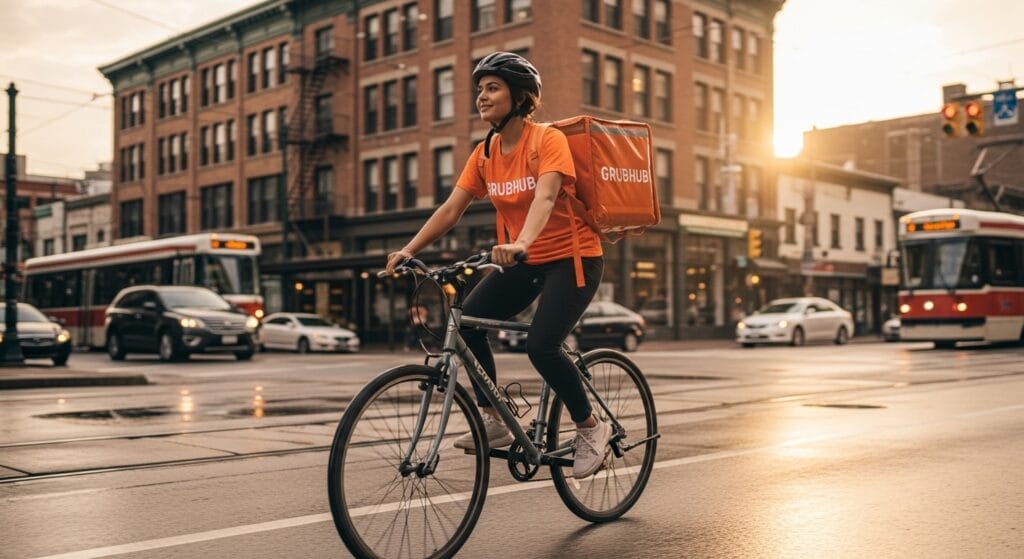
Partner (Entry Level) — No minimum requirements, but scheduling access opens on Saturday for the following week. By Saturday, most desirable evening and weekend blocks in competitive markets are already claimed. Partner drivers frequently find themselves without any viable blocks for peak hours, which creates a ceiling on earning potential that is very difficult to break through without deliberate tier advancement.
Pro — Requires approximately 85% Acceptance Rate and consistent block completion. Pro drivers get schedule access on Friday, providing a meaningful advantage over Partners in claiming prime dinner-rush blocks.
Premier — The top tier, requiring a 95%+ Acceptance Rate and strong Block Completion Rate. Premier drivers access the schedule on Thursday, a full two days before Partners. In markets with limited block availability, this is the difference between a full weekly schedule and scrambling for leftovers.
The Scheduling Strategy That Actually Works
Experienced drivers in strong markets treat Thursday as their most important workday of the week—not for deliveries, but for schedule planning. As soon as Premier access opens, they claim every viable block for the following week: Friday dinner, Saturday lunch and dinner, Sunday brunch. Weekday lunch blocks in downtown office corridors. The best earners run Grubhub like a part-time job with set hours, because that is exactly what the platform rewards.
Premier drivers also report access to larger catering orders and corporate lunch deliveries—high-value, pre-scheduled orders that rarely surface for lower-tier drivers. These orders can pay $25 to $60 as a single delivery and represent some of the platform’s best per-hour earnings.
Salary by City: Grubhub Strongholds
Grubhub’s geographic reality in 2026 is stark. The platform is a dominant force in the Northeast and parts of the Midwest, and a distant third-place option almost everywhere else. Your location determines whether Grubhub is a primary income source or a backup app.
Top 5 Highest-Paying Grubhub Markets
| Rank | City / Market | Est. Gross Hourly | Key Driver |
|---|---|---|---|
| 1 | New York City, NY | $30.00 – $38.00/hr | Seamless merger dominance; corporate lunch volume; no-car delivery density |
| 2 | Chicago, IL | $28.00 – $34.00/hr | Grubhub HQ city; massive Loop market share; high order frequency |
| 3 | Seattle, WA | $27.00 – $33.00/hr | Regulatory pay floors; tech worker tipping culture; Prop-equivalent protections |
| 4 | Boston, MA | $26.00 – $32.00/hr | High average order value; harsh winters boost delivery demand and tips |
| 5 | Philadelphia, PA | $24.00 – $29.00/hr | Dense college market (UPenn, Drexel, Temple); consistent lunch volume |
Weakest Markets to Avoid
Florida (Miami/Tampa), Texas (Dallas/Houston), Arizona (Phoenix), Las Vegas, and most of the Carolinas consistently rank as Grubhub’s weakest performing zones. In these markets, Uber Eats and DoorDash have locked up restaurant partnerships and customer loyalty. Grubhub drivers in these regions frequently report 25–40 minute waits between orders even during peak hours. If you’re in these markets, Grubhub works best as a supplemental app running alongside a primary platform—not as a standalone income source.
Contribution Pay: The Safety Net With a Trapdoor
Grubhub’s Contribution Pay is the most-discussed and most-misunderstood feature on the platform. Here’s what it actually does, and why experienced drivers approach it with extreme caution.
How It Works
If you schedule a block and your combined delivery earnings (base pay + tips) fall below the market’s guaranteed hourly minimum—typically $12 to $15 per hour depending on location—Grubhub pays you the difference. So if you work a 3-hour block and earn $28 in deliveries, and your market guarantee is $14/hr ($42 total), Grubhub contributes $14 to bring you to the guaranteed amount.
The qualification requirement is strict: you must maintain a 90% Acceptance Rate for the entire day (not just the block). Declining one bad order can void your contribution eligibility for the full day.
On its surface, this is an excellent safety net—particularly valuable during slow weather days, unexpected market lulls, or holiday weekends when volume is unpredictable.
Why Experienced Drivers Avoid It Anyway
Here is what the platform doesn’t broadcast: collecting Contribution Pay too frequently—even for reasons entirely outside your control—triggers Grubhub’s algorithm to flag your account. The system interprets regular contribution claims as possible fraud, deliberate order delay, or gaming of the guarantee system.
Drivers report receiving warnings after claiming contribution just three or four times in a single month. The consequence isn’t just a warning—it’s permanent removal of scheduling privileges, effectively demoting you to a permanent off-block status where consistent income becomes nearly impossible.
The strategic response most experienced drivers have adopted: if a block goes quiet, end it early. Forfeit the contribution, protect the scheduling access. Treat contribution as a true emergency backup for the worst possible shifts, not a routine income supplement. This is a perverse system design—a safety net most smart drivers choose not to use—but it reflects the reality of the platform in 2026.
Grubhub vs. DoorDash: The Platform Comparison That Matters
| Factor | Grubhub | DoorDash |
|---|---|---|
| Avg Hourly (Active) | $20 – $26/hr | $18 – $25/hr |
| Order Volume | Lower | 3x Higher |
| Base Pay | Higher ($3.50–$7.00) | Lower (~$2.00) |
| Acceptance Rate Impact | Critical (blocks/tiers) | Minimal |
| Schedule System | Block-based priority | Open dash / Top Dasher |
| Tip Transparency | Full upfront disclosure | Partial (hidden tip model) |
| Income Guarantee | Yes (Contribution, on block) | No |
| Off-Block Viability | Low (suburban markets) | Moderate |
| Best For | Consistent shift-workers | High-volume earners |
The key insight: DoorDash’s volume advantage means more opportunities to cherry-pick. Grubhub’s structure rewards consistency over strategy. Neither platform is universally superior—the right choice depends on your market, your schedule flexibility, and whether you can maintain the acceptance rates Grubhub demands.
Frequently Asked Questions
What is Grubhub Contribution Pay?
Grubhub Contribution Pay is a minimum hourly earnings guarantee for drivers who schedule blocks in advance. If your delivery earnings during a scheduled block fall below the market minimum (typically $12–$15/hr), Grubhub pays the shortfall. To qualify, you must maintain a 90% Acceptance Rate for the entire day the block falls on. Critically, collecting contribution pay too frequently can trigger account review and permanent loss of scheduling access—a risk experienced drivers take seriously.
How does Grubhub Instant Cash Out work?
Grubhub pays all drivers via direct deposit every Thursday for the previous Monday–Sunday work week. If you need earlier access to earnings, Instant Cash Out is available daily for a $0.50 fee to most debit cards. Drivers who bank with Chase can access Instant Cash Out for free through Grubhub’s banking partnership. The $0.50 fee is modest compared to DoorDash’s Fast Pay ($1.99) but slightly less flexible than Uber Eats’ real-time deposit system.
Is Grubhub better than DoorDash for income?
It depends entirely on your market and driving style. In strong Grubhub markets (NYC, Chicago, Boston, Philadelphia), Grubhub’s higher base pay, contribution guarantee, and full tip transparency can produce better hourly earnings than DoorDash—especially for drivers willing to maintain Premier status and schedule blocks strategically. In weak Grubhub markets (Texas, Florida, Southwest), DoorDash’s volume advantage makes it the superior earning platform. Many serious gig drivers run both simultaneously, using Grubhub’s block system for stable baseline income and DoorDash for volume fill during gaps.
Can I drive Grubhub without scheduling a block?
Yes, but the experience varies dramatically by market. In markets like NYC or Chicago during peak dinner hours, sufficient overflow demand exists that unscheduled drivers can still receive orders. In suburban or smaller markets, working off-block in 2026 is largely unproductive—you’ll see few offers, no contribution guarantee applies, and scheduled drivers will consistently receive priority over you. If you’re in a competitive market, off-block should be treated as opportunistic top-up income, not primary earning time.
How long is the Grubhub waitlist?
Waitlist times range from 3 months in smaller or less saturated markets to more than 2 years in high-demand metros like New York City and Chicago. Grubhub strictly caps driver numbers in each zone to maintain viable order volume for existing drivers. When a spot opens, Grubhub sends an email activation window of approximately 48 hours. Missing that window typically means returning to the back of the queue. Check your email weekly and set specific email alerts for Grubhub messages to avoid missing your activation window.
Is Grubhub Worth It in 2026? The Strategic Verdict
Grubhub is not a platform you stumble into and earn well from by accident. It is a platform you master—or one that quietly pays you below your potential while you wonder what you’re doing wrong.
The drivers earning $28+ per hour in Chicago and Boston are not lucky. They’re Premier-tier drivers who claimed Thursday’s blocks before anyone else had access, who maintain 95% acceptance rates not because they accept bad orders blindly, but because they’ve learned their market well enough to know which offers are actually profitable at any given time. They’ve built Grubhub into a structured part-time income source that functions predictably, week after week.
For drivers in weak markets—Phoenix, Las Vegas, Miami—the calculus is different. Grubhub may never become a primary earner, regardless of tier status. In those markets, the smart strategy is a multi-app approach, with Grubhub running in the background as a supplement rather than a centerpiece.
The block system is a feature, not a limitation—if you’re willing to engage with it properly. The contribution pay guarantee is a safety net—if you’re strategic enough not to lean on it. And the waitlist, frustrating as it is, exists because Grubhub has successfully protected driver earnings in strong markets by preventing oversaturation.
Know your market. Work the schedule. Protect your tier status. That’s the 2026 Grubhub playbook.
Data Methodology
The earnings figures, acceptance rate thresholds, and market performance data cited in this guide are derived from the 2026 Food Delivery Analysis research brief compiled by our delivery economics team (January 2026), cross-referenced with publicly available driver forum data, platform-published pay structure documentation, and aggregated driver earnings reports from Northeast, Midwest, and Southwest metro markets. City-specific hourly ranges represent gross earnings (before vehicle expenses and taxes) reported by active drivers during standard peak-hour block shifts. Individual results will vary based on market saturation, time of day, block availability, tip behavior, and driver acceptance rate maintenance. This guide is updated periodically to reflect platform policy changes; readers should verify current contribution pay thresholds and tier requirements directly with Grubhub’s partner portal.
“If you are looking for Gig Economy jobs, check out our guides on [DoorDash Dasher] and [Walmart Spark].”