
Getaround vs Turo: Which Car Sharing App Makes You More Money in 2026?
Getaround vs Turo
The peer-to-peer car sharing market has undergone dramatic shifts in 2026, fundamentally reshaping the economics for hosts seeking passive income streams. With Getaround’s February 2025 exit from the U.S. market to concentrate exclusively on European operations, American hosts now face a simplified decision tree, while European hosts continue weighing two distinct operational philosophies. This analysis examines the financial mechanics, operational requirements, and profit potential of both platforms to determine which maximizes returns under specific circumstances.
Calculate Your True Car Sharing Profit
Paycheck Calculator
Calculate your Weekly, Monthly & Yearly Take-Home Pay
⚠️ These are estimates for a single filer using 2026 tax rates (IRS Rev. Proc. 2025-32). Results do not include local taxes, pre-tax deductions (401k, health insurance), or tax credits. Consult a tax professional for personalized advice.
The Fundamental Business Models: Active vs. Passive Revenue
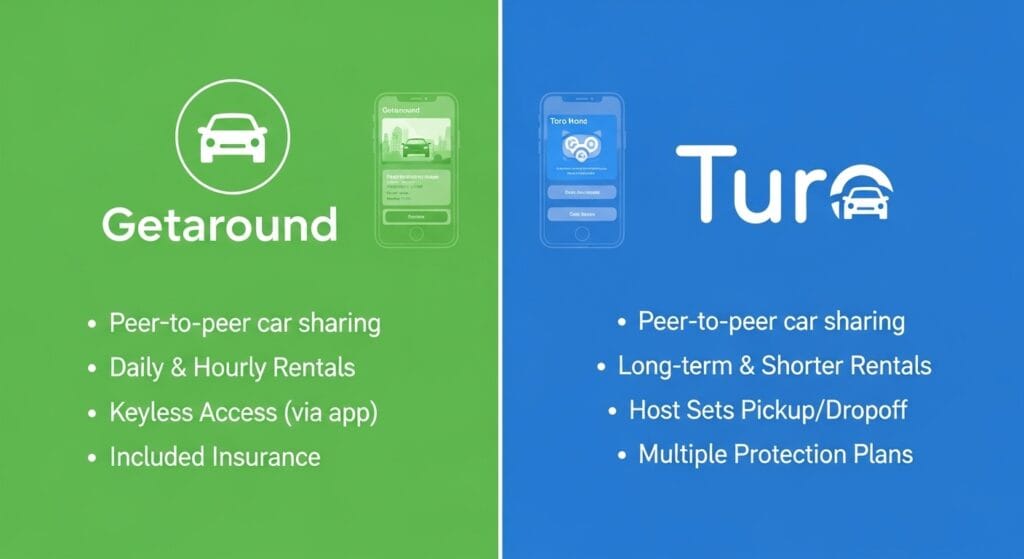
Understanding the core distinction between Turo and Getaround requires examining their structural approaches to monetization. Turo operates on what industry analysts term the “Airbnb model”—hosts actively manage longer-duration rentals averaging three to five days, primarily serving travelers, vacationers, and consumers test-driving vehicles before purchase. The platform’s 2026 introduction of risk-based pricing algorithms has further refined this model, rewarding hosts who attract advance bookings (four or more days prior) with higher revenue percentages while imposing elevated commission structures on last-minute, statistically riskier reservations.
Getaround, conversely, pioneered the “utility model” for urban car sharing—short-term, high-frequency rentals averaging under 24 hours. European renters utilize the platform for errands, furniture transport from retailers like IKEA, and supplemental urban commuting. The platform’s Connect technology has become the absolute standard across European markets in 2026, creating operational homogenization that favors practical urban vehicles such as the Renault Clio and Peugeot 208 over premium assets.
Hardware Infrastructure and Operational Labor Requirements
The operational divergence between platforms becomes immediately apparent in their hardware mandates. Turo requires zero proprietary technology installation. Hosts manage vehicle access through manual key exchanges, personal lockbox systems (frequently mounted to windows or door handles), or direct handoffs at agreed-upon locations. This hardware-free approach eliminates upfront capital expenditure but creates substantial labor obligations.
Turo’s 2026 standards have become exceptionally stringent regarding pre-trip documentation. The platform now mandates hosts upload a minimum of 50 clear photographs before each rental period, documenting every exterior panel, interior surface, and potential damage point. Failure to meet this photographic threshold results in automatic damage claim denials, regardless of actual renter responsibility. Additionally, hosts must clean, inspect, and photograph vehicles between every trip—a time investment that scales linearly with booking frequency.
Getaround’s mandatory Connect device represents the inverse approach. European hosts must install this proprietary hardware, incurring approximately €100-200 in one-time installation fees plus ongoing subscription costs of roughly €25 monthly per vehicle. This technology enables complete smartphone-based remote unlocking, eliminating host presence requirements entirely. Renters access vehicles through the mobile application, unlock doors, retrieve keys from the glove compartment, and return the vehicle without human interaction.
This automation creates genuinely passive income potential—a single vehicle can complete three to four sequential weekend rentals without host involvement. However, the absence of between-trip inspections introduces maintenance challenges. Vehicles accumulate interior debris, cleanliness deteriorates faster, and minor damage often goes undetected across multiple rental cycles, complicating attribution when issues eventually surface.
Earnings Architecture and Revenue Distribution
Turo’s compensation structure operates on a sliding scale correlated with insurance protection levels. Hosts selecting the 90 Plan retain 90 percent of listed daily rates but accept $2,500-plus deductibles on damage claims—a high-risk, high-reward proposition suitable for experienced operators with emergency capital reserves. The balanced 80/85 Plan offers 80-85 percent revenue retention with $1,500 deductibles, while conservative hosts choosing the 60/75 Plan sacrifice earnings for $250 deductible protection, keeping just 60-75 percent of proceeds.
The platform’s advantages include significantly elevated daily rate potential. Hosts charging premium prices for desirable vehicles (Tesla Model 3s, large SUVs, luxury sedans) can generate substantial gross revenue. Additional monetization opportunities include delivery fees—airport drop-offs can command $50-100 surcharges that substantially boost effective daily rates for hosts willing to provide concierge-level service.
However, Turo income remains fundamentally active rather than passive. Revenue generation ceases when hosts stop performing labor. The cleaning, photography, and coordination requirements between each booking create an income ceiling determined by available personal time rather than market demand alone.
Getaround’s European earnings model presents different mathematics. After platform fees and mandatory subscription costs, hosts generally retain 50-60 percent of gross revenue—notably lower than Turo’s most generous tiers. The monthly subscription fee creates what financial analysts term a “profitability floor”: hosts begin each month €25 in arrears, requiring sufficient bookings merely to achieve breakeven before generating actual profit.
Despite lower per-trip margins, Getaround’s volume-based model can produce competitive total earnings. The automated access system enables simultaneous booking density impossible under manual coordination. A strategically located urban economy car might complete a Friday evening grocery run, Saturday morning IKEA trip, and Sunday afternoon excursion without host intervention—three separate revenue events within 48 hours.
Insurance Structures and Host Risk Exposure
Turo’s tiered protection plans create direct correlations between earnings retention and financial exposure. The 90 Plan’s $2,500-plus deductible means hosts bear substantial risk on any incident—a single significant claim can eliminate months of accumulated profit. The platform’s 2026 enforcement of “wear and tear” exclusions has intensified this risk. Minor damage under three inches in dimension receives coverage denial unless hosts subscribe to the most comprehensive (and least profitable) protection tier.
This policy shift reflects Turo’s strategic repositioning toward “travel planners”—tourists and vacation renters who statistically generate fewer claims than local, utilitarian users. While this improves overall fleet safety, it potentially reduces booking frequency during off-peak travel seasons, creating revenue volatility for hosts in markets with pronounced seasonal tourism patterns.
Getaround’s European insurance integration embeds coverage within platform fees, simplifying the host decision matrix but introducing different risk vectors. Major accident coverage protects hosts from catastrophic financial exposure, but the platform’s primary risk concerns minor wear and tear accumulation. The absence of between-trip inspections makes damage attribution nearly impossible when issues eventually surface.
If a scratch appears after five sequential renters, determining responsibility becomes speculative. Hosts frequently discover claim denials based on insufficient evidence, as the automated system provides no documentation trail identifying which specific renter caused which specific damage. This risk particularly affects hosts operating higher-value vehicles where cosmetic repairs carry substantial costs.

Strategic Fleet Optimization by Platform
Turo’s economics favor premium asset deployment. Vehicles commanding daily rates of $75-150-plus justify the substantial labor investment in cleaning, coordination, and documentation. A Tesla Model 3 renting at $120 daily generates sufficient gross revenue that even after Turo’s commissions and time investment, net hourly returns remain attractive. Conversely, economy vehicles renting at $35-50 daily produce gross revenue insufficient to compensate for identical labor requirements, creating negative effective hourly wages after expense allocation.
Getaround’s volume model inverts this calculus. Economy vehicles with modest daily rates ($25-40) generate acceptable returns when booking density reaches three to four trips weekly. A Renault Clio earning €30 per trip completing 15 monthly rentals produces €450 in gross revenue. After the €25 subscription and platform’s 40-50 percent fee retention, net proceeds approximate €200-250 monthly—modest per-vehicle returns that scale efficiently across multi-vehicle fleets requiring minimal incremental labor.
Geographic Considerations and Market Availability
The February 2025 Getaround market exit created a binary geographic decision framework. U.S.-based hosts have no choice—Turo operates as the sole dominant peer-to-peer platform, making the comparison academic. American hosts must optimize within Turo’s ecosystem or exit car sharing entirely.
European hosts retain genuine platform optionality. Urban markets with dense populations, limited personal vehicle ownership, and robust public transportation create ideal Getaround environments. Cities like Paris, Barcelona, and Amsterdam feature sufficient demand density that economy vehicles achieve the high-frequency booking patterns necessary for profitability. Conversely, suburban or tourist-dependent European markets may favor Turo’s longer-duration, higher-margin model despite operational labor requirements.
Tax Implications and Expense Treatment
Both platforms generate self-employment income requiring tax reporting, but expense deductibility differs meaningfully. Turo hosts can deduct vehicle depreciation, insurance, maintenance, cleaning supplies, and mileage driven for coordination activities. The active labor component potentially enables hosts to classify earnings as active business income rather than passive rental income, affecting tax treatment in certain jurisdictions.
Getaround’s subscription fees, Connect device costs, and proportional vehicle expenses receive similar deductibility, but the passive nature may trigger different tax classifications depending on host involvement levels and regional regulations. European hosts should consult tax professionals regarding VAT obligations and expense categorization under local frameworks.
Conclusion: Profit vs. Passivity
The Turo versus Getaround decision ultimately reflects personal priority hierarchies rather than universal financial superiority. Turo maximizes absolute profit potential for hosts willing to treat car sharing as an active business venture. Premium vehicles, strategic pricing, delivery service monetization, and operational excellence can generate substantial monthly returns—but only proportional to invested labor hours.
Getaround delivers maximum passivity for European hosts prioritizing hands-off income generation. The automated infrastructure enables genuine “earn while you sleep” scenarios, though monthly subscription overhead and lower revenue retention reduce per-vehicle profitability. Multi-vehicle operators can scale efficiently, but single-vehicle hosts must achieve consistent booking density to surpass breakeven thresholds.
For American hosts, the question is moot—Turo represents the only viable peer-to-peer option. For European hosts, the optimal choice depends on available time, fleet composition, and personal tolerance for active management versus automated operations with compressed margins. Neither platform universally dominates; selection requires honest assessment of individual circumstances and priorities.
“If you are looking for gig economy jobs, check out our guides on [Amazon Flex vs DoorDash] and [Lyft Driver Salary].”