Pharmacy Technician Salary 2026: $17-$32/hr Real Pay Data
Pharmacy Technician Salary
The pharmacy technician field is undergoing a dramatic transformation in 2026. Burnout, mass departures from retail chains, and a growing demand for specialized clinical skills have fractured the job market into two very different tracks—one that will leave you underpaid and overworked, and one that quietly offers a livable, stable career with room to grow. This guide uses the most current compensation data available to show you exactly where you stand, what you can realistically earn, and how to make strategic moves that put more money in your pocket.
Quick Pharmacy Tech Salary Summary (2026 Update)
At a glance — national figures for 2026:
Retail Entry-Level: $16.50 – $19.00/hr | ~$34,300 – $39,500/yr Retail Lead/Senior: $22.00 – $28.00/hr | ~$45,700 – $58,200/yr Hospital (Inpatient): $24.00 – $32.00/hr | ~$49,900 – $66,500/yr Specialized (Chemo/IV): $28.00 – $38.00/hr | ~$58,000 – $79,000/yr
CPhT Certification Premium: +$3.00 – $5.00/hr over uncertified Top-Paying State: California — up to $40+/hr for unionized hospital techs
Tech Paycheck Calculator
Paycheck Calculator
Calculate your Weekly, Monthly & Yearly Take-Home Pay
⚠️ These are estimates for a single filer using 2026 tax rates (IRS Rev. Proc. 2025-32). Results do not include local taxes, pre-tax deductions (401k, health insurance), or tax credits. Consult a tax professional for personalized advice.
The Retail Reality: What CVS and Walgreens Actually Pay
Let’s start with the environment most new pharmacy technicians enter: the chain retail pharmacy. CVS, Walgreens, and major grocery store pharmacies are the default on-ramp into this career, and for good reason—they hire trainees with minimal experience, fund your certification training, and provide broad exposure to the day-to-day mechanics of prescription dispensing.
However, the compensation picture at retail requires honest scrutiny. Entry-level retail techs currently earn between $16.50 and $19.00 per hour nationally. In states with lower minimum wages—Alabama, Mississippi, West Virginia, Arkansas, and Kentucky—that floor barely clears $16.00 per hour. You are, in many markets, earning roughly what a warehouse associate or fast food shift supervisor earns, but with the added weight of medication accuracy, HIPAA compliance, and the potential consequences of a dispensing error.
The stress factor compounds the pay problem. Retail pharmacy techs in 2026 operate under intense corporate productivity metrics: phones answered within a certain number of rings, drive-through wait times, vaccination quotas, and prescription volume benchmarks. You are the first human face an upset patient sees when their insurance denies a claim or their medication is out of stock. Turnover in retail pharmacy remains high precisely because of this mismatch between compensation and daily demands.
That said, retail has a legitimate use in a smart career strategy. Senior and Lead Technician roles at major chains now pay between $22.00 and $28.00 per hour—a notable ceiling increase driven by the current “retail exodus,” where experienced techs are leaving for hospitals faster than chains can replace them. Walmart and CVS in particular have raised wage caps in high-cost markets as a retention tool. If you are willing to absorb the stress and manage upward into a lead role, retail can temporarily close the gap with hospital pay. For most people, though, it remains a starting point—not a destination.
Why Hospital Techs Earn 25% More
The single most financially impactful career decision a pharmacy technician can make is transitioning from retail to an inpatient hospital setting. Hospital pharmacy techs earn between $24.00 and $32.00 per hour at the standard inpatient level—a floor that already beats the retail ceiling in most markets. The question most techs ask is: why? What justifies that premium?
The answer comes down to scope of duty and work environment. Hospital pharmacy techs are not managing frustrated customers and drive-through windows. They are preparing sterile intravenous medications in controlled clean room environments, loading and maintaining automated dispensing machines (Pyxis units) on nursing floors, supporting emergency department pharmacies that operate around the clock, and performing unit-dose packaging for patients whose medications must be exact to the milligram. The technical demands are genuinely higher, the consequences of errors are more severe, and the training required—particularly for sterile compounding—is more rigorous.
PTCB certification statistics consistently show that CPhTs working in hospital settings have higher job retention rates and greater schedule stability than their retail counterparts. Hospitals also typically offer structured shift schedules, meaning when your 8- or 12-hour shift ends, it ends—there are no “can you stay late for the drive-through rush” conversations. Benefits packages at hospital systems, including health insurance, retirement contributions, and tuition assistance for further education, frequently exceed what retail chains offer at comparable seniority levels.
The transition from retail to hospital does require the CPhT credential in most cases—virtually all hospital systems require it as a baseline employment condition. But once you have that certification and 12 to 18 months of retail experience demonstrating your ability to handle prescription volume and maintain accuracy, you are a competitive applicant for hospital positions. The $4 to $8 per hour raise you receive upon making that transition is not a reward for seniority—it is compensation for a meaningfully more technical role.
The Clean Room Premium: Specialized Roles
Beyond standard inpatient hospital work, a tier of specialized pharmacy technician roles exists that most people entering the field don’t know about—and these positions represent the highest earning potential available without a pharmacist’s license.
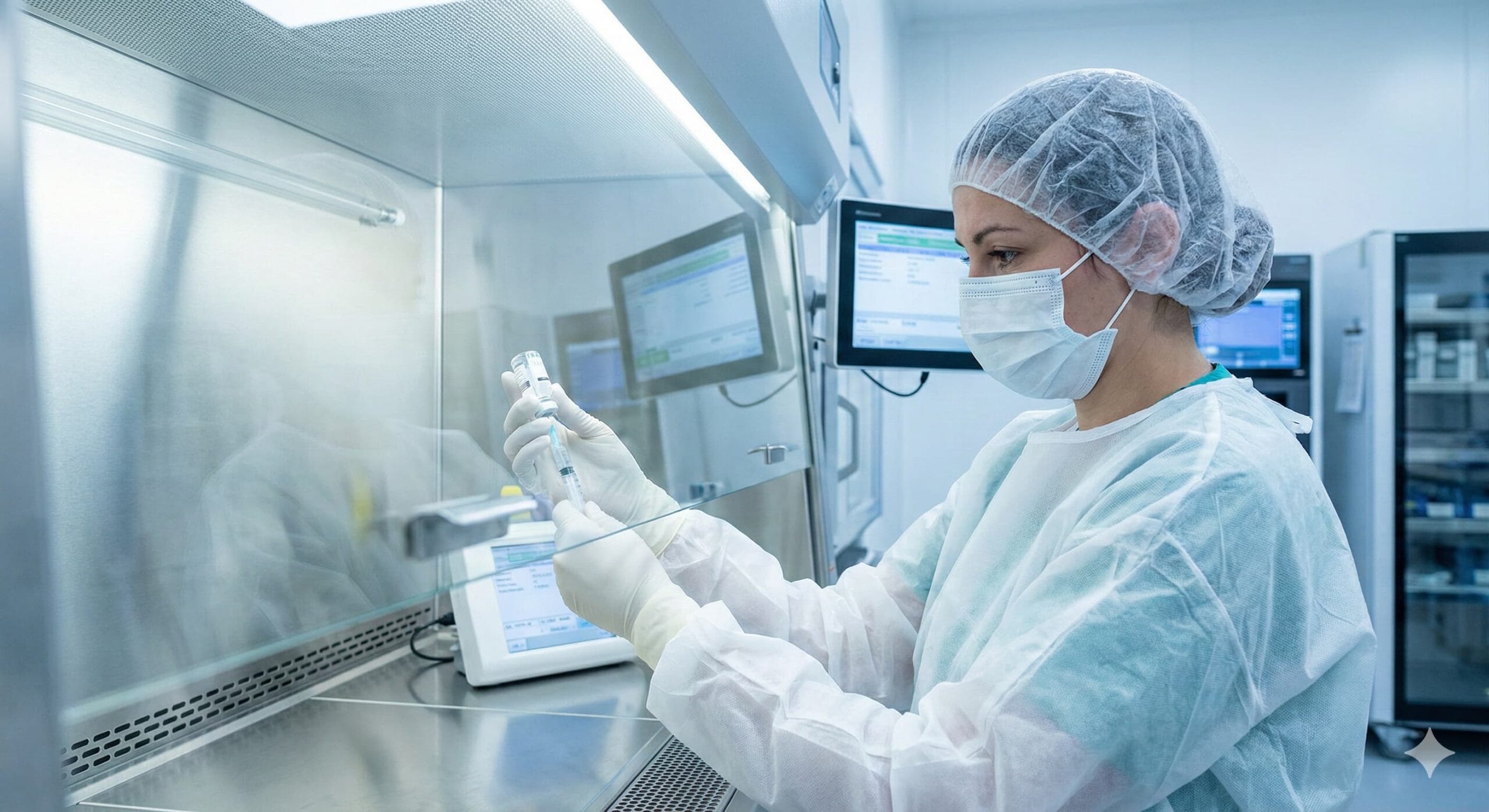
Sterile Compounding Technicians prepare intravenous medications in ISO-classified clean rooms, wearing full gowning (often called “bunny suits”) to maintain sterility. They work under laminar airflow hoods, aseptically mixing antibiotics, chemotherapy agents, total parenteral nutrition, and other IV preparations. Pay ranges from $26 to $34 per hour, and the skill set is genuinely specialized—training takes months to acquire and is not easily replaced.
Chemotherapy Pharmacy Technicians handle hazardous oncology drugs under negative-pressure hoods with enhanced PPE protocols. The additional risk and precision demands push compensation to $30 to $40 per hour. Required hazardous drug handling certification and compliance with USP 800 standards make these roles available only to techs who have specifically pursued this training.
Nuclear Pharmacy Technicians occupy the highest-paying tier, earning $32 to $42 per hour. They prepare radioactive compounds used in PET and CT imaging diagnostics—a role that comes with strict radiation safety protocols and an unusual caveat: shifts often begin at 2:00 AM, because radiopharmaceuticals have short half-lives and must be prepared and delivered for morning imaging runs. The combination of unusual hours and highly specialized skills creates a compensation premium that few other technician roles can match.
If you are early in your career and willing to invest in specialized training, these clean room and nuclear roles offer the clearest path to pharmacy tech salaries that approach or exceed $75,000 to $80,000 annually.
Salary by State: Top Paying Locations
Geography has a substantial effect on pharmacy technician wages. The following states consistently offer the strongest compensation, driven by a combination of high minimum wage floors, unionized healthcare workforces, and elevated cost of living adjustments.
| Rank | State | Avg. Hourly Rate | Key Driver |
|---|---|---|---|
| 1 | California (CA) | $26.00 – $35.00 | High state minimum wage; unionized hospital techs in SF/LA earn $40+/hr |
| 2 | Washington (WA) | $25.00 – $32.00 | Strong tech-sector economy; high hospital demand in Seattle systems |
| 3 | Alaska (AK) | $24.00 – $30.00 | Remote location premium to attract and retain certified staff |
| 4 | Oregon (OR) | $23.50 – $29.00 | Competitive with WA; broad scope of practice for certified techs |
| 5 | District of Columbia | $23.00 – $28.00 | High density of federal, research, and academic medical center hospitals |
At the other end of the spectrum, techs in Alabama, Mississippi, West Virginia, Arkansas, and Kentucky are looking at floors as low as $15.50 to $16.50 per hour, with ceilings rarely exceeding $20.00 in retail settings. If you live in a lower-wage state, the hospital transition becomes even more financially critical—the premium over retail is proportionally significant regardless of regional base wages.
Certification: The $129 Investment That Changes Everything
The CPhT credential offered through the Pharmacy Technician Certification Board (PTCB) is, at this point, no longer optional for anyone who wants a meaningful career in this field. It is the gating mechanism that separates the entry-level trainee track from every higher-paying option that exists.
Uncertified pharmacy technicians—working as trainees or assistants—earn between $16.00 and $18.50 per hour nationally. Their duties are limited to cashiering, typing prescription labels, and counting non-controlled medications. Certified CPhTs earn between $21.00 and $26.00 per hour in retail settings and considerably more in hospital environments. The certification opens access to taking physician calls, performing compounding duties, and in some states, conducting final verification checks.
The exam costs approximately $129. At the pay differential described above—roughly $3 to $5 more per hour—that cost is recovered within the first week of working at the higher wage. The ROI is not a slow investment; it is immediate. Furthermore, PTCB certification data shows CPhTs face meaningfully lower layoff risk during healthcare system contractions, partly because replacing a certified tech requires time and investment that hospitals prefer to avoid.
The smart approach: if you are hired as a trainee at a retail chain, most major chains will cover your exam cost after six months of employment. Let them fund your credential, then use that credential to access the hospital market. You exit retail with zero out-of-pocket certification expense and a substantially improved employment profile.

Frequently Asked Questions
Is the PTCB certification exam hard?
The PTCB exam is moderately challenging but very passable with focused preparation. It covers four core domains: medications (roughly 38% of exam content), federal pharmacy law and regulations, patient safety and quality assurance, and order entry and processing. The math component—covering dosage calculations, unit conversions, and IV flow rates—trips up the most unprepared candidates. Most test-takers who use a structured study guide and practice exams for four to six weeks report passing on the first attempt. The exam consists of 90 questions with a two-hour time limit. It is not designed to be a barrier to entry; it is designed to verify competence.
CVS vs Walgreens pay: is there a meaningful difference?
In practice, CVS and Walgreens pay within a very narrow band of each other at the entry and mid levels—roughly $17.00 to $19.50 per hour for standard retail techs in most markets. Where differences emerge is at the senior and lead technician tier, where individual store performance, local competition for staff, and regional cost of living adjustments create variability. Walgreens has in recent years been more aggressive with signing bonuses in high-turnover markets, while CVS has leaned toward retention bonuses tied to service anniversaries. Neither chain offers a structurally superior compensation system—your negotiating leverage at either one depends almost entirely on local market conditions and whether you hold the CPhT credential.
Can pharmacy technicians work from home?
Yes, and this is one of the more significant developments in the field over the past several years. Remote pharmacy technician roles exist primarily in two areas: prior authorization and insurance processing, and centralized prescription verification for mail-order pharmacy operations. Prior authorization techs work with insurance companies and physician offices to secure coverage approvals for medications—entirely phone and computer-based work that requires strong knowledge of pharmacy benefit structures and insurance adjudication. These roles typically pay between $18.00 and $24.00 per hour and are increasingly offered as fully remote positions. They will not make you rich, but for techs who cannot manage the physical demands of a retail or hospital floor, or who need schedule flexibility, they represent a legitimate and growing segment of the market.
Your Strategic Roadmap
The pharmacy technician career is not a passive one—your earnings are directly tied to the decisions you make about certification, setting, and specialization. The roadmap is clearer than in most healthcare support roles: start with employer-funded retail training, obtain your CPhT as quickly as possible, move to a hospital inpatient position, and evaluate whether specialized compounding training is a path you want to pursue. Each of those steps corresponds to a meaningful, documented pay increase. None of them require additional degrees. All of them are achievable within two to three years of entering the field.
The retail-to-hospital transition alone—the single most impactful move available—adds $8,000 to $15,000 to your annual income while simultaneously reducing your daily stress load. That is an unusual combination in any industry. The data in this guide makes the path clear. What you do with it is up to you.
Data Methodology
Salary figures in this guide are drawn from the 2026 Pharmacy Careers Analysis research brief, cross-referenced with the accompanying compensation dataset covering national and state-level pharmacy technician wages. Data reflects national median hourly rates segmented by practice setting (retail entry-level, retail lead/senior, hospital inpatient, and specialized clean room roles).
State-level figures reflect averages across employer types within each state and account for regional cost-of-living and unionization factors where applicable. Certification premium data is based on differential analysis between CPhT-credentialed and non-credentialed technician compensation across comparable roles. All figures represent 2026 projections and should be treated as directional ranges rather than guaranteed offers. Individual compensation will vary based on employer, geographic market, years of experience, and specialized training credentials held.
“If you are looking for Medical & Nursing jobs, check out our guides on [Physical Therapist ] and [Radiologic Technologist ].”