USPS PSE Clerk Salary 2026: $21.44/hr + OT Guide
USPS PSE Clerk Salary
If you’re researching a USPS Postal Support Employee (PSE) Clerk position in 2026, you’ve landed in the right place. The pay is legitimate, union-negotiated, and rising year over year—but the schedule is a different story. PSE clerks are the operational foundation of the U.S. Postal Service, covering everything from retail window sales to industrial parcel sorting, and the job can look dramatically different depending on which facility you’re assigned to. This guide cuts through the recruiting language and gives you the real numbers, the real schedule, and everything you need to decide whether this position works for your life.
Quick PSE Clerk Salary Summary (2026 Update)
Base hourly rate: $21.44–$22.00/hr (Level 6, APWU 2024–2027 National Agreement). Night differential: +$1.16/hr for all hours between 6:00 PM–6:00 AM. Overtime rate: ~$32.17/hr after 40 hours per week. Penalty overtime: ~$42.90/hr after 56 hours per week (excluding December). Annual estimate: $44,600–$48,000 for full-time hours. 2026 raise scheduled for November: approximately $21.97/hr (+2.5%). No split shift premium exists—unpaid schedule gaps are common in smaller offices.
Clerk Paycheck Calculator
Paycheck Calculator
Calculate your Weekly, Monthly & Yearly Take-Home Pay
⚠️ These are estimates for a single filer using 2026 tax rates (IRS Rev. Proc. 2025-32). Results do not include local taxes, pre-tax deductions (401k, health insurance), or tax credits. Consult a tax professional for personalized advice.
The 2026 PSE Pay Scale: Every Rate You Need to Know
The PSE Level 6 base rate of $21.44–$22.00 per hour became effective under the APWU 2024–2027 National Agreement and covers the vast majority of clerks hired into both Window (Function 4) and Mail Processing (Function 1) roles. APWU contract analysis shows that PSEs receive slightly higher general wage increases than career employees—approximately 2.3–2.5% annually—specifically because PSEs do not qualify for COLA (Cost of Living Adjustments). This tradeoff is built into the contract to partially offset the benefits gap between PSE and career status.
Here’s the full breakdown of what you can earn in 2026:
| Pay Type | Rate | Trigger |
|---|---|---|
| Base Rate (Level 6) | $21.44–$22.00/hr | Standard shift hours |
| Night Differential | +$1.16/hr | Hours worked 6:00 PM–6:00 AM |
| Overtime (1.5x) | ~$32.17/hr | After 8 hrs/day or 40 hrs/week |
| Penalty Overtime (2.0x) | ~$42.90/hr | After 10 hrs/day or 56 hrs/week* |
| November 2026 Raise | ~$21.97/hr | 2.5% scheduled increase |
*Penalty overtime is excluded during December peak season—USPS operationally suspends this threshold to manage holiday volume.
The annual math: A PSE working full-time straight days (no overtime, no night differential) earns approximately $44,600–$45,760 per year. Factor in even moderate overtime during peak season (October–mid-December), and gross annual pay can climb to $50,000–$52,000. Night shift at a Distribution Center with regular differential pay brings the effective hourly rate to $22.54–$22.60, adding roughly $2,000–$2,400 per year over the base rate.
The Hidden Downside: Understanding Split Shifts
This is the section most job postings skip entirely—and the number one reason PSE turnover is high in smaller offices. Understanding split shift pay before you accept an offer is not optional. It is essential.
What a split shift actually looks like:
- Shift A (Distribution): 4:00 AM – 8:00 AM. You sort incoming mail from the overnight truck and stage routes for carriers.
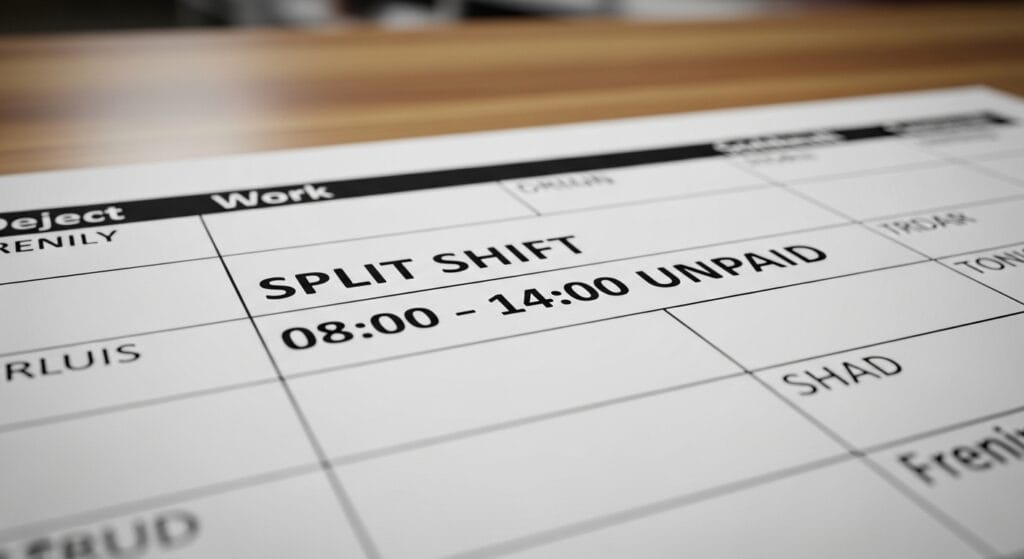
- The Gap: 8:00 AM – 2:00 PM. You are off the clock. This time is completely unpaid.
- Shift B (Dispatch/Window): 2:00 PM – 6:00 PM. You serve customers at the retail window and load outgoing mail onto the afternoon truck.
On paper, you work 8 hours and earn $21.44/hr. In practice, you have committed the equivalent of a 14-hour day—from 4:00 AM to 6:00 PM—with a 6-hour unpaid gap in the middle.
Why this hits harder than it sounds: If you live 30–45 minutes from your assigned Post Office, the commute math turns punishing. You drive in at 4:00 AM, drive home (or sit in your car) for 6 hours, then drive back and work another 4 hours. Three round-trips in one day is not uncommon. Clerks who have worked split shifts in Level 18 or Level 20 (small-town) offices frequently report sleeping in their vehicles during the unpaid gap rather than burning gas driving home.
The pay rule is unambiguous: There is no “split shift premium” in the APWU contract. You are paid straight time ($21.44/hr) for hours worked. The unpaid gap is not compensated, not subsidized, and not negotiable at the individual level.
The one contractual protection you do have: If you are scheduled to return for Shift B, you are guaranteed a minimum of 2 hours of work or pay upon arrival. If your supervisor sends you home 45 minutes into your evening shift, they still owe you 2 hours of pay. This is codified under Article 8 of the APWU National Agreement.
Who avoids split shifts entirely: PSEs assigned to large Processing & Distribution Centers (P&DCs) almost never face split shifts. Plant facilities run continuous operations—straight 8–10 hour shifts like 7:00 PM–3:30 AM are standard. If split shifts are a dealbreaker for your situation, specifically asking during the interview whether the position is “Function 1 (Plant)” or “Function 4 (Station/Window)” will tell you everything you need to know before you sign.
Window Clerk vs. Mail Processing: Two Jobs Under One Title
The PSE Clerk title is deceptively broad. “Accepting postal clerk jobs” without knowing whether you’re working retail or an industrial floor is one of the most common new-hire mistakes. These are fundamentally different roles.
Mail Processing Clerk (Function 1 — The Plant): This is a pure industrial job. You’ll be stationed at DBCS (Delivery Barcode Sorter) machines feeding letter trays, or performing “the throw”—manually sorting parcels weighing up to 70 lbs into labeled hampers. There is zero customer contact. The environment is a warehouse floor with concrete, machinery noise (earplugs required), and variable temperature depending on the season. APWU data analysis shows Function 1 clerks have higher injury-related leave usage, largely due to the repetitive motion demands of sorting operations during peak season. Hours skew heavily toward overnight and early morning: 2:00 AM – 9:00 AM shifts are standard. Hiring for this path goes through Virtual Entry Assessment MC (476).
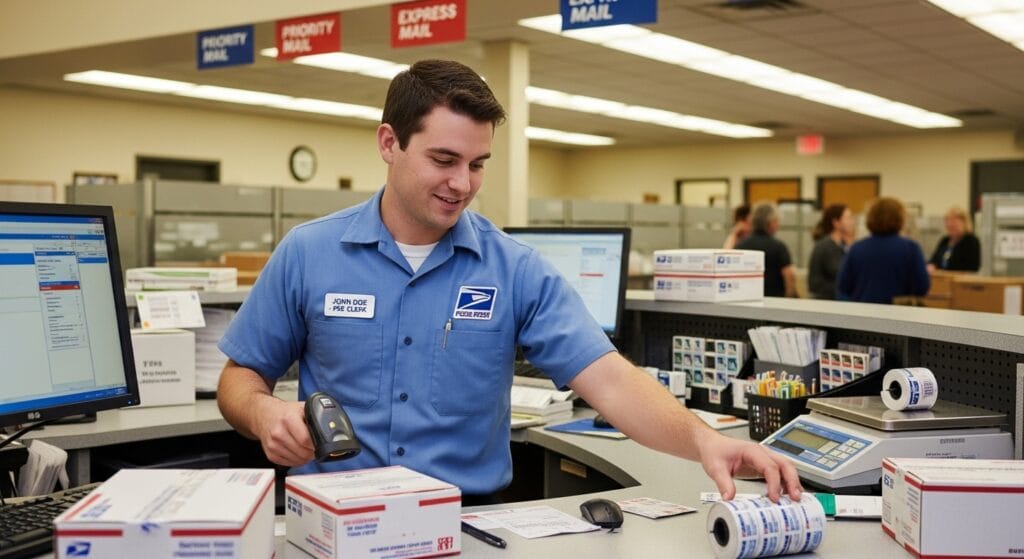
Window Clerk / Sales & Service Distribution Associate (Function 4 — The Station): This is a retail customer service job inside a Post Office branch. Your daily duties include weighing and pricing packages, selling stamps and Money Orders, processing Certified and Priority mail, and accepting Passport applications (you’ll verify identity documents and handle passport photo submissions). The environment is public-facing and conversational. Hiring for this path goes through Virtual Entry Assessment CS (477).
The Window-Specific Financial Risk: Cash Accountability
Window clerks are personally and financially responsible for their cash drawer. This is called being “under the safe.” At the end of every shift, your drawer is counted. If it comes up $50 short, you owe the USPS $50—directly, from your own pocket. Errors in postage calculations, incorrect change, or unrecorded transactions all come out of the individual clerk’s accountability.
This is a significant stress factor that does not exist in Mail Processing. Clerks with retail cash management experience adapt quickly. Those who have never operated a cash drawer in a high-transaction environment should budget time during training to get comfortable with the postage pricing system before errors start accumulating.
Salary by State: High Demand Offices
PSE base pay is uniform nationally—the APWU contract sets one rate regardless of location. However, entry-level PSE availability, conversion timelines, and effective earnings (through overtime access and night differential) vary significantly by state and facility type.
| State | Key Driver | Night Diff Relevance | Overtime Access | Conversion Speed |
|---|---|---|---|---|
| California | High-volume P&DCs (LA, Bay Area) | High — large plant workforce | Excellent during peak | Moderate (large PSE pool) |
| Texas | Rapid postal growth, Dallas/Houston | Moderate | High year-round | Faster than avg. |
| New York | NYC metro density, JFK mail volume | Very High | Consistent | Slower — competitive |
| Florida | Seasonal parcel surge, retirement communities | Moderate | Strong Oct–Jan | Moderate |
| Illinois | Chicago distribution hub | High | Strong — hub OT | Moderate |
Note: All figures reflect base APWU Level 6 rates. State-level variation in take-home pay is driven primarily by overtime availability and facility-level staffing shortages, not geographic pay differentials.
The Window Exam: What “Passing” Actually Means for Your Job
The path to working the retail window has a gate—and failing to clear it costs you the position entirely.
After being hired, prospective Window Clerks are sent to a 5–7 day classroom course called Window Academy. The curriculum covers USPS retail regulations, all mail classes (Priority Mail, Ground Advantage, First Class, Media Mail), international customs forms, HAZMAT shipping restrictions, Money Order processing, and Passport application procedures.
The final assessment is Exam 421—a comprehensive, closed-book test. It is not a multiple-choice trivia quiz. It requires applied knowledge: calculating postage under specific scenarios, identifying prohibited HAZMAT items, and applying international shipping rules correctly.
The employment consequence: Most Window Clerk positions are offered conditionally. If you fail Exam 421 at the conclusion of Window Academy, employment is typically terminated immediately. There is no standard retake policy at the national level—your postmaster’s discretion and local office policy govern whether any remediation is offered. The practical reality is that this exam should be treated as a licensing test, not an orientation quiz.
A critical distinction worth memorizing: Exam 477 gets you hired. Exam 421 keeps you employed. These serve completely different purposes, and treating the Window Academy as a formality after being hired is the mistake that ends positions before they start.
The Conversion Clock: Your Path to Career Status
PSE status is not the destination—it’s the entry point. Every PSE’s goal is conversion to Career Status, which unlocks the federal pension, TSP (the federal 401k equivalent), step pay increases, Sunday Premium pay, and Sick Leave accrual.
The 24-month rule: Under the APWU National Agreement extended through 2026, PSEs in Level 20 and higher offices are automatically converted to Career Part-Time Flexible (PTF) status after accumulating 24 months of relative standing (time in PSE status with the USPS). You do not need to apply or compete for a vacancy—conversion is contractual and automatic upon hitting the threshold.
Early conversion: If a career Regular Clerk retires, is promoted, or otherwise vacates a bid position, and you are the senior PSE in that office, you can convert significantly before the 24-month mark. Seniority is tracked from your first day in PSE status. Tracking retirements and vacancy announcements in your facility is part of playing the long game in this position effectively.
Benefits: Honest Assessment for Non-Career Employees
PSEs receive a limited benefits package, and knowing exactly what you have prevents gaps in coverage planning.
Health insurance: You are eligible for the USPS Non-Career Health Plan, with USPS covering approximately 75% of the premium. This is a meaningful benefit—access to federal health coverage is unusual for non-career government employees. After conversion to career status, you gain access to the full Federal Employee Health Benefits (FEHB) marketplace.
Annual leave: PSEs earn 1 hour of Annual Leave for every 20 hours worked. Critically, PSEs do not earn Sick Leave. Any sick day taken is unpaid unless covered by Annual Leave.
Paid holidays: Six federal holidays are paid: New Year’s Day, Memorial Day, Independence Day, Labor Day, Thanksgiving, and Christmas. Career employees receive more holidays with additional premium pay—this is one of the tangible financial differences conversion resolves.
Frequently Asked Questions
What is the Window Exam?
There are actually two distinct exams. Exam 477 (Virtual Entry Assessment CS) is the pre-hire test that determines whether you receive a job offer for a Window position. Exam 421 is the post-hire Window Academy exam that you must pass after completing 5–7 days of classroom training. Failing Exam 421 typically results in immediate termination. It covers USPS retail regulations, mail classification, HAZMAT rules, and international shipping requirements in a closed-book format.
Do I have to memorize zip codes?
No. ZIP code memorization is not part of the job or the exam requirements. Modern USPS sorting systems are barcode-driven and fully computerized. Mail Processing clerks work with machine-assisted sorting (the DBCS system handles routing automatically), while Window Clerks use the USPS postal software (POS) to calculate postage and routing. Knowing your local service area geography is useful context, but rote ZIP code memorization is not a performance requirement.
PSE Clerk vs MHA (Mail Handler Assistant): What’s the difference?
These are two different non-career job series within USPS, governed by different unions and covering different work. PSE Clerks fall under the APWU (American Postal Workers Union) and work in Post Office retail stations or Distribution Center sorting operations. MHAs (Mail Handler Assistants) fall under the NPMHU (National Postal Mail Handlers Union) and work exclusively in Processing & Distribution Centers performing mail handling, container management, and bulk mail processing. PSE positions typically offer more schedule variety (including retail window work), while MHA positions are more uniformly industrial. Base pay rates are comparable, but the conversion paths, contract terms, and benefits structures differ between the two unions.
Data Methodology
Pay rate data in this guide reflects the APWU 2024–2027 National Agreement rates as negotiated and effective for the 2026 calendar year, with the Level 6 base rate confirmed at $21.44–$22.00/hr following the November 2025 general wage increase. Night differential rates (+$1.16/hr) are sourced from Article 9 of the APWU National Agreement. Overtime thresholds and penalty overtime provisions are sourced from Article 8. Conversion timeline information reflects the automatic conversion provisions extended through 2026.
Exam requirements reflect current USPS training program documentation for Virtual Entry Assessments and Window Academy certification. State-level workforce data reflects general facility volume and staffing patterns drawn from USPS operational reporting. All annual salary estimates assume standard 40-hour work weeks without factoring in schedule gaps from split shifts. Individual results may vary based on office level, facility type, and seniority standing.
“If you are looking for Government & USPS jobs, check out our guides on [USPS Mail Handler] and [USPS Rural Carrier ].
APWU (American Postal Workers Union)