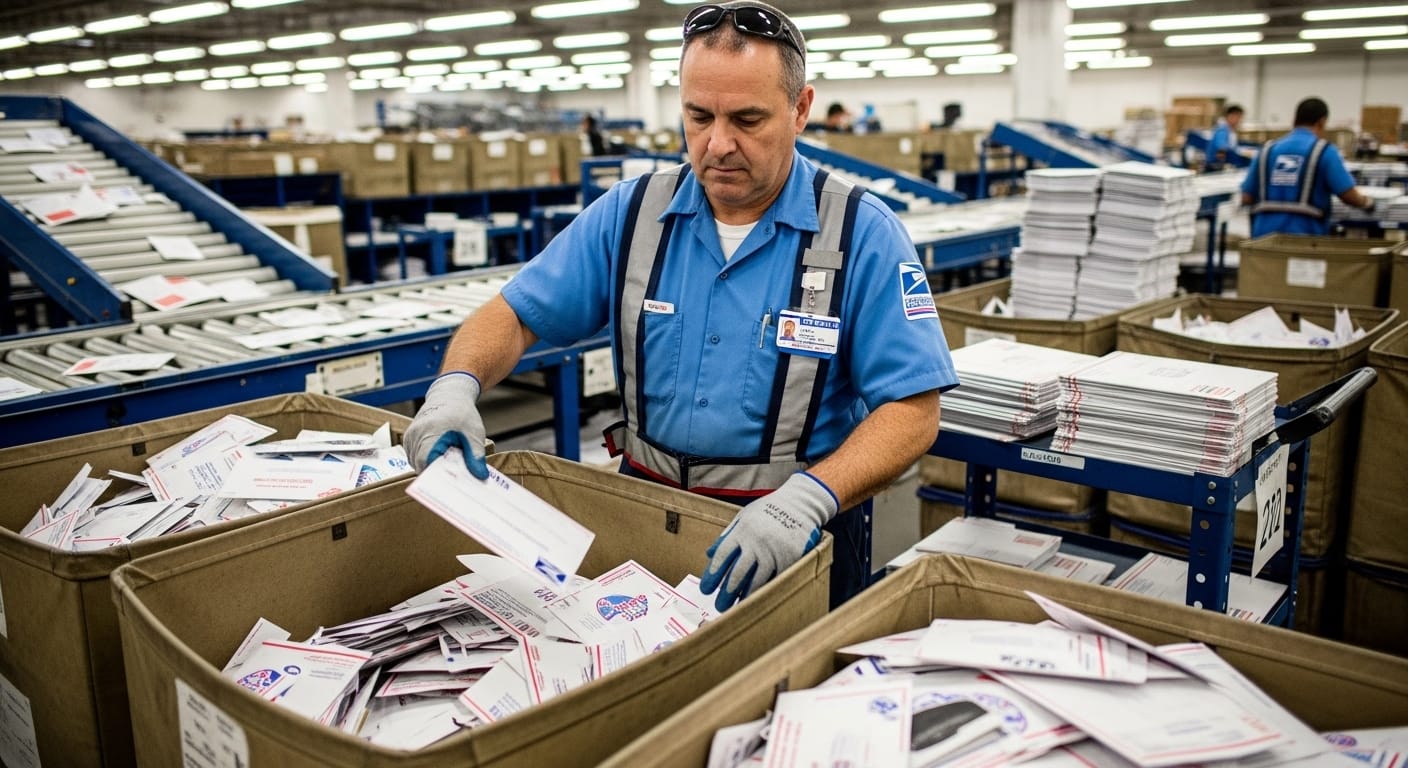
USPS Mail Handler Salary 2026: $20.52/Hr Night Pay
USPS Mail Handler Salary
If you’re researching the Mail Handler Assistant (MHA) position, you’ve already made a smart move. This isn’t a glamour job—it’s an industrial warehouse role inside a federal facility, and the pay structure is built around that reality. You’re not delivering mail in the rain. You’re moving it in massive Processing & Distribution Centers (P&DCs) that operate 24 hours a day, seven days a week, 365 days a year. That overnight schedule comes with a financial upside most warehouse workers at private companies never see: a federally negotiated night differential, locked-in automatic raises, and a 24-month runway to full career status with federal benefits.
This guide breaks down exactly what MHAs earn in 2026—base pay, night differential, overtime, and the hard truth about Sunday premium—and gives you the location-level context to know whether the rate in your city makes sense.
Quick Mail Handler Salary Summary (2026 Update)
According to the NPMHU wage charts under the 2022 National Agreement (with the November 2025 general wage increase applied), here’s where MHA pay stands:
- MHA Level 4 Base: $19.27/hr (Step A) → $20.27/hr (Step B after 6 months)
- MHA Level 5 Base: $20.25/hr (Step A) → $21.29/hr (Step B after 6 months)
- Night Differential: +$1.10 to +$1.25/hr (6 PM–6 AM, flat rate)
- Effective Night Rate: ~$20.37–$22.54/hr depending on level and step
- Overtime Rate: $28.91–$31.94/hr (1.5x base)
- Annual Estimate: $40,000–$48,000 for full-time MHA on overnight schedule
- Career Conversion at 24 months: ~$24.00–$26.00/hr entry rate + Sunday premium
Warehouse Pay Calculator (Night/Sunday)
Paycheck Calculator
Calculate your Weekly, Monthly & Yearly Take-Home Pay
⚠️ These are estimates for a single filer using 2026 tax rates (IRS Rev. Proc. 2025-32). Results do not include local taxes, pre-tax deductions (401k, health insurance), or tax credits. Consult a tax professional for personalized advice.
The MHA Pay Scale: Breaking Down Every Dollar
The MHA pay structure is simpler than most people expect, but understanding every component is how you accurately calculate your real take-home. There are two levels, two steps, and three major premium categories that layer on top of base pay.
Level 4 is the standard entry classification for MHAs performing physical mail handling—dumping, loading, unloading, and platform work. In 2026, Level 4 starts at $19.27 per hour at Step A. After 26 weeks of continuous service (roughly 6 months), every MHA automatically advances to Step B at $20.27 per hour. There is no evaluation, no manager sign-off, and no negotiation. It’s contractual, guaranteed, and built directly into the NPMHU agreement.
Level 5 applies to MHAs who are assigned to operate powered industrial equipment—tow motors (electric tugs), forklifts, and in some modern facilities, Automated Guided Vehicles (AGVs). Level 5 Step A starts at $20.25/hr, advancing to $21.29/hr at the 6-month mark. Not every MHA gets a Level 5 assignment; it depends on plant needs and whether you’re willing and certified to operate the equipment. But if the opportunity comes up, it’s worth taking.
The November 2025 general wage increase (approximately 1.3%) has already been factored into these figures. The NPMHU contract is multi-year, so these rates are stable through the current agreement period, with additional cost-of-living adjustments baked in for subsequent years.
Night Differential & Sunday Premium: The Real Money
This is where the MHA pay structure diverges most sharply from what you’d earn doing similar work at a private warehouse—and it’s the biggest financial argument for the postal service over UPS, FedEx, or Amazon fulfillment centers at a comparable base rate.
Night Shift Differential
The USPS night differential is a flat dollar amount added to every hour worked between 6:00 PM and 6:00 AM. Unlike private employers who often calculate night premium as a percentage of base (typically 10–15%), USPS negotiates a fixed rate through the NPMHU contract. For MHAs in 2026, that rate is approximately $1.10 to $1.25 per hour.
Why does this matter? Because most MHAs are hired specifically for Tour 1 (overnight, typically 11 PM–7:30 AM) or Tour 3 (evening, typically 4 PM–12:30 AM). Mail processing is a reverse-schedule industry—mail is collected during the day and processed at night so it can be distributed and delivered the next morning. That means the night shift isn’t a specialty assignment for senior employees. It’s the baseline reality for new hires.
If you’re a Level 4 MHA on Tour 1 working a full 8-hour overnight shift at Step A, your effective hourly rate isn’t $19.27—it’s $20.37 to $20.52. Over a 40-hour week, that differential adds roughly $44–$50 to your paycheck. Over a full year, you’re looking at an additional $2,300–$2,600 in gross earnings compared to a hypothetical day shift at the same base rate.
Plant workers confirm that during peak season (November through January), when mandatory overtime routinely runs shifts to 10–12 hours, the night differential compounds. A Level 5 MHA working 50 hours per week on Tour 1, including overtime at 1.5x base, can see weekly gross earnings exceeding $1,150.

Sunday Premium: The Non-Career Gap
Here’s the part of the MHA pay structure that catches people off guard. MHAs do not receive Sunday premium pay. Career Mail Handlers earn a 25% bonus on top of their base rate for every hour worked on Sunday. At a career rate of $25.00/hr, that’s $31.25/hr on Sundays—an extra $50 every Sunday shift. MHAs receive straight time on Sundays, with night differential applied only if the shift falls within the 6 PM–6 AM window.
This gap exists because MHAs are classified as the “flexible” workforce—the staffing layer that gives career employees access to their contractual day off. In practice, MHAs are almost guaranteed to work Sundays precisely because Sunday is the highest-volume mail day due to Amazon and Priority Mail parcels. The plant needs coverage, career handlers take the day off by seniority, and MHAs fill the schedule.
The strategic takeaway: your 24-month conversion to career status is not just a pay raise—it’s the moment Sunday premium unlocks. At that point, every Sunday shift (which you’re already working anyway) becomes 25% more valuable.
Salary by Location: Major Processing Plants
Pay rates for MHAs are set nationally by the NPMHU contract, so the base rate is the same regardless of facility. However, total compensation varies meaningfully by location because larger, higher-volume plants tend to offer more overtime hours, more consistent Tour 1 availability, and faster career conversion timelines due to higher staffing levels. Facilities with 200+ work years are contractually required to convert MHAs to career status at the 24-month mark.
| Facility | Location | Approx. Level 4 Night Rate | Overtime Availability | Career Conversion Track |
|---|---|---|---|---|
| Morgan Processing & DC | New York, NY | ~$20.40–$20.52/hr | Very High | 24-Month Guaranteed |
| Los Angeles NDC | Los Angeles, CA | ~$20.40–$20.52/hr | High | 24-Month Guaranteed |
| Chicago NDC | Bedford Park, IL | ~$20.40–$20.52/hr | High | 24-Month Guaranteed |
| Atlanta P&DC | Atlanta, GA | ~$20.40–$20.52/hr | Moderate–High | 24-Month Guaranteed |
| Dallas NDC | Coppell, TX | ~$20.40–$20.52/hr | Moderate–High | 24-Month Guaranteed |
| Philadelphia P&DC | Philadelphia, PA | ~$20.40–$20.52/hr | High | 24-Month Guaranteed |
| Denver P&DC | Denver, CO | ~$20.40–$20.52/hr | Moderate | Facility-Dependent |
| Memphis P&DC | Memphis, TN | ~$20.40–$20.52/hr | Moderate | Facility-Dependent |
Note: The “Night Rate” column reflects Level 4 Step A base + mid-range night differential ($1.13/hr). Career conversion to “24-Month Guaranteed” status applies at facilities with 200+ work years per NPMHU contract terms. Smaller facilities may have longer conversion timelines.
The 24-Month Career Conversion: The Real Finish Line
No discussion of MHA pay is complete without the career conversion pathway, because it’s the single biggest financial event in your first two years. According to the current NPMHU-USPS agreement, MHAs at qualifying large facilities are automatically converted to Career Mail Handler (Full-Time Flexible) status after 24 months of continuous employment.
What changes at conversion is dramatic. Your base rate jumps from approximately $20.27/hr (Level 4 Step B) to approximately $24.00–$26.00/hr at Career Step AA or A—a raise of $3.70–$5.75 per hour. Sunday premium (25%) kicks in immediately. Your night differential changes from a flat dollar amount to a percentage-based calculation that grows with your career pay grade. You begin accruing annual leave and sick leave. You become eligible for the Federal Employees Health Benefits (FEHB) program and the Federal Employees Retirement System (FERS) pension.
The annualized difference between a top-step MHA and a new Career handler can exceed $8,000–$10,000 per year in gross pay alone, before the benefit value of federal health insurance is counted. For workers who can commit to 24 months in the plant, the MHA role is one of the most accessible entry points into federal employment that exists.
Frequently Asked Questions
MHA vs PSE Clerk: Which Is Better?
This is the most common comparison for new USPS applicants, and the honest answer is that they’re different jobs for different people. The MHA role is physical labor—moving pallets, dumping mail sacks, loading trucks. The PSE (Postal Support Employee) clerk role involves more mental and dexterity-based work: sorting mail by ZIP code, running automated sorting machines (DBCS, FSS), and scheme memorization.
The MHA typically offers faster career conversion in large plant environments because of the 24-month automatic conversion provision. PSEs may have slower conversion timelines depending on local staffing needs. MHA base pay is slightly lower than PSE base pay in most plants. If you’re physically fit and want the clearest path to career status, the MHA track at a major P&DC is often the faster route. If scheme memorization and machine operation appeal to you, the PSE/clerk track offers different long-term growth.
Do I Have to Drive?
No. The MHA role does not require a driver’s license as a baseline qualification. You are not delivering mail, operating postal vehicles on public roads, or required to commute in a USPS vehicle. However, if you’re assigned to Level 5 duties, you will be expected to operate forklifts and tow motors (electric tugs) within the plant. These are powered industrial vehicles operating on the warehouse floor—not street-legal vehicles. Forklift certification is provided or verified by the postal service and is covered as part of your job assignment, not a pre-hire requirement.
Is Overtime Mandatory?
Yes, and this is one of the realities new MHAs frequently underestimate. During peak season (November–January) and during understaffed periods—which describes most mail plants most of the time—overtime can be mandatory. USPS supervisors can and do require MHAs to stay beyond their scheduled shift or come in on days off, particularly during probation (the first 90 days) and peak periods.
Standard overtime is 1.5x your base rate for all hours beyond 8 in a single day or beyond 40 in a week. At Level 4, that’s approximately $28.91/hr; at Level 5, approximately $30.44/hr. Note that Career employees have access to Penalty Overtime (2.0x) for hours beyond contractual thresholds, but MHAs do not, except during peak when Penalty OT is suspended for everyone. If you have a second job, childcare obligations, or health limitations that make 10–12 hour shifts difficult, you should factor mandatory overtime into your decision before accepting an MHA position.
Data Methodology
The pay figures cited throughout this guide are sourced from the NPMHU (National Postal Mail Handlers Union) 2022 National Agreement, including the November 2025 general wage increase of approximately 1.3%. Annual income estimates are calculated on a 40-hour work week, 52-week basis. Night differential rates reflect the flat-dollar provisions applicable to non-career MHA employees working hours between 6:00 PM and 6:00 AM as defined in Article 8 of the NPMHU-USPS agreement.
Career conversion rates (~$24.00–$26.00/hr) represent the Career Mail Handler Schedule 2, Steps AA/A effective under the same agreement. Overtime calculations use the standard 1.5x multiplier applied to Step A Level 4 and Level 5 base rates. Location-based data reflects facility type and volume classification rather than geographic pay differentials, as MHA rates are nationally standardized. All figures should be verified against the most current NPMHU wage bulletin prior to accepting any job offer, as contract renegotiations and COLA adjustments may update specific rates.
Last updated: 2026. Always confirm current rates with your local USPS Human Resources contact or the NPMHU at npmhu.org.
“If you are looking for Government & USPS jobs, check out our guides on [USPS Mail Carrier ] and [USPS Rural Carrier].
NPMHU (National Postal Mail Handlers Union)