GoPuff Driver Pay 2026: Earn $18–$24/Hr Real Pay
GoPuff Driver Pay
If you’ve spent even one shift circling a strip mall looking for a parking spot near a restaurant, only to wait 18 minutes for an order that earns you $4.50, you already understand the core problem with traditional gig delivery. GoPuff doesn’t work that way. Their Micro-Fulfillment Center (MFC) model removes restaurants from the equation entirely—and in 2026, that structural difference translates directly into how much money lands in your account at the end of the week.
This guide breaks down GoPuff driver pay in real numbers: what the warehouse model actually means for your hourly rate, how the subsidy safety net works, where in the country drivers earn the most, and how it all stacks up against DoorDash and Uber Eats.
Quick GoPuff Salary Summary (2026 Update)
At a Glance — What GoPuff Drivers Earn in 2026
- Average Hourly (Active Time): $18 – $24/hr
- Base Pay Per Order: $3.00 – $6.00
- Boost Pay (Peak Hours): +$1.00 – $4.00 per order
- Hourly Subsidy Guarantee: $15 – $20/hr (on scheduled blocks)
- Tips: 100% to driver (avg. $2–$5 per order)
- Orders Per Hour: 3–5 drops/hr (batched, clustered routes)
- Top Market: Philadelphia, PA (HQ city, highest warehouse density)
- Guaranteed Minimums: Available on scheduled blocks
- Driver Classification: 1099 Independent Contractor (W-2 in select markets)
GoPuff Earnings Calculator
Calculate your Weekly, Monthly & Yearly Take-Home Pay
⚠️ These are estimates for a single filer using 2026 tax rates (IRS Rev. Proc. 2025-32).
Results do not include local taxes, pre-tax deductions (401k, health insurance), or tax credits.
Consult a tax professional for personalized advice.Paycheck Calculator
The Warehouse Advantage: No More Waiting at Restaurants
This is the single biggest structural difference between GoPuff and every other major delivery app—and it’s the reason many drivers who try GoPuff don’t go back.
How the Micro-Fulfillment Center (MFC) Model Works
When a customer orders snacks, drinks, household essentials, or alcohol through GoPuff, the order is picked and packed by warehouse employees at a local MFC. You, the driver, park at that one location. Warehouse staff bring the bags to your car. You scan them, confirm the route, and leave with 2–4 orders already loaded—a batched delivery run clustered within a tight 2–5 mile radius.
Then you come back to the same warehouse. Every time.
That’s the core efficiency. There is no “drive 4 miles to McDonald’s, wait 12 minutes, drive 6 miles to Chipotle, wait 8 minutes, then finally start delivering.” Your pickup location never changes. Your deadhead miles—the unpaid driving between jobs that silently bleeds your earnings on DoorDash—are dramatically reduced.
The Batched Order Advantage
On DoorDash, most runs are single-order. Batched routes are a bonus, not the standard. On GoPuff, leaving the warehouse with 2–4 bags is the default workflow. Because those deliveries are all drawn from the same local inventory and clustered geographically around the MFC, your drop-off sequence is pre-optimized. You’re not navigating across a city. You’re looping through a neighborhood.
A fast, efficient driver can realistically complete 3–5 drops per hour in an active market. At $5–$9 per order (base + tip), that’s $15–$45 per active hour before the subsidy guarantee even kicks in.
What This Means for Your Car
Drivers report measurably less wear and tear since they return to the same hub every run. You’re not racking up miles hunting hotspots across a metro area or idling through unfamiliar neighborhoods waiting for the next ping. Lower mileage directly reduces fuel costs, tire wear, and depreciation—expenses that eat into your real take-home on restaurant delivery platforms. In markets outside California, where no mileage subsidy exists, this efficiency difference becomes a meaningful part of your actual net earnings.
The One Real Trade-Off
The MFC model ties you to a specific geographic zone. You can’t “roam” to a busier part of the city the way you can on DoorDash. If your assigned MFC has a slow night, you’re waiting at that hub—not chasing demand elsewhere. The scheduled block system mitigates this with the hourly subsidy, but it does mean GoPuff rewards drivers who commit to a zone rather than those who work the whole city.

Pay Structure Deep Dive: How GoPuff Actually Pays You
Base Pay: Simple and Predictable
GoPuff pays a flat rate per order based on the number of bags: $3.00–$6.00 per order. There’s no complex per-mile calculation like DoorDash’s “base pay + distance multiplier” formula. You don’t need a spreadsheet to understand what you’re earning. A 3-bag order pays more than a 1-bag order. That’s it.
Boost Pay: The Peak Hour Multiplier
During high-demand windows—Friday and Saturday nights, game days, holidays, late-night hours near college campuses—GoPuff activates Boost Pay, adding $1–$4 per order on top of base pay. These windows are predictable and repeat weekly, making it easy to structure your schedule around them.
Tips: Smaller but Faster
Tips on GoPuff average $2–$5 per order, lower than the $5–$10 you might see on a $45 restaurant order. The reason is straightforward: GoPuff order values are lower (snacks and drinks versus full restaurant meals). However, because you’re completing 3–5 orders per hour instead of 1–2, the per-hour tip income is often comparable. Tips are 100% yours and are not factored into the subsidy guarantee calculation—meaning they’re pure upside on top of your guaranteed floor.
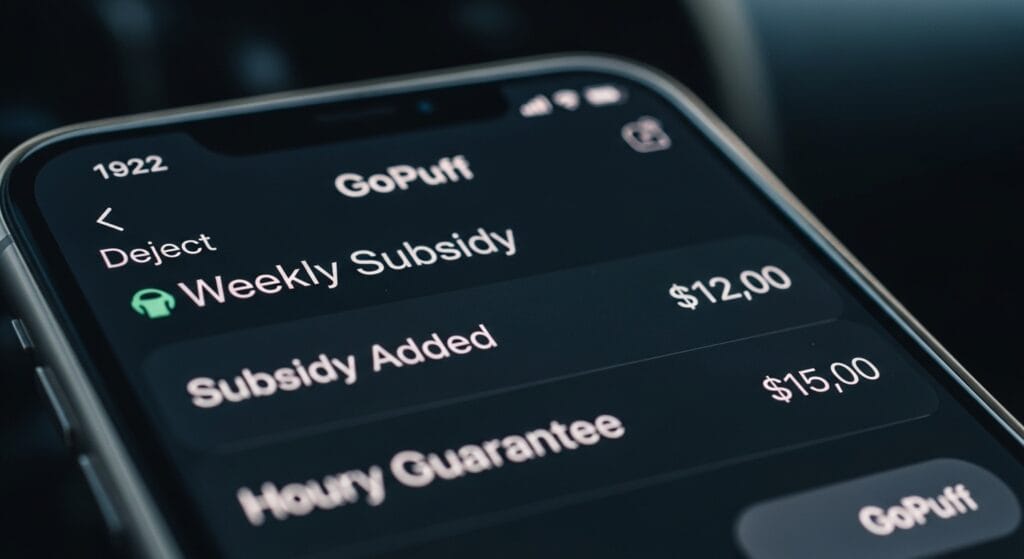
The Weekly Subsidy: Your Financial Safety Net
This is GoPuff’s signature pay feature and the reason many drivers choose it over pure commission apps in slower markets.
Here’s how it works: If you claim a scheduled block (say, 8 hours on a Thursday evening) and your combined base pay for that block comes to $100, but your market’s guaranteed minimum is $18/hour, you should have earned $144 for those 8 hours. GoPuff automatically adds the $56 difference to your weekly pay.
The conditions are straightforward: you must be on a scheduled block, and you must maintain a high order acceptance rate (typically 85%+). If you decline too many orders, you forfeit the guarantee and earn only your accepted commissions. The subsidy isn’t a bonus—it’s a floor. Your tips sit above it, separate.
In slow suburban markets or off-peak weekday hours, this guarantee effectively turns GoPuff into one of the most financially stable gig platforms available.
Wait Pay: Getting Paid to Be Available
In many zones as of 2026, GoPuff also offers a Wait Pay rate—a per-minute compensation (often $0.10–$0.15/min) for time spent at the MFC waiting for order assignments during a scheduled block. It’s modest, but it matters: 20 minutes of wait time earns you $2–$3. On DoorDash, those 20 minutes pay nothing.
GoPuff vs. Restaurant Delivery: Side-by-Side
| Feature | GoPuff (Warehouse) | DoorDash / Uber Eats (Restaurant) |
|---|---|---|
| Pickup Location | Single MFC — always the same spot | Scattered across the city |
| Workflow | Batched: 2–4 orders per run | Mostly single orders |
| Wait Times | Low — staff pack bags before you arrive | High — kitchen finishes on their schedule |
| Deadhead Miles | Low — tight delivery radius, return to hub | High — chasing hotspots city-wide |
| Hourly Guarantee | Yes — on scheduled blocks | No — pure commission |
| Wait Pay | Yes — cents per minute at warehouse | No |
| Order Selection | No — you take the assigned bin | Yes — you can decline orders |
| Flexibility | Moderate — blocks required for best pay | High — log in anywhere, anytime |
| Tip Average | $2–$5 per order | $4–$10 per order |
| Orders Per Hour | 3–5 (batched, clustered) | 1–2 (single, spread out) |
The Bottom Line on the Comparison
GoPuff wins on predictability, efficiency, and guaranteed income floors. DoorDash wins on raw flexibility and per-order tip potential. If you treat gig work like a structured part-time job, GoPuff is the stronger platform. If you want to log in spontaneously and work wherever demand is hottest, DoorDash gives you more control.
Salary by City: GoPuff Strongholds
GoPuff’s business model thrives in markets with dense late-night demand: college towns, urban cores, and cities with high Prop 22-style protections. Here are the top five markets for GoPuff driver earnings in 2026.
| Rank | City / State | Est. Avg. Hourly | Why Drivers Earn More |
|---|---|---|---|
| 🥇 1 | Philadelphia, PA | $21 – $26/hr | GoPuff HQ city; highest MFC density in the country; brand loyalty drives volume |
| 🥈 2 | San Francisco, CA | $20 – $25/hr | Prop 22 mileage rate ($0.35/active mile) stacks on top of base pay; tech-savvy user base |
| 🥉 3 | Boston, MA | $19 – $24/hr | Dense student population (Harvard, BU, Northeastern) + brutal winters spike late-night orders |
| 4 | Madison, WI | $18 – $22/hr | UW-Madison college hub; alcohol delivery is the dominant order type; tight delivery radius |
| 5 | Phoenix, AZ | $17 – $21/hr | High alcohol delivery volume = bigger order totals = larger percentage tips |
Note: Hourly figures represent active drive time on scheduled blocks including base pay, boost pay, and average tips. Individual results vary by time of day, acceptance rate, and market saturation.
The Scheduling System: How to Win the “Thursday Drop”
Understanding GoPuff’s scheduling system is the difference between earning $22/hr and earning $11/hr.
Every Thursday, GoPuff releases the following week’s available scheduled blocks. Drivers with better reliability scores see the drop first. Blocks disappear fast in strong markets. Here’s how to maximize your access:
- Set a reminder for the exact drop time in your market (often noon or 6 PM local time)
- Maintain a high Reliability Score — late cancellations or no-shows restrict future block access
- Target Friday and Saturday evening blocks — these generate the highest boost pay and tip activity
- Avoid declining orders on block — falling below 85% acceptance forfeits your subsidy for that block
If you don’t secure a block, On-Demand mode is available — you log in and pick up overflow orders that scheduled drivers rejected. In peak windows, on-demand can be lucrative. Off-peak, it’s unreliable. Build your income strategy around blocks and treat on-demand as a supplement.
Alcohol Delivery: The High-Value Niche
GoPuff carries beer, wine, and liquor in legally permitted markets, and alcohol orders are consistently the highest-tipping category on the platform. A customer ordering a $60 bottle of whiskey tips differently than someone ordering a $12 bag of chips.
Requirements to Enable Alcohol Delivery:
- Must be 21 years of age or older
- Must complete GoPuff’s in-app alcohol certification (approximately 15–20 minutes)
- Must understand your state’s specific alcohol delivery laws
Workflow Rules (Non-Negotiable):
- ID scan required through the app upon delivery — no exceptions
- No “leave at door” — alcohol requires hand-to-hand delivery only
- If customer doesn’t answer or cannot verify age, the order returns to the MFC
Compliance Warning: Sting operations are conducted by both local authorities and GoPuff’s own compliance team. Delivering to a minor results in immediate and permanent deactivation. The income upside from alcohol orders is real, but only for drivers who follow every verification step with zero shortcuts.
The Earnings Impact: Enabling alcohol delivery in a strong market like Phoenix or Philadelphia can add $3–$6 to your effective hourly rate during evening blocks when alcohol order volume peaks.
Frequently Asked Questions
What is the GoPuff subsidy, and how do I qualify for it?
The GoPuff subsidy is a guaranteed hourly minimum paid to drivers who work scheduled blocks. If your base pay earnings during a scheduled shift fall below the market’s guaranteed threshold—typically $15–$20/hour—GoPuff pays the difference. To qualify, you must be on a scheduled block (not on-demand) and maintain an order acceptance rate of approximately 85% or higher during that block. Tips are excluded from the subsidy calculation, meaning they are pure additional income on top of your guaranteed floor.
What are the alcohol delivery rules for GoPuff drivers?
You must be 21 or older and complete GoPuff’s in-app alcohol certification before receiving alcohol order assignments. Every alcohol delivery requires an in-person ID scan through the app—no exceptions, no “they look old enough” judgment calls. You cannot leave alcohol orders unattended. GoPuff and local authorities conduct compliance checks, and delivering to a minor results in immediate deactivation with no appeal process.
GoPuff vs. Uber Eats: Which pays more in 2026?
The honest answer is: it depends on your market and working style. Uber Eats typically offers higher per-order tips (driven by larger restaurant order values) and greater geographic flexibility. GoPuff offers a lower per-order tip average but compensates with higher order volume (3–5/hr vs. 1–2/hr), an hourly subsidy guarantee, wait pay, and dramatically lower deadhead miles. In suburban or mid-density markets where Uber Eats orders are sparse, GoPuff’s subsidy model makes it the more reliable choice. In dense urban markets with constant Uber Eats demand, top Uber Eats drivers can outperform GoPuff hourly. Running both platforms and choosing based on daily conditions is a common strategy among experienced gig drivers.
Do I need to schedule blocks, or can I just show up?
You can work on-demand without a scheduled block, but you will not receive the hourly subsidy guarantee and will only see orders that scheduled drivers rejected. On-demand access is most profitable during Friday and Saturday peak windows when demand exceeds scheduled driver capacity. For consistent, predictable weekly income, scheduled blocks are essential.
Does GoPuff pay for gas?
No. GoPuff drivers are 1099 independent contractors and are responsible for all vehicle expenses. The exception is California, where Prop 22 mandates a mileage reimbursement of approximately $0.35/active mile. All other drivers should track mileage carefully for tax deduction purposes—the IRS standard mileage rate for business use is a significant deduction at tax time.
Is GoPuff Right for You in 2026?
GoPuff is built for a specific type of driver: someone who wants structured, predictable part-time income, values efficiency over flexibility, and is willing to compete for scheduled blocks rather than just logging in whenever. The warehouse model is not a gimmick—it genuinely reduces wasted miles, eliminates restaurant wait times, and creates a more controlled working environment than any restaurant-based delivery platform.
The drivers who struggle on GoPuff are those expecting DoorDash-style freedom: log in anywhere, work any area, decline freely. That’s not what GoPuff offers. What it offers instead is a guaranteed floor, a predictable workflow, and the most efficient per-hour structure in the gig delivery market for drivers who commit to the model.
If one pickup location and a guaranteed minimum sound better than chasing restaurants across a city, GoPuff deserves a serious look in 2026.
Data Methodology
The salary figures, pay ranges, and market data in this guide are derived from a synthesis of the following sources: the 2026 Delivery Logistics Analysis (internal research brief, January 25, 2026), aggregated driver-reported earnings from gig economy forums and community platforms, publicly available information on GoPuff’s driver pay structure, California Prop 22 mileage reimbursement guidelines, and IRS standard mileage rate guidance for independent contractors.
City-level earnings estimates reflect active driving time on scheduled blocks and include base pay, boost pay, and average tips. Individual earnings will vary based on market density, scheduled block availability, acceptance rate, time of day, and personal driving efficiency. This guide is updated for 2026 and will be reviewed quarterly as GoPuff adjusts its pay structures. It does not constitute financial or employment advice.
“If you are looking for Gig Economy jobs, check out our guides on [Roadie Driver] and [TaskRabbit Tasker ].”