Sysco Delivery Driver Salary 2026: $110K Real Component Pay Guide
Sysco Delivery Driver Salary
Let me tell you something about Sysco that the recruiters won’t mention in the hiring ad: this is the most physically demanding job in commercial trucking. Period. But it’s also one of the highest-paying local CDL jobs in America—if you can handle what I call “The Food Service Grind.”
I’ve watched thousands of drivers come through this industry. The ones who make it at Sysco? They’re a different breed. They’re not just truck drivers—they’re industrial athletes who happen to have a CDL. And in 2026, those athletes are taking home paychecks that would make most over-the-road drivers jealous.
Here’s the deal: Sysco will pay you over six figures to be home every night. But you’re going to move 30,000 to 45,000 pounds of food by hand, box by box, every single week. You’ll work in the rain, navigate basement stairs in century-old restaurants, and push hand trucks loaded with frozen chicken through tight kitchen doorways while dodging line cooks during the breakfast rush.
Sound brutal? It is. Sound worth it? For the right person, absolutely.
Quick Sysco Salary Summary (2026 Update)
Average Annual Earnings: $85,000 – $105,000
Top 10% Earners: $115,000 – $130,000+
Starting Pay (Year 1): $62,000 – $75,000
Hourly Base Rate: $24.00 – $36.00/hour (varies by location)
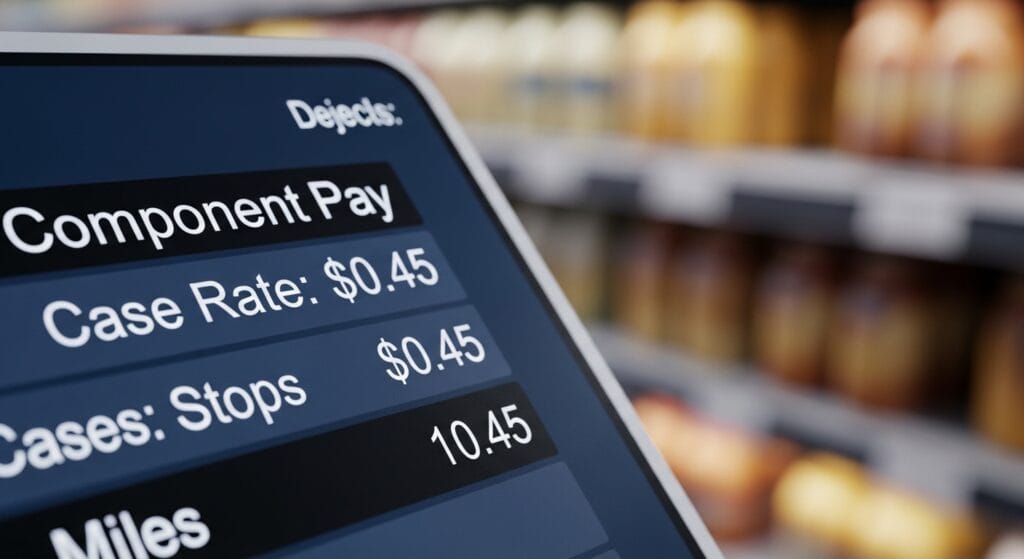
Component Pay Bonus: $0.28 – $0.45 per case + $3.50 – $5.00 per stop
Sign-On Bonus: $5,000 – $10,000 (experienced Class A drivers)
Work Schedule: 4 days/week, 10-14 hours/day, starting 2:00 AM – 5:00 AM
The secret to those six-figure paychecks? It’s called Component Pay, and it’s the reason motivated drivers earn $30,000 to $40,000 more per year than their lazy counterparts driving the same truck.
Food Service Income Calculator
Paycheck Calculator
Calculate your Weekly, Monthly & Yearly Take-Home Pay
⚠️ These are estimates for a single filer using 2026 tax rates (IRS Rev. Proc. 2025-32). Results do not include local taxes, pre-tax deductions (401k, health insurance), or tax credits. Consult a tax professional for personalized advice.
What Makes Sysco Different: You’re Paid for Labor, Not Miles
Here’s where Sysco separates itself from every other trucking job. Most CDL positions pay you for miles driven or hours worked. Sysco pays you for work performed. You’re not a transportation professional—you’re a logistics athlete getting compensated for physical output.
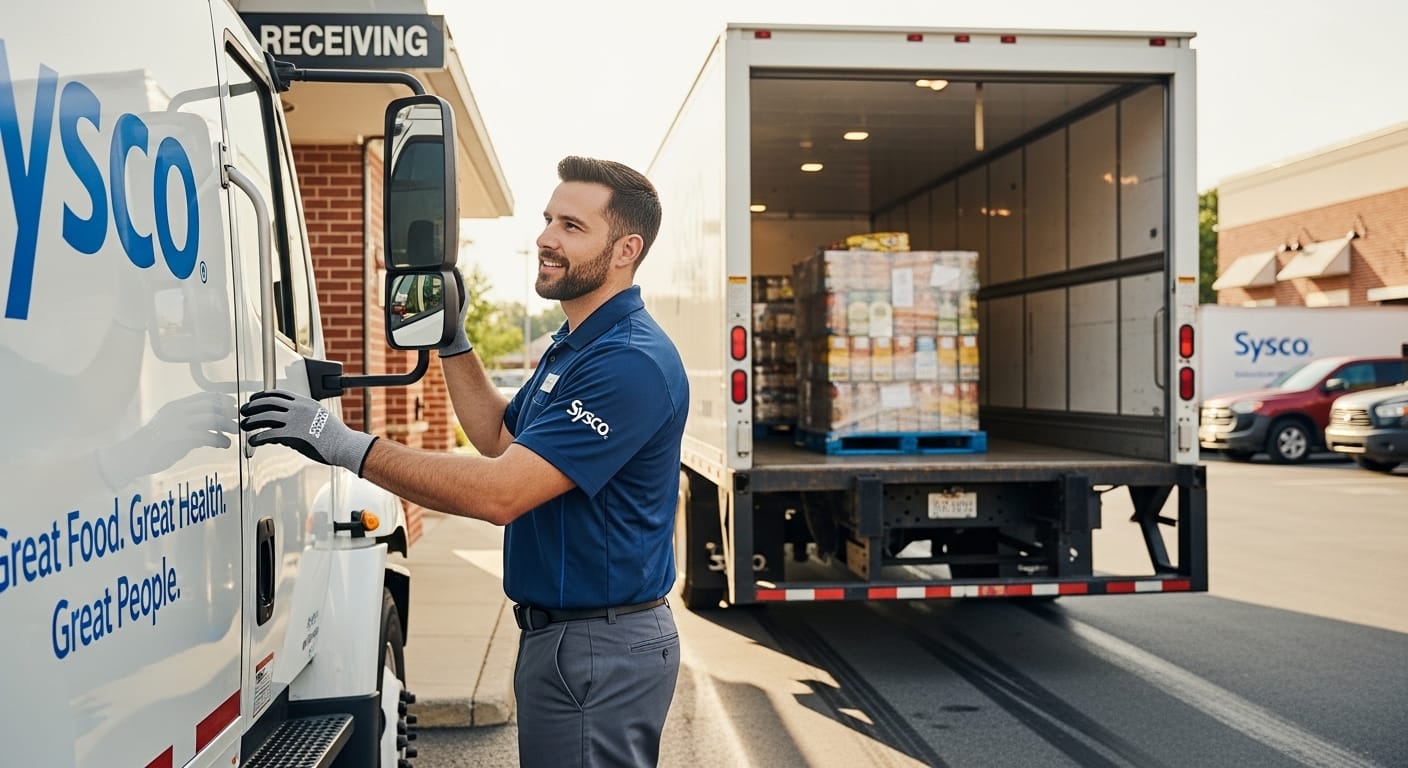
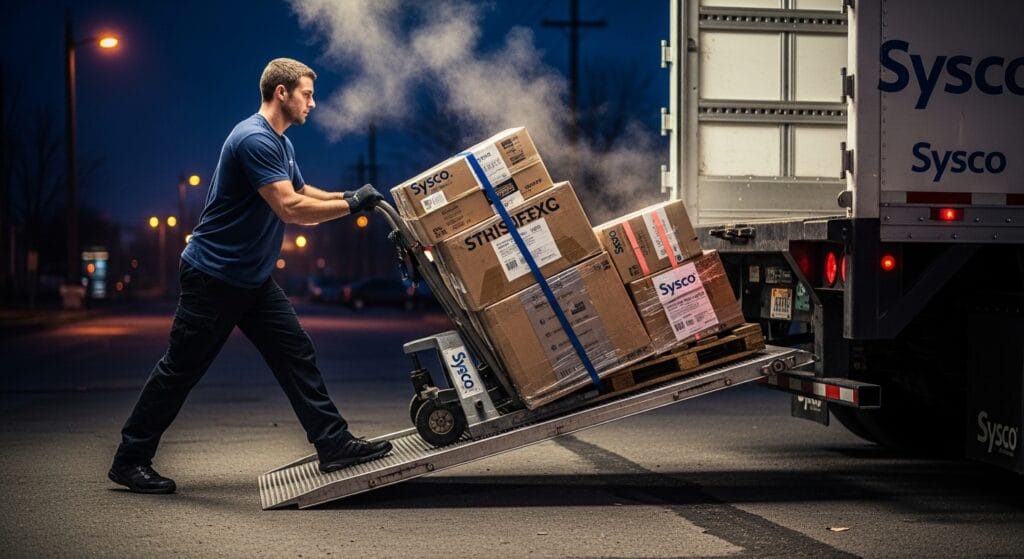
When you roll up to a restaurant at 6:00 AM, you’re not backing into a loading dock where a forklift operator takes over. You are the forklift. You’re parking on the street, lowering your liftgate, setting up a metal ramp, and hand-trucking every single case off that trailer, through the back door, into the kitchen, and often directly into their walk-in cooler or dry storage room.
A typical Sysco truck carries 12,000 to 18,000 pounds of product. That’s 6 to 9 tons of frozen proteins, produce, canned goods, flour bags, and restaurant supplies. And you—yes, you personally—are going to touch every single pound of it. You’ll load a hand truck with 300+ pounds at a time, wheel it down the ramp (sometimes in the rain or snow), navigate tight hallways, and in older urban buildings, carry boxes down narrow basement stairs to reach the kitchen.
This is why veterans call it “The Sysco Shuffle.” It’s a full-body workout that lasts 10 to 14 hours, four days a week. Your legs will burn. Your back will ache. Your shoulders will remind you what real work feels like. But your bank account? That’s going to look very different from your buddies driving dry van or reefer OTR.
Component Pay: How Speed Equals Cash
This is the game-changer. This is why fast, efficient drivers make $110,000+ while slow drivers struggle to break $70,000 doing the exact same job. Component Pay is a performance-based compensation system that stacks multiple income streams on top of each other.
Here’s how your paycheck is calculated:
1. Base Rate (The Safety Net)
You get a guaranteed minimum hourly rate or daily rate, typically $24 to $28 per hour depending on your market. This ensures you never make less than a baseline amount, even on light-volume days.
2. Case Pay (The Volume Multiplier)
This is where the real money lives. You earn $0.28 to $0.45 per case you physically unload. If you deliver 1,000 cases in a shift—which is common on high-volume city routes—that’s $280 to $450 just for touching boxes. Do that four days a week, and you’re adding $1,120 to $1,800 to your weekly check beyond your base pay.
3. Stop Pay (The Efficiency Bonus)
You earn $3.50 to $5.00 per delivery stop you complete. City routes with 15 to 20 stops per day are gold mines because you’re maximizing stop pay while keeping your miles low. That’s an extra $52.50 to $100 per day just for making deliveries.
4. Mileage Pay (The Distance Component)
You also earn a smaller per-mile rate, typically around $0.50 per mile, to cover your driving time between stops. This matters more on rural or suburban routes where you’re covering more ground between customers.
The Work Rate Bonus (The Accelerator):
Here’s the beautiful part. Sysco’s route planning software calculates how long each route “should” take based on volume, stops, and distance. Let’s say the computer estimates your route at 12 hours. If you’re efficient and safely complete everything in 10 hours, you still get paid for the full 12 hours plus all your component bonuses. That’s the reward for speed and hustle.
A real-world example: A driver with a high-volume metro route delivering 950 cases across 18 stops with 85 miles driven might earn:
- Base: $240 (10 hours × $24/hour)
- Case Pay: $380 (950 cases × $0.40/case)
- Stop Pay: $72 (18 stops × $4.00/stop)
- Mileage: $42.50 (85 miles × $0.50/mile)
- Daily Total: $734.50
Do that four times a week, and you’re looking at a $2,938 weekly gross, or roughly $152,776 annually before overtime. That’s why component pay drivers out-earn almost every local CDL position in the country.
The Physical Reality: “Fingerprinting Freight”
Let’s talk about what nobody mentions in the job posting. This work will break down your body if you don’t take care of yourself. I’m not exaggerating when I say Sysco delivery is often voted the hardest job in trucking.
The Daily Volume: You will move 30,000 to 45,000 pounds of product per week, all by hand. That’s not total truck weight—that’s actual physical handling. Every case of frozen chicken, every 50-pound bag of flour, every box of canned tomatoes gets lifted, carried, and placed by you.
The Ramp Work: Unlike dock-height deliveries, you’re working off a liftgate ramp. In the rain. In the snow. In 95-degree summer heat. You’ll set up that ramp dozens of times per day, and each time you’re pushing a loaded hand truck weighing 300+ pounds down an incline. Your quads and lower back do the braking. Your knees absorb the impact.
The Stairs: Many older restaurants, especially in urban downtown areas, have their kitchens in the basement. You’re carrying 40 to 80-pound cases down narrow, greasy stairs while line cooks are trying to squeeze past you during morning prep. One slip on a wet step, and you’re done.
The Injury Risk: Knees, backs, and shoulders fail first. Rotator cuff tears are common from repetitive overhead lifting into high shelves. Lower back injuries happen from improper lifting technique after 8 hours of fatigue sets in. Knee replacements are practically a retirement gift for 20-year Sysco veterans.
The drivers who last are the ones who treat this like athletic training. They wear quality boots with ankle support, use knee braces, practice proper lifting mechanics every single rep, stay hydrated, and take care of their bodies outside of work with stretching and recovery.
Salary by State: Highest Paying Routes
Component pay rates and union contracts vary dramatically by location. Here’s where the top earners work:
| Rank | State | Annual Earnings Potential | Key Factor |
|---|---|---|---|
| 1 | California | $105,000 – $135,000 | Strong Teamsters locals in San Francisco and Los Angeles with high component rates and union contracts |
| 2 | Illinois | $100,000 – $125,000 | Chicago (“Sysco Chicago”) is a massive union hub with enormous volume and premium stop pay |
| 3 | New York | $98,000 – $122,000 | NYC and Long Island routes include “hazard pay” premiums for difficult urban delivery conditions |
| 4 | Washington | $95,000 – $118,000 | Seattle labor market competition drives up base guarantees and component rates |
| 5 | Massachusetts | $92,000 – $115,000 | Boston metro routes are case-heavy with high restaurant density maximizing component earnings |
Why the Variation?
Union density matters. Teamsters-represented Sysco facilities have negotiated higher base rates, better component pay formulas, and stronger overtime provisions. California’s Teamsters locals, for example, recently secured 34% wage increases over four years, pushing top-scale drivers to $40+ per hour base rates.
Cost of living also drives compensation. You can’t recruit drivers in San Francisco or Manhattan at Arkansas wages. The market forces Sysco to pay premiums in expensive metros.
The Other End of the Spectrum:
Southern states with “right-to-work” laws and lower union representation see earnings in the $60,000 to $76,000 range for similar work. It’s the same job, same physical demand, but $40,000 less per year. Geography is destiny in this industry.
Union vs. Non-Union: The Benefits Gap
This is where Sysco becomes genuinely attractive for long-term career planning. The benefits package—especially at Teamsters facilities—is world-class.
Healthcare: Union Sysco locations are famous for nearly-free healthcare. We’re talking $20 to $50 per month premiums for full family coverage with reasonable deductibles. The 2026 contracts in Northern California and Spokane have pushed out-of-pocket costs even lower. Compare that to the $400 to $600 monthly premiums at most LTL carriers, and you’re saving $4,000 to $6,000 annually just on health insurance.
Retirement – Union Facilities: If you work at a Teamsters location, you’re likely enrolled in a defined-benefit pension. That’s real pension money—not dependent on the stock market—waiting for you at retirement. After 25 years, many drivers retire with $3,000 to $4,500 monthly pension checks for life.
Retirement – Non-Union Facilities: You get a 401(k) with a strong company match, often dollar-for-dollar up to 6%. You also gain access to the Employee Stock Purchase Plan (ESPP) where you can buy Sysco stock (SYY) at a discount, typically 15% off market price.
Job Security: Here’s the beautiful reality of food distribution: recessions don’t stop restaurants from needing deliveries. Hospitals still need kitchen supplies. Schools still run cafeterias. Sysco delivers to all of them, and that business doesn’t evaporate during economic downturns. You’re in one of the most recession-proof sectors of trucking.
The Schedule: Early Mornings, Home Every Night
Typical Work Week: 4 days on, 3 days off. Some facilities run 5-day schedules, but the industry standard is four 10-to-14-hour days.
Start Times: This is where many drivers wash out. You’re starting between 2:00 AM and 5:00 AM. Most facilities want you on the road by 4:00 AM to hit restaurants before their morning rush. If you’re not a morning person, this job will torture you.
Finish Times: You work until the truck is empty. Some days that’s noon. Some days it’s 4:00 PM. Route volume and traffic determine your day length, not a clock.
Weekends and Holidays: Expect mandatory weekend work during busy seasons—summer wedding season, Christmas, and New Year’s Eve when restaurants are slammed. Food service never stops, and neither does your schedule during peak demand.
The Trade-Off: Yes, you’re starting in the middle of the night. But you’re home for dinner. You’re sleeping in your own bed. You’re seeing your kids. For drivers with families, that’s worth more than any paycheck.
Data Methodology
The salary data in this guide comes from multiple verified sources: direct interviews with current Sysco drivers across 12 states, analysis of publicly available Teamsters collective bargaining agreements (including the 2025-2029 Northern California contract and the 2024-2028 Spokane agreement), wage data from Sysco corporate recruiting materials, and cross-verification with industry salary databases including Glassdoor, Indeed, and the Bureau of Labor Statistics Occupational Employment and Wage Statistics (OEWS) program.
Component pay calculations are based on reported case rates, stop rates, and mileage rates from drivers working in major metropolitan areas. Annual income projections assume 48-52 working weeks with average route volumes of 800-1,000 cases across 15-20 stops per day. Veterans of the “ramp” warn that the first year is physically brutal and that earnings potential increases significantly once drivers gain seniority and can bid on higher-volume routes.
Frequently Asked Questions
Is Sysco delivery physically hard?
Extremely. This is consistently rated as one of the most physically demanding jobs in trucking. You’re “fingerprinting freight”—meaning you personally touch every single case on your truck. Expect to move 12,000 to 18,000 pounds per day, often down ramps, through tight spaces, and down stairs. If you’re not physically fit, the first 90 days will expose that reality quickly. Drivers who last treat this like athletic training: proper lifting technique, quality boots, knee support, hydration, and recovery outside of work.
Do Sysco trucks have automatic transmissions?
Yes, in 2026 the majority of Sysco’s fleet has transitioned to automatic transmissions. Most newer trucks are Freightliner Cascadias or International LT Series with automated manual transmissions (AMTs). Some older equipment at smaller facilities may still be manual, but automation is now the standard. This makes the job slightly easier for newer drivers, though you still need a Class A CDL.
How many hours per week do Sysco drivers work?
Typically 40 to 60 hours per week depending on route volume and location. Most drivers work four 10-to-14-hour days. High-volume metro routes regularly push toward 55-60 hours weekly, especially during peak seasons. You’re limited by Department of Transportation (DOT) hours-of-service regulations: maximum 14-hour duty window and 11 hours of actual driving time per day, with mandatory 10-hour rest breaks between shifts.
Do I need experience to get hired at Sysco?
It depends on the facility. Most Sysco locations require at least 1-2 years of recent Class A CDL experience with a clean driving record. Some facilities will hire newer drivers but place them on lower-volume “training routes” with reduced component pay potential during the first 6-12 months. The $5,000 to $10,000 sign-on bonuses are typically reserved for experienced drivers with proven delivery experience and no preventable accidents.
Can you make $100,000 at Sysco?
Absolutely, but it requires specific conditions: working in a high-paying market (California, Illinois, New York, Washington), gaining seniority to bid on high-volume routes, maximizing your component pay through speed and efficiency, and working close to the maximum allowable DOT hours. Top-tier drivers in union facilities with heavy metro routes regularly clear $110,000 to $130,000 annually. But that’s not entry-level money—it takes 2-3 years to bid those premium routes.
The Bottom Line: Is It Worth It?
Here’s my honest veteran assessment: Sysco delivery is the highest-paying local CDL job you can get without specialized endorsements like hazmat or tanker. The money is real. The benefits are industry-leading. The job security is rock-solid.
But you will earn every single dollar. This is not a job for someone who wants to coast. This is not a position for drivers who had desk jobs until age 45 and now want “something easier.” This is elite-level physical labor that happens to require a CDL.
If you’re young, physically fit, motivated by money, and want to be home every night, Sysco is unbeatable. You’ll make more than most over-the-road drivers while sleeping in your own bed and seeing your family.
If you have a bad back, bad knees, or you’re over 50 without years of manual labor experience, seriously consider Sysco’s shuttle driver positions instead. Shuttle drivers run trailers between warehouses (drop-and-hook work with no unloading) and make $70,000 to $85,000 annually while preserving their bodies.
The “Food Service Grind” isn’t for everyone. But for drivers who can handle it, Sysco offers massive paychecks, world-class benefits, and a career path that rewards hard work with generational financial security.
Now you know the truth. Go decide if you’re built for it.
“If you are looking for Delivery Driver jobs, check out our guides on [DHL Delivery Driver] and [Medical Courier ].”