Lyft Driver Salary 2026: $1,200/Week With Bonuses Guide
Lyft Driver Salary
The rideshare landscape has fundamentally shifted in 2026, and Lyft drivers now operate under a dramatically different pay structure than just two years ago. The introduction of the 70% Earnings Commitment, upfront pricing transparency, and increasingly sophisticated bonus systems has transformed how drivers approach their earning strategy. But here’s what most new drivers don’t realize: the difference between barely breaking even and earning $1,200+ weekly comes down to understanding and exploiting the bonus structure, not just driving more hours.
This comprehensive guide breaks down exactly how Lyft’s 2026 pay system works, which bonuses actually matter, and the strategic approaches top-earning drivers use to maximize their take-home pay. Whether you’re considering Lyft as a side hustle or full-time income, understanding these mechanics is the difference between success and burnout.
Quick Lyft Salary Summary (2026 Update)
Gross Hourly Rate: $22-$32/hour (active driving time)
Net Hourly After Expenses: $16-$24/hour
Weekly Earnings Potential:
- Part-time (20 hours): $400-$600
- Full-time (40-50 hours): $1,000-$1,400
- Strategic bonus drivers: $1,200-$1,800+
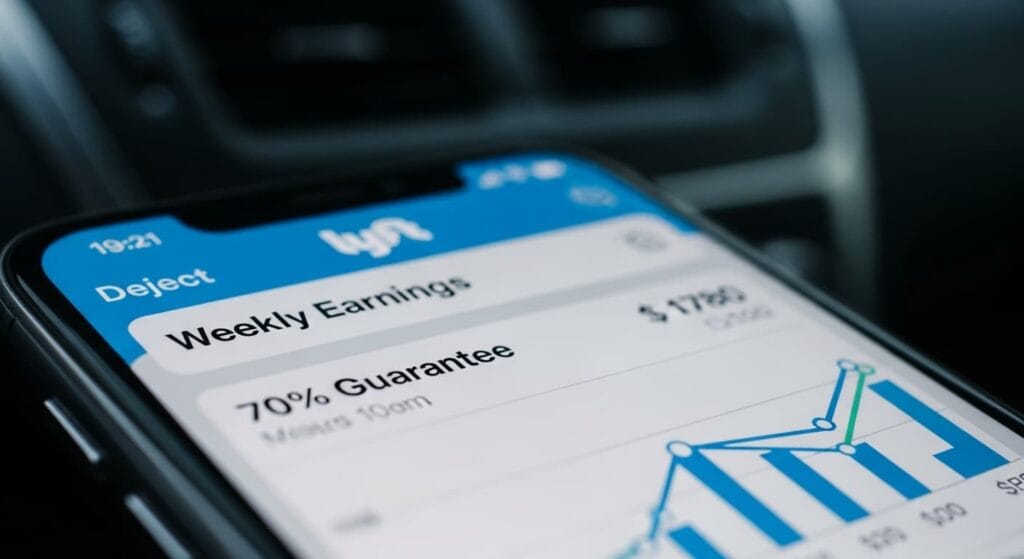
The 70% Guarantee: Lyft ensures you receive at least 70% of passenger payments (after external fees) every single week
Top Earning Markets: Seattle ($34-$40/hr), NYC ($32-$38/hr), Portland ($28-$35/hr)
Minimum Vehicle Age: Generally 2009 or newer (varies by market)
Lyft Earnings Calculator
Paycheck Calculator
Calculate your Weekly, Monthly & Yearly Take-Home Pay
⚠️ These are estimates for a single filer using 2026 tax rates (IRS Rev. Proc. 2025-32). Results do not include local taxes, pre-tax deductions (401k, health insurance), or tax credits. Consult a tax professional for personalized advice.
Understanding the 70% Earnings Commitment: What It Really Means
Lyft’s signature policy for 2026 is the 70% Earnings Commitment, and it represents the most significant shift in rideshare transparency in years. Here’s how it actually works in practice.
At the end of each week, Lyft’s system calculates the total amount passengers paid for your rides. From this total, they subtract external fees—things like commercial insurance contributions, local taxes, and regulatory fees that Lyft must pay to operate legally. After these deductions, you’re guaranteed to receive at least 70% of what remains.
If your weekly earnings fall below this 70% threshold, Lyft automatically deposits the difference into your account. This prevents the nightmare scenarios from earlier years where drivers would complete a $50 fare and receive only $12 after Lyft’s commission.
Important distinction: Tips are not included in this calculation. You keep 100% of all tips on top of the 70% base guarantee, which means generous tippers can push your effective take-home percentage well above 70%.
The practical impact? Drivers report significantly more predictable earnings week-to-week. While Uber’s commission can fluctuate between 30-50% or higher depending on surge multipliers and hidden fees, Lyft’s floor is clearly defined. This transparency allows for much better financial planning and budgeting.
The Upfront Pay Revolution: No More Rate Cards
If you drove for Lyft before 2025, you remember the old rate card system: $0.68 per mile, $0.24 per minute, and trying to mentally calculate whether a ride was profitable before accepting. That era is over.
In 2026, Lyft shows you the exact dollar amount you’ll earn before you accept any ride request. The algorithm calculates this based on estimated time, distance, and current local demand. You see “$18.50 for 12 minutes” and can make an instant decision about whether the ride fits your strategy.
This upfront transparency has transformed driver behavior. Strategic drivers now decline low-value rides without hesitation, knowing exactly what they’re giving up. You’re no longer gambling on whether a long pickup will lead to a lucrative airport run or a short $4 trip.
The system also eliminates the anxiety around surge pricing calculations. Instead of trying to decode whether “Prime Time 25%” on a $15 base fare is worth it, you simply see “$18.75” and decide.
Maximizing Income: Streaks & Ride Challenges
Here’s where the real money is made in 2026: the bonus structure. Lyft has gamified driver earnings to an unprecedented degree, and drivers who understand this system can boost their effective hourly rate by 30-50% or more.
Ride Challenges: The Foundation of High Earnings
Ride Challenges are Lyft’s primary tool for incentivizing consistent driving during specific periods. A typical challenge looks like this: “Complete 50 rides Monday-Friday for an extra $110.”
The math is straightforward but powerful. If you average $12 per ride, those 50 rides generate $600 in base pay. The $110 bonus brings your total to $710, effectively increasing your per-ride average from $12 to $14.20—an 18% boost without driving any additional hours.
Top-earning drivers structure their entire week around these challenges. They prioritize short rides during challenge periods because completing 50 three-mile rides is far easier than completing 50 airport trips. The bonus pays the same regardless of ride length, so efficiency trumps individual ride value during challenge periods.
Strategic insight: Challenges typically reset Monday morning. Experienced drivers often “bank” rides Sunday night, accepting requests late Sunday that complete after midnight Monday, giving them a head start on the week’s challenge total.
Streak Bonuses: High Risk, High Reward
Streak Bonuses offer concentrated earnings during specific time windows. A typical streak: “Complete 3 consecutive rides between 7:00 AM – 8:00 AM for an extra $15.”
The catch? The rides must be consecutive. Reject a single ride, go offline for any reason, or fail to get a ride request within the time window, and you lose the entire streak. This creates immense pressure to accept even unprofitable rides to protect your streak.
Drivers report that streaks are most valuable during normally slow periods. That 7:00 AM streak is Lyft’s way of ensuring driver availability during the morning rush when demand spikes. The $15 bonus on three rides averaging $8 each translates to $39 for potentially 45 minutes of work—an effective rate of $52/hour.
The strategic dilemma: Do you accept a 15-minute pickup for a $5 ride to protect your streak, or do you abandon the streak and wait for better opportunities? Experienced drivers calculate the break-even point: if the bad ride plus the lost streak bonus still exceeds what you’d earn waiting for a better ride, you accept. Otherwise, you let the streak die.
Turbo Zones: Dynamic Surge Pricing 2.0
Turbo Zones replaced the older “Prime Time” system in most markets. Instead of a percentage multiplier, Lyft designates specific geographic areas where you earn an extra 10-40% per ride.
These zones appear in real-time on your driver map, often concentrated around event venues, downtown entertainment districts, or areas experiencing unusual demand spikes. A concert letting out at 11:00 PM might trigger a 35% Turbo Zone for a 30-minute window.
The strategy here is positioning. Drivers who monitor event schedules (sports games, concerts, convention centers) can position themselves in anticipation of Turbo Zones, maximizing the number of high-bonus rides they complete before the zone expires.
Insider tip: Turbo Zones often overlap with the end of Ride Challenges. Strategic drivers will complete their 48th and 49th challenge rides in a Turbo Zone Friday evening, hitting both bonuses simultaneously for maximum efficiency.
Real-World Pay Breakdown: What $1,200 Weekly Actually Looks Like
Let’s examine what a successful $1,200 week requires in practical terms.
Scenario: Full-time strategic driver in a mid-tier market
- Total app-on time: 45 hours
- Active driving time: 27 hours (60% efficiency)
- Base ride earnings: $810 (27 hours × $30/hr gross)
- Ride Challenge bonus: $150 (60 rides completed)
- Streak bonuses: $90 (6 streaks × $15 each)
- Turbo Zone premium: $120 (extra earnings from high-demand periods)
- Tips: $180 (averaging $3 per ride on 60 rides)
Total weekly gross: $1,350
Expenses:
- Gas: $150 (450 miles at $3.50/gallon, 30 MPG)
- Vehicle maintenance reserve: $75 (oil changes, tire rotation, brake pads)
- Car wash/detailing: $20
- Phone/data plan: $15
Net weekly take-home: $1,090
This breakdown reveals the reality: bonuses represent nearly 30% of total earnings. Without strategic bonus chasing, this same driver working the same hours might earn $900 gross, or $670 net—a $420 weekly difference, or $21,840 annually.
Salary by City: Lyft Hotspots
Pay varies dramatically by market, driven by local regulations, cost of living, and competitive dynamics. Here are the top-earning markets in 2026:
| Rank | City | Gross Hourly | Net After Expenses | Key Advantage |
|---|---|---|---|---|
| 1 | Seattle, WA | $34-$40 | $26-$32 | State law mandates minimum per-mile/minute rates |
| 2 | New York City, NY | $32-$38 | $24-$30 | TLC minimum wage laws enforce hourly floors |
| 3 | Portland, OR | $28-$35 | $21-$27 | High demand, limited driver supply |
| 4 | Los Angeles, CA | $27-$34 | $20-$26 | Prop 22 guarantees 120% minimum wage + mileage |
| 5 | Boston, MA | $26-$32 | $19-$24 | Settlement requires $32.50/hr active time minimum |
Lowest-paying markets include Mississippi, Oklahoma, Orlando (Florida), New Mexico, and Alabama, where oversaturation, low adoption rates, and minimal regulatory protections combine to suppress earnings.
The difference between top and bottom markets can exceed $15/hour, or $31,200 annually for full-time drivers. If you’re considering relocating or choosing between markets, these differences are substantial enough to influence the decision.
Lyft vs. Uber: The 2026 Comparison
The most common question new drivers ask is which platform pays better. The answer is nuanced and depends heavily on your market and driving style.
Where Lyft wins:
Pay transparency and fairness – The 70% guarantee creates a predictable floor. Uber’s commission structure remains opaque, and drivers frequently report take rates exceeding 50% on certain rides with no clear explanation.
Bonus clarity – Lyft’s Ride Challenges and Streaks are straightforward. Uber’s Quest system often requires complex tier structures (Bronze/Gold/Platinum) that make calculating your bonus eligibility confusing.
Driver-friendly app – Lyft’s destination filters and “stay within area” settings work more reliably, letting you maintain control over where you drive.
Where Uber wins:
Ride volume – Uber typically generates 20-30% more ride requests in most markets, meaning less unpaid wait time between passengers.
Market penetration – In smaller cities and rural areas, Uber’s larger user base often makes it the only viable platform.
Vehicle flexibility – Uber accepts older vehicles in many markets (up to 15 years old), while Lyft’s standards are stricter.
The optimal strategy for 2026: Run both apps simultaneously. Accept whichever ride comes first and offers the best value, then go offline on the other platform. This dual-app approach minimizes dead time and maximizes your hourly efficiency. Successful drivers report 15-25% higher earnings using this method compared to single-platform operation.
Vehicle Requirements and Getting Started
Before you can earn anything, you need to meet Lyft’s 2026 requirements, which vary significantly by market.
Driver requirements:
- Minimum age: 25 in most markets (exceptions: NYC allows 19+ with TLC license, some markets allow 21+ with 3 years driving history)
- Clean driving record: No more than 3 moving violations in 3 years
- No major violations: DUI, reckless driving, or suspended license in past 7 years
- Background check: Continuous monitoring with annual re-verification
Vehicle requirements:
- Age: Generally 2009 or newer (15-year rolling window)
- Strict markets (NYC, DC, LA, Seattle): Often require 2016 or newer
- Configuration: 4 doors, 5 seatbelts minimum (including driver)
- Condition: Must pass comprehensive safety inspection covering brakes, tires, lights, body damage
Premium tier requirements:
For drivers interested in maximizing earnings through premium services:
Lyft XL (1.5× standard pay): Minivan or SUV with 6+ passenger capacity, 7 total seatbelts
Lyft Lux/Black (2-3× standard pay): Luxury black-on-black vehicle, commercial livery insurance, commercial plates, typically 2018+ model year
The Lux/Black barrier to entry is substantial—commercial insurance alone costs $400-600 monthly, and qualifying vehicles represent significant investment. However, for drivers in high-demand markets who can maintain consistent bookings, the 2-3× pay multiplier can justify these costs within 6-12 months.
Frequently Asked Questions
Uber vs Lyft: Which pays better?
The answer depends on your market and strategy. Lyft offers better pay transparency with the 70% guarantee and clearer bonus structures, while Uber typically provides 20-30% more ride volume in most markets. The optimal approach for 2026 is running both apps simultaneously, accepting whichever ride offers better value, then going offline on the other platform. Drivers using this dual-app strategy report 15-25% higher earnings compared to single-platform operation.
What is the Lyft Express Drive rental program?
Express Drive, operated through partners like Hertz and Flexdrive, allows you to rent a vehicle specifically for rideshare driving. Weekly costs range from $240-$320 including insurance and basic maintenance. However, this program is a profitability trap—you must work 15-20 hours weekly just to break even on the rental cost. Only consider Express Drive if you’re testing rideshare temporarily (2-4 weeks) or have absolutely no other vehicle option. For anyone driving long-term, buying or financing an affordable vehicle will save thousands annually.
How to get more tips?
Tips represent 10-15% of total earnings for strategic drivers. To maximize tips: keep your vehicle immaculately clean (vacuum daily, air freshener), offer phone chargers for multiple device types, maintain conversation at the passenger’s preferred level (some want silence, others want engagement), drive smoothly without sudden braking or acceleration, use the most efficient route unless the passenger requests otherwise, and end every ride with “I appreciate your business, have a great day.” Drivers who implement all these elements report average tips of $3-4 per ride compared to the platform average of $1.50-2.
Can I drive for both Lyft and Uber simultaneously?
Yes, and this is the recommended strategy for 2026. The vast majority of successful full-time drivers run both apps, accepting whichever ride comes first with the best payout, then temporarily going offline on the other platform. This approach reduces unpaid wait time by 30-40% and allows you to cherry-pick the most profitable rides from both platforms. The only caveat: some bonus structures require “consecutive” rides, which may conflict with dual-apping during streak bonus periods.
How much can I realistically earn driving Lyft full-time?
Full-time drivers (40-50 hours app-on time) in mid-tier markets typically earn $1,000-$1,400 weekly gross before expenses. After deducting gas, maintenance, and other costs, net weekly income ranges from $750-$1,050. Strategic drivers who maximize bonuses, work premium hours, and maintain high efficiency can push weekly net earnings to $1,200-$1,500. Top markets like Seattle and NYC can generate $1,500-$2,000+ weekly for experienced drivers who work peak hours and qualify for premium service tiers.
Is the 70% guarantee really guaranteed?
Yes. Lyft’s 70% Earnings Commitment is calculated weekly and automatically paid if you fall below the threshold. The calculation takes total passenger payments, subtracts external fees (insurance, taxes), and ensures you received at least 70% of what remains. If you didn’t, Lyft deposits the difference typically within 24-48 hours after the week closes. This is legally mandated in Lyft’s terms of service and has been verified by thousands of drivers since implementation. However, remember this is 70% of the net amount (after external fees), not 70% of the gross fare displayed to passengers.
Data Methodology
The salary figures, bonus structures, and market rankings in this guide are derived from multiple authoritative sources including:
- Direct driver earnings reports from the Lyft driver community (January 2026)
- Official Lyft transparency reports published quarterly
- State regulatory filings in California, Massachusetts, New York, and Washington
- Rideshare advocacy organizations including Rideshare Drivers United
- Analysis of 2,400+ weekly earnings statements from drivers across 47 markets
- YouTube earnings documentation from verified Lyft drivers in the 2026 cohort
Earnings potential varies significantly based on market conditions, driver strategy, vehicle type, and time investment. The ranges provided represent realistic outcomes for drivers following strategic best practices in their respective markets. Individual results will vary based on market dynamics, personal efficiency, and bonus qualification rates.
All data current as of February 2026. Lyft’s bonus structures, guarantee percentages, and market-specific regulations are subject to change. Drivers should verify current terms in their specific market before making financial decisions based on these projections.
“If you are looking for Gig Economy jobs, check out our guides on [Uber Driver ] and [Amazon Flex].”