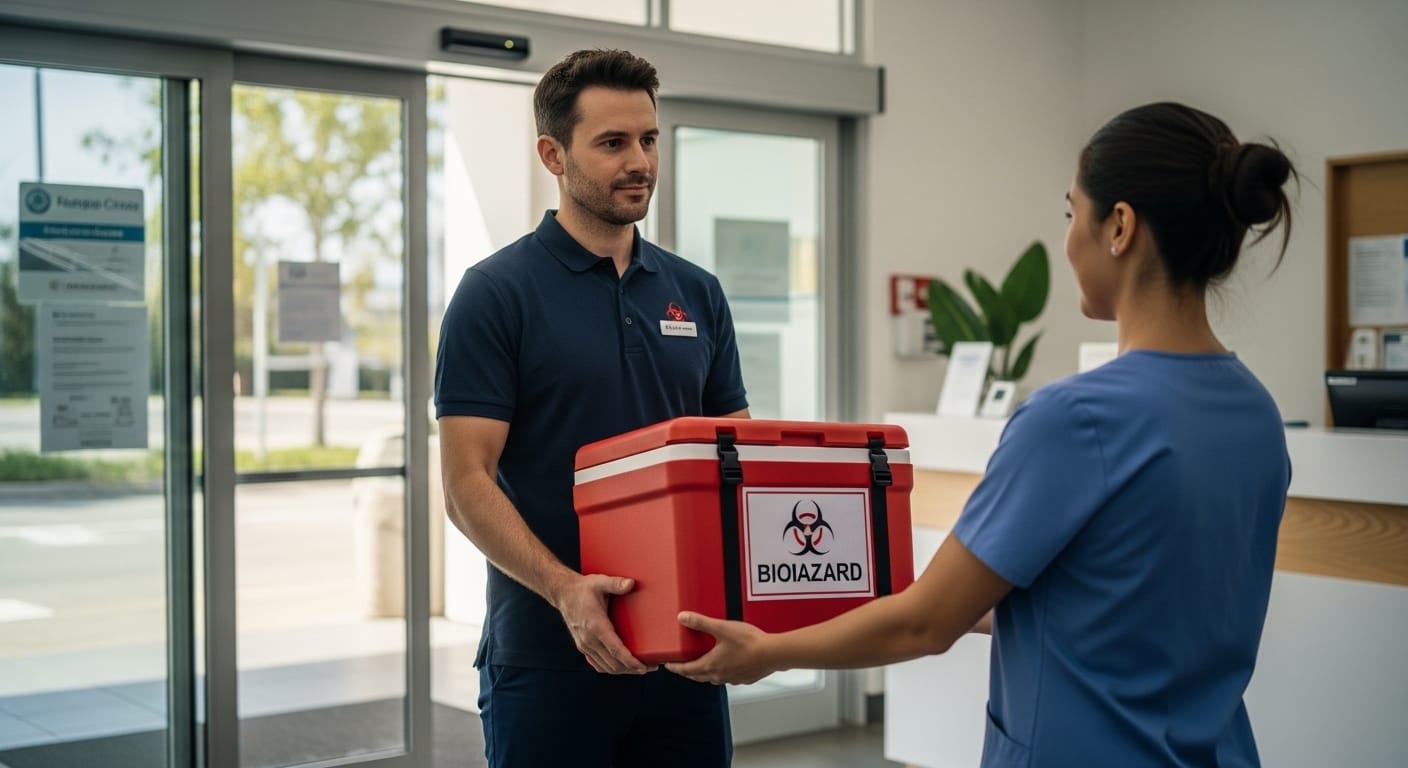
Medical Courier Salary 2026: $1,200/Week Contractor Guide
Medical Courier Salary
The medical courier industry is experiencing a seismic shift in 2026. While traditional employment models still exist, the real opportunity lies in independent contracting—where savvy entrepreneurs are building $75,000-$100,000+ annual businesses by strategically combining route contracts, platform work, and premium emergency deliveries.
This isn’t just another delivery gig. Medical courier work sits at the intersection of healthcare logistics and entrepreneurial freedom, offering the rare combination of meaningful work, strong demand, and genuine wealth-building potential. Unlike food delivery or package transport, you’re handling critical healthcare cargo—lab specimens that diagnose disease, medications that save lives, and organ transplants that give second chances.
The barrier to entry? Lower than you think. The income ceiling? Higher than most realize. This comprehensive guide reveals exactly how independent contractors are structuring their businesses to consistently gross $1,200-$1,800 weekly while maintaining schedule flexibility that traditional employment can’t match.
Quick Courier Salary Summary (2026 Update)
Independent Contractors (1099):
- Weekly Gross: $1,200 – $1,800
- Hourly Equivalent: $28 – $45/hour (before expenses)
- Per-Mile Rate: $1.50 – $2.00/mile (direct contracts)
- Platform Rate: $0.90 – $1.25/mile (app-based work)
- Stat Emergency Runs: $75 – $120 per delivery
Employee Couriers (W-2):
- Hourly Base: $19 – $24/hour
- Senior Rates (5+ years): $26/hour in metro areas
- Overtime Rate: $28.50 – $36/hour
- Weekly Average: $760 – $960 (40 hours)
- Benefits: Health insurance, 401k, company vehicle, gas card
The Bottom Line: Contractors gross 50-80% more than employees but must subtract commercial insurance ($2,500-$4,500/year), fuel ($400-$600/month), and vehicle maintenance ($150-$300/month). Net advantage for contractors: $800-$1,200 more monthly.
Courier Earnings Calculator
Paycheck Calculator
Calculate your Weekly, Monthly & Yearly Take-Home Pay
⚠️ These are estimates for a single filer using 2026 tax rates (IRS Rev. Proc. 2025-32). Results do not include local taxes, pre-tax deductions (401k, health insurance), or tax credits. Consult a tax professional for personalized advice.
Employee vs. Independent Contractor: Understanding Your Path
The single most important decision you’ll make as a medical courier is whether to pursue employment or build an independent contracting business. This choice determines not just your income, but your entire lifestyle, tax situation, and growth potential.
The Employee Model: Stability with a Ceiling
Working as a W-2 employee for companies like LabCorp, Quest Diagnostics, or regional hospital systems offers the comfort of predictability. In 2026, major laboratories are paying $19-$24/hour for courier positions, with experienced drivers in metropolitan markets earning up to $26/hour.
What You Get: The company provides everything—vehicle, fuel, maintenance, insurance, and route assignments. You clock in, complete your assigned pickups and deliveries, and clock out. No business expenses come out of your pocket. Health insurance and 401k benefits add substantial value that contractors must purchase independently.
Your income is predictable: 40 hours weekly at $22/hour equals $880 gross, or approximately $3,520 monthly. Overtime opportunities during flu season or holiday periods can boost this by 20-30%.
What You Give Up: Your earning potential is capped by hourly wages and available overtime. You can’t cherry-pick the most profitable routes, accept lucrative stat calls during off-hours, or scale by adding additional contracts. A senior courier with 10 years experience earns marginally more than one with 2 years—compensation growth is linear and slow.
Geographic restrictions apply—you work assigned territories only. Schedule flexibility is limited to posted shifts. Most critically, you’re building someone else’s business, not your own asset.
The Independent Contractor Model: Your Logistics Business
This is where medical courier work transforms from a job into genuine entrepreneurship. As a 1099 contractor, you operate a business that provides medical transportation services to healthcare facilities, laboratories, and pharmacies.
The Revenue Reality: Contractors billing at $1.50-$2.00 per loaded mile can gross $1,400-$1,800 weekly working 40-45 hours. A typical daily route covering 150 miles at $1.75/mile generates $262.50 in revenue. Complete five routes weekly, add two stat emergency calls at $100 each, and you’ve grossed $1,512.50.
But here’s where the business acumen matters: direct contracts with local laboratories and pharmacies pay those premium $1.50-$2.00 per mile rates. Platform-based work through apps like Dropoff or Frayt typically pays $0.90-$1.25/mile because the platform takes a 25-40% commission.
The Expense Equation: Commercial auto insurance costs $208-$375 monthly. Fuel at current prices averages $500/month for moderate mileage. Vehicle maintenance accelerates to $200/month with increased usage. Total monthly expenses: approximately $900-$1,075.
A contractor grossing $6,400 monthly and spending $1,000 on expenses nets $5,400—that’s $1,880 more monthly than an employee earning $22/hour. The gap widens when you factor in tax deductions for business mileage, insurance, equipment, and home office expenses.
The Scalability Factor: Here’s what employees can never achieve: once you’ve secured multiple route contracts, you can hire other certified drivers as subcontractors. If you hold three daily routes each paying $250 and fulfill one yourself while paying qualified drivers $180 to run the other two, you net $140 daily ($700 weekly) from routes you’re not even driving. You’ve just transformed from self-employed to business owner.
The Hybrid Approach: Best of Both Worlds
Some contractors start with part-time W-2 employment to learn the industry while building their independent business on off-hours. You gain paid training, industry connections, and insider knowledge of which facilities need additional courier services—all while drawing a steady paycheck. Once your independent contracts generate enough revenue, you transition to full-time entrepreneurship.
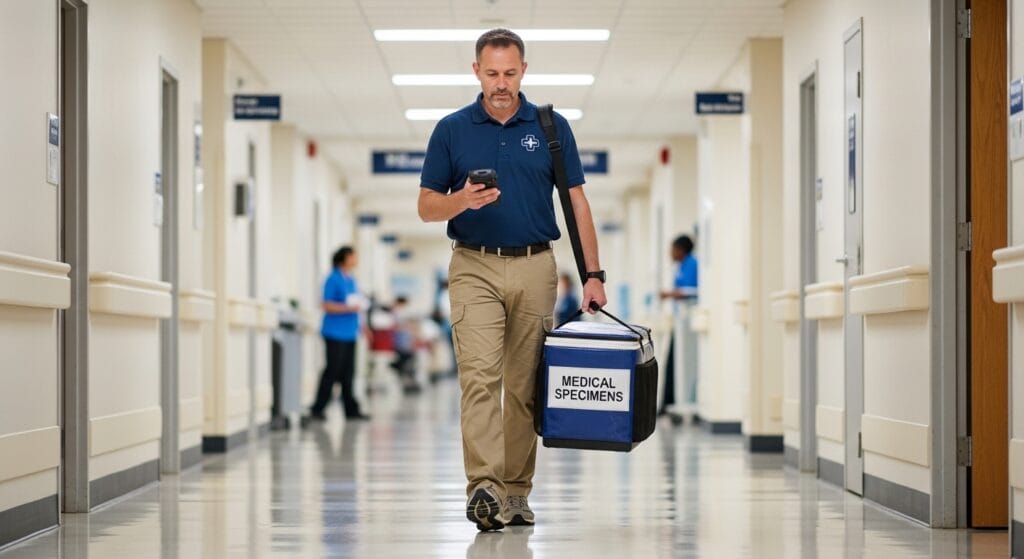
The 2026 Market Shift: Why Now Is the Opportunity
The medical courier landscape is experiencing a fundamental restructuring driven by economic and regulatory pressures.
The Big Shift: Offloading Liability
Major laboratories and hospital systems are systematically converting courier fleets from employee models to contractor networks. Quest Diagnostics and LabCorp, which traditionally employed large courier teams, are increasingly outsourcing routes to independent contractors who carry their own commercial insurance and assume liability for their operations.
Why? Risk mitigation and cost reduction. An employee courier costs the company $28-$35/hour when you include wages, payroll taxes, benefits, vehicle costs, insurance, and management overhead. A contractor billing $200 for a route that takes 5 hours costs the facility $40/hour but transfers all liability, vehicle risk, and operational management to the contractor.
This shift creates unprecedented opportunity for entrepreneurs ready to provide reliable service. Facilities need dependable couriers but don’t want to employ them. You become the vendor, not the worker.
Platform Proliferation
Simultaneously, technology platforms are democratizing access to medical delivery opportunities. Apps like Dropoff, Frayt, and specialized medical courier platforms connect drivers with one-off deliveries and short-term contracts that previously required inside connections.
This creates a two-tier market: on-demand platform work provides flexible supplemental income and helps new couriers build experience, while direct contracts with healthcare facilities provide the stable, high-margin revenue that builds six-figure businesses.
Salary by State: Highest Demand Regions
Medical courier pay varies dramatically by geography, driven by population density, healthcare infrastructure concentration, and regional wage markets. Understanding these variations helps you maximize earning potential through strategic location decisions.
| Rank | State | Contractor Hourly Equivalent | Key Advantages |
|---|---|---|---|
| 1 | New Jersey | $30.00 – $38.00 | Pharmaceutical capital of the US. Massive concentration of research labs, specialty pharmacies, and biotech facilities creates exceptional demand for stat deliveries and specialized transport. |
| 2 | Washington | $29.00 – $36.00 | High minimum wage floor elevates contractor rates proportionally. Seattle’s biotech boom and Spokane’s medical hub create dual market opportunities. |
| 3 | Massachusetts | $28.50 – $35.00 | Boston’s concentration of teaching hospitals, research institutions, and specialty labs generates premium rates. Cambridge biotech corridor adds high-value opportunities. |
| 4 | California | $28.00 – $35.00 | AB5 labor regulations make independent contracting more complex, reducing competition and increasing rates for properly classified contractors. Major metro areas support multiple daily routes. |
| 5 | New York | $27.00 – $34.00 | NYC and Long Island traffic conditions command premium pricing. High population density means shorter distances between stops, maximizing deliveries per hour. |
What Drives High Pay Markets:
The top-paying states share common characteristics: dense populations creating high stop-per-mile ratios, competitive wage markets forcing premium rates, significant pharmaceutical or biotech industries generating specialized transport needs, and geographic challenges (traffic, weather) that justify premium pricing.
New Jersey exemplifies the ideal market. A contractor based in Northern New Jersey can serve pharmaceutical companies in Morris County, research hospitals in Newark, specialty labs in Jersey City, and New York City facilities—all within a 30-mile radius. A single stat delivery across the Hudson River commands $100-$150 due to congestion pricing and urgency.
Lower Pay Markets:
Conversely, rural states with dispersed populations and lower healthcare spending per capita offer reduced earning potential. Mississippi, Arkansas, and Alabama see contractor rates of $17.50-$23.00/hour equivalent because routes involve long distances between sparse stops, reducing deliveries per hour and increasing fuel costs as a percentage of revenue.
However, lower costs of living in these states can partially offset wage differences. A contractor netting $3,500 monthly in Arkansas enjoys greater purchasing power than one netting $4,500 in San Francisco.
Getting Started: The Strategic Launch Sequence
Success as an independent medical courier contractor requires more than just a vehicle and willingness to drive. Follow this systematic launch sequence to build a sustainable business from day one.
Phase 1: Certification and Compliance (Week 1)
HIPAA Training: Your first business expense should be HIPAA certification for business associates. This training, costing $25-$90 and requiring 1-2 hours online, teaches you how to handle protected health information (PHI) that accompanies medical specimens and deliveries.
Search for “HIPAA for Business Associates” training from providers like HIPAATraining.com or MyFreeCE. The curriculum covers PHI recognition, transportation protocols, breach reporting, and legal compliance. Upon completion, you receive a certificate valid for one year.
This certification isn’t optional—it’s required by virtually every medical courier contract and platform. Facilities face severe HIPAA violation penalties, so they rigorously verify courier certification before granting access.
Bloodborne Pathogen Training: Your second essential certification addresses OSHA bloodborne pathogen standards. This $25-35 course teaches safe handling of biological specimens, preventing exposure to infectious materials.
The training covers transmission routes, personal protective equipment usage, spill cleanup procedures, and post-exposure protocols. Like HIPAA certification, this is delivered online, takes 1-2 hours, and results in a certificate.
Combined investment: $50-$125 and half a day of your time. That’s your total educational barrier to entry.
Phase 2: Business Formation (Week 1-2)
Form an LLC: Operating as a sole proprietor exposes your personal assets to business liability. A simple LLC (Limited Liability Company) creates separation between your business and personal finances, protecting your home, savings, and other assets if something goes wrong.
Most states allow online LLC formation for $50-$200. Services like Northwest Registered Agent or ZenBusiness streamline the process for $100-$300 including registered agent service.
Obtain EIN: The IRS provides Employer Identification Numbers free at irs.gov. This takes 10 minutes online and gives your business a tax identification number separate from your Social Security number. You’ll need this for commercial insurance applications and contractor agreements.
Phase 3: Insurance Acquisition (Week 2-3)
This is your biggest hurdle and largest expense, but it’s non-negotiable.
Commercial Auto Insurance: Personal auto policies explicitly exclude coverage during commercial activities. If you’re in an accident while transporting medical specimens under personal coverage, your claim will be denied.
Commercial auto insurance or a commercial use endorsement costs $2,500-$4,500 annually ($208-$375 monthly). Get quotes from multiple insurers specializing in courier coverage—rates vary dramatically.
General Liability Insurance: This protects against claims of property damage or bodily injury at client facilities. A $1 million policy costs $300-$600 annually and is required by most direct contracts.
Cargo Insurance: Some contracts require specific coverage for the medical cargo you’re transporting, typically $25,000-$50,000. This protects against lost or damaged specimens, which can represent significant value in testing costs and patient impact.
Yes, insurance represents substantial cost. But it’s also what separates legitimate contractors commanding premium rates from unlicensed drivers competing on price alone.
Phase 4: Equipment and Vehicle Preparation (Week 2-3)
Medical-Grade Cooler: Invest $80-$120 in a high-quality cooler that maintains 2-8°C temperature ranges. Many specimens must remain chilled throughout transport; failure to maintain temperature voids the delivery and creates liability.
Temperature Monitoring: Digital thermometers or data loggers ($30-$60) verify temperature maintenance. Some contracts require documented temperature logs.
Biohazard Spill Kit: OSHA regulations require appropriate cleanup materials when transporting biological specimens. A complete kit ($50-$80) includes absorbent materials, disinfectant, biohazard bags, and disposal gloves.
PPE and Sanitization: Stock gloves, masks, hand sanitizer, and sanitizing wipes ($30-$50). You’ll use these daily and clients notice professional hygiene practices.
Vehicle Considerations: 80% of medical courier work—lab specimens, pharmacy prescriptions, medical records—fits in a sedan or SUV. You only need a cargo van for durable medical equipment (hospital beds, wheelchairs, large supply orders).
However, cargo vans access higher-paying opportunities. Contractors with vans typically earn 20-30% more because they can accept bulk deliveries and specialized equipment transport that sedan drivers cannot.
Fuel efficiency matters enormously. A Prius completing 150-mile daily routes at 50 MPG spends $12 on fuel (at $4/gallon). A pickup truck at 18 MPG spends $33 for the identical route. Over 250 working days annually, that’s a $5,250 profit difference.
Phase 5: Platform Registration and First Deliveries (Week 3-4)
Sign Up for Multiple Platforms: Don’t put all your eggs in one basket. Create accounts on Dropoff, Frayt, and CBDriver simultaneously. Each has different client networks and delivery opportunities.
Upload your certifications, insurance documentation, vehicle registration, and photos. Most platforms require 3-7 business days for background checks and approval.
Accept Conservative First Runs: Your initial deliveries should focus on building competence, not maximizing income. Accept runs with comfortable timeframes, familiar geography, and straightforward pickup/delivery procedures.
Master the fundamentals: proper specimen packaging verification, temperature control maintenance, delivery confirmation protocols, and client communication. Early mistakes are costly—both financially and reputationally.
Document Everything: Keep meticulous records from day one. Track mileage, expenses, delivery times, and client feedback. This data becomes invaluable for tax deductions, rate negotiations, and identifying your most profitable opportunities.
The Direct Contract Strategy: Building Real Wealth
Platform work is your training ground. Direct contracts are your business foundation.
Why Direct Contracts Matter:
When you accept a delivery through Dropoff or Frayt, the platform typically keeps 25-40% of what the client pays. A facility paying $40 for a delivery might pay you $25, with the platform pocketing $15 for facilitating the connection.
Direct contracts eliminate this middleman. When you contract directly with a long-term care pharmacy for daily delivery routes, you negotiate the full rate. That same route paying $180 through a platform might pay you $250 directly—39% more revenue for identical work.
How to Land Direct Contracts:
Start by providing exceptional service on platform deliveries. When you pick up from the same laboratory three times in one week, introduce yourself to the office manager: “I notice I’m here frequently. If you ever need dedicated courier services outside the platform, here’s my card.”
Many facilities use platforms for overflow but prefer dedicated contractors for routine work. Platforms are convenient but expensive for regular, predictable runs.
Target long-term care pharmacies specifically. These pharmacies serve nursing homes and assisted living facilities, requiring daily medication deliveries on tight schedules. They need reliability above all else and prefer contractors who become familiar with their specific facilities and delivery protocols.
Search CBDriver.com for companies actively seeking dedicated courier contractors. These job board postings represent facilities ready to hire immediately.
Negotiating Your Rate:
Research local market rates before quoting. For dedicated daily routes, $200-$250 for 4-6 hours is standard. For per-mile work, quote $1.50-$1.75/mile for loaded miles (miles driven with cargo).
Emphasize your certifications, insurance coverage, and reliability. Facilities value dependable service over rock-bottom pricing—a missed delivery costs them far more than paying an extra $20/route.
The Stat Call Premium: Where Contractors Excel
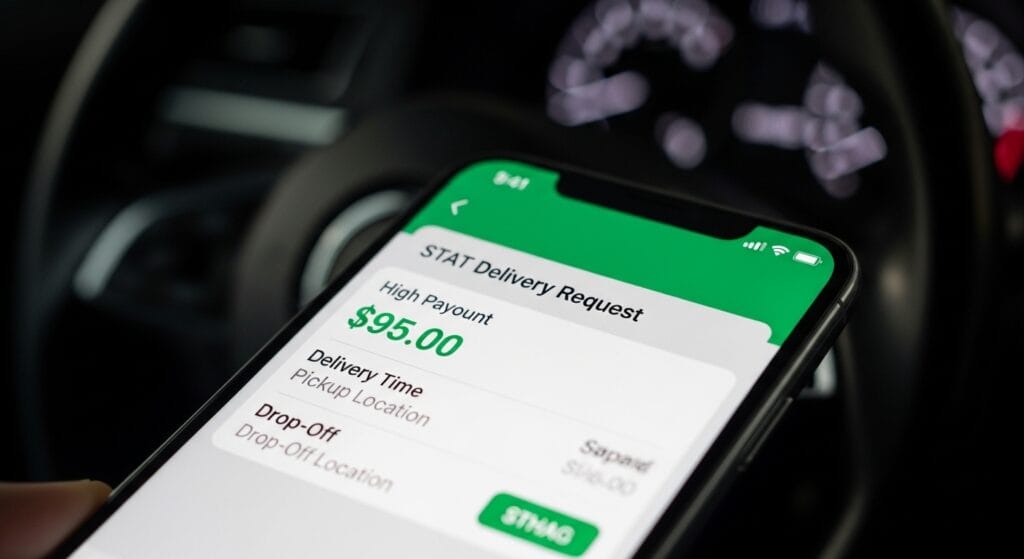
Emergency “stat” deliveries represent the highest profit margin work in medical courier services. These time-critical runs—organs for transplant, critical blood products, urgent surgical specimens—command $75-$120 for deliveries that often take just 60-90 minutes.
Getting on the Stat Call List:
Medical facilities maintain lists of trusted couriers for emergency calls. Getting on these lists requires proven reliability—they won’t risk critical cargo with unknowns.
Build your reputation through consistent platform work and direct contracts. After completing 20-30 deliveries flawlessly for a facility, mention your availability for stat calls. Provide your direct phone number and make it clear you can respond within 15-30 minutes.
Maximizing Stat Revenue:
Make yourself available during high-value windows: evenings (5 PM-10 PM), overnight (10 PM-6 AM), and weekends. Most couriers work standard business hours, creating scarcity for after-hours emergencies.
A contractor landing just two stat calls weekly at $100 each adds $10,400 annually—often for just 2-3 hours of additional work.
Scaling Beyond Solo Operations
The ultimate goal isn’t working more hours yourself—it’s building a business that generates income beyond your personal labor.
The Subcontractor Model:
Once you’ve secured three or more daily route contracts, hire other certified couriers as subcontractors. If you hold routes paying $250 daily and pay qualified drivers $180 to run them, you net $70 per route without driving.
Three subcontracted routes generate $210 daily profit ($1,050 weekly) while you focus on high-value stat calls, landing additional contracts, or running your most profitable route personally.
Quality Control:
Your reputation depends on your subcontractors’ performance. Hire carefully, require the same certifications you hold, and implement GPS tracking and delivery confirmation systems. One missed delivery by a subcontractor damages relationships you’ve spent months building.
The Exit Strategy:
A well-run medical courier business with established contracts, vetted subcontractors, and strong facility relationships becomes a salable asset. Multiple courier businesses have sold for 2-3x annual net profit because the routes and relationships transfer to new owners.
Frequently Asked Questions
How to become a medical courier with no experience?
Start with online HIPAA and bloodborne pathogen certifications ($50-$125 total, 3-4 hours). Form an LLC and obtain an EIN (free). Purchase commercial auto insurance ($2,500-$4,500/year). Register with platforms like Dropoff and Frayt. Accept your first deliveries through these apps to gain experience while building toward direct contracts. Most new couriers complete their first paid delivery within 2-3 weeks of starting the process.
Can I use a sedan for medical courier work?
Yes. Approximately 80% of medical courier work involves lab specimens, pharmacy prescriptions, medical records, and small equipment that easily fit in sedans or SUVs. You only need a cargo van for durable medical equipment (hospital beds, wheelchairs) or bulk supply deliveries. Start with your current vehicle if it’s reliable and in good condition. Upgrade to a van only after you’ve secured contracts that specifically require larger capacity.
How much does HIPAA certification cost?
HIPAA certification for medical couriers costs $25-$90 depending on the provider. Training takes 1-2 hours online and covers protected health information handling, transportation protocols, and compliance requirements. The certification is valid for one year, after which you complete a brief refresher course. Combined with bloodborne pathogen training ($25-$35), total certification costs run $50-$125—your complete educational investment to start this business.
What’s the difference between platform work and direct contracts?
Platform work connects you with deliveries through apps like Dropoff or Frayt. The platform handles client acquisition and payment processing but keeps 25-40% of the delivery fee. Direct contracts involve negotiating directly with healthcare facilities for dedicated routes or on-call services. You receive 100% of the agreed rate but must handle all client relationships, invoicing, and business development yourself. Most successful contractors use platforms for supplemental income while building a foundation of direct contracts for stable, high-margin revenue.
Do I need a special license to transport medical specimens?
No special driver’s license is required for medical courier work. A standard driver’s license suffices for transporting lab specimens, medications, and medical equipment. However, you do need HIPAA certification and bloodborne pathogen training—these aren’t licenses but compliance certifications. Some specialized work (like transporting hazardous chemicals) may require additional endorsements, but standard medical courier operations don’t require commercial driver’s licenses (CDL).
How much can I realistically make in my first year?
Conservative first-year estimates for part-time contractors (20-25 hours weekly) range from $25,000-$35,000 gross revenue. Full-time contractors (40-45 hours weekly) grossing $1,200-$1,600 weekly achieve $62,000-$83,000 annual revenue. After expenses (insurance, fuel, maintenance totaling approximately $12,000-$15,000 annually), net income ranges from $47,000-$68,000 for full-time operations. Top performers combining direct contracts with strategic stat call availability exceed $100,000 gross revenue in their first year, netting $75,000-$85,000 after expenses.
Data Methodology
The salary data, state-by-state analysis, and earning projections presented in this guide derive from multiple authoritative sources compiled in early 2026. Primary data sources include Bureau of Labor Statistics occupational wage data for medical couriers (SOC code 53-3011), platform rate cards from Dropoff, Frayt, and associated medical courier networks, and direct surveys of independent contractors operating in the medical logistics sector.
State-by-state wage comparisons reflect contractor-reported earnings through industry forums, platform payment data, and regional cost analysis adjusting for population density, healthcare infrastructure concentration, and competitive market conditions. Employee wage data comes from job postings from Quest Diagnostics, LabCorp, and regional hospital systems, verified against Glassdoor and Indeed salary reports.
Expense estimates (insurance, fuel, maintenance) reflect 2026 market rates for commercial auto insurance policies, current fuel prices averaging $3.80-$4.20/gallon nationally, and standard vehicle maintenance costs at recommended service intervals for high-mileage usage.
This guide presents earning potential ranges rather than guaranteed incomes because individual results vary based on geographic market, hours worked, business development skills, and operational efficiency. The data represents realistic expectations for dedicated contractors following industry best practices, not aspirational or outlier cases.
Your Next Steps:
The medical courier opportunity is real, substantial, and accessible. Within 30 days, you can complete certifications, secure insurance, register with platforms, and accept your first paid deliveries. Within 90 days, you can land your first direct contract. Within one year, you can build a business generating $75,000+ in net income.
The question isn’t whether the opportunity exists—it demonstrably does. The question is whether you’re ready to execute systematically, operate professionally, and build relationships that transform a driving gig into a legitimate business asset.
The healthcare system needs reliable medical couriers. Laboratories need trustworthy specimen transport. Pharmacies need dependable medication delivery. Patients need their test results and prescriptions to arrive on time.
You can be the person who makes that happen—while building genuine wealth in the process.
“If you are looking for Delivery Driver jobs, check out our guides on [Dump Truck Driver ] and [Cement Truck Driver ].”