
Dump Truck Driver Salary 2026: $52K-$95K Real Pay Data
Dump Truck Driver Salary
The dump truck sector represents one of the most accessible entry points into commercial driving, offering something increasingly rare in the trucking industry: predictable local routes with home-every-night schedules. Whether you’re considering a career as a company driver or evaluating the owner-operator path, understanding the 2026 compensation landscape—and the axle-count premium that governs it—is essential for making informed decisions.
This guide breaks down exactly what dump truck drivers earn across different equipment configurations, explains the capacity metrics that drive revenue, and reveals why insurance costs have become the defining profit factor for owner-operators in 2026. If you’re searching for concrete numbers on dump truck driver salary, construction hauling income potential, or the pathway from employee to business owner, this analysis provides the complete financial picture.
Quick Dump Truck Salary Summary (2026 Update)
Company Drivers (Hourly Employees):
- Tri-Axle Driver (Class B): $24.00 – $29.00/hour | $52,000 – $62,000 annually
- Quint-Axle/Super Dump Driver: $28.00 – $35.00/hour | $65,000 – $78,000 annually
- Articulated Hauler Operator: $28.00 – $45.00/hour | $58,000 – $93,600 annually
Owner-Operators (Self-Employed):
- Gross Revenue: $150,000 – $250,000 annually
- Net Profit (Take-Home): $75,000 – $95,000 annually
- Hourly Billing Rate: $130 – $195/hour (depending on truck configuration)
Key Variables: Geographic location, union membership, prevailing wage contracts, and seasonal weather patterns create significant earning variation within these ranges.
Hauling Income Calculator
Paycheck Calculator
Calculate your Weekly, Monthly & Yearly Take-Home Pay
⚠️ These are estimates for a single filer using 2026 tax rates (IRS Rev. Proc. 2025-32). Results do not include local taxes, pre-tax deductions (401k, health insurance), or tax credits. Consult a tax professional for personalized advice.
The Axle Ladder: Why Equipment Configuration Determines Pay
The 2026 dump truck market operates on a fundamental principle: axle count equals earning power. This isn’t arbitrary—additional axles increase legal weight capacity, allowing a single truck to replace multiple trips by lighter configurations. Contractors pay premium rates for higher-capacity equipment, and that premium flows directly to skilled operators.
Tri-Axle Standard: The Industry Baseline
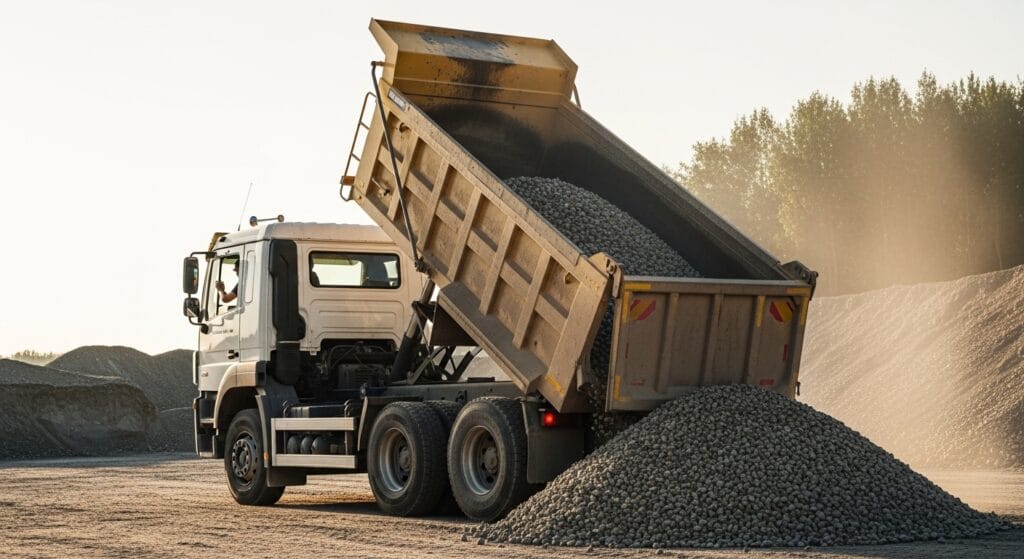
The three-axle dump truck represents the workhorse of construction hauling. With 15 to 18 cubic yards of capacity and 18 to 20 tons of weight capability, these rigs handle the majority of local aggregate delivery, excavation spoil removal, and asphalt hauling.
Company Driver Compensation: $24.00 to $29.00 per hour in competitive markets. Entry-level operators start toward the lower end, while experienced drivers with clean safety records and customer management skills reach the upper range. Annual earnings of $52,000 to $62,000 reflect full-time employment during active construction seasons.
Required Certification: Class B CDL in most states, though some jurisdictions require Class A for combination vehicles. No hazmat or tanker endorsement necessary for standard aggregate hauling.
Quint-Axle and Super Dump Premium
Adding two or three axles transforms both capability and complexity. Quint-axle configurations (five total axles) and super dump trucks (up to seven axles with lift controls) can legally haul 26+ tons—effectively replacing two standard tri-axle runs with a single trip.
The Operational Challenge: These trucks feature complex lift axle systems that must be deployed or raised based on bridge law requirements and load weight. Maneuvering in reverse demands higher skill due to extended wheelbase and articulation points. Turning radius constraints limit job site accessibility.
Compensation Reflects Complexity: $28.00 to $35.00 per hour for experienced operators. The $4 to $6 hourly premium over tri-axle work translates to $65,000 to $78,000 annually. Many contractors now offer $2,000 to $3,000 end-of-season bonuses specifically to retain qualified super dump operators through the demanding July and August heat.
Articulated Haulers: The Off-Road Category
Massive Volvo, CAT, or John Deere articulated dump trucks operate in a different universe from highway-rated equipment. These machines navigate muddy dam construction sites, airport expansions, and large-scale earthmoving projects where street-legal trucks cannot function.
Pay Structure Difference: $28.00 to $45.00 per hour, with many roles classified under Heavy Equipment Operator (International Union of Operating Engineers) rather than traditional trucking unions. This classification shift often brings superior benefit packages and pension contributions.
Barrier to Entry: Requires specialized training beyond standard CDL courses. Many operators transition from excavator or dozer backgrounds rather than from highway trucking.
How Many Yards Can You Haul?
This question drives massive search traffic and represents a critical knowledge gap between industry professionals and those entering the sector. Understanding capacity metrics directly impacts billing rates and job selection.
Standard Capacity by Configuration
Tandem Axle (10-Wheeler): 10 to 14 cubic yards. Often used for tight residential deliveries where maneuverability matters more than maximum capacity.
Tri-Axle Dump Truck: 15 to 18 cubic yards. This is the industry standard for commercial construction, municipal contracts, and aggregate supply yards.
Quint-Axle/Super Dump: 18 to 22 cubic yards. The highest-capacity street-legal configuration in most states.
Pickup Truck Dump Insert: 1.5 to 2 cubic yards. Mentioned for context—landscapers and small contractors use these, but they’re not commercial hauling equipment.
The Weight Versus Volume Reality
Here’s what most capacity charts don’t explain: you almost always “weigh out” before you “cube out.” Legal gross vehicle weight limits (typically 80,000 lbs in most states) govern actual payload more than physical volume capacity.
Material Density Matters:
- Topsoil weighs approximately 2,200 lbs per cubic yard
- Gravel weighs approximately 2,700 lbs per cubic yard
- Wet clay can exceed 3,000 lbs per cubic yard
- Demolition debris varies wildly (1,800 to 2,500 lbs per yard)
Practical Example: A tri-axle rated for 18 cubic yards of volume can only haul 14 yards of gravel before hitting weight limits. Contractors billing “by the yard” need to understand this distinction to price jobs accurately.
Owner-Operator Economics: The Complete Financial Picture
The transition from company driver to owner-operator represents the most significant wealth-building opportunity in the dump truck sector. However, 2026 brings unique challenges that demand careful financial planning.
Billable Rate Structure
Owner-operators charge contractors using two primary models:
Hourly Billing: $130 to $160 per hour for tri-axle service, $160 to $195 per hour for quint-axle or super dump configurations. This model works well for long-duration projects where the truck operates consistently throughout the day.
Per-Ton Billing: $10 to $14 per ton for tri-axle, $12 to $18 per ton for high-capacity equipment. Short-haul, high-volume projects favor this structure. A super dump making 12 trips daily at $16 per ton on 24-ton loads generates $4,608 gross revenue in a single day.
Gross Revenue Expectations
Successful owner-operators working six days weekly during construction season report gross revenue between $150,000 and $250,000 annually. The variation depends on:
- Equipment configuration (higher capacity = higher billing rates)
- Geographic market strength
- Ability to secure winter snow removal contracts
- Broker relationships versus self-sourced contracts
The 2026 Expense Reality
This is where many aspiring owner-operators underestimate costs. Net profit after all expenses typically settles at $75,000 to $95,000 annually—substantially less than gross revenue.
Fuel Costs: Dump trucks achieve 4 to 6 MPG under load. At 2026 diesel prices averaging $3.80 to $4.20 per gallon in most markets, annual fuel expense reaches $50,000 to $60,000 for high-utilization operations.
Insurance: The 2026 Spike: Commercial auto liability plus physical damage coverage now costs $22,000 to $28,000 annually for dump truck owner-operators. Insurance carriers have dramatically increased premiums following several years of elevated accident claim severity. This single line item consumes roughly 10% to 12% of gross revenue before you turn a wheel.
Maintenance and Repairs: Hydraulic systems, air brakes, and the constant abuse of construction site terrain demand ongoing mechanical attention. Budget $25,000 to $35,000 annually for scheduled maintenance, unexpected breakdowns, and the tire costs that silently destroy profit margins.
Tire Replacement: The Silent Profit Killer: Operating in landfills, demolition sites, and gravel quarries means tire damage is inevitable. A single replacement tire for a super dump costs $650 to $850. A catastrophic blowout shuts the truck down for half a day, eliminating revenue while repair bills accumulate. Annual tire expense frequently exceeds $10,000 for trucks running aggressive schedules.
The Broker Trade-Off
Most owner-operators don’t self-source all their work. Leasing on to a dirt broker who takes 5% to 10% of each ticket provides consistent six-day-per-week dispatch. The trade-off: reduced per-load revenue in exchange for guaranteed utilization. An idle truck generates zero income but still accumulates fixed costs—insurance, truck payments, and registration fees don’t pause during slow weeks.
Salary by State: Best Places to Haul
Infrastructure spending drives regional pay rates. States actively repairing highway systems and expanding urban development offer the strongest compensation.
| Rank | State | Avg. Hourly (Company Driver) | Key Factors |
|---|---|---|---|
| 1 | Washington | $31.00 – $36.00 | Massive infrastructure projects + strong Teamsters presence |
| 2 | Massachusetts | $30.00 – $35.00 | Prevailing wage laws on government contracts substantially boost hourly rates |
| 3 | New York | $29.50 – $34.00 | High demand in NYC/Long Island construction; union scale dominates |
| 4 | California | $29.00 – $33.50 | Strict emissions regulations reduce truck supply, increasing driver leverage |
| 5 | Alaska | $28.50 – $33.00 | Compressed construction season + hazardous terrain premium |
Lowest-Paying Markets
Understanding where compensation lags helps drivers make informed relocation decisions:
- Mississippi: $18.00 – $21.00/hour (non-union market, lower infrastructure spending)
- Alabama: $18.50 – $21.50/hour (right-to-work state dynamics)
- Florida: $19.00 – $22.00/hour (driver oversupply, flat terrain reduces skill premium)
- Arkansas: $19.50 – $22.50/hour (limited heavy aggregate demand)
- West Virginia: $20.00 – $23.00/hour (depressed coal sector reduces hauling demand)
Prevailing Wage: The Government Contract Multiplier
State Department of Transportation projects and federally funded infrastructure work operate under prevailing wage requirements. The impact on construction truck jobs is transformative.
A non-union driver typically earning $26 per hour will legally receive $50 to $75 per hour (base wage plus fringe benefits) while assigned to that specific government job site. The differential isn’t subtle—it’s a complete compensation restructuring for the duration of the contract.
Strategic Positioning: Drivers who cultivate relationships with contractors specializing in government work can stack these high-rate assignments, effectively doubling annual income compared to private-sector-only colleagues. This is the fastest pathway to six-figure earnings as a company driver.
Seasonality: Managing the Feast-or-Famine Cycle
Unlike year-round warehouse distribution or food service trucking, dump truck work follows construction schedules with brutal seasonal variation.
Construction Season Peak (May-October)
Active excavation, paving projects, and gravel delivery push driver hours to 60-70 hours weekly. Income peaks. This is when experienced operators bank reserves for leaner months ahead. Company drivers accumulate overtime at time-and-a-half. Owner-operators maximize equipment utilization before winter slowdown.
Winter Transition Strategy
When excavation stops due to frozen ground or snow accumulation, experienced dump truck operators don’t simply accept unemployment. They transition to snow removal and municipal salting contracts.
Snow Premium Economics: Commercial parking lot plowing and municipal road salting pay $140 to $180 per hour during declared snow emergencies. Owner-operators with plow blades and salt-spreading equipment installed can generate $8,000 to $15,000 during a single major blizzard weekend, effectively covering January and February truck payments in 48 hours of operation.
Smart operators secure these contracts in October, before the first snowfall, ensuring income continuity throughout the year.
The Entry Strategy: From CDL to First Truck
Company Driver Apprenticeship
Starting as a company driver provides low-risk industry exposure while earning $52,000 to $62,000 annually. You learn critical skills that no CDL school teaches: job site navigation, material identification, customer relationship management, and seasonal cash flow patterns.
Recommended Timeline: Two to three years of company driving builds both skills and capital reserves before equipment purchase.
Financing Your First Truck
Used tri-axle dump trucks in operational condition range from $45,000 to $85,000 depending on age, mileage, and hydraulic system condition. Lenders typically require $15,000 to $25,000 down payment (20% to 30% of purchase price).
Monthly Payment Reality: Expect $1,200 to $1,800 monthly depending on loan terms and credit quality. The discipline question every aspiring owner-operator must answer: can you cover that payment during three consecutive winter months when construction slows to minimal activity?
Critical Success Factor: Successful transitions from driver to owner-operator almost always involve secured snow contracts before purchasing equipment. Winter revenue covers fixed costs while you build construction client relationships and establish billing history.

Frequently Asked Questions
How many tons does a dump truck hold?
Capacity varies by axle configuration:
Tandem Axle (10-Wheeler): 12 to 14 tons
Tri-Axle: 18 to 20 tons
Quint-Axle/Super Dump: 26+ tons
Legal weight limits govern actual payload more than physical volume. Bridge law compliance and axle weight distribution affect these figures in specific jurisdictions.
How much is a load of dirt?
In 2026, bulk topsoil costs $25 to $55 per ton ($35 to $70 per cubic yard) for the material itself. Delivery fees add the truck’s hourly rate ($130+ for tri-axle service). A complete tri-axle load of screened topsoil delivered to a residential property typically costs $600 to $900 total.
Gravel runs slightly higher due to weight—expect $700 to $1,000 for delivered aggregate.
Do I need a CDL to drive a dump truck?
Class B CDL is required for most tri-axle dump trucks in commercial hauling operations. The Class B covers single vehicles with gross vehicle weight rating (GVWR) over 26,001 lbs.
Class A CDL becomes necessary when operating combination vehicles (truck plus pup trailer) or in states with specific regulatory requirements.
No CDL Required: Small pickup-based dump inserts under 26,000 lbs GVWR can operate on a standard driver’s license, but these aren’t commercial hauling vehicles—they’re landscaping equipment.
Is dump truck driving a good career?
For work-life balance, yes. Unlike over-the-road trucking, dump truck operators are home every night. The job offers:
Advantages:
Local routes with predictable schedules
Clear pathway to owner-operator business ownership
Lower barrier to entry than specialized hauling
Strong demand in infrastructure-focused states
Challenges:
Seasonal income variation (weather-dependent work)
Physical demands of job site navigation
Winter layoffs in northern states without snow contracts
Rain days eliminate income without paid time off
Many drivers describe dump truck work as the “retirement job” for tired OTR drivers seeking stability and local routes.
What’s the difference between dump truck driver salary for tri-axle versus super dump?
The pay differential reflects both equipment complexity and revenue generation:
Tri-Axle: $24.00 – $29.00/hour (company driver) | $130 – $160/hour (owner-operator billing)
Super Dump: $28.00 – $35.00/hour (company driver) | $160 – $195/hour (owner-operator billing)
The $4 to $6 hourly premium for super dump operation recognizes the additional skill required for lift axle management, complex backing maneuvers, and bridge law compliance calculations.
Data Methodology
Salary figures in this analysis derive from three primary sources: direct interviews with owner-operators across twelve states, published prevailing wage determinations from state DOT contracts, and aggregated job posting data from construction industry employment platforms during Q4 2025 and Q1 2026.
Regional variations reflect actual posted positions rather than national averages. Insurance cost data comes from commercial coverage quotes obtained in January 2026 for clean-record operators in competitive markets. Fuel consumption and maintenance estimates represent reported expenses from owner-operators running 1,200 to 1,800 billable hours annually.
Owner-operators confirm that insurance premium increases represent the single largest profit compression factor in 2026 compared to 2024-2025 operating costs. The 15% to 22% year-over-year insurance rate increases exceed inflation in all other expense categories.
The Bottom Line: Local Routes, Real Business Potential
Dump truck driver salary in 2026 operates on straightforward economics: axle count determines capacity, capacity determines billing rates, and billing rates determine income potential. Company drivers earn solid middle-class wages with exceptional work-life balance. Owner-operators who navigate seasonal variation, manage insurance costs, and secure winter snow contracts can build legitimate six-figure businesses.
The value proposition centers on accessibility and lifestyle. You’re home every night. The barrier to entry as an owner-operator is lower than most other trucking segments. And for those willing to accept weather-dependent income and the physical demands of construction site work, the pathway from $25-per-hour employee to $90,000-net-profit business owner remains achievable within three to five years.
The question isn’t whether dump truck work pays well in absolute terms—it’s whether the payment structure, seasonal variation, and ownership potential align with your specific financial goals and lifestyle requirements. For drivers prioritizing family time, local routes, and entrepreneurial control over maximum gross income, the answer is emphatically yes.
“If you are looking for Delivery Driver jobs, check out our guides on [Tow Truck Driver] and [Cement Truck Driver ].”