TSA Officer Salary 2026: $40K–$76K Real Pay Scale
TSA Officer Salary
If you’ve been searching for a stable, long-term government career with genuine advancement potential, the Transportation Security Administration is worth your serious attention in 2026. This isn’t the TSA of a decade ago, where officers were stuck in a stagnant pay system with little hope of meaningful raises. The Pay Equity Plan has fundamentally changed the compensation structure, aligning TSO salaries with the rest of the federal government and guaranteeing progression milestones that simply didn’t exist before. This guide breaks down every number you need to understand what you’ll earn, where you’ll earn the most, and why the full federal benefits package makes this career far more valuable than its base salary suggests.
Quick TSA Salary Summary (2026 Update)
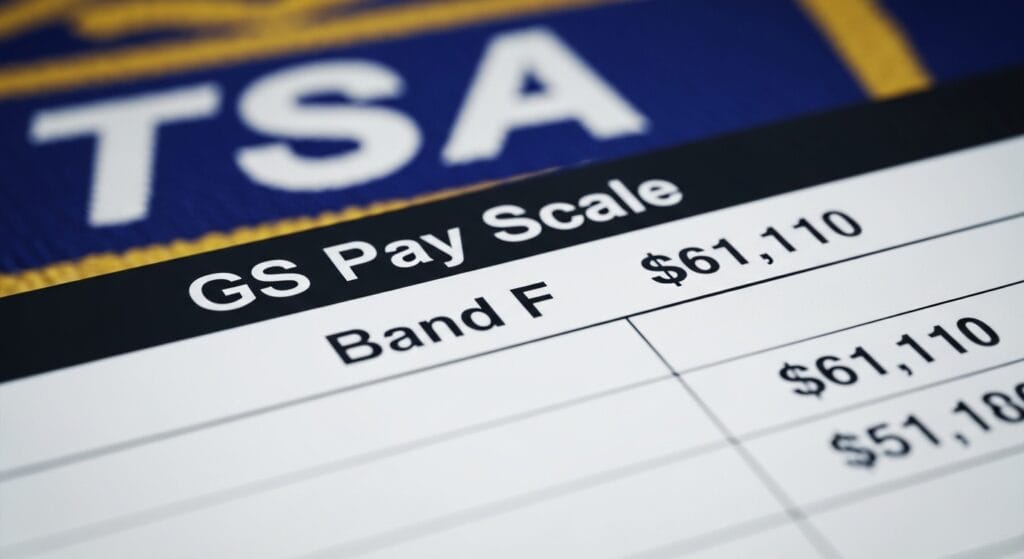
Entry-Level (Band D) starts at $40,327 with standard locality — or $50,413+ at high-cost airports like SFO. After just 12 months, automatic promotion to Band E brings your salary to $49,960+. Within 24 months, Band F reaches $61,110 – $71,240+ depending on location. Locality Pay adds 17% – 46% on top of every base figure. Full package includes FERS pension, 5% TSP match, and FEHB health coverage (72% government-paid premium).
TSA Pay Calculator (Base + Locality)
Paycheck Calculator
Calculate your Weekly, Monthly & Yearly Take-Home Pay
⚠️ These are estimates for a single filer using 2026 tax rates (IRS Rev. Proc. 2025-32). Results do not include local taxes, pre-tax deductions (401k, health insurance), or tax credits. Consult a tax professional for personalized advice.
What Changed: The Pay Equity Plan Explained
Since the Pay Equity Plan implementation, TSA Officers are compensated under a system that mirrors the federal government’s General Schedule (GS) framework — the same pay structure used by agencies like the FBI, IRS, and Department of Veterans Affairs. This matters enormously because it replaced the old SV pay system, which offered very little in the way of predictable raises or transparent advancement timelines.
The new structure is built around three primary officer bands:
Band D (GS-5 Equivalent) — Entry Level. This is where every new hire begins. Band D is best understood as a 12-month probationary salary, not a career wage. You’re being trained, evaluated, and prepared for certification across all checkpoint positions: X-ray operation, pat-down procedures, travel document checking, and more. Band D is the starting line, not the destination.
Band E (GS-7 Equivalent) — Experienced Officer. After one year of satisfactory performance, you automatically advance to Band E. No open positions needed. No supervisor approval required. This single promotion delivers a pay increase of roughly $8,000–$10,000 depending on your airport’s locality rate. Band E is also a legitimate long-term career home for officers who choose not to pursue leadership. You can build an entire TSA career at Band E, advancing through step increases for decades.
Band F (GS-9 Equivalent) — Lead Officer. After a second year, you advance again to Band F — the full-performance level. Band F officers wear stripes and take on additional responsibilities: managing checkpoint rotation, covering breaks, and handling more complex screening scenarios. Most career-focused TSOs aim for Band F as their primary compensation milestone.
Band G (GS-11 Equivalent) — Supervisor. Officers who wish to move into management can compete for Supervisory TSO positions at Band G. This is a competitive promotion (not automatic), but it opens salaries in the $63,160–$82,100+ range before locality adjustments.
2026 TSA Officer Salary by Band: Base Pay Table
The following figures represent base pay only. Your actual paycheck will be meaningfully higher once your airport’s locality percentage is applied. These base figures are consistent across all TSA locations nationally.
| TSA Band | Role | GS Equivalent | Base Pay Range |
|---|---|---|---|
| Band D | TSO – Entry Level | GS-5 | $34,450 – $44,780 |
| Band E | TSO – Experienced | GS-7 | $42,680 – $55,480 |
| Band F | Lead TSO | GS-9 | $52,200 – $67,860 |
| Band G | Supervisor (STSO) | GS-11 | $63,160 – $82,100 |
The range within each band reflects the “step” system — 10 incremental raises you earn automatically through years of service. A Band F, Step 1 officer earns $52,200 base; a Band F, Step 10 officer earns $67,860 base. Those steps accumulate over roughly 18 years, arriving at regular intervals of one, two, or three years depending on your level.
Locality Pay: Why LAX Pays More Than Omaha
The federal government’s Office of Personnel Management (OPM) publishes annual locality pay tables that determine how much additional compensation is added on top of base salaries for workers in different geographic areas. The logic is straightforward: $52,000 doesn’t buy the same lifestyle in San Francisco that it does in rural Nebraska. Locality pay is the government’s mechanism for maintaining purchasing power equity across the country.
For TSA officers, locality pay is calculated using a simple formula:
Base Pay × (1 + Locality Percentage) = Your Actual Salary
A Band D officer at a small regional airport in the “Rest of U.S.” (RUS) zone earns: $34,450 × 1.1706 = $40,327. That same officer accepting a transfer to Los Angeles earns: $34,450 × 1.3647 = $47,013 — a $6,686 annual difference for the identical job and seniority level, before a single additional hour of overtime or premium shift.
2026 Key Locality Rates:
- San Francisco Bay Area (SFO): +46.34% — highest in the nation
- New York Metro (JFK/LGA/EWR): +37.95%
- Los Angeles (LAX): +36.47%
- Washington DC/Baltimore (DCA/BWI/IAD): +34.35%
- Seattle-Tacoma (SEA): +29.12%
- Denver (DEN): +27.43%
- Orlando (MCO): +19.41%
- Rest of U.S. (Baseline): +17.06%
The practical implication for your career planning is significant. TSA actively allows officers to apply for transfers between airports. An officer who starts their career in a lower-cost market to gain experience and seniority, then transfers to a high-cost hub, keeps all their step progress at Band E or F while immediately receiving the new airport’s full locality adjustment. It’s one of the most underused strategic moves available to career TSOs.
Salary by Airport: Top Paying Hubs (2026)
The table below shows what a Band F (Lead TSO) officer earns at entry of the band (Step 1) after 24 months of service at each major hub. These figures represent the realistic near-term salary target for most officers who successfully complete their first two years.
| Airport | City | Locality Rate | Band F Step 1 Salary |
|---|---|---|---|
| SFO | San Francisco, CA | +46.34% | $76,388 |
| JFK / LGA | New York, NY | +37.95% | $71,985 |
| LAX | Los Angeles, CA | +36.47% | $71,214 |
| DCA / IAD | Washington, DC | +34.35% | $70,115 |
| BOS | Boston, MA | +31.97% | $68,873 |
| SEA | Seattle, WA | +29.12% | $67,393 |
| ORD / MDW | Chicago, IL | +29.12% | $67,393 |
| MCO | Orlando, FL | +19.41% | $62,341 |
| Rest of U.S. | Smaller markets | +17.06% | $61,121 |
Note: Band F reaches Step 10 ($67,860 base) after approximately 18 years of service through step increases alone. At SFO locality rates, Band F Step 10 exceeds $99,300 annually — without ever becoming a supervisor. Add Sunday and night differential pay (see below), and six-figure compensation is genuinely achievable for career officers at major hubs.
Shift Differentials: The Premium Pay Most Applicants Miss
TSA officers at major airports frequently work overnight shifts and Sunday assignments, and the federal pay system rewards this with substantial hourly premiums. These differentials are applied on top of your full locality-adjusted salary.
Night Differential (+10%): Any work performed between 6:00 PM and 6:00 AM earns an additional 10% of your base hourly rate. A Band F officer at a moderate-cost airport earning $61,110 annually ($29.38/hr) takes home $32.32/hr during night hours.
Sunday Premium (+25%): Any shift that falls on a Sunday earns 25% above your standard hourly rate for the entire shift. The same Band F officer earns $36.73/hr on Sundays.
Combined Night + Sunday: Officers working Sunday overnight shifts receive both differentials simultaneously. In practice, this means $40–$45/hr for a Band F officer at a mid-tier airport, and $50–$58/hr for officers at top-paying hubs like SFO or JFK.
Officers who strategically select Sunday night shifts throughout the year can add $8,000–$15,000 to their reported W-2 earnings annually, meaningfully boosting their “high-3” average — the figure used to calculate their FERS pension at retirement.

Federal Benefits: The Compensation Nobody Talks About
The TSA salary figures above are only part of the compensation story. Federal financial advisors routinely estimate that the full benefits package adds 30–40% to the effective value of a TSO’s compensation. Here is a clear-eyed breakdown of what that means in practice.
FERS Pension (Defined-Benefit Retirement)
TSA officers are enrolled in the Federal Employees Retirement System (FERS) from their first day of employment. You contribute 4.4% of your gross salary into the pension; the federal government contributes approximately 18%. After 20–30 years of service, you receive a guaranteed monthly annuity check for life, calculated as follows:
1% × High-3 Average Salary × Years of Service = Annual Pension
A Band F officer who retires after 25 years with a high-3 average of $72,000 receives $18,000 per year ($1,500/month) for life, with cost-of-living adjustments built in. At age 62 or older with at least 20 years of service, the multiplier increases to 1.1%, improving the annual pension to $19,800. This is a financial asset — a defined-benefit pension equivalent to a $350,000–$500,000 private savings account — that private security contractors simply cannot offer.
Thrift Savings Plan (TSP)
The TSP is the federal government’s equivalent of a 401(k), with contribution limits set at $24,500 in 2026. The government provides: (1) an automatic 1% contribution to your TSP account regardless of whether you contribute, and (2) a dollar-for-dollar match on the next 3% you contribute, plus a 50% match on the following 2%. In plain terms: if you contribute 5% of your salary, the government adds 5% for free. A Band F officer at $61,110 who contributes 5% ($3,056) receives a $3,056 government match, doubling their retirement savings contribution at no additional out-of-pocket cost.
Federal Employees Health Benefits (FEHB)
TSA officers access the same health insurance marketplace available to U.S. senators and members of Congress — approximately 200 plan options including national PPOs, HMOs, and high-deductible plans. The federal government covers approximately 72% of premium costs regardless of which plan you select. Typical employee contributions for family coverage run $250–$450/month, compared to $700–$1,100/month for equivalent private-sector coverage. Dental and vision coverage is available through the Federal Employees Dental and Vision Insurance Program (FEDVIP) at group rates.
Part-Time Benefits: An Unusual Advantage
Many TSA airports hire new officers on a part-time basis (20–25 hours per week) to cover peak morning and evening screening banks. What distinguishes federal part-time employment from private-sector equivalents is that part-time TSOs receive full health, dental, and vision benefits and accrue pro-rated annual and sick leave. Most part-timers can bid for full-time lines within 6–12 months as seniority accumulates. This makes a TSA part-time position meaningfully more valuable than most hourly private jobs.
Frequently Asked Questions
Is the job boring? What does a typical shift actually look like?
This is one of the most common questions prospective officers ask, and it deserves a candid answer. TSA work is repetitive by design — checkpoint security requires consistency, not creativity. On a given day, you will rotate through multiple positions: operating the X-ray monitor, managing the travel document checking station, conducting physical pat-downs, and managing passenger flow at the divest belt. Rotation happens every 30 minutes at most airports to prevent fatigue and maintain alertness.
Whether this feels boring depends entirely on your personality. Officers who find purpose in the security mission — understanding that their vigilance is a genuine national security function — tend to settle in well. Officers who need varied, creative work tend to struggle. The social dimension also matters: TSA checkpoints are inherently people-centric environments. You will interact with hundreds of travelers daily, assist nervous flyers, and work alongside a team that becomes tightly knit due to shared schedules. Most career officers describe the work as “comfortable” rather than boring, especially once they hold seniority and can bid preferred positions and shifts.
How long is the background check? What should I expect?
TSO candidates report the background check takes anywhere from three to six months on average, though timelines vary significantly by airport, staffing needs, and the complexity of your personal history. The investigation covers your full employment history, residential history, financial background, and criminal record. Common delays involve: gaps in employment history, prior addresses that are difficult to verify, foreign travel, and financial issues such as delinquent federal debt.
To expedite your process, proactively gather documentation before you apply: tax returns for the past three years, a complete residential history with landlord contact information, a comprehensive employment history with supervisor names and contact details, and reference information for personal references who can be reached quickly. Officers who are well-organized during the suitability review phase typically clear faster than those who require multiple follow-up requests from investigators.
Do I get a pension? How does retirement actually work for TSA officers?
Yes — TSA officers receive the Federal Employees Retirement System (FERS) pension, which is a defined-benefit plan. This means the government guarantees you a monthly check for the rest of your life after you meet the service and age requirements. The basic formula is 1% of your high-3 average salary multiplied by your years of service.
For law enforcement officers (a category that includes Transportation Security Officers under specific provisions), early retirement is possible at age 50 with 20 years of service. For standard FERS, you can retire at your Minimum Retirement Age (MRA, ranging from 55–57 depending on birth year) with 30 years of service. FERS also includes Social Security coverage, meaning TSA officers accrue Social Security credits alongside their pension — a significant advantage over some older federal retirement systems that excluded Social Security participation.
The TSA Assessment Battery: What to Expect on the Entrance Exam
The hiring process includes a required aptitude exam — the TSA Assessment Battery (TAB) — that has seen meaningful updates in recent years. The section that trips up the most applicants is the 2D-to-3D Spatial Reasoning component. You are shown a flat, two-dimensional shape (imagine an unfolded cardboard box template) and must identify which three-dimensional object it would become when folded. It tests your brain’s ability to mentally rotate and assemble shapes — a skill that correlates strongly with X-ray image interpretation.
Practice materials for this section are available online, including video walkthroughs that demonstrate folding strategies step-by-step. Candidates who spend even five to ten hours with practice problems before their test date report substantially higher confidence. The written and interpersonal portions of the assessment are more straightforward, but the spatial reasoning section rewards dedicated preparation.
Data Methodology
The salary figures in this guide are derived from the following sources:
Base Pay: 2026 General Schedule (GS) pay tables published by the U.S. Office of Personnel Management (OPM), reflecting the 2026 federal pay adjustment. TSA Band D, E, and F figures are directly mapped to GS-5, GS-7, and GS-9 Step 1 equivalents respectively, consistent with the agency’s Pay Equity Plan band alignment.
Locality Pay Rates: 2026 OPM locality pay tables for the cited metropolitan areas (San Francisco-Oakland-San Jose, New York-Newark-Jersey City, Los Angeles-Long Beach-Anaheim, Washington DC-Baltimore-Arlington, Boston-Worcester-Providence, Seattle-Tacoma, Chicago-Naperville, Orlando-Deltona-Daytona Beach, and Rest of U.S.). Rates reflect the final 2026 OPM schedules.
Benefits Figures: FERS pension formula and TSP matching structure per the Office of Personnel Management FERS regulations. FEHB premium contribution percentages per OPM FEHB Program guidance (approximately 72% government share). TSP 2026 contribution limits per IRS Publication 560.
Shift Differentials: Night differential (10%) and Sunday premium (25%) rates per Title 5 U.S. Code, § 5546, governing premium pay for federal employees.
Disclaimer: Salary projections are estimates based on publicly available federal pay data. Actual compensation may vary based on step placement, geographic reassignments, agency-specific premium pay policies, and future federal pay adjustments. Prospective applicants should verify current rates at OPM.gov and USAJOBS.gov prior to accepting any offer.
Last Updated: 2026 Pay Period 1 | Source: OPM.gov, TSA.gov, USAJOBS.gov
“If you are looking for Government & USPS jobs, check out our guides on [USPS PSE Clerk] and [USPS Mail Handler].