
Amazon Flex Worth It? Drivers Keep 30% of Pay
📊 Quick Facts — Amazon Flex Salary 2026
| Advertised Gross Pay | $18.00 – $25.00 / hr |
| Real Net Hourly Pay | ~$5.67 / hr (avg) |
| Surge Pay Ceiling | Up to $55.00 / hr |
| National Avg Annual Gross | $38,383 |
| Top 10% Annual Gross | ~$49,000 |
| Entry-Level / 25th Percentile | ~$33,500 gross |
| BLS OES Code | 53-3031 (Driver/Sales Workers & Truck Drivers) |
| IRS Mileage Rate 2026 | 72.5¢ / mile (Notice 2026-10) |
| Last Updated | March 2026 |
If you’re searching for how much do Amazon Flex drivers make before you sign up, here’s the short answer: advertised gross pay is $18–$25/hr, but most drivers take home closer to $5–$6 after real expenses. That’s not a typo. Read every word of this breakdown before you put a single mile on your car.
Amazon Flex Worth It? (2026)
Amazon Logistics is an absolute freight train right now. The company processed an estimated 6.3 billion domestic deliveries in 2024 — a 6.78% year-over-year increase — capturing a 28.2% share of the entire U.S. parcel market. That translates to roughly 17.2 million orders per day, 717,000 packages per hour, and 199 packages per second. Amazon is mathematically projected to overtake the USPS by total volume before 2028.
The gig economy propping all of this up has swelled to a $674.1 billion global market in 2026, with approximately 76.4 million Americans now working as independent contractors. On paper, that makes this the golden age of flexible driving work. In practice, it means you’re competing harder than ever for blocks.
Here’s what the app won’t tell you: Amazon runs a two-tier delivery network by design. The heavy lifting goes to roughly 390,000 Delivery Service Partner (DSP) drivers in branded Amazon vans — salaried employees of contracted companies, handling predictable high-density routes. The Flex pool, approximately 85,000 active independent contractors, is the overflow valve. You get the unpredictable spillover: rural routes, sub-same-day spikes, Amazon Fresh grocery runs, and whatever the algorithm decides nobody else wants.
One DSP driver on an optimized route can process the work of five or six Flex drivers. Amazon knows this. The algorithm is structured around it. Flex blocks are genuinely scarce, competitive, and increasingly dominated by tech-savvy drivers using notification bots to snag openings within milliseconds of posting. If you’re manually refreshing the app, you’re already losing the battle.
The 2026 outlook adds another wrinkle: Amazon is pouring $4 billion into rural expansion, tripling its rural delivery network and targeting 4,000 smaller cities for same-day and next-day service. New blocks will appear — but they’ll come loaded with high-mileage dispersed routes that quietly destroy your profit margins. More on that in a minute.
Plug in your block payout and mileage to calculate your true net hourly wage:
Paycheck Calculator
Calculate your Weekly, Monthly & Yearly Take-Home Pay
⚠️ These are estimates for a single filer using 2026 tax rates (IRS Rev. Proc. 2025-32). Results do not include local taxes, pre-tax deductions (401k, health insurance), or tax credits. Consult a tax professional for personalized advice.
Formula: (Gross Block Pay) – (Total Miles × $0.20 fuel) – (Total Miles × $0.12 depreciation) – (15.3% × [Gross – Miles × $0.725]) = Net Pay. Divide by block hours for real hourly rate.
Amazon Flex Salary Breakdown: Gross Pay vs True Net Earnings
This is the section where the math gets brutal. Understanding Amazon Flex salary 2026 requires treating yourself like a small business, not an employee — because that’s exactly what you are in the eyes of the IRS.
Table 1: Amazon Flex Hourly Pay 2026 — Advertised Gross vs. Real Net
| Salary Metric | Pay Rate | What It Actually Means |
|---|---|---|
| Advertised Base Pay | $18.00 – $25.00 / hr | Gross revenue displayed in the app. Zero expenses deducted. |
| Real Net Hourly Pay | $5.67 / hr (avg) | After fuel, depreciation, and 15.3% self-employment tax. Drivers keep ~30% of gross. |
| Surge Pay (Top Earner) | Up to $55.00 / hr | Transient peaks during holidays or driver shortages. Not reliable income. |
Let’s walk through a real block. You grab a 3-hour block advertised at $24.00/hr. Gross payout: $72.00. Now subtract the actual business costs:
- Fuel (70 miles × $0.20/mile): -$14.00
- Vehicle depreciation & maintenance ($0.12/mile): -$8.40
- Self-employment tax (15.3% on taxable profit): -$3.25 (after the 72.5¢ IRS mileage deduction brings taxable income to ~$21.25)
NET take-home: $46.35 for the 3-hour block — or $15.45/hr.
And that’s on an above-average block. Run the same math on the floor-rate $18.00/hr block that most drivers actually see, and net pay compresses to that $5.67/hr average. Drivers are retaining roughly 30 cents of every advertised dollar.
Critical 1099 warning: Amazon withholds zero taxes from your weekly payout. You owe the IRS the full 15.3% self-employment tax yourself, covering both sides of Social Security and Medicare. You must pay quarterly estimated taxes or face a penalty at year-end. Use Stride or TripLog to track every business mile automatically — the 72.5¢/mile IRS deduction for 2026 is your primary tax shield.
Note: on standard Amazon.com fulfillment blocks, tips are not permitted. Tips only apply to Amazon Fresh, Whole Foods, and select Instant Offer deliveries. Don’t factor gratuities into your projections for regular package blocks.
For a head-to-head comparison on real hourly pay by platform, check out [Internal Link: Amazon Flex vs DoorDash: Real Hourly Pay 2026].
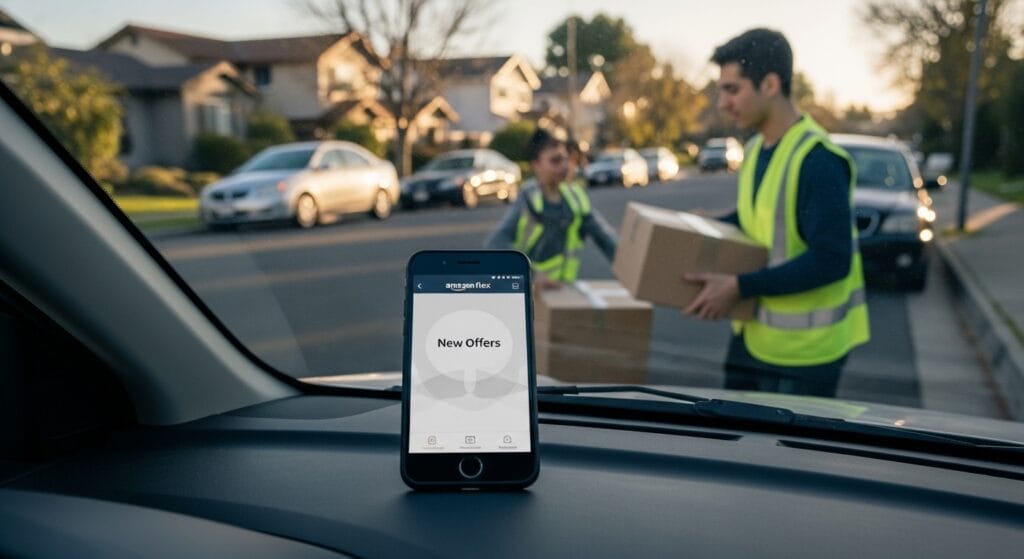
Amazon Flex Pay by City & State
The algorithm doesn’t pay the same everywhere. Block rates are dynamically adjusted based on local cost of living, fuel prices, driver supply, and route complexity. Here’s where the Amazon flex pay per hour is highest — with actual net figures applied.
Top 5 Highest-Paying Cities for Amazon Flex Drivers (2026)
| City | State | Gross/Hr | Annual Gross | Real Net/Hr |
|---|---|---|---|---|
| Corcoran | California | $29.42 | $61,186 | $8.83 |
| Soledad | California | $27.60 | $57,418 | $8.28 |
| Denver | Colorado | $26.76 | $55,660 | $8.03 |
| Los Angeles | California | $26.20 | $54,496 | $7.86 |
| Portola Valley | California | $25.72 | $53,499 | $7.72 |
Net figures apply the 30% profit retention model (fuel, depreciation, 15.3% SE tax).
California dominates the top of the list — four of the five highest-paying markets are in-state. But notice what happens when you apply real expenses: Corcoran’s $29.42/hr gross collapses to $8.83/hr net. California’s gas prices and tax burden eat the advantage alive. Denver stands out as a legitimate non-California market, with the Mountain West’s difficult winter routing and altitude factors forcing the algorithm to sustain premium rates.
Top 5 Highest-Paying States (2026 Macro Averages)
| State | Avg Annual Gross | Avg Monthly Gross | Avg Weekly Gross |
|---|---|---|---|
| Maryland | $45,342 | $3,778 | $871 |
| Minnesota | $44,858 | $3,738 | $862 |
| Washington | $43,487 | $3,623 | $836 |
| Oregon | $40,582 | $3,381 | $780 |
| Colorado | $40,361 | $3,363 | $776 |
Maryland and Minnesota leading the state averages suggests intense gig platform competition in those corridors — Amazon has to bid up rates to keep drivers from defecting to DoorDash or Instacart. Understand that these are all gross figures. Apply the 70% expense haircut before making any geographic decisions.
The Reality of Wear & Tear
This is the hidden killer that doesn’t show up on your deposit screen.
Delivery driving is one of the most mechanically abusive use cases for a personal vehicle. You’re doing constant stop-start cycles, heavy braking, prolonged idling in traffic, and navigating cracked pavement and apartment parking structures at low speed for hours on end. The math on what this costs you:
- Oil changes: $30–$70 every 3,000–5,000 miles (you’ll hit this fast)
- Tire replacement: $400–$800 per set
- Brake pad/rotor replacement: $150–$400 per axle
Add it up per mile and you’re absorbing $0.08–$0.15 in pure vehicle destruction on every single mile driven. The IRS setting the standard mileage deduction at 72.5 cents per mile in 2026 isn’t arbitrary generosity — it’s the government’s own acknowledgment of how much a vehicle actually costs to operate in this capacity.
Then there’s the insurance trap. Most personal auto insurance policies explicitly void commercial coverage the moment you’re delivering for compensation. You’re operating in a legal gray zone during every block, relying on Amazon’s contingent corporate liability coverage — which has specific gaps and limitations drivers rarely read until something goes wrong.
Apartment deliveries compound everything. Multi-floor walkups, locked lobbies, buzzer systems that don’t work, gates requiring codes — these kill your time per stop and often push you past block completion time. Amazon’s stop count has quietly crept upward, with drivers on forums reporting 40-stop allocations squeezed into 2.5-hour blocks.
Also compare your Amazon delivery driver net income to what full-time employment with a DSP looks like with hourly wages, overtime protection, and no vehicle costs before choosing this path. See [Internal Link: Amazon DSP vs UPS Driver] for a full breakdown.
FAQ
How much do Amazon Flex drivers actually make after gas?
After fuel, depreciation, and 15.3% self-employment tax, most drivers net around $5.67/hr — roughly 30% of advertised gross. It can range $5.40–$6.60 depending on vehicle efficiency and local fuel costs.
Is it hard to get blocks in 2026?
Yes, very. Roughly 85,000 active drivers are competing for overflow volume the DSP network doesn’t absorb. Blocks release with minimal notice and disappear in seconds. Many drivers report bots and notification apps are the only realistic path to consistent block access.
Does Amazon Flex pay for gas or tolls?
No. You absorb 100% of fuel and toll costs as a 1099 contractor. Limited bridge toll reimbursements exist in a few specific markets (NYC/NJ Amazon Fresh), but these are exceptions and notoriously difficult to collect. Track every mile with Stride or TripLog for your tax deduction.
Do Flex drivers pay their own taxes?
Yes — the full 15.3% self-employment tax, covering both employer and employee portions of Social Security and Medicare. Pay quarterly estimated taxes to the IRS. Use the 72.5¢/mile deduction (IRS Notice 2026-10) to reduce your taxable gross.
What are the best cities for Amazon Flex?
Corcoran, CA ($29.42/hr gross), Soledad, CA ($27.60/hr), and Denver, CO ($26.76/hr) are the top three by advertised rate. Denver is the best realistic bet for most drivers given California’s fuel and cost-of-living offsets.
How much is base pay vs surge pay?
Base is $18–$25/hr. Surge peaks can reach $55/hr during holidays, weather events, or driver shortages. Surge is real but unpredictable — don’t build your budget around it.
What are the biggest expenses for Flex drivers?
Vehicle depreciation edges out fuel as the largest long-term cost. Brakes, tires, transmission wear, and oil changes accumulate fast. After that: self-employment taxes, then fuel. These three categories explain why drivers keep only ~30 cents of every gross dollar.
Final Verdict: Is Amazon Flex Worth It in 2026?
As a side hustle for quick cash: Conditionally yes — if your car has low mileage, you live close to a fulfillment center, and you treat every dollar of gross pay as $0.30 net before celebrating. Flex can generate $200–$400/week in supplemental income for a driver who is disciplined about block selection and expense tracking. Go into it eyes open.
As a full-time income replacement: No. The numbers don’t support it. At $5.67/hr average net, a full-time 40-hour week generates roughly $227 — and that’s before you account for the time spent hunting blocks, deadheading back home, and the accelerating depreciation on a vehicle you need to last years. The 53% of Flex drivers who work part-time have it right.
The hard truth is that the Amazon Flex framework is structurally designed to transfer Amazon’s vehicle costs, fuel costs, insurance liability, and tax burden directly onto the driver. You provide the car, the maintenance, the insurance, and the labor. Amazon provides the algorithm and the blocks — on its terms, at its price, with zero employment protections.
If you’re going to run Flex, run it like a business: track every mile from the moment you leave your driveway, pay quarterly estimated taxes, decline low-mileage blocks that don’t pencil out, and never mistake gross pay for money in your pocket.
The gig can work. Just know exactly what you’re signing up for.
“If you are looking for Delivery Driver jobs, check out our guides on [Owner Operator] and [CDL Worth It].”