Owner Operator Truck Driver Worth 2026: $87K Net or $64K?
Is Becoming an Owner Operator Truck Driver Worth It in 2026?
Quick Facts — Owner-Operator Truck Driver Salary 2026
| Median Net Income | $87,614 |
| Top 10% Net Income | $156,000–$250,000+ |
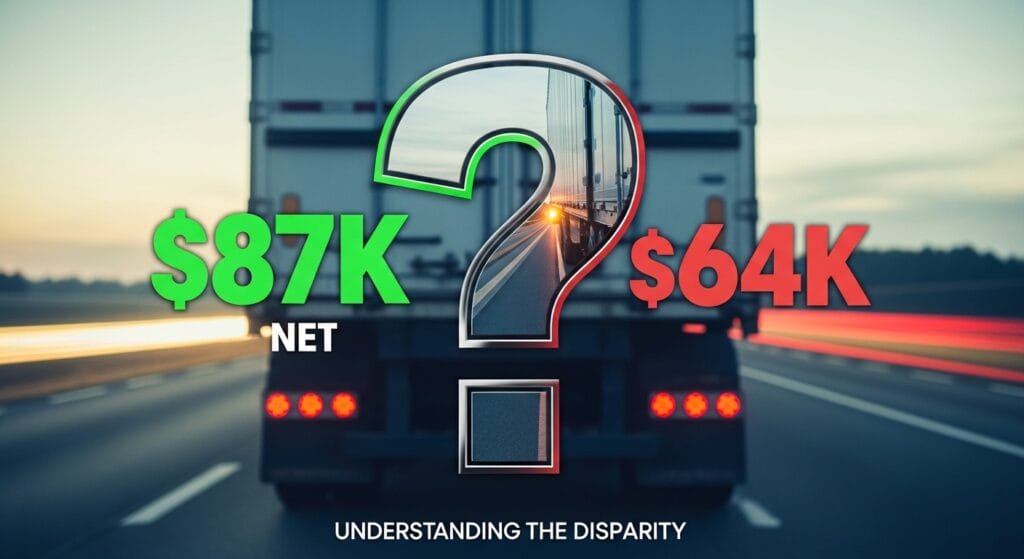
| Entry-Level Net Income | $60,000–$64,524 |
| Best State | Wyoming |
| BLS OES Code | 53-3032 |
| Last Updated | February 2026 |
How Much Do Owner-Operators Make? The Real Answer
Here’s the question every driver types into Google before pulling the trigger on their own authority: how much do owner operators make? The honest answer is that it ranges from just enough to stay afloat to genuinely life-changing money — and the gap between those two outcomes comes down almost entirely to how well you understand your own numbers.
Before we go any further, I want you to burn one truth into your brain. Gross revenue and net take-home pay are not the same thing. Not even close. I’ve watched more than a few good drivers ruin themselves financially because they saw a $280,000 gross on paper and thought they were rich. They weren’t. They were broke before the end of the second year.
Use the table below and the calculator in Section 3 to understand where your situation actually lands — because the difference between the low earner and the top earner in this business isn’t talent or luck. It’s whether you know your cost-per-mile to the penny.
Table 1: Owner-Operator Salary 2026 — Gross vs Net Profit
| Performance Tier | Estimated Gross Revenue | Estimated Expenses | Average Net Take-Home Pay |
|---|---|---|---|
| Low Earner (Spot Market Dependent) | $180,000–$220,000 | $120,000–$160,000 | $60,000–$64,524 |
| Median Operator (Contract + Discipline) | $230,000–$280,000 | $142,000–$192,000 | $87,614 |
| Top Earner (Debt-Free / Specialized) | $350,000–$500,000+ | $194,000–$250,000+ | $156,000–$250,000+ |
Source: ATBS Financial Data, ATRI Operating Cost Survey, OOIDA 2026 Member Data.
The Independent Trucking Market in 2026
The independent trucking market is massive — and it’s been through a brutal purging over the last three years. According to the Federal Motor Carrier Safety Administration (FMCSA) and the Owner-Operator Independent Drivers Association (OOIDA), there are currently approximately 922,854 independent contractors operating in the U.S. commercial trucking space. Of those, roughly 350,000 run under their own DOT/MC authority — meaning they are true independent owner-operators like me — while the rest operate as lease-operators under larger corporate fleets.
The demographic picture is sobering. The average age of an independent owner-operator today is 55 years old, with an average of 26 years of industry experience. The workforce is aging out, and younger drivers haven’t been filling that pipeline fast enough. That creates a long-term capacity tightening that will benefit anyone who stays in and builds smart.
On the freight market side, 2026 is best described as a slow, capacity-driven recovery following one of the worst freight recessions in recent memory. The industry has seen a net loss of for-hire carriers every single month since Q4 of 2022. That’s a long, painful purge — but it’s creating a floor. The Total Spot Market Cycle Indicator moved up $0.11 per mile in January 2026, pushing rates to their highest point since late 2022. Flatbed demand spiked 51% month-over-month. Refrigerated freight has posted 25 consecutive months of year-over-year growth.
This isn’t a boom. It’s a survivors’ market. The operators who weathered the storm — especially the 66% who carried zero equipment debt going into 2026 — are now in a genuinely strong competitive position.
For more context on whether general truck driving stacks up as a career path in today’s environment, read our breakdown here: Truck Driver Salary

Owner-Operator Truck Driver Salary Breakdown: Where Does the Money Go?
The owner operator truck driver salary question can’t be answered with a single number because your gross revenue gets systematically dismantled by operating costs before a single dollar reaches your bank account. Let me show you exactly how this works on a real ledger.
The American Transportation Research Institute (ATRI) benchmarks the total average operating cost at $2.26 per mile for a Class 8 commercial motor vehicle in 2026. Non-fuel operating costs alone hit a record $1.779 per mile. Here is what’s eating your gross in real terms, using a median operator running 120,000 miles and grossing $240,000:
| Expense Category | Cost Per Mile | Annual Total |
|---|---|---|
| Diesel Fuel | $0.480 | $57,600 |
| Truck & Trailer Payments | $0.390 | $46,800 |
| Maintenance & Repairs | $0.198 | $23,760 |
| Commercial Insurance | $0.102 | $12,240 |
| Tolls, ELD, HVUT, Accounting | ~$0.100 | $12,000 |
| Total Expenses | ~$1.27 | ~$152,400 |
| Net Business Income | ~$87,600 |
And we’re not done yet. From that $87,600 net business income, you owe 15.3% self-employment tax on top of federal income tax (typically 12–22%) and any applicable state income tax. A smart operator sets aside 25–30% of weekly net income in a dedicated tax reserve to cover quarterly estimated payments. If you skip that step, April 15 will destroy you.
The single biggest trap for new owner-operators is the jump in insurance costs. If you’re running a brand-new DOT authority, expect to pay $14,000 to $22,000 per year in commercial liability and cargo insurance premiums — and that number has been climbing. Truck insurance premiums spiked 12.5% year-over-year in the latest ATRI data, largely driven by nuclear jury verdicts in trucking litigation. That’s a fixed cost. The truck generates no revenue while it sits in the shop, and the insurance bill still comes due.
The independent truck driver pay reality, when you factor all of this in, means the average operator retains only 17% to 35% of gross revenue. That’s it. Everything else is overhead.
Use this calculator to plug in your estimated gross revenue and real expenses — and see what your actual net profit looks like before you commit:
Paycheck Calculator
Calculate your Weekly, Monthly & Yearly Take-Home Pay
⚠️ These are estimates for a single filer using 2026 tax rates (IRS Rev. Proc. 2025-32). Results do not include local taxes, pre-tax deductions (401k, health insurance), or tax credits. Consult a tax professional for personalized advice.
The owner operator net income math is unforgiving, but it’s also completely learnable. The difference between a $64,000 year and a $156,000 year isn’t horsepower. It’s discipline, lane selection, and whether your truck has a payment on it.
Owner-Operator Salary by State: Location Matters More Than You Think
Where you’re based and what corridors you run directly affect your owner operator salary 2026 outcome. High-gross states like California, New Jersey, and Massachusetts are a statistical trap — inflated gross revenue that gets eaten alive by CARB compliance costs, state income taxes above 10%, astronomical insurance premiums in dense urban environments, and sky-high cost of living. The real money is in states that combine strong freight demand with low tax friction.
| State | Dominant Freight | Estimated Average Net Annual Pay |
|---|---|---|
| Wyoming | Heavy haul, crude oil, energy infrastructure | $108,000–$125,000 |
| North Dakota | Frac sand, crude oil tankers, drilling equipment | $105,000–$118,000 |
| Texas | Cross-border Mexico freight, petroleum, retail distribution | $102,000–$115,000 |
| Florida | Consumer retail, agricultural exports, port containers | $98,000–$110,000 |
| Oregon | Timber, Pacific Northwest port distribution | $96,000–$108,000 |
Wyoming and North Dakota lead the board because they combine zero state income tax with extremely high per-mile gross rates for specialized energy-sector loads. You’re compensated for adverse terrain, harsh winters, and remote hauls. That premium is real.
Texas is a different play — massive volume, zero state income tax, and the highest density of active distribution centers in the American South. Deadhead miles stay low because freight is everywhere. Florida mirrors that zero-tax advantage, and for operators who build outbound agricultural lane relationships, the margins are consistent year-round.
Startup Costs in 2026: The True Cost of Launching Your Authority
If you’re seriously considering running under your own authority, you need to walk into this with eyes wide open on capital requirements. Total startup costs in 2026 range from approximately $84,500 to over $262,000 — and that range is almost entirely determined by one decision: new versus used equipment.
Equipment:
- Used Class 8 tractor (reliable condition): $45,000–$100,000
- New semi-truck (warranty-backed): $120,000–$200,000+
- Standard dry van trailer: $40,000–$70,000
- Refrigerated trailer: $90,000+
Regulatory & Compliance Costs:
- FMCSA Authority Application: ~$300
- IRP base plates: ~$1,500
- Heavy Vehicle Use Tax (HVUT): ~$550
- UCR registration: ~$200
Insurance (Year One, New Authority):
- Commercial liability + cargo insurance: $14,000–$22,000+ annually
- Physical damage coverage: additional $3,000–$8,000
Operating Capital Reserve: Most brokers run 30 to 90-day payment windows on initial invoices. You need $10,000 to $30,000 in liquid cash to fuel and maintain the truck while you’re waiting on your first checks to clear. This is the number that kills new operators who don’t have it.
The minimum viable launch — used truck, basic trailer, full compliance, modest reserve — is roughly $85,000 to $110,000. Anyone who tells you they launched an owner-operator business on $20,000 either had a family member front them money or they’re running without proper insurance. Don’t be that operator.
FAQ
How much do owner-operators make a year after expenses?
Net income ranges from $60,000–$64,524 for operators heavily dependent on the spot market, $87,614 for disciplined median operators with consistent contract freight, and $156,000+ for experienced operators running debt-free equipment or specialized loads. Most operators retain 17% to 35% of gross revenue after all expenses are accounted for.
Is it profitable to be an owner-operator in 2026?
Yes — but the margin for error has been completely eliminated. The 2026 market is what analysts are calling a “marginless recovery.” Spot rates have stabilized and capacity has tightened, but insurance, parts, and financing costs are permanently elevated. The 85–90% failure rate for new owner-operators within 24 months isn’t about driving skill — it’s about underestimating the $2.26 per-mile cost structure.
How much does it cost to start as an owner-operator?
Expect $84,500 to $262,000+ depending on whether you buy new or used. The largest single variable is equipment, followed by first-year insurance premiums for a new DOT authority, and the operating capital reserve you’ll need to bridge the invoice payment gap.
What are the biggest expenses for an independent truck driver?
In order of severity: (1) diesel fuel at $0.48/mile — $50,000 to $80,000 annually; (2) equipment financing at $0.39/mile, up 8.3% in 2026; (3) maintenance and repairs at $0.198/mile, or $15,000–$25,000 per year; and (4) commercial insurance at $0.102/mile, now the fastest-growing cost category due to nuclear litigation verdicts.
How much do you pay in taxes as an owner-operator?
As a sole proprietor or LLC, you pay 15.3% self-employment tax on 92.35% of your net business income, plus federal income tax (12–22% bracket for most operators), plus applicable state income tax. Total tax burden typically lands between 25% and 35% of net business income. You are required to make quarterly estimated payments to the IRS — failing to do this is one of the fastest ways to end your career. The DOT per diem of $80 per day is one of the most powerful deductions available to you. Use it.
Do owner-operators pay for their own fuel?
Yes, 100%. There is no corporate fuel card backstop. Fuel is your single largest variable expense and the one area where small efficiency gains multiply into tens of thousands of dollars per year. Adjusting your average speed from 70 MPH to 65 MPH can move your fuel efficiency by 1 MPG across 100,000 miles — and that alone can be worth $15,000–$20,000 to your net income. Get a top-tier fleet fuel card that leverages bulk purchasing discounts; the data shows these programs can save operators $5,941 to $26,404 annually.
Should I buy or lease a semi-truck in 2026?
Leasing is the safer entry point for undercapitalized new operators — lower upfront cost, predictable monthly expenses, and some full-maintenance agreements that protect you from catastrophic repair bills. The cost over the life of the contract is significantly higher, and you build zero equity. Buying is the wealth-building play. Once that truck is paid off and you’re running debt-free, the elimination of a $2,500+ monthly payment turns a $64,000 year into a $100,000+ year almost automatically. The 66% of owner-operators carrying zero equipment debt heading into 2026 are the ones still standing after the freight recession. There’s a lesson in that number.
Final Verdict: Is the Owner-Operator Life Worth It in 2026?
The owner operator salary 2026 reality is this: the potential is real, the failure rate is brutal, and the difference between the two comes down to one thing — whether you run this like a business or like a job.
If you’re a disciplined operator who knows your cost-per-mile, maintains deep cash reserves, avoids cheap spot freight that subsidizes broker margins, and can get your equipment paid off in three to five years, the income ceiling in this industry is genuinely high. Top earners are netting $156,000 to $250,000+ on a single truck. Fleet owners scaling beyond that. That’s not a myth — that’s documented ATBS client data.
But if you’re going in undercapitalized, running on high-interest financing, and treating gross revenue like a paycheck, the math will end you. It ends 85% of people who try this within two years. The 2026 market is unforgiving to operators who don’t understand that a $240,000 gross year can produce a $55,000 net — or worse, a net loss — depending on how the truck is managed.
The freight cycle is turning. Capacity has tightened, rates are recovering, and the operators who endured the 2023–2025 recession are now positioned to benefit from reduced competition. If you go into this with realistic expectations, a solid financial cushion, and the mindset of a business owner rather than an employee, owning your authority in 2026 is one of the most financially rewarding paths available to an experienced driver.
Do your math first. Then make your move.
Data sourced from ATRI, OOIDA, ATBS, FMCSA, and FTR Transportation Intelligence. All figures represent 2025–2026 reporting periods.
“If you are looking for Delivery Driver jobs, check out our guides on [Tanker Truck Driver] and [Truck Driver].”