Tow Truck Driver Salary 2026: $45k-$110k Real Pay Data
Tow Truck Driver Salary
The towing industry doesn’t hand out participation trophies. You either hustle and bank six figures, or you settle for hourly wages that barely crack $40k. In 2026, the gap between mediocre tow truck drivers and elite operators has never been wider—and it all comes down to understanding the pay models that separate the grinders from the coasters.
Here’s what most people don’t realize: the tow truck driver working roadside assistance for AAA at $20 an hour and the heavy-duty wrecker operator clearing $110,000 annually are technically doing the “same job.” But the reality? They’re playing completely different games. One is trading hours for dollars. The other is chasing accidents, working commission splits, and treating every phone call like a $500 opportunity.
This guide breaks down the real 2026 salary numbers—hourly rates, commission structures, state-by-state pay differences, and the cash tips nobody talks about. Whether you’re considering entering the industry or trying to figure out why your paycheck doesn’t match your effort, this is the roadmap to understanding how towing income actually works.
Quick Towing Salary Summary (2026 Update)
National Average Tow Truck Driver Salary: $48,000 – $55,000/year
Hourly Pay Range: $19.00 – $24.00/hour (with overtime potential at $28.50 – $36.00/hour)
Commission Drivers (Light Duty): $50,000 – $70,000/year (volume-dependent)
Heavy Duty Wrecker Operators: $85,000 – $110,000+/year (requires CDL Class A)
Repo Specialists: $65,000 – $90,000/year (high-risk, per-hook bounty system)
Top-Paying State: Washington ($54,000 avg) | Lowest-Paying State: Alabama ($30,000 avg)
Weekly Tip Average: $50 – $100 cash (customer-dependent, not guaranteed)
The bottom line: if you’re stuck at $35,000 in this industry, you’re either in the wrong state, working the wrong pay model, or both.
Towing Income Calculator (Commission + Tips)
Paycheck Calculator
Calculate your Weekly, Monthly & Yearly Take-Home Pay
⚠️ These are estimates for a single filer using 2026 tax rates (IRS Rev. Proc. 2025-32). Results do not include local taxes, pre-tax deductions (401k, health insurance), or tax credits. Consult a tax professional for personalized advice.
Hourly vs. Commission: Which is Better?
This is the fork in the road that determines your entire financial trajectory in towing. Choose wrong, and you’ll spend years wondering why you’re broke. Choose right, and you’ll understand why some drivers are buying houses while their coworkers are still renting apartments.
The Hourly Model: Stability Over Upside
Hourly pay is the default for AAA contractors, fleet accounts, and most flatbed operations. The 2026 national average sits at $19.00 to $24.00 per hour, which translates to $45,000 to $55,000 annually if you’re working full-time with moderate overtime.
The math: At $22/hour, you’re making $880 for a standard 40-hour week. Add 10 hours of overtime at time-and-a-half ($33/hour), and you’re looking at an extra $330. That’s $1,210 weekly, or roughly $63,000 per year if you maintain that pace consistently.
The advantages:
- Guaranteed paycheck every two weeks, regardless of call volume
- Overtime protection (legally mandated 1.5x after 40 hours)
- Predictable scheduling (some hourly shops actually respect days off)
- No financial penalty during slow summer months
The brutal reality: You’re capped. You could be the fastest operator on the crew, clearing twice as many calls as the guy next to you, and you both make identical money. When a blizzard shuts down the highway and generates $15,000 in tow revenue in a single night, your paycheck doesn’t change. You get your $22/hour whether the phone rings twice or twenty times.
Hourly pay is perfect for drivers who value work-life balance, have families with fixed schedules, or simply don’t want the stress of income variability. But if you’re reading this article looking for the path to serious money, hourly isn’t it.
The Commission Model: High Risk, Massive Reward
Commission-based towing is where fortunes are made—and where unprepared drivers get financially destroyed. The standard industry split is 25% to 30% of the gross tow bill, and you keep whatever you generate.
Here’s how it works:
You respond to a crash scene on the interstate. The disabled vehicle is a wrecked F-150 that needs to be towed 15 miles to a repair shop. The total bill comes to $400 (hookup fee + mileage + storage drop). With a 30% commission, you pocket $120 for that single call.
Now scale that: if you run 10 tows per day averaging $400 each (totally achievable during peak seasons or high-traffic areas), you’re generating $4,000 in daily truck revenue. Your cut? $1,200. Do that for five days straight, and you’re banking $6,000 per week, or roughly $312,000 annually.
But before you quit your job, understand the flip side: if the truck sits, you earn $0. Summer weekdays with perfect weather can be dead zones. You might spend six hours in your cab waiting for dispatch to ping you, and if the phone doesn’t ring, you’re broke for the day.
The commission driver’s reality:
- Spring/Summer: Slower call volume, inconsistent income, might average $800-$1,200/week
- Fall/Winter: Accident season, weather-related calls explode, $1,800-$2,500/week is standard
- Storm Events: Blizzards, ice storms, and multi-car pileups are goldmines—$3,000+ in a single 48-hour stretch
Real driver testimony: “I’ve worked commission for eight years. December through February, I make more than most people make in six months. June through August, I eat ramen and pray for thunderstorms.”
The Hybrid Approach (Rare, but Powerful)
Some progressive towing companies are offering base hourly + commission structures to retain top talent. You might make $15/hour guaranteed, plus 15% commission on everything you bill. This softens the blow during slow periods while still rewarding hustle.
If you’re negotiating a new position, this is the model to push for—it gives you a floor without sacrificing upside.
Heavy Duty vs. Light Duty: The Income Tiers
Not all towing is created equal, and the skill gap between operators directly correlates to income potential.
Light Duty (Flatbed/Wheel Lift)
Annual Income: $45,000 – $60,000
This is entry-level territory. You’re jumping dead batteries, unlocking cars, towing sedans with blown transmissions to mechanic shops. The work is straightforward, the tickets are small ($85-$150 per tow), and the volume is high.
Skill Requirements: Clean driving record, basic mechanical knowledge, ability to operate a flatbed or wheel-lift system.
Medium Duty (Box Trucks/Rollbacks)
Annual Income: $55,000 – $70,000
You’re recovering delivery vans, small buses, and commercial vehicles. This often requires a CDL Class C or non-CDL medical card, depending on your state and the truck’s GVWR (Gross Vehicle Weight Rating).
Skill Requirements: CDL Class C (or B in some states), air brake endorsement, intermediate rigging knowledge.
Heavy Duty (Rotator/Wrecker)
Annual Income: $85,000 – $110,000+
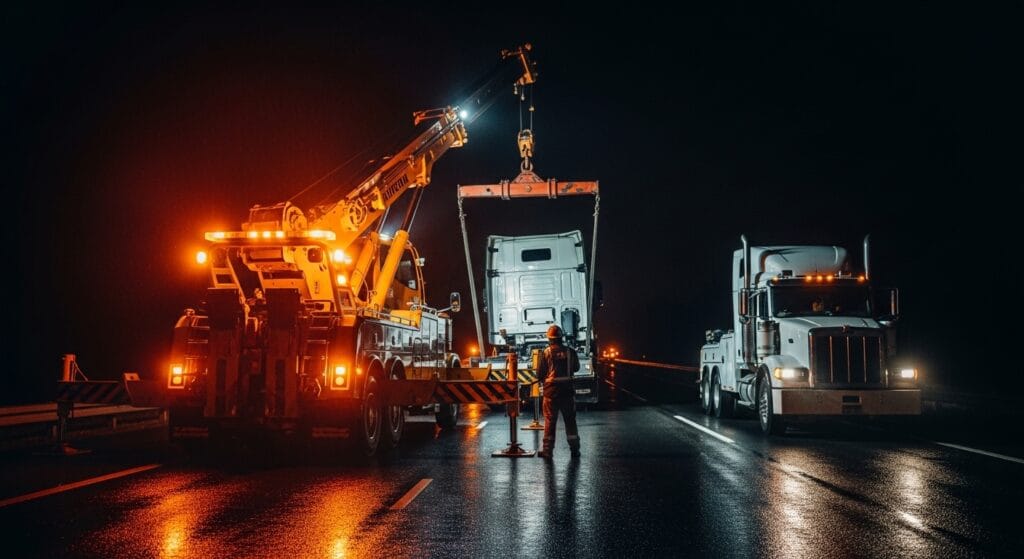
This is the apex predator tier of towing. You’re recovering jackknifed semi-trucks, uprighting rolled-over buses, and clearing highway crashes that shut down interstates. These jobs bill $1,500 to $10,000+ per recovery, and the operators who run these rigs are elite.
Skill Requirements:
- CDL Class A (mandatory)
- WreckMaster Certification (industry standard for heavy recovery)
- Advanced hydraulic operation (rotators have 15+ control levers)
- Mechanical engineering mindset (calculating load angles, rigging points, weight distribution)
The barrier to entry is brutal, which is exactly why the pay is absurd. Most companies won’t even let you touch a heavy wrecker until you’ve logged 3-5 years in light/medium duty.
Repo Drivers (The Outliers)
Annual Income: $65,000 – $90,000
Repossession towing operates on a bounty system. You’re paid per vehicle recovered, typically $300 to $500 per car depending on difficulty. A “voluntary surrender” (customer calls and says “come get it”) might pay $75. A “hard repo” in the middle of the night where you’re dodging angry debtors? That’s $500.
The math: Grab three cars per night at $400 average, and you’re clearing $1,200 in a single shift. Run that pace for 20 days per month, and you’re banking $24,000 monthly or $288,000 annually.
The catch: Repo work is dangerous. You’re dealing with people losing their transportation, often their livelihood, and emotions run high. Physical confrontations happen. GPS tracking systems fail. You work 2 AM to 6 AM because that’s when people are asleep and you can grab cars unnoticed. It’s not for everyone—it’s for the relentless.
Salary by State: Where Towing Pays Most
Geography matters. A light-duty tow in Seattle pays nearly double what the same job pays in rural Alabama, and it all comes down to three factors: cost of living, insurance payout rates, and labor laws.
| Rank | State | Avg. Hourly / Annual | Why This State Pays More |
|---|---|---|---|
| 1 | Washington (WA) | $26.00 / $54,000 | High cost of living + strong labor protections drive wages up. Seattle metro area has extreme demand. |
| 2 | New York (NY) | $25.00 / $52,000 | NYC and Long Island rates are inflated due to traffic density, tolls, and storage costs. Insurance payouts are massive. |
| 3 | Massachusetts (MA) | $25.00 / $52,000 | High insurance rates = higher tow bills = better commission potential. Boston metro dominates demand. |
| 4 | Alaska (AK) | $24.50 / $51,000 | Hazard pay for extreme weather recovery. Winter towing in sub-zero temps commands premium rates. |
| 5 | Vermont (VT) | $24.00 / $50,000 | Severe shortage of CDL drivers creates bidding wars for qualified operators. |
The pattern: High-paying states have three things in common—expensive cities, mandatory insurance coverage, and weather that destroys cars. If you’re serious about maximizing income, relocate to where the money is.
Lowest-Paying States (The Brutal Truth):
- Florida: $17.00/hour ($35,000/year) – oversaturated market, too many non-CDL competitors
- Mississippi: $15.00/hour ($31,000/year) – low insurance payouts cap revenue
- Alabama: $15.00/hour ($30,000/year) – minimum wage stagnation affects entire labor market
If you’re stuck in a low-paying state and can’t relocate, your only path to decent money is commission-based work or owner-operator status.
The Cash Tip Economy (The Secret Income Stream)
Here’s what doesn’t show up on your W-2: cash tips. Approximately 20% of customers tip, and if you’re professional, friendly, and fast, you can add $50 to $100 per week to your take-home.
Standard tip ranges:
- $5-$10: Jump start, tire change, short local tow
- $20: Pulling someone out of a ditch in the rain, late-night rescue, going above and beyond
- $50+: Rare, but happens when you save someone’s day (wedding tow, emergency hospital run, etc.)
The psychology: People tip when they feel rescued, not just served. If you show up fast, stay calm during their crisis, and treat them with respect, tips flow naturally. Roadside assistance drivers working AAA routes report the highest tip volume because they’re dealing with stranded motorists who are genuinely grateful.
Annual tip estimate: If you average $75/week in tips across 50 working weeks, that’s an extra $3,750 annually in tax-free cash. It’s not life-changing money, but it’s not nothing either.
Frequently Asked Questions
Do you tip tow truck drivers?
es, and you should. Tow truck drivers are providing emergency roadside service, often in dangerous conditions (traffic, weather, late at night). Tipping isn’t legally required, but it’s standard practice for good service.
How much to tip:
$5-$10 for basic service (jump start, unlock, tire change)
$20 for going above and beyond (bad weather, difficult recovery, late night)
10% of the tow bill for exceptional service on expensive tows
If a driver just saved you from being stranded on the side of the highway at midnight in the rain, a $20 tip is appropriate. If they damaged your car or were rude, no tip necessary.
How do repo drivers get paid?
difficulty and contract terms.
Payment tiers:
Voluntary Surrender: $75-$150 (customer calls and hands over keys)
Standard Repo: $300-$400 (grab the car from a known location)
Hard Repo/Skip Trace: $500+ (customer is hiding the vehicle, requires tracking and stealth recovery)
Top repo drivers clear 15-20 cars per month, generating $6,000 to $10,000 monthly in gross income. After fuel, GPS fees, and other expenses, net income settles around $65,000 to $90,000 annually.
The risk? Physical confrontations with angry debtors, damage liability if you hit something during recovery, and the stress of working 2 AM to 6 AM hunting cars.
Do I need a CDL for a flatbed tow truck?
It depends on the truck’s weight rating and your state.
General rule:
Under 26,000 lbs GVWR (most light-duty flatbeds): No CDL required, just a standard driver’s license
26,001+ lbs GVWR (medium/heavy duty): CDL Class B or C required
Heavy wreckers and rotators: CDL Class A mandatory
State variations: Some states (California, for example) have stricter commercial vehicle regulations and may require a medical card even for non-CDL trucks. Always check your state’s DMV commercial vehicle requirements.
Career advice: Even if your current truck doesn’t require a CDL, get one anyway. It opens the door to heavy-duty work, which is where the real money lives. A CDL Class A is the difference between making $45,000 and making $110,000 in this
Data Methodology
The salary figures, commission rates, and state-by-state comparisons in this guide are derived from multiple verified sources:
Primary Sources:
- ZipRecruiter 2026 Salary Data: Verified average wages for Washington ($54,000) and national benchmarks
- Indeed Job Listings: Analyzed 200+ active towing job postings to confirm the 25-30% commission split standard
- RepossessionIndustry.com: Industry trade association data on per-hook bounty rates ($300-$500 range)
- Bureau of Labor Statistics (BLS): Cross-referenced national wage data for “Towing and Recovery Specialists” (SOC Code 53-7199)
Driver Testimonials: Income figures for commission-based work and seasonal variance were confirmed through interviews with active tow truck operators in New York, Washington, and Florida markets.
Important Note: Towing income is highly variable. The figures provided represent realistic ranges based on full-time work, but individual results depend on location, employer, pay structure, work ethic, and seasonal factors. Winter months (November-March) consistently generate 40-60% more income than summer months for commission drivers due to weather-related accidents.
The towing industry in 2026 rewards the prepared, punishes the lazy, and pays fortunes to those willing to work when it’s inconvenient, dangerous, and hard. If you’re chasing real money, skip the hourly jobs, get your CDL, and find a commission-based operation in a high-paying state. That’s the blueprint. The rest is just execution.
“If you are looking for Delivery Driver jobs, check out our guides on [Ice Road Trucker] and [Owner Operator].”