Flatbed Truck Driver Salary 2026: Up to $110K
Quick Facts — Flatbed Truck Driver Salary 2026
| Median Annual Salary | $57,440 – $68,000 (with premiums) |
| Top 10% / Heavy Haul | $78,800 – $110,000+ |
| Entry Level | $38,640 |
| Best State | Illinois ($62,320+) |
| BLS OES Code | 53-3032 |
| Last Updated | February 2026 |
The Flatbed Premium: What the Numbers Don’t Show
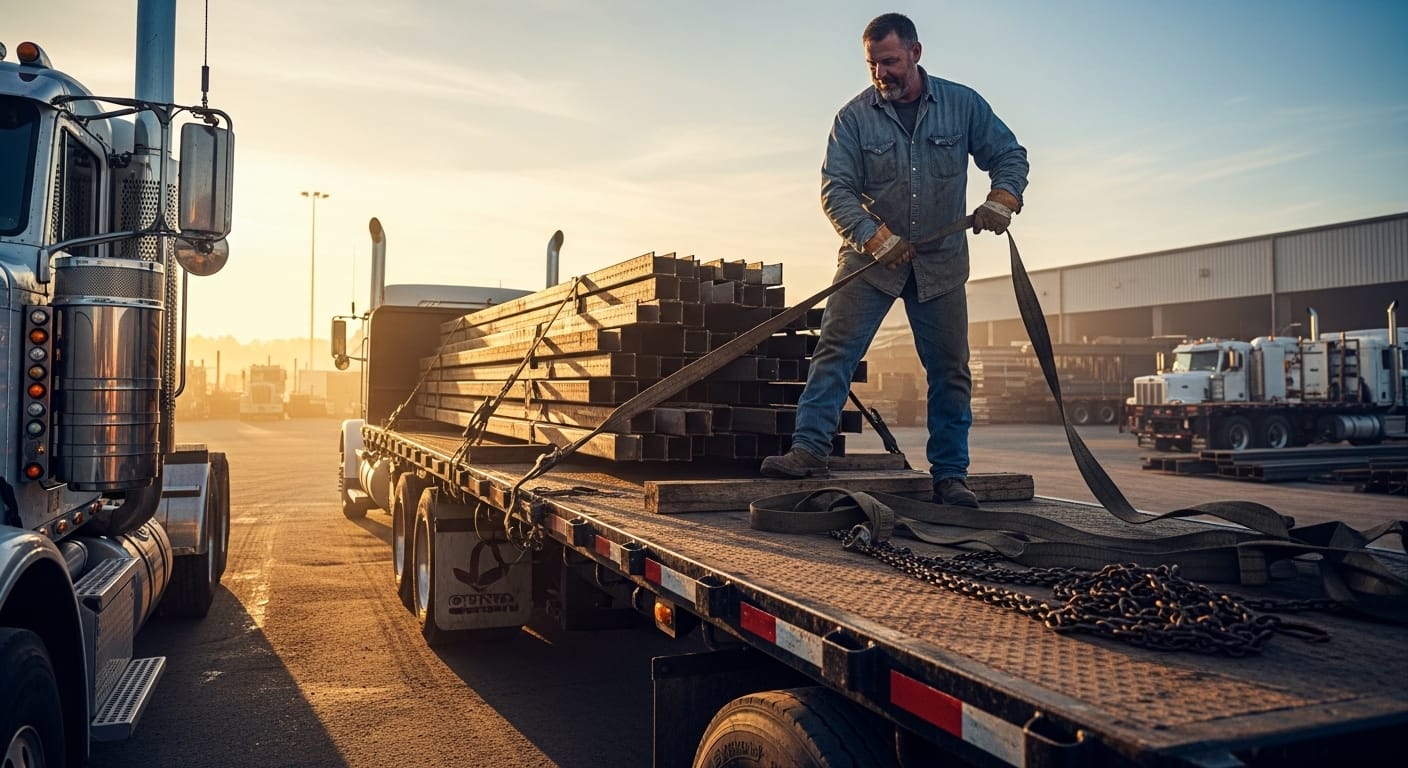
Let me tell you something that no spreadsheet is ever going to capture properly. I have been throwing tarps and swinging chains across this country for twenty years. I have strapped down 40,000-pound steel coils in Pennsylvania in January when it was eight degrees and the chains were so cold they burned right through my gloves. I have tarped lumber loads in Oregon rain so heavy you could barely see the headlights on the truck behind you. And every single time I rolled into a truck stop and saw a dry van driver complaining about a two-hour dock delay, I had to bite my tongue.
Because here is the truth about flatbedding that the Bureau of Labor Statistics number — that $57,440 median — simply does not tell you: we do not just drive trucks. We run a portable rigging operation on every single load.
The BLS lumps all heavy tractor-trailer drivers together under OES code 53-3032. That number averages out the grocery store dry van guy who drops a trailer at a dock and goes to sleep with the truly physical, skilled labor of a flatbed driver who spends two hours per stop securing complex freight. The real flatbed median, once you factor in the tarp pay, the chain pay, the multiple-stop pay, and the oversize permits — sits closer to $65,000 to $68,000 for a quality company driver in 2026. And if you are running heavy haul oversize loads — wind turbine blades, industrial generators, wide-load machinery — you are easily pushing $90,000 to $110,000+ on a W-2.
That premium exists for a reason. You earn every single cent of it.
Rookie to Owner-Operator: The Flatbed Ladder
The flatbed world is not a flat playing field. There is a real ladder here, and where you sit on it determines what lands in your bank account.
| Experience Tier | Annual Salary | CPM / Pay Structure |
|---|---|---|
| Rookie (0–2 years) | $38,640 – $48,000 | 45–52 CPM company driver |
| Experienced Company Driver (3–10 years) | $57,440 – $72,000 | 58–70 CPM + accessorials |
| Senior / Heavy Haul / Owner-Operator | $78,800 – $110,000+ | Percentage pay (25–28%) or $1.20+ CPM |
Understanding CPM vs. Percentage Pay
Most new flatbed drivers start on CPM — cents per mile. At 45 CPM running 2,500 miles a week, you are looking at roughly $1,125 in base linehaul pay before any extras. That is your floor as a rookie.
But experienced flatbedders, especially those running steel and heavy machinery, often transition to percentage pay — typically 25% to 28% of the load’s gross revenue. Here is why that matters: a flatbed load of structural steel or machinery is worth significantly more per mile to the carrier than a dry van load of paper towels. When you are hauling a $4,500 load of steel pipe 400 miles, 25% of that puts $1,125 in your pocket for a 400-mile run. Try getting that on CPM.
Owner-operators who own their equipment and run under their own authority — or lease to a carrier — are the top of the food chain. They absorb the fuel, maintenance, and insurance costs, but the ceiling disappears. The best heavy haul owner-operators I know personally are clearing $120,000 to $150,000 net after expenses on a good year. That is not luck. That is mastering the craft completely.

Accessorial Pay: Tarping, Strapping, and Oversize
This is the section that separates real flatbed knowledge from the guys who have never actually stood on top of a 53-foot trailer. Accessorial pay is the hidden engine of the flatbed paycheck, and understanding it is the difference between a driver earning $55,000 and the same driver earning $72,000 on the same number of miles.
Tarp Pay: $40 to $100 Per Load
Every time you throw a tarp, you get paid a flat fee. Standard lumber tarps — the big ones, the ones that weigh 80 to 100 pounds when they are wet — require you to climb up on top of the load, drag the tarp across, and secure it before the elements destroy whatever you are hauling. In 2026, typical tarp pay runs $40 to $60 for a standard tarp and up to $80 to $100 for a full lumber tarp job where you are covering the entire load with multiple pieces. Run one tarped load per day, 250 days a year, and you have just added $12,500 to $15,000 to your annual income that never shows up in base CPM comparisons.
Chain and Binder Pay: $25 to $50 Per Load
Securing steel coils, pipes, or machinery requires chains, binders, and specific load securement knowledge governed by FMCSA regulations. Many carriers pay a flat $25 to $50 per load specifically for the chain-and-binder process. This is not optional labor — it is federally regulated, and if you do it wrong, people die. That expertise is compensated.
Multiple Stop Pay: $50 to $75 Per Extra Stop
A lot of flatbed freight — especially construction materials and steel — gets broken down across multiple job sites. Every stop after the first one earns you an additional $50 to $75. Three stops on a delivery? That is an extra $100 to $150 on that load alone.
Oversize / Permit Loads: The Elite Tier
This is where the real money lives. Running oversized loads — anything requiring a state permit for width, height, length, or weight — demands a completely different skill set. You need to understand route surveys, escort vehicle coordination, bridge weight limits, and curfew restrictions that vary state by state. Carriers compensate this expertise heavily. Oversize permit load pay can add $100 to $300+ per load, and drivers who specialize in this work regularly out-earn every other driver category in trucking.
Estimate your total compensation including accessorial tarp pay:
Paycheck Calculator
Calculate your Weekly, Monthly & Yearly Take-Home Pay
⚠️ These are estimates for a single filer using 2026 tax rates (IRS Rev. Proc. 2025-32). Results do not include local taxes, pre-tax deductions (401k, health insurance), or tax credits. Consult a tax professional for personalized advice.
Flatbed vs Dry Van (Door Swingers)
I am going to be blunt here because I have earned the right to be. Dry van is easier. There, I said it. That does not mean dry van drivers are bad drivers — it means the job description is fundamentally different, and the market pays accordingly.
| Category | Flatbed | Dry Van |
|---|---|---|
| Median Annual Pay | $65,000–$68,000 | ~$54,000 |
| Physical Labor | Intense — tarping, chaining, strapping outdoors in all weather | Minimal — drop and hook, no touch freight |
| Load Securement | Driver’s full legal and physical responsibility | Sealed trailer, no securement required |
| Dock Waits | Minimal — most flatbed loads are open-air job sites | Significant — retail and grocery warehouses can sit for 4–6 hours |
| Weather Exposure | Constant — snow, ice, rain, 100-degree heat | Protected — cab to dock |
| CPM Range | 60–70 CPM + accessorials | 50–55 CPM base |
| Specialty Upside | $90,000–$110,000+ (heavy haul) | Limited ceiling |
The math is not complicated. Flatbed pays a 15% to 20% premium over dry van because carriers cannot find enough drivers willing to do the physical work. When I am out there at a job site in West Texas at 6 AM, throwing chains over a load of oilfield pipe while the dust is blowing sideways and the temperature is already 88 degrees, the person sitting in a dry van cab waiting for a lumper to unload their trailer is not doing the same job as me. The market agrees.
State-by-State: Where the Steel Belt Pays
Flatbed freight is not distributed evenly across America. It concentrates where industry concentrates — steel mills, lumber operations, heavy manufacturing, and energy infrastructure. These five states represent the highest-paying corridors for flatbed work in 2026:
| State | Avg. Flatbed Annual Pay | Why It Pays |
|---|---|---|
| Illinois | $62,320+ | Chicago’s heavy manufacturing sector; major Midwest steel corridors |
| Pennsylvania | $59,740+ | Rust-belt hub for steel coils, aluminum, and heavy industrial freight |
| Texas | $58,960+ | Oilfield equipment hauling; infrastructure boom; massive freight volume |
| Ohio | $54,330+ | Automotive manufacturing; raw material processing plants |
| Indiana | $54,000+ | Agricultural equipment; raw metals; crossroads freight volume |
The Midwest corridor — Illinois through Pennsylvania — is the highest-density flatbed market in the country because of the concentration of steel mills along the Great Lakes. If you want to maximize your earnings as a flatbed driver and you have flexibility on where you base yourself, that industrial belt is where the freight — and the money — lives.
FAQ
How much does a flatbed truck driver make in 2026?
An experienced flatbed company driver earns between $65,000 and $72,000 annually in 2026, factoring in base CPM plus accessorial pay (tarping, chaining, multiple stops). Entry-level drivers start closer to $38,000–$48,000. Senior drivers running heavy haul and oversize freight regularly earn $90,000 to $110,000+. Owner-operators at the top of their craft can exceed $120,000 net.
Do you need a CDL to drive a flatbed truck?
Yes — a Class A CDL is required for any combination vehicle where the GCWR exceeds 26,000 lbs and the trailer exceeds 10,000 lbs. Every commercial flatbed rig qualifies. While endorsements are not always mandatory for standard flatbed work, a Hazmat endorsement significantly expands your freight options and earning potential, particularly for flatbed loads carrying industrial chemicals or pressurized materials.
Is flatbed trucking the hardest type of trucking?
By physical demand, yes — it is the most demanding sector in commercial trucking. You are working outdoors in every weather condition. Lumber tarps weigh 80 to 120 pounds each when dry, and considerably more when wet. Dragging a saturated tarp across the top of an uneven machinery load on a windy day is not a desk job. Your body accumulates real wear from years of climbing on and off trailers, swinging binders, and maneuvering heavy chains. That physical cost is precisely why the pay premium exists and why it is not going away.
What is “Tarp Pay” and how much is it?
Tarp pay is a flat-fee accessorial payment made by the carrier each time a driver is required to apply a tarp to protect a load. Standard tarp pay runs $40 to $60 per tarp, with full lumber load tarping jobs paying $80 to $100. Over a full year of regular tarped loads, this adds $10,000 to $15,000 to a driver’s total annual compensation — money that base CPM comparisons consistently ignore.
What is the difference between flatbed, step-deck, and RGN trailers?
A standard flatbed is 48 to 53 feet long with a deck height around 60 inches. A step-deck (or drop-deck) has a lower rear deck, allowing taller freight that would otherwise violate height limits. An RGN (Removable Gooseneck) detaches at the front, creating a ground-level ramp that allows equipment — bulldozers, cranes, massive generators — to drive directly onto the trailer. Each step up in trailer complexity corresponds to higher pay, higher permit requirements, and a smaller pool of qualified drivers.
Sources
- Bureau of Labor Statistics, Occupational Employment and Wage Statistics: OES Code 53-3032 — Heavy and Tractor-Trailer Truck Drivers, May 2024 data (latest official release)
- FMCSA Cargo Securement Rules: Federal Motor Carrier Safety Administration regulations governing chain, strap, and tarp requirements for flatbed freight
- Industry CPM and accessorial benchmarks based on 2025–2026 carrier rate surveys across major flatbed carriers
Twenty years in, I still get a quiet sense of pride every time I pull a perfectly tarped load into a job site and the foreman walks over to check the chains and just nods. That nod means everything is tight, everything is legal, and nobody is getting hurt today. That is what flatbedding is — it is skilled labor, it is dangerous work, and the paycheck reflects both of those facts. If you are willing to get out of the cab and do the work, flatbedding will pay you better than almost anything else in trucking. If you are not, the dry van lane is to your left.
Last Updated: February 2026 | SalaryClear.com | Data sourced from BLS OES 53-3032
“If you are looking for Delivery Driver jobs, check out our guides on [Transit Bus Driver] and [Hot Shot Trucking].”