
Transit Bus Driver Salary 2026: $60K–$90K+
Quick Facts — Transit Bus Driver Salary 2026
| Metric | Figure |
|---|---|
| Median Annual Salary | $60,170 |
| Top 10% (Senior Union) | $82,660+ |
| Entry-Level / Extra Board | $37,630 |
| Best State | New York ($73,420+) |
| BLS OES Code | 53-3052 |
| Last Updated | February 2026 |
Let me be straight with you right now, before you even touch that steering wheel: the number the Bureau of Labor Statistics prints as a “median salary” for transit bus drivers is only half the story. The other half is written in overtime slips, union contracts, and the specific three letters stamped on the side of the garage you report to every morning — MTA, NJ Transit, King County Metro.
I have been driving city routes for twenty years. I started on the Extra Board at a garage in Newark, New Jersey, working split shifts that had me leaving my house at 5:30 AM and not returning until 8:30 PM — with a four-hour unpaid hole in the middle of my day. I have driven through blizzards, managed passengers in mental health crises, and negotiated my way through more double-parked delivery trucks than I can count. I have also watched my paycheck nearly double from that first year to where I sit today. The difference between those two paychecks is spelled out in one acronym: ATU — the Amalgamated Transit Union.
Here is everything you need to understand about what this career actually pays in 2026, and more importantly, why it pays what it does.
See what overtime and weekend differential does to your paycheck:
Paycheck Calculator
Calculate your Weekly, Monthly & Yearly Take-Home Pay
⚠️ These are estimates for a single filer using 2026 tax rates (IRS Rev. Proc. 2025-32). Results do not include local taxes, pre-tax deductions (401k, health insurance), or tax credits. Consult a tax professional for personalized advice.
The Extra Board to Senior Driver
The first thing any transit agency hiring manager will tell you is that you are starting on the Extra Board. What they will not fully explain — at least not until you are already committed — is what that actually means for your quality of life.
The Extra Board is essentially an on-call pool. The agency calls you. You do not pick your route, your shift, or your start time. You might work the 4:00 AM owl shift one day and the 2:00 PM school pull-out the next. You are the agency’s shock absorber — filling in for call-outs, covering sick days, plugging gaps in the board. The pay is there, but the schedule is brutal and unpredictable. I personally know drivers who quit within their first six months because they could not handle having no control over their own time.
The good news? Every month you survive the Extra Board, you are accumulating seniority. And in a union transit shop, seniority is currency.
| Tier | Annual Base Salary | Hourly Equivalent | Schedule Reality |
|---|---|---|---|
| Entry / Extra Board | $37,630 | ~$18.09 | On-call, unpredictable, split shifts |
| Median (Full-Time City Driver) | $60,170 | $28.93 | Established run, fixed shifts |
| Senior Union Driver (Top 90%) | $82,660+ | $39.74+ | Best routes, first pick, max overtime |
Once you have enough seniority to “pick a run” — meaning you can choose your route and shift during the quarterly or semi-annual sign-up — your entire working life changes. You take the route that gets you home at a reasonable hour. You take the route with the fewest passenger management incidents. Some senior drivers at my garage who have been here fifteen-plus years have the same comfortable express route, the same start time, five days a week, for years on end. That is what you are working toward.
And then there is the overtime question. Due to chronic driver shortages across virtually every major transit agency in America right now, overtime is not optional — it is practically guaranteed. Median drivers who are willing to pick up extra pieces are routinely clearing $75,000 to $85,000 on a “median” base salary of $60,170. Factor in “spread penalty” pay — time-and-a-half when your split shift extends beyond a standard spread window — and the numbers move even faster. I have filed W-2s that surprised even me.
Best States for Transit Drivers
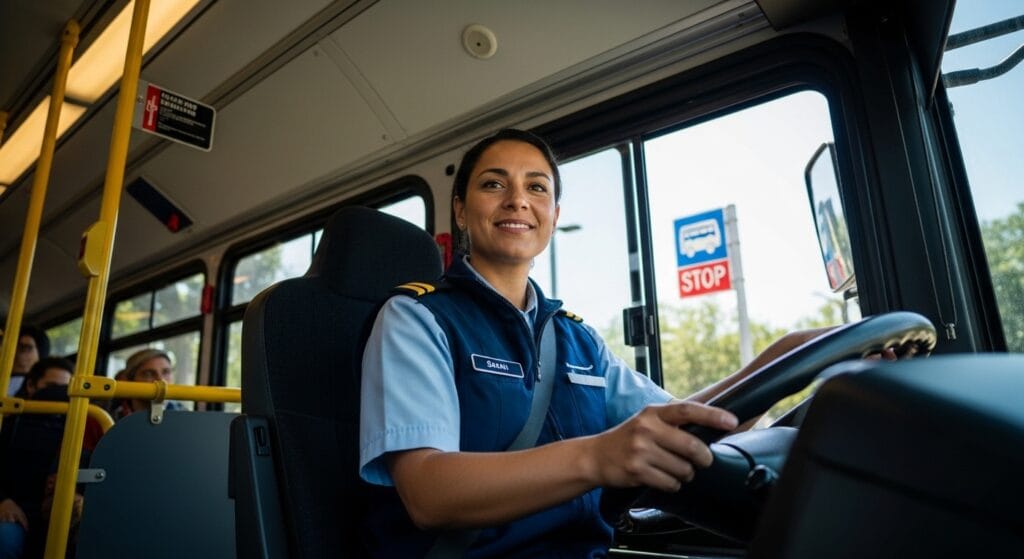
Transit pay is inseparable from the size of the metropolitan tax base behind it and the strength of the local ATU chapter negotiating your contract. A bus driver in a rural county and a bus driver for the New York MTA are both classified under OES 53-3052 — but they live in completely different financial realities.
| State | Average Annual Wage | Key System |
|---|---|---|
| New York | $73,420+ | MTA / LIRR Bus / NJ Transit (NY metro) |
| Washington | $68,960+ | King County Metro (Seattle) |
| Illinois | $67,720+ | Chicago Transit Authority (CTA) |
| Alaska | $67,050+ | Municipal systems + hazard pay |
| California | $65,540+ | LA Metro / SF Muni |
New York sits at the top for a reason. The MTA is the largest public transit system in North America, and the ATU Local 1056 contract there is one of the most comprehensive in the country. Senior MTA bus operators in the New York-Newark-Jersey City metro area routinely push their total compensation — base, overtime, uniform allowance, and shift differentials — well above $90,000 annually. The pension alone, a defined-benefit plan, is worth a significant multiple of that over a 25-year career.
NJ Transit is its own animal. New Jersey drivers are covered under separate contracts but benefit from the same massive commuter volume and dense route network. Starting pay is competitive, and the top of the pay scale for a senior NJ Transit operator hits over $35 per hour in base wage alone — before overtime, before weekend differential, before any additional stipends.
California deserves a special mention because of what happens at the senior end of the scale. SF Muni drivers in San Francisco, operating under Local 1741, have regularly been reported earning over $100,000 in total compensation when overtime is included. I know drivers who transferred from the Midwest to California just to work the SF routes. The cost of living is brutal, but the pay keeps up.
Transit Bus vs. School Bus
I get asked this comparison constantly, usually by younger drivers trying to figure out which CDL path makes more sense. The honest answer is that it depends entirely on what you value — but financially, transit almost always wins over the long run.
| Factor | Transit Bus Driver | School Bus Driver |
|---|---|---|
| Median Annual Salary | $60,170 | $47,040 |
| Hours | Full-time (40 hrs/week minimum) | Part-time split shift (4–6 hrs/day) |
| Summer Employment | Yes — year-round routes | Often none (contract ends in June) |
| Passengers | General public — all ages, all situations | Children — structured but emotionally demanding |
| Union Coverage | Strong ATU contracts at major agencies | Variable — often weaker or non-union |
| Overtime Potential | High — driver shortages are severe | Low — limited by school calendar |
| Pension | Defined-benefit at most public agencies | Rare outside large districts |
The split shift comparison is critical. School bus drivers work a morning run, go home (or sit at the garage), and come back for the afternoon pickup. They are getting paid for maybe five or six hours of actual work — and in most non-union districts, they are not getting compensated for that dead time in between. Transit drivers on the Extra Board face the same split shift structure initially, but the difference is that we are working toward full-time runs with full-time pay and full-time benefits. The school bus driver is often permanently locked into that part-time structure.
FAQ
Do you need a CDL to drive a transit bus?
Yes, and the requirements are specific. You need a Class B Commercial Driver’s License (CDL) — not Class A, which is for tractor-trailers, but Class B, which covers vehicles over 26,001 pounds where you are not towing a heavy trailer. On top of the Class B base license, you need two specific endorsements:
“P” Passenger Endorsement: Requires a separate written knowledge test and a skills test specifically for vehicles designed to carry 16 or more passengers. This is non-negotiable for transit work.
Air Brakes: City buses use pneumatic (air) braking systems. If you do not pass the air brakes knowledge test and have the restriction removed from your license, you cannot legally operate a standard transit bus. Most candidates fail their first air brakes written test because they underestimate how technical the brake adjustment and inspection questions are.
Most major transit agencies — MTA, NJ Transit, King County Metro — will sponsor your CDL training if you are hired as a trainee, meaning they pay for your license in exchange for a commitment to work for them for a set period. If you walk in the door already holding a Class B with P and air brakes endorsements, you are immediately more competitive.
Is driving a city bus as stressful as people say?
I will not sugarcoat this: yes. The stress is real, it is daily, and it is different from any other driving job. You are not just a driver. Every single shift, you are functioning simultaneously as a professional navigator maneuvering a 40-foot, 15-ton vehicle through dense city traffic, a customer service representative fielding complaints and questions, a fare enforcement officer handling evasion, and sometimes an informal first responder managing medical emergencies or escalating behavioral situations. I have had passengers in psychotic episodes on my bus. I have had fights break out four rows back while I am trying to maintain a schedule. I have had someone collapse and required me to pull over and call emergency services while seventy other passengers needed to get to work.
The drivers who last twenty years in this job, like me, are not superhuman. We are people who have developed a specific emotional toolkit — patience, detachment when necessary, and the ability to de-escalate with a calm voice and steady energy. The ATU also advocates strongly for safety protections at major agencies, including protective barriers, body cameras, and enhanced security protocols at high-incident stops. That advocacy matters and it is another reason union membership is not just about wages.
What does the Amalgamated Transit Union actually do for your paycheck?
Everything. The ATU is why a senior MTA driver is earning $90,000 and a driver at a non-union private shuttle company running the same type of routes might be earning $38,000. The union negotiates your base pay scale, your step increases (usually annual raises tied to years of service), your overtime rules, your spread penalty pay, your healthcare, and your pension. For any driver considering a career in public transit, understanding the difference between a strong ATU contract shop and a non-union private operator is the single most important financial literacy lesson of your career.
Sources
- U.S. Bureau of Labor Statistics, Occupational Employment and Wage Statistics: OES Code 53-3052 — Bus Drivers, Transit and Intercity. May 2024 data release (most current official figures as of early 2026 planning). bls.gov/oes/current/oes533052.htm
- Amalgamated Transit Union (ATU International): Contract reference data and local wage scales.
- Federal Motor Carrier Safety Administration (FMCSA): CDL Class B, Passenger endorsement, and Air Brakes qualification requirements.
Twenty years in, I still show up to that garage every morning because this job — for all its chaos and stress — pays a livable, dignified wage with a pension waiting at the end of it. The Extra Board almost broke me in year one. Union seniority rebuilt me. If you have got the patience for the public and the discipline to work your way up that seniority list, the financial case for transit bus driving in 2026 is as strong as it has ever been.
“If you are looking for Delivery Driver jobs, check out our guides on [Beverage Truck ] and [Hot Shot Trucking].”