Oil Rig Worker Salary 2026: $50K–$250K Real Pay
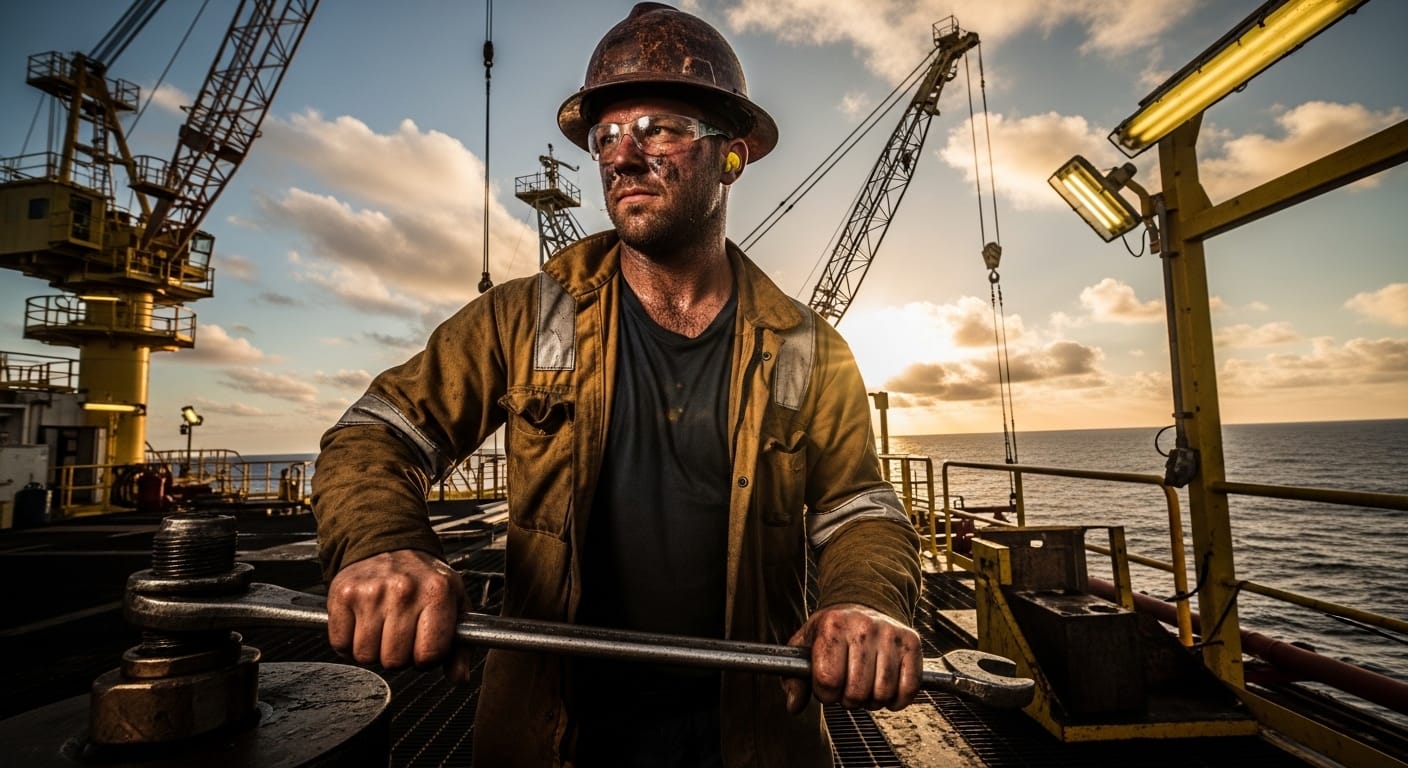
Oil rig work in 2026 pays between $50,000 and $250,000 annually depending on your role, theater of operation, and certifications — and the jobs are genuinely viable. The BLS confirms 10,600 annual openings industry-wide, driven almost entirely by attrition, not growth. With Brent crude holding at $79 per barrel and U.S. production at 13.6 million barrels per day, operators are disciplined on capex but desperate for certified field personnel. If you hold an IWCF ticket and offshore medical clearance, you are in a seller’s market right now.
Oil Rig Worker Salary & Job Viability 2026
- Salary Range: $50,000 (Roustabout) → $250,000+ (Offshore Drilling Engineer/Supervisor)
- BLS Employment (Feb 2026): 116,200 workers in oil and gas extraction; 10,600 openings projected annually through 2034
- Net Pay (W-2, $95K gross, Texas, single filer): $75,662.50 after federal income tax + FICA — effective federal rate of 20.355%
- Offshore Premium: Gulf of Mexico base salaries run 20% to 40% higher than equivalent Permian Basin onshore roles; zero living expenses during 182 days on rotation add a purchasing-power equivalent of $15,522.39 in gross pre-tax value annually
How much does an oil rig worker make in 2026?
Oil rig workers in 2026 earn between $50,000 and $250,000 per year. Entry-level Roustabouts start at $50,000 to $60,000. Roughnecks earn $55,000 to $65,000. Drillers command $70,000 to $90,000. Toolpushers reach $80,000 to $100,000. Specialized engineers and geologists break $120,000. Offshore contractor day rates in North America average $776 per day, scaling to $1,258 for a Drilling Supervisor.
| Rig Hierarchy Classification | Exact 2026 Base Salary Range (USD) | Core Operational Responsibilities |
|---|---|---|
| Roustabout (Entry-Level) | $50,000 – $60,000 | Manual labor, lifting/rigging support, deck maintenance, equipment cleaning |
| Roughneck / Floorman | $55,000 – $65,000 | Drill floor operations, pipe connection management, mechanical oversight |
| Driller | $70,000 – $90,000 | Drilling cabin operation, fluid management, direct drill floor supervision |
| Toolpusher (Rig Manager) | $80,000 – $100,000 | Complete rig oversight, IWCF Level 4 management, Permit to Work (PTW) control |
| Specialized Engineer / Geologist | > $120,000 | Subsurface well design, advanced fluid dynamics, structural data analysis |
Beyond base salaries, contractor day rates reveal stark regional disparities. Australasia pays the highest peak rates globally — a Drilling Supervisor there commands $1,574 per day. Africa averages $916 per day across all roles, reflecting the expatriate premium demanded for deepwater projects. The Global Energy Talent Index (GETI) 2026 reports that exactly 50% of rig workers secured a baseline salary increase this year, with 22% receiving raises exceeding 5%.
| Global Operating Region | Average Contractor Day Rate (USD) | Highest Compensated Role (Day Rate) |
|---|---|---|
| Africa | $916 | Geophysicist ($1,347) |
| Australasia | $896 | Drilling Supervisor ($1,574) |
| Europe | $808 | Commissioning Engineer ($1,139) |
| North America | $776 | Drilling Supervisor ($1,258) |
| Middle East | $647 | Project Manager ($883) |
| Asia | $626 | Construction Manager ($979) |
| Latin America | $377 | Drilling Supervisor ($671) |
What is the exact net pay for a roughneck after taxes?
A single offshore W-2 worker earning $95,000 gross in a zero-income-tax state like Texas takes home exactly $75,662.50 after federal income taxes and FICA. The 2026 standard deduction for a single filer is $16,100, reducing taxable income to $78,900. Total federal income tax liability is $12,070.00. FICA withholding at 7.65% adds $7,267.50. Total federal burden: $19,337.50. Effective federal tax rate: 20.355%.
| 2026 IRS Tax Bracket (Single Filer) | Taxable Income Range | Marginal Rate | Tax Liability |
|---|---|---|---|
| First Bracket | $0 to $12,400 | 10% | $1,240.00 |
| Second Bracket | $12,400 to $50,400 | 12% | $4,560.00 |
| Third Bracket | $50,400 to $78,900 | 22% | $6,270.00 |
| Total Federal Income Tax | $12,070.00 | ||
| FICA (7.65% on $95,000) | $7,267.50 | ||
| Total Federal Burden | $19,337.50 | ||
| Net Take-Home (Texas) | $75,662.50 |
The 14/14 Rotation Shadow Income Advantage — Information Gain No Competitor Publishes:
On a standard 14/14 rotation, an offshore worker lives on the installation for exactly 182 days per year. The operator provides 100% of room, board, utilities, and all meals at zero cost to the employee. If a comparable onshore worker spends a conservative $60 per day on food, utilities, and domestic consumption, the offshore worker averts exactly $10,920 in post-tax expenditures annually.
Because this $10,920 is a post-tax savings, its pre-tax equivalent is dramatically higher. To generate $10,920 in net discretionary capital at a combined marginal rate of 29.65% (22% federal income tax + 7.65% FICA), an onshore worker requires an additional $15,522.39 in gross salary. The $95,000 offshore salary therefore carries a true purchasing-power-parity equivalent of an onshore gross income of $110,522.39. This shadow income is the single most underreported financial advantage in oil and gas labor economics.
For 1099 contractors, the tax architecture shifts significantly. The full 15.3% self-employment tax applies (both employee and employer FICA portions), but Schedule C deductions become available. Deductible items include specialized safety gear, IWCF and BOSIET certification fees, union dues, and business travel at the 2026 IRS standard mileage rate of exactly $0.70 per mile. Standard denim jeans and basic work shirts are non-deductible regardless of exclusive rig use — only distinctive, non-street-wearable items such as flame-resistant (FRC) coveralls with high-visibility striping and steel-toed boots required by the site safety manager qualify for a Schedule C write-off under 2026 IRS guidelines.
Calculate your exact 2026 take-home pay based on your day rate and tax bracket:
Paycheck Calculator
Calculate your Weekly, Monthly & Yearly Take-Home Pay
⚠️ These are estimates for a single filer using 2026 tax rates (IRS Rev. Proc. 2025-32). Results do not include local taxes, pre-tax deductions (401k, health insurance), or tax credits. Consult a tax professional for personalized advice.
Are oil rig jobs in high demand for 2026?
Oil rig jobs are in high demand in 2026 — but the demand is driven by attrition, not expansion. The BLS counts 116,200 workers in oil and gas extraction as of February 2026 and projects 10,600 openings annually through 2034. The broader mining and extraction sector shrinks by 1.6% over the decade, but rig floor attrition from physical degradation and career exits creates a constant vacuum that automation has not yet filled.
| Exact BLS Demographic Metric | Decisive Data Point | Reference Period |
|---|---|---|
| Current Sector Employment | 116,200 workers | February 2026 |
| Broader Sector Projected Change | -1.6% (-9,300 jobs) | 2024–2034 Decade |
| Specific “Oil & Gas Worker” Change | +1.0% (+1,300 jobs) | 2024–2034 Decade |
| Annual Projected Openings | 10,600 openings per year | 2024–2034 Annual Average |
The critical distinction is this: the BLS Occupational Outlook Handbook isolates “Oil and gas workers” — rig floor personnel specifically — from the broader extraction sector’s administrative and corporate roles. That specific occupational classification projects 1.0% growth from 2024 to 2034, growing from 115,900 jobs to 117,200 jobs over the decade. The net addition of 1,300 jobs sounds modest; the 10,600 annual openings is the number that matters for anyone actually trying to get hired.
The automation threat is real but slow. AI-based reservoir modeling, extraction robotics, and drone surveillance are eliminating redundant manual labor in the broader sector. But replacing a certified Driller sitting in a cyber-chair managing a well with 15,000 PSI of downhole pressure is not a 2026 problem. According to GETI 2026 data, 60% of hiring managers are actively increasing salaries to attract qualified candidates — the clearest market signal that demand for skilled personnel outstrips supply at current wage levels.
How do onshore and offshore oil rig salaries compare?
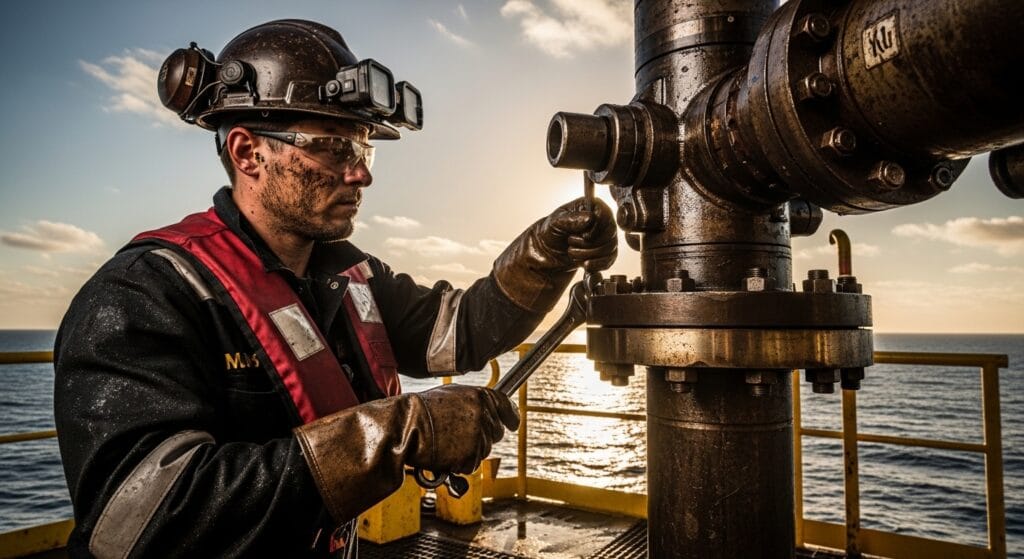
Offshore Gulf of Mexico workers earn 20% to 40% more than equivalent onshore roles. The GoM base salary range is $80,000 to $250,000 with contractor day rates of $776 to $1,258. The Permian Basin averages $51,495 annually for an onshore rig worker, with peak 90th-percentile earners reaching $77,793. Onshore specialized contractor day rates run $500 to $560 — versus $776 offshore.
| Operational Theater | Base Salary / Day Rate Range | Hazard Premium & Allowance Framework |
|---|---|---|
| Gulf of Mexico (Offshore) | $80,000 – $250,000 base; $776 – $1,258 day rate | 20%–40% base premium over onshore; zero living expenses during 182 rotation days per year |
| Permian Basin (Onshore) | $51,495 – $77,793 base; $500 – $560 day rate | Standard hourly/day rate; $206/day GSA federal per diem applies to 1099 contractors on deployment |
The wage gap is structurally anchored in rig lease economics. U.S. onshore drilling rig day rates — what the operator pays to lease the entire rig and its crew — have slid to a composite of $23,623 per day in 2026. Class D Permian Basin rigs specifically command $30,305 per day. Because the onshore lease margin is tighter, the capital available to flow through to individual worker wages is constrained relative to deepwater drillships that lease for $400,000 to $600,000 per day.
Onshore contractors do have one meaningful compensation lever: the GSA federal per diem. For the Midland/Odessa region of the Permian Basin in FY2026, the GSA lodging cap is exactly $132 per day and the Meals & Incidental Expenses (M&IE) rate is $74 per day — a combined tax-free daily allowance of exactly $206. A 1099 contractor running a 20-day hitch in the Permian receives $4,120 in untaxed per diem per rotation. That is not profit — it is intended subsistence reimbursement — but it meaningfully supplements the lower base compensation relative to offshore roles.
The GoM offshore premium exists because it has to. Offshore workers contend with Category 4 hurricane evacuations, high-pressure subsea blowout scenarios, mandatory Helicopter Underwater Escape Training, and the psychological weight of being 150 miles from shore with no exit option for 14 consecutive days. The pay premium is not generosity. It is the market’s minimum viable compensation to staff those rigs.
What are the hidden costs of working on an oil rig?
Before an offshore worker boards a helicopter in the Gulf of Mexico, they personally absorb $1,400 to $2,600 in mandatory certification costs. BOSIET runs $900 to $1,800. HUET standalone costs $400 to $900. TWIC is $125. The OGUK offshore medical exam costs $120 to $250. These are out-of-pocket, pre-income requirements that no employer is legally obligated to reimburse in 2026.
| Mandatory Certification | Exact 2026 Cost (USD) | Validity Period | Unpaid Time Cost |
|---|---|---|---|
| BOSIET (Includes HUET) | $900 – $1,800 | 4 Years | 3 Days |
| HUET (Standalone) | $400 – $900 | 2–4 Years | 1 Day |
| TWIC (U.S. Security Clearance) | ~$125 | 5 Years | Application Processing |
| OGUK Offshore Medical Exam | $120 – $250 | 2 Years | 1–2 Hours |
| OPITO MIST (Safety Training) | $300 – $600 | 4 Years | 2 Days |
| Total Entry-Level Certification Burden | $1,400 – $2,600 | ~6 Unpaid Days |
The gear costs compound the problem. Flame-resistant clothing, steel-toed boots resistant to drilling fluid chemical degradation, hard hats, and safety eyewear add several hundred dollars before the first shift. These recur — FRC wears out, boots degrade in the chemical environment on the drill floor, and certifications expire on fixed cycles. BOSIET renews every four years via a FOET refresher; the offshore medical renews every two years.
The IRS provides partial relief for 1099 contractors, but the rules are strict and widely misunderstood. Standard work clothing — including jeans worn exclusively on the rig — is non-deductible. Only PPE that is entirely unsuitable for everyday street wear qualifies as a Schedule C deduction: FRC coveralls with mandated high-visibility striping, steel-toed boots explicitly specified by the site safety manager, and similar items with no dual-purpose civilian use. Workers who deduct general work clothing are taking an audit risk, not a legitimate write-off.
The physical toll is a hidden cost that no spreadsheet captures. Twelve hours per shift on a drill floor involves continuous exposure to caught-between hazards from spinning drill string, high-pressure line failures, and H2S gas risk on sour wells. The cumulative physical degradation — hearing loss from machinery noise, joint damage from manual pipe handling, and respiratory exposure — directly contributes to the high attrition rate that generates 10,600 annual BLS openings. The offshore hazard pay premium is, in part, a discount on your long-term health.
How long are oil rig shifts and rotations?
The Gulf of Mexico standard is the 14/14 rotation: 14 consecutive days on the installation, 14 days off, with a 12-hour daily shift. That is 168 hours of labor in a single two-week hitch — more than double the 80 hours worked in a standard terrestrial fortnight. Deepwater drillships and international remote assets use 21/21 or 28/28 schedules to reduce helicopter mobilization frequency and cost.
| Rotational Framework | Days On | Days Off | Daily Shift | Hours Per Hitch |
|---|---|---|---|---|
| Standard Offshore (14/14) | 14 | 14 | 12 Hours | 168 Hours |
| Extended Deepwater (21/21) | 21 | 21 | 12 Hours | 252 Hours |
| International Remote (28/28) | 28 | 28 | 12 Hours | 336 Hours |
The 12-hour shift leaves exactly 12 hours for mandatory sleep, hygiene, meals, and shift-handover briefings. There is no discretionary personal time during a rotation. The rig operates 24 hours per day, 365 days per year — no holidays, no weekends, no weather days unless the asset is evacuated. Simultaneous Operations (SIMOPS) are routine: drilling, construction, and maintenance occur concurrently in a confined footprint, requiring sustained hyper-vigilance across all 12 hours of an operational window.
The transition back to civilian life every two to four weeks is its own documented psychological challenge. Moving from absolute operational discipline and industrial isolation directly into family and social environments requires significant mental resilience. Relationships under this framework fail at elevated rates. The financial premium of offshore work is in part compensation for this disruption — and anyone considering the career who is focused exclusively on the gross salary number is looking at an incomplete balance sheet.

FAQ
Do oil rig workers get paid during their weeks off?
No. Oil rig workers on standard employment contracts are paid only for their days on the installation. The 14 days off are unpaid leave. The high per-day and annual compensation figures account for this structure — the annualized salary already reflects a 182-day working year, not 365.
Do you need a college degree to work on an oil rig?
No degree is required for entry-level rig positions. A Roustabout needs physical fitness and a BOSIET certification — period. Advancement to Driller and Toolpusher requires IWCF well control certification and accumulated operational hours, not academic credentials. Drilling Engineers and Geologists require petroleum engineering or geoscience degrees for roles above $120,000.
What is the hardest and highest-paying job on an oil rig?
The Toolpusher is the hardest operational job and the highest-paid non-engineer on the drill floor, commanding $80,000 to $100,000 base annually. The Toolpusher holds 24-hour accountability for all rig operations, IWCF Level 4 well control authority, and Permit to Work (PTW) sign-off on every high-risk task. Offshore Drilling Supervisors on day-rate contracts reach $1,258 per day in North America — the absolute peak in this market.
If you are looking for Trades & Blue Collar jobs, check out our guides on [Construction Foreman] and [Sheet Metal Worker].
Works cited
- Short-Term Energy Outlook – EIA, accessed March 12, 2026, https://www.eia.gov/outlooks/steo/pdf/steo_full.pdf
- 2026 Offshore Challenge: Softening Demand Puts the Brakes on Day Rates, accessed March 12, 2026, https://jpt.spe.org/2026-offshore-challenge-softening-demand-puts-the-brakes-on-day-rates
- Employment Projections: 2024-2034 Summary – BLS.gov, accessed March 12, 2026, https://www.bls.gov/news.release/ecopro.nr0.htm
- World Energy Employment 2025, accessed March 12, 2026, https://iea.blob.core.windows.net/assets/e5b9e908-26fe-4228-8978-e4ee36c555ed/WorldEnergyEmployment2025.pdf
- 2026 Oil Rig Jobs Guide: Positions, Salary & Skills – Brunel, accessed March 12, 2026, https://www.brunel.net/en-us/blog/oil-and-gas/oil-rig-jobs-in-2026-comprehensive-guide-to-roles-pay-and-qualifications
- How much does a toolpusher earn on offshore oil rigs? – Rigzone, accessed March 12, 2026, https://www.rigzone.com/insights/salary-1/how-much-does-a-toolpusher-earn-on-offshore-oil-rigs-58
- These are the highest paying oil rig jobs (with salaries) in 2026 – Airswift, accessed March 12, 2026, https://www.airswift.com/blog/oil-rig-jobs-salary
- What is the compensation for a drilling fluids engineer? – Rigzone, accessed March 12, 2026, https://www.rigzone.com/insights/salary-1/what-is-the-compensation-for-a-drilling-fluids-engineer-26
- IRS releases tax inflation adjustments for tax year 2026, including amendments from the One, Big, Beautiful Bill | Internal Revenue Service, accessed March 12, 2026, https://www.irs.gov/newsroom/irs-releases-tax-inflation-adjustments-for-tax-year-2026-including-amendments-from-the-one-big-beautiful-bill
- IRS Releases 2026 Tax Brackets, Contribution Limits, Other Tax Updates – Colorado PERA, accessed March 12, 2026, https://copera.org/pera-on-the-issues/irs-releases-2026-tax-brackets-contribution-limits-other-tax-updates
- 2026 individual tax brackets, and tips for understanding what you pay | Principal, accessed March 12, 2026, https://www.principal.com/individuals/learn/individual-tax-brackets-understand-what-you-pay
- 2026 Tax Brackets and Federal Income Tax Rates | Tax Foundation, accessed March 12, 2026, https://taxfoundation.org/data/all/federal/2026-tax-brackets/
- Tax brackets for 2025 and 2026 – Ameriprise Financial, accessed March 12, 2026, https://www.ameriprise.com/financial-goals-priorities/taxes/tax-brackets
- 2025 and 2026 tax brackets and federal income tax rates – Fidelity Investments, accessed March 12, 2026, https://www.fidelity.com/learning-center/personal-finance/tax-brackets
- Tax Deductions for Oilfield Workers: 2026 Checklist – Bonsai, accessed March 12, 2026, https://www.hellobonsai.com/blog/tax-deductions-for-oilfield-workers
- Are Your Work Boots Tax Deductible? Here’s What You Should Know, accessed March 12, 2026, https://nicksboots.com/blogs/blog/are-your-work-boots-tax-deductible-here-s-what-you-should-know
- When Is Work Clothing Tax-Deductible? A 2026 Guide for Business Owners & Contractors, accessed March 12, 2026, https://pantanacpa.com/blog/when-is-work-clothing-tax-deductible-a-2026-guide-for-business-owners-contractors/
- Ultimate Guide to Offshore Oil Rig Careers – ablemkr, accessed March 12, 2026, https://ablemkr.com/ultimate-guide-to-offshore-oil-rig-careers/
- Oil and Gas Extraction: NAICS 211 : U.S. Bureau of Labor Statistics, accessed March 12, 2026, https://www.bls.gov/iag/tgs/iag211.htm
- Industry and occupational employment projections overview and highlights, 2024–34 : Monthly Labor Review – BLS.gov, accessed March 12, 2026, https://www.bls.gov/opub/mlr/2026/article/industry-and-occupational-employment-projections-overview.htm
- Employment Projections – 2024-2034 – Bureau of Labor Statistics, accessed March 12, 2026, https://www.bls.gov/news.release/pdf/ecopro.pdf
- Oil and Gas Workers : Occupational Outlook Handbook: : U.S. …, accessed March 12, 2026, https://www.bls.gov/ooh/construction-and-extraction/oil-and-gas-workers.htm
- How Much Do Oil Rig Workers Make? – Pay Only If We Win, accessed March 12, 2026, https://albtriallawyers.com/how-much-do-oil-rig-workers-make/
- Understanding Job On Oil Rig Salary: Earnings And Risks Explained, accessed March 12, 2026, https://injuredcase.com/oil-rig-job-salary-complete-guide-to-earnings-in-2025/
- 2026 Salary Thread : r/maritime – Reddit, accessed March 12, 2026, https://www.reddit.com/r/maritime/comments/1q7ffvu/2026_salary_thread/
- Oil Rig Worker Salary in Texas: Hourly Rate (Mar, 2026) – ZipRecruiter, accessed March 12, 2026, https://www.ziprecruiter.com/Salaries/Oil-Rig-Worker-Salary–in-Texas
- U.S. drilling rig day rates decline for fourth straight month – Enverus, accessed March 12, 2026, https://www.enverus.com/blog/u-s-drilling-rig-day-rates-decline-for-fourth-straight-month/
- FY 2026 per diem rates for Texas, accessed March 12, 2026, https://www.co.kinney.tx.us/upload/page/0310/FY%202026%20per%20diem%20rates%20for%20Texas.pdf
- FY 2026 per diem rates for Texas | GSA, accessed March 12, 2026, https://www.gsa.gov/travel/plan-book/per-diem-rates/per-diem-rates-results?action=perdiems_report&city=&fiscal_year=2026%20%28Current%20federal%20fiscal%20year%29&state=TX&zip=
- Tickets & Training: The Hidden Costs For Offshore Oil & Gas Workers, accessed March 12, 2026, https://foe.scot/resource/tickets-training-the-hidden-costs-for-offshore-oil-gas-workers/
- Offshore Certifications in 2026: What Workers Need to Secure the Best Roles – Enxgy, accessed March 12, 2026, https://enxgy.com/offshore-certifications-in-2026-what-workers-need-to-secure-the-best-roles/
- OPITO HUET, FOET & BOSIET Courses | FMTC Safety, accessed March 12, 2026, https://fmtcsafety.com/course-category/opito-huet-foet-bosiet-courses/
- Best training courses for oil rig jobs with no experience? – Rigzone, accessed March 12, 2026, https://www.rigzone.com/insights/educational-pathways-5/best-training-courses-for-oil-rig-jobs-with-no-experience-673
- 25 Tax Write-Offs for Oil and Gas Contractors, accessed March 12, 2026, https://www.keepertax.com/tax-write-offs/oil-gas-contractors