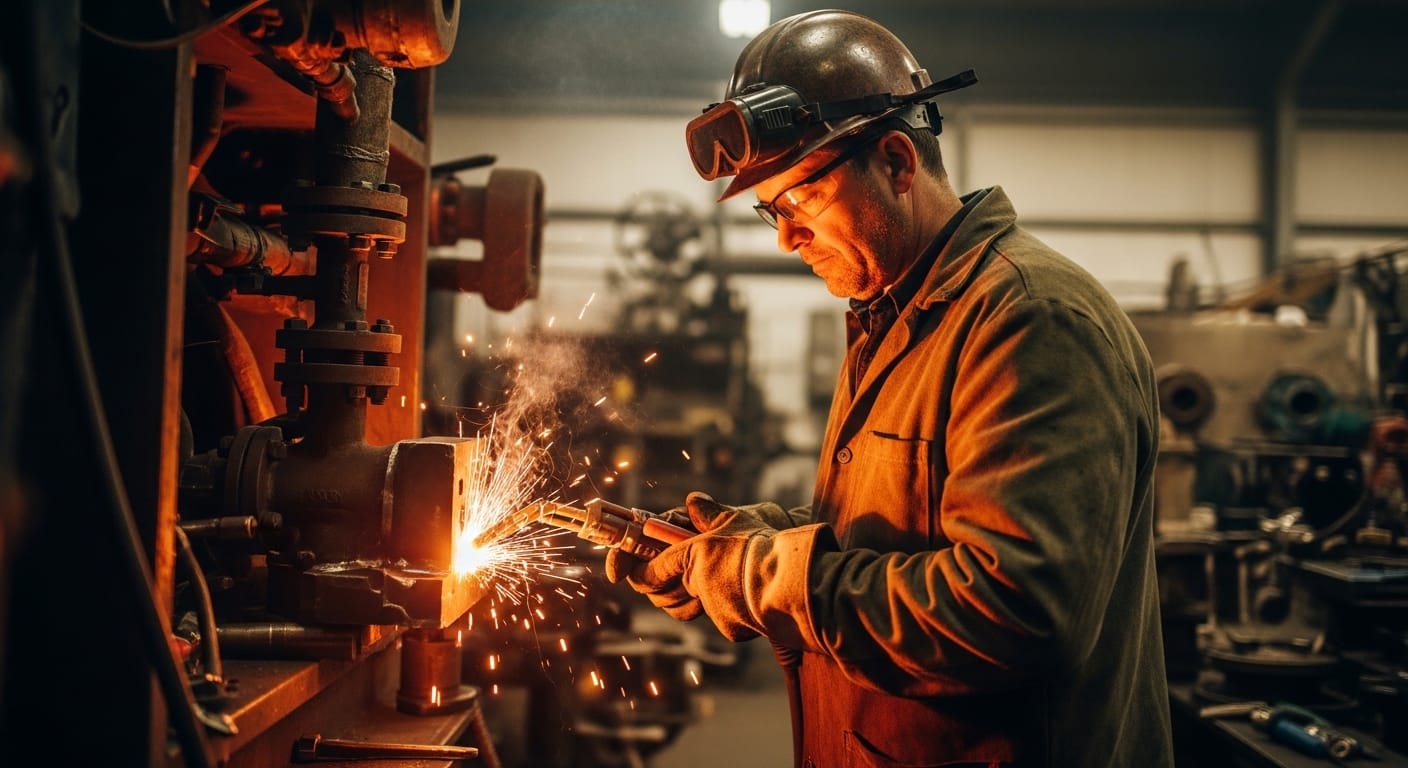
Boilermaker Salary 2026: $102K+ on Shutdowns
What Boilermakers Salary in 2026
Let’s cut straight to it. You’re not here for a motivational speech. You want to know if crawling inside a pressure vessel at 3 AM during a Gulf Coast refinery shutdown is worth it financially. The answer, backed by the Bureau of Labor Statistics (BLS OES Code: 47-2011, May 2024 release), is an unambiguous yes — if you’re willing to earn it.
The median boilermaker in the United States earns $71,140 per year, or roughly $34.20 an hour at a standard 40-hour week. But the guys who’ve been doing this trade for 15 years will tell you: nobody serious in this trade works a standard 40-hour week. Not during outage season. The real money — the money that lets you pay off a truck in a year and put your kids through college — lives inside the turnaround schedule. We’ll get to that.
Here’s the fast overview before we go deep:
Table of Contents
- What Boilermakers Salary in 2026
- Apprentice to Master Boilermaker: How the Money Grows
- Best States for Boilermakers: Where Geography Becomes a Pay Multiplier
- Boilermaker vs Pipefitter: The Heavy Industrial Salary Debate
- FAQ
- Sources & Data
Table 1: Boilermaker Salary Quick Overview — 2026
| Tier | Percentile | Annual Salary | Hourly Rate |
|---|---|---|---|
| Apprentice (Entry) | Bottom 10% | $49,510 | ~$23.81/hr |
| Journeyman Boilermaker | Median (50%) | $71,140 | ~$34.20/hr |
| Shutdown Specialist | Top 90% | $102,120+ | $49.10+/hr |
Source: BLS OES 47-2011, May 2024 — most current verified data available for 2026 planning.
Apprentice to Master Boilermaker: How the Money Grows
This isn’t a trade where you show up day one and start earning journeyman wages. The Brotherhood of Boilermakers runs a structured apprenticeship program — typically 5 years — and your pay climbs alongside your certifications, your physical tolerance, and frankly, your psychological tolerance for confined spaces.
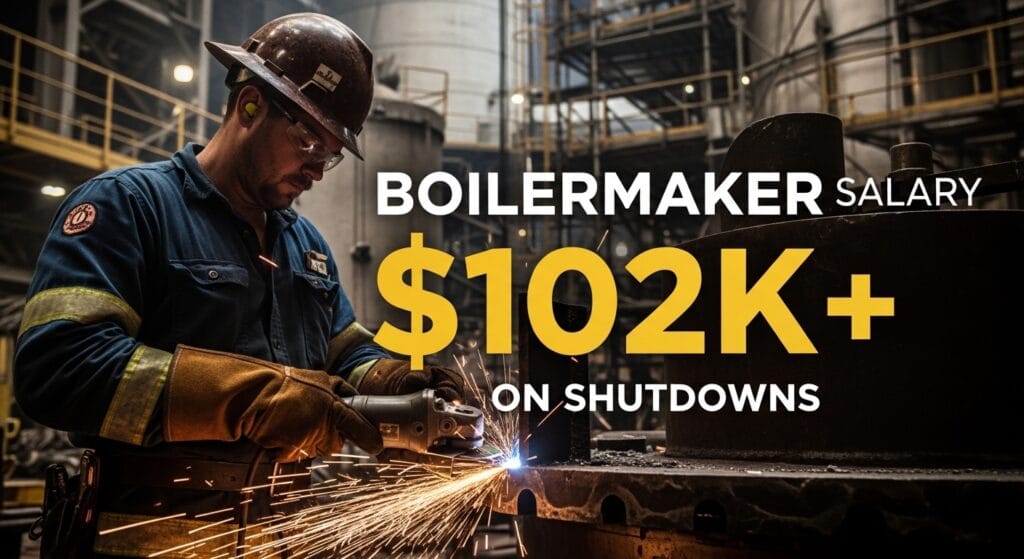
But here’s what most salary articles never explain: base wages are only part of the story. The real financial architecture of a boilermaker’s career is built on three pillars — base rate, per diem, and shutdown overtime. A journeyman traveling to a Texas refinery turnaround isn’t just earning his $34/hour. He’s also collecting a per diem allowance — often $150 to $250 per day, tax-free — to cover room and board. Stack 30 days of that on top of 84-hour work weeks at time-and-a-half, and suddenly you’re looking at compensation that makes the annual salary number almost irrelevant.
See what a 7-day, 12-hour shutdown schedule does to your paycheck. Plug in your journeyman rate and watch the number change.
Paycheck Calculator
Calculate your Weekly, Monthly & Yearly Take-Home Pay
⚠️ These are estimates for a single filer using 2026 tax rates (IRS Rev. Proc. 2025-32). Results do not include local taxes, pre-tax deductions (401k, health insurance), or tax credits. Consult a tax professional for personalized advice.
Table 2: Boilermaker Career Earnings — 2026
| Career Stage | Years in Trade | Base Hourly | Annual Base | Shutdown Earnings Potential |
|---|---|---|---|---|
| 1st-Year Apprentice | 0–1 | ~$17–$20 | ~$35,000–$41,000 | Limited (not yet certified for confined space) |
| 3rd-Year Apprentice | 2–3 | ~$24–$27 | ~$50,000–$56,000 | Moderate — working under supervision |
| Journeyman Boilermaker | 5+ | $34.20 | $71,140 | $90,000–$120,000 during peak outage seasons |
| Shutdown Specialist / Foreman | 10–15+ | $49.10+ | $102,120+ | $120,000–$160,000+ in aggressive travel years |
That “Shutdown Earnings Potential” column is where conversations at union halls get interesting. A traveling journeyman who chases turnarounds — meaning he’s following the Spring and Fall outage seasons across the Gulf Coast, the Mid-Atlantic, and the Pacific refineries — can realistically clear $100,000 in six months. Six months. Not a year.
The other six months? Some guys take it. They go home, fix the house, coach Little League, and decompress. Others chase the next outage and clear $150,000+ for the full calendar year. The lifestyle is brutal. The financial outcome is not.
Best States for Boilermakers: Where Geography Becomes a Pay Multiplier
Not all boilermaker jobs are created equal, and geography has an enormous impact on your earning ceiling. Industrial density — specifically, the concentration of petroleum refineries, chemical processing facilities, power generation plants, and natural gas infrastructure — determines where the work is and how much it pays.
Table 3: Top 5 States for Boilermaker Pay — 2026
| State | Annual Mean Wage | Why It Pays |
|---|---|---|
| California | $101,380+ | Strict emissions compliance laws drive constant retrofitting and environmental upgrades on industrial plants. Union density is extremely high. |
| Illinois | $94,250+ | Chicago-area heavy industrial corridor and some of the strongest union locals in the country. |
| Pennsylvania | $88,690+ | Legacy steel and manufacturing infrastructure combined with a rapidly growing natural gas sector. |
| Louisiana | $74,340+ | The heartbeat of Gulf Coast refinery work. Massive concentration of petrochemical plants in the Baton Rouge–New Orleans corridor. |
| Texas | $71,270+ | The volume leader. The Houston/Beaumont/Port Arthur triangle is the single largest employer of boilermakers in the country. Lower base than California, but the sheer number of turnaround opportunities means your total annual income often exceeds California workers. |
The Gulf Coast — specifically the Louisiana/Texas corridor — deserves its own paragraph, because salary tables don’t fully capture what it means to work there. This region contains the highest density of petroleum refining capacity in the Western Hemisphere. When a refinery in Port Arthur, Texas schedules a 30-day turnaround, they’re not hiring 10 boilermakers. They’re hiring 200 to 400 boilermakers simultaneously, working around the clock in rotating shifts to get that plant back online. The wages are competitive. The per diem is real. And if you’ve got your confined space certifications and a reliable truck, your phone doesn’t stop ringing from April through June and again from September through November.
Boilermaker vs Pipefitter: The Heavy Industrial Salary Debate
If you’re in the trades and trying to decide between these two career paths, or if you’re writing content trying to capture comparison searches, this is the section that matters. Both trades require industrial welding skills. Both work in refineries and power plants. But they are not the same job, and the pay difference reflects that.
Table 4: Boilermaker vs Pipefitter — 2026 Comparison
| Category | Boilermaker (47-2011) | Pipefitter (47-2152) |
|---|---|---|
| Median Annual Salary | $71,140 | $62,970 |
| Primary Work Environment | Inside pressure vessels, boilers, tanks, vats | External pipe routing, valve stations, mechanical rooms |
| Primary Hazard | Confined spaces, heat, pressure, limited visibility | Geometry/fit-up precision, high-pressure system leaks |
| Shutdown Demand | Extremely high — vessels must be internally inspected and repaired | High — but scope is often more predictable and external |
| Welding Requirement | Advanced structural welding, often in vertical/overhead confined positions | Advanced welding, often in more accessible orientations |
| Earnings Premium | ~$8,170/year more at median | Baseline comparison |
| Travel Expectation | Very high (traveling boilermakers are the industry norm) | Moderate — more local plant work available |
That $8,170 annual premium at the median doesn’t sound earth-shattering on its own. But it compounds. Over a 30-year career, a boilermaker working the same number of hours as a pipefitter is earning roughly $245,000 more in base wages alone — before you factor in the shutdown premium that boilermakers are disproportionately called for due to the internal vessel inspection and repair work that only they’re certified to execute.
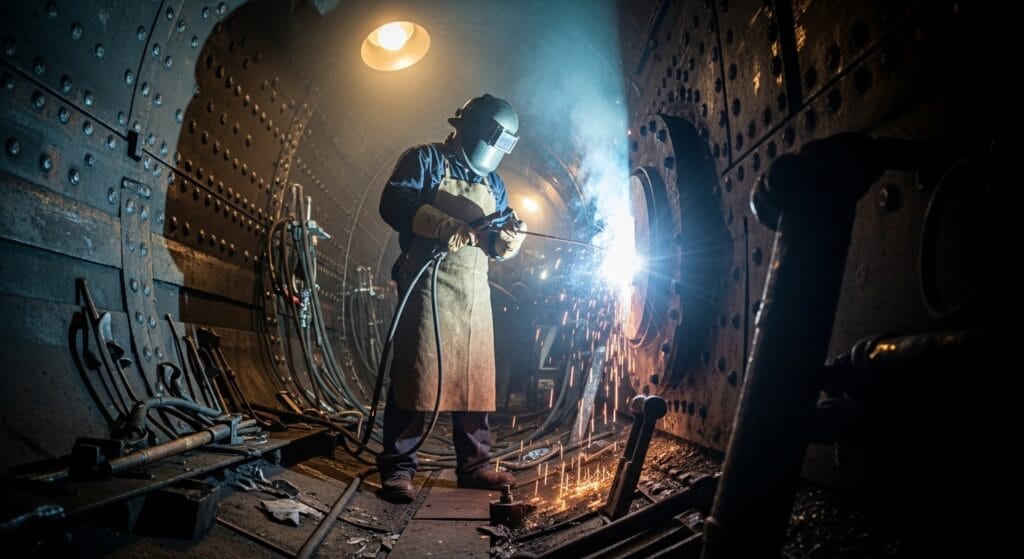
The trade-off is real and worth naming directly: you earn more because the work is harder and more dangerous. Pipefitters work on the outside of systems. Boilermakers work on the inside. You’re going to be dirty, sweating, breathing through a respirator in a space that might be 120 degrees and barely big enough to turn around in. But the shutdown checks make it all worth it.
FAQ
Can someone with claustrophobia work as a boilermaker?
This is the first thing to address honestly, because the trade will self-select you out if you can’t manage it. A substantial portion of the highest-paid work in this trade — the vessel entry, the internal shell inspection, the confined space welding — takes place in spaces where the psychological stress is real. That said, “claustrophobia” exists on a spectrum. Many experienced boilermakers will tell you that the job teaches you to manage it over time — that the discipline of the confined space entry protocol, the buddy system, and the methodical workflow actually creates a mental framework that manages anxiety. But if you genuinely cannot function in enclosed spaces, this is not the right trade. There’s no shame in that. Pipefitting and ironwork are both strong, well-compensated alternatives.
Is the boilermaker trade dying?
No. But the BLS data does project a modest 2% employment decline over the next decade, and it’s worth explaining why — and why it doesn’t represent the catastrophe it sounds like. The decline is almost entirely attributable to the retirement of coal-fired power generation. Coal plants are closing, and they employ significant numbers of boilermakers for maintenance. That work is genuinely going away.
What is not going away is the maintenance obligation on every other form of industrial infrastructure: natural gas plants, nuclear facilities, chemical refineries, water treatment plants, and food processing facilities all rely on boilers and pressure vessels that require federally mandated inspection and maintenance cycles. You can’t defer that maintenance. Furthermore, boilermakers are at the center of the environmental retrofit boom — installing flue gas desulfurization systems (scrubbers) on existing plants to meet EPA emissions standards. That’s billions of dollars worth of work being scheduled over the next decade. The trade isn’t dying. It’s relocating its center of gravity from coal to petrochemical and environmental compliance.
What certifications increase a boilermaker’s salary the most?
Your core NCCER Boilermaker certification and union journeyman card are the foundation. From there, the certifications that translate directly to higher shutdown pay rates are: confined space rescue certification, advanced structural welding endorsements (particularly 6G pipe welding), rigging and signaling certification, and OSHA 30-Hour Construction. A boilermaker who brings all of these to a refinery turnaround is not competing with entry-level applicants. He’s being called specifically by name by the general foreman who worked with him on the last three outages.
How do per diem and travel pay work?
Per diem is a daily allowance paid on top of wages to cover living expenses when you’re working away from home. Under most union collective bargaining agreements and even many non-union contractor arrangements, this runs $150 to $250 per day, tax-free, for every day you’re working on location. On a 30-day turnaround where you’re working every day, that’s $4,500 to $7,500 in tax-free supplemental income on top of your regular wages. This is why the “annual salary” number is genuinely misleading for traveling tradespeople — total compensation is frequently 20 to 40% higher than base wage figures suggest.
What does a typical turnaround schedule actually look like?
Seven days a week. Twelve-hour shifts. Minimum four weeks straight, sometimes six or eight. You wake up at 4:30 AM, eat at the contractor camp, bus to the site, get into your PPE, and you work until your shift ends. You eat dinner, shower, sleep, and do it again. There’s no weekend. There’s no holiday pay distinction because every day is overtime at that point. It is physically and mentally demanding in ways that desk work simply is not. But when you look at the direct deposit notification on your phone after week four, and you’ve earned what many office workers earn in six months, you understand the economics of why this trade exists and why the men who do it have an earned sense of pride about it.
Sources & Data
All salary figures in this article are sourced from the Bureau of Labor Statistics Occupational Employment and Wage Statistics (OEWS), OES Code 47-2011 — Boilermakers, May 2024 release. This represents the most current official government wage data available for 2026 planning and career decision-making. State-level figures are drawn from the same BLS geographic series.
Turnaround earnings estimates and per diem figures reflect prevailing union collective bargaining agreement structures across IBBEW (International Brotherhood of Boilermakers, Iron Ship Builders, Blacksmiths, Forgers and Helpers) affiliated locals and are consistent with industry-reported compensation for Gulf Coast and Mid-Atlantic refinery outage work.
SalaryClear.com publishes verified salary guides for skilled trades workers. All data is sourced from federal labor statistics and cross-referenced with industry compensation benchmarks.
If you are looking for Trades & Blue Collar jobs, check out our guides on [Ironworker] and [Wind Turbine].