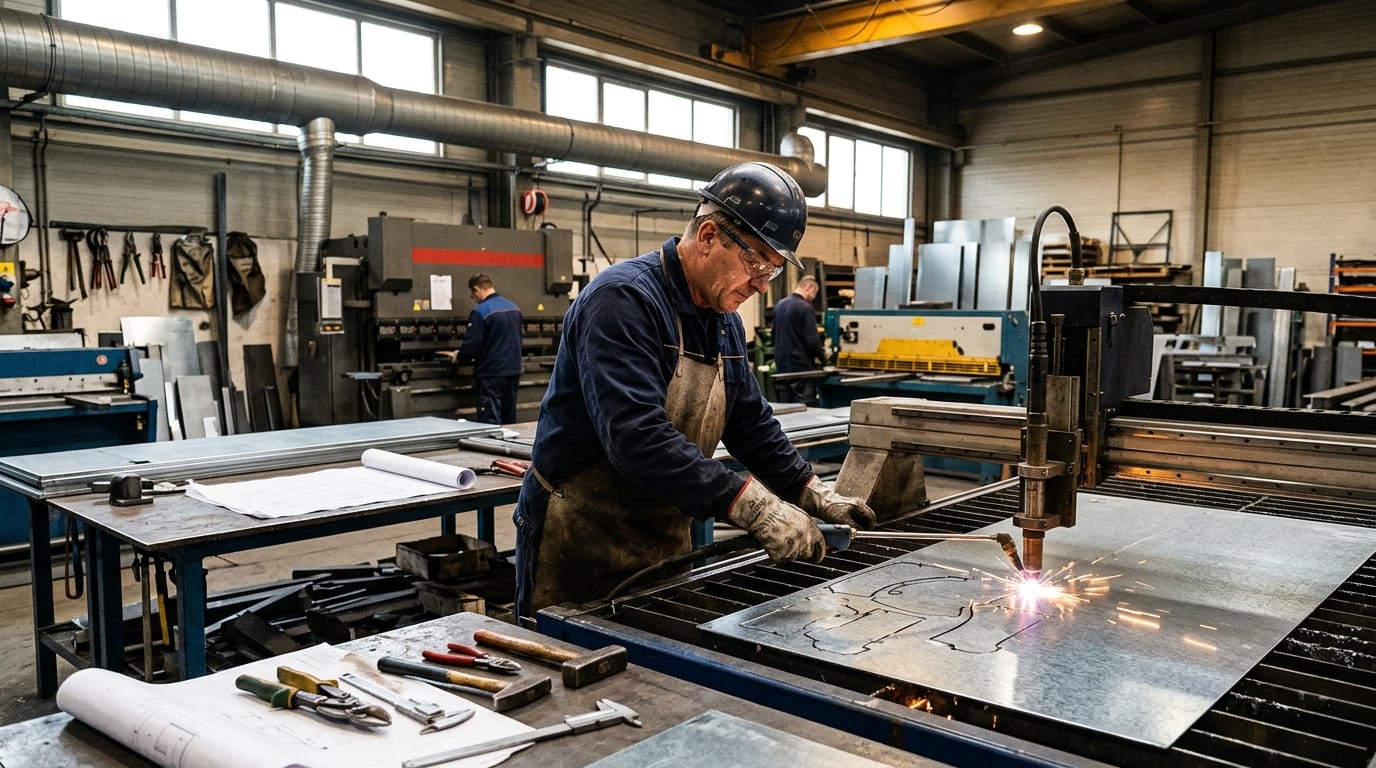
Sheet Metal Worker Salary 2026: $60K–$130K Total Pay
Sheet Metal Worker Salary
Quick Facts — Sheet Metal Worker Salary 2026
| Median Annual Wage | $60,850 |
| Top 10% (Union Journeyman) | $102,680+ |
| Entry-Level (Apprentice Year 1) | $38,030 |
| Best State | New York ($79,500+) |
| BLS OES Code | 47-2211 |
| Last Updated | February 2026 |
Let me tell you something that most salary websites get completely wrong about this trade. They’ll post the BLS median — $60,850 — and leave it there, as if that number tells you anything meaningful about what a Sheet Metal Worker actually takes home after 15 years in a strong union local. It doesn’t. Not even close.
I’ve been swinging tin for 25 years. I came up through a SMART Union apprenticeship, spent my first seven years on the shop floor running a plasma table and a Pittsburgh lock former, then transitioned to the field where I’ve been hanging ductwork, architectural panels, and specialty exhaust systems on everything from hospital operating suites to 60-story high-rise towers. I know what this trade pays at every level, and I know what it costs your body to earn it.
Here’s the real answer first, then I’ll break down every layer underneath it.
What Sheet Metal Workers Earn in 2026: The Direct Answer
The BLS median of $60,850 per year represents a W-2 journeyman wage in a mixed market — union and non-union combined. That number is honest but incomplete. In a strong prevailing wage state with a solid local, a journeyman’s total compensation package — the wage on the check, plus contractor-funded pension contributions, annuity funds, and health insurance — routinely lands between $95,000 and $130,000 in total value, even when the taxable hourly rate looks like $45–$55 per hour on paper.
Non-union? The base wage is real but the package is thin. You’ll cap out around $55,000–$70,000 with standard employer benefits and very little pension security.
Table 1: Quick 2026 Salary Overview
| Tier | Annual Base | Hourly | Total Package (Union Est.) |
|---|---|---|---|
| Apprentice — Year 1 | $38,030 | $18.28 | $52,000–$60,000 |
| Apprentice — Year 5 | $50,000–$55,000 | $24–$26 | $68,000–$80,000 |
| Journeyman (Median) | $60,850 | $29.26 | $85,000–$105,000 |
| Journeyman (Top Metro) | $80,000–$95,000 | $40–$47 | $115,000–$135,000 |
| Foreman / Architectural Specialist | $102,680+ | $49.36+ | $130,000–$150,000+ |
Apprentice to Journeyman: The Pay Ladder
We are the only trade that manufactures what we install. A pipefitter installs pipe someone else made. A carpenter frames with lumber someone else milled. We walk into the shop, read the blueprints, run the sheet through the brake and the notcher, and then go hang it ourselves on the job site. That dual skill set — fabricator and installer — is exactly why this apprenticeship takes five years and why the pay trajectory is worth understanding carefully.
Paycheck Calculator
Calculate your Weekly, Monthly & Yearly Take-Home Pay
⚠️ These are estimates for a single filer using 2026 tax rates (IRS Rev. Proc. 2025-32). Results do not include local taxes, pre-tax deductions (401k, health insurance), or tax credits. Consult a tax professional for personalized advice.
The SMART Union Apprenticeship Structure
The Sheet Metal Workers’ International Association (SMART) runs a Joint Apprenticeship Training Committee (JATC) program that is typically five years in length, combining on-the-job hours with classroom instruction. You are not going to school instead of working — you are working full-time and attending classes on nights or scheduled release days. The math, the blueprint reading, the geometry, and the trade theory are not optional. Locals will wash you out if you don’t maintain your grades.
The pay structure scales as a percentage of journeyman scale within each local:
| Apprentice Year | % of Journeyman Scale | Example (Local at $50/hr JW) | Total Package Value |
|---|---|---|---|
| Year 1 | ~45–50% | ~$22.50–$25.00/hr | $52,000–$62,000 |
| Year 2 | ~55–60% | ~$27.50–$30.00/hr | $65,000–$74,000 |
| Year 3 | ~65–70% | ~$32.50–$35.00/hr | $76,000–$86,000 |
| Year 4 | ~75–80% | ~$37.50–$40.00/hr | $88,000–$98,000 |
| Year 5 (Pre-Journeyman) | ~85–90% | ~$42.50–$45.00/hr | $98,000–$110,000 |
The Total Package is the number that matters. When your contractor contributes $10–$15 per hour worked into a pension fund, another $3–$6 into an annuity, and pays your entire family health insurance premium — that’s $20+ per hour in compensation that never appears on your W-2 but absolutely builds your wealth. A 30-year-old journeyman in Local 73 (Chicago) with a fully funded pension is building retirement security that most college graduates with 401(k) matching plans will never match.
Shop vs. Field: The Real Split That Salary Tables Miss
This is the part no one writes about, and it defines life in this trade.
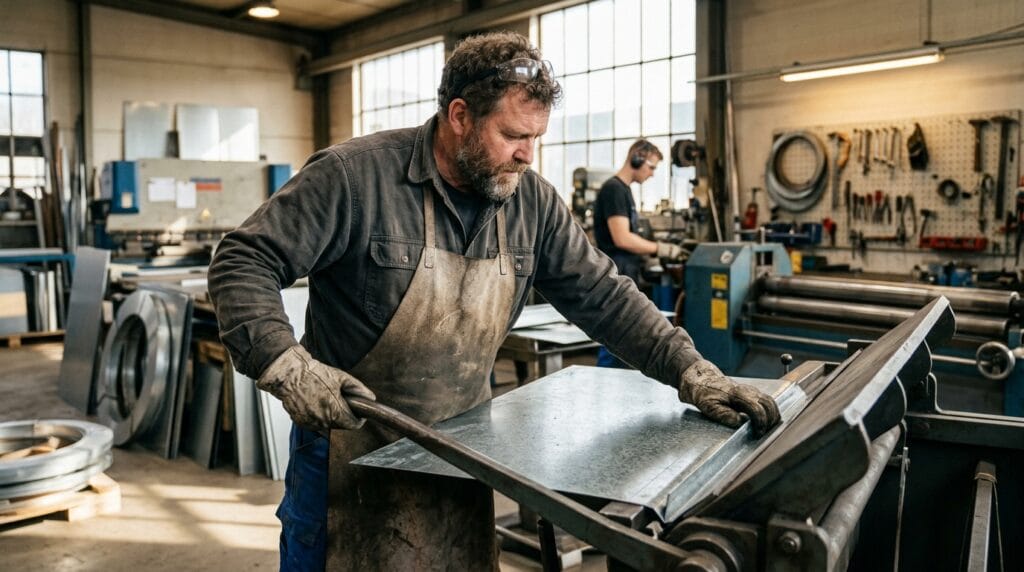
The Fabrication Shop is controlled. You have a concrete floor, overhead lighting, a break room, and climate control that’s at least better than the outdoors. You’re running equipment — plasma cutters, press brakes, Pittsburgh lock machines, snap lock formers, and increasingly, CNC-driven automated coil lines that can produce 500 linear feet of duct in a shift. Shop work rewards precision and efficiency. You read the isometrics, you lay out the fittings, you calculate the allowances for the seams and connectors, and you run the metal. There is pride in pulling a perfect 90-degree elbow off the brake with exactly the right profile and throat radius on the first hit.
The math in shop fabrication is no joke. Every fitting — a transition, an offset, a cheek piece, a tapered elbow — requires applied geometry. You are calculating stretch-outs from a flat pattern. You are thinking in three dimensions from a two-dimensional drawing. Apprentices who can’t handle trigonometry and spatial reasoning wash out. The ones who thrive understand that sheet metal work is geometry made physical.
The Field is a different world entirely. The ductwork you built in the shop gets loaded onto a flatbed, driven to the site, and now you have to hang it overhead in a building that is half-framed, has no working HVAC yet, and is either 105°F in July or 28°F in February depending on the season. You are working off pump jacks, scaffolding, or a scissor lift. You are drilling into concrete decks overhead while metal filings fall into your safety glasses. You are wrestling a 200-pound section of 48-inch rectangular trunk duct into position with one hand while your partner on the other side of the beam guides it onto the threaded rod hangers.
Field work pays more in most locals because it carries physical premium. Your hands will be cut constantly — sheet metal edges before they’re folded and clipped are essentially industrial razor blades. You will develop calluses on your palms that don’t go away. The noise exposure from pneumatic drills, metal-on-metal contact, and construction activity requires consistent double-hearing-protection use or you will have meaningful hearing loss by year ten. The overhead work loads your shoulder rotator cuffs in ways that accumulate over a career.
That said — the satisfaction of walking through a completed building and knowing that every inch of ductwork moving air through those ceilings came out of your hands is something no desk job ever replicates.
Best States for Sheet Metal Workers
Compensation in this trade is not nationally uniform. It is driven by three factors: union density, prevailing wage laws on public and commercial projects, and the volume and complexity of construction in the market.
Top 5 States for Sheet Metal Worker Pay — 2026
| State | Median Annual Base | Key Driver |
|---|---|---|
| New York | $79,500+ | NYC high-rise commercial ductwork; Local 28 one of the strongest in SMART |
| Illinois | $76,200+ | Chicago architectural and heavy commercial; Local 73 power |
| Washington | $75,100+ | Seattle tech-sector construction boom; strong green building ventilation codes |
| Massachusetts | $74,500+ | Boston biotech and pharma clean-room HVAC; specialty work commands premium |
| California | $71,300+ | Volume market; seismic and environmental compliance drives complexity |
Why do Illinois and New York effectively double the national entry wage? Prevailing wage laws — specifically Davis-Bacon on federally funded projects and state equivalents on public work — require contractors to pay the area’s union scale even if they’re running non-union labor. In a city like Chicago, the prevailing wage rate for a sheet metal journeyman on a public project might be set at $52 per hour plus full benefits. That floor lifts the entire market. Non-union contractors in that environment still have to offer competitive pay to attract workers who know what the scale looks like.
States with weak prevailing wage enforcement or right-to-work statutes see median wages 30–40% lower because the floor disappears.
Sheet Metal Worker vs. HVAC Technician
People confuse these two trades constantly, and it’s worth setting the record straight. We build the ductwork system — the distribution network that moves the air. HVAC Technicians install and service the mechanical equipment — the furnaces, air handlers, compressors, and refrigerant lines. Both trades are essential, and on a large commercial project, we work alongside each other continuously.
| Factor | Sheet Metal Worker (47-2211) | HVAC Technician (49-9021) |
|---|---|---|
| Median Annual Base | $60,850 | $59,810 |
| Primary Skill Set | Fabrication, layout geometry, installation | Mechanical systems, refrigerants, electrical |
| Union Pathway | SMART | UA (Plumbers & Pipefitters) or SMART |
| On-Call Exposure | Low — project-based construction schedule | High — emergency service calls, nights/weekends |
| Physical Environment | Shop + Field (overhead, heights, confined spaces) | Field-dominant (rooftops, mechanical rooms, attics) |
| Licensing Required | Journeyman card (union) / varies by state | EPA 608 (refrigerants), state HVAC license |
| Top 10% Earnings | $102,680+ | $100,640+ |
My honest take: If you hate being on call at 2 AM because someone’s AC went out in July, Sheet Metal is the better lifestyle trade. We run a construction schedule. Project starts and ends. When the building is commissioned and we’re done, we’re done. HVAC technicians who go into service work essentially become emergency responders for mechanical systems — high earning potential, but you are married to a phone.
If you love the diagnostic puzzle of chasing an electrical fault through a rooftop unit at midnight — HVAC service is genuinely rewarding and the market for skilled techs is exploding. Both trades feed each other. The ducts are worthless without the equipment, and the equipment is worthless without the ducts.
FAQ
Does this trade really require math — or is it just saying that to sound impressive?
It requires real applied mathematics, not conversational exaggeration. Fabricating a symmetrical offset elbow from flat stock requires you to calculate the true length of each section, account for seam allowances, and lay out the pattern correctly before a single cut is made. Errors in layout don’t show up until the duct is on the floor and the two halves don’t close. Apprentices work through coursework in geometry, trigonometry, and blueprint reading as formal curriculum. If you struggled in high school geometry, you will need to commit to catching up before or during apprenticeship.
What are the real physical risks in this trade?
Lacerations are endemic. Unfinished metal edges are razor-sharp and the volume of cutting, bending, and handling means exposure is constant. Proper gloves help but do not eliminate the risk. Hearing loss from sustained exposure to fabrication equipment and pneumatic installation tools is a serious long-term concern that many workers underestimate until it’s too late. Knee and lower back degradation from years of concrete floors in the shop and overhead installation in the field accumulates steadily. Workers who last 25 to 30 years typically develop deliberate body mechanics early — how you step, how you brace, how you position for overhead work — because the ones who don’t protect themselves early are dealing with surgeries by their mid-40s.
Is the SMART Union apprenticeship worth it compared to non-union training?
The total compensation gap over a 30-year career is not close. Beyond the hourly rate advantage in strong markets, the pension and annuity benefits funded entirely by union contractors represent $400,000 to $800,000 in retirement assets accumulated over a career without requiring a single dollar of out-of-pocket contribution from the worker. The health insurance benefit alone — full family coverage paid by the contractor — is worth $20,000–$30,000 per year in today’s insurance market. The apprenticeship investment of five years on a scaled wage is paid back many times over.
What is architectural sheet metal and why does it pay more?
Architectural sheet metal covers the aesthetic and weather-barrier applications of the trade — copper roofing on historic buildings, custom decorative cornices, standing seam metal roofs, ornamental gutters and downspouts, curtain wall flashing systems on glass towers. It requires a higher level of layout skill, finishing knowledge, and often involves expensive materials where a mistake is not easily corrected. Specialists in architectural work — particularly copper and zinc applications — command premium rates and are in shorter supply than standard HVAC ductwork mechanics.
Sources & Methodology
All base wage data cited in this guide is sourced from the Bureau of Labor Statistics Occupational Employment and Wage Statistics (OEWS) program, OES Code 47-2211 (Sheet Metal Workers), based on the May 2024 survey, the most current official release available for 2026 planning. State-level figures reflect the BLS state-specific OEWS tables. Total compensation estimates incorporate SMART collective bargaining agreement structures for benefit package contributions and are not reflected in BLS base wage data.
For the most current local wage scales and total package breakdowns in your specific market, contact your nearest SMART JATC office directly — they publish the current wage scale and benefits summary for your local.
This guide was written from 25 years of direct trade experience and verified against BLS OEWS data (OES 47-2211, May 2024). Compensation figures reflect market conditions as of early 2026. Union wage scales are subject to negotiation and vary by local — always verify current rates with your JATC.
If you are looking for Trades & Blue Collar jobs, check out our guides on [Millwright] and [Commercial Diver].