CNC Machinist Salary 2026: $35k–$100k+ Explained
Quick Facts — CNC Machinist Salary 2026
| Median Annual (Setup Machinist) | $53,450 |
| Top 10% (Programmer/Specialist) | $74,380+ |
| Entry-Level (Operator) | $35,460 |
| Best State | Washington ($66,230+) |
| BLS OES Code | 51-4041 (Machinist) / 51-9161 (CNC Operator) |
| Last Updated | February 2026 |
Let me tell you something about this trade. The first time I set up a 5-axis Haas to cut titanium brackets for a commercial aircraft landing gear assembly, I stood there for a moment before I hit cycle start.
Not because I was nervous — I knew that program was clean. I stood there because I’d written every line of that G-code myself, I’d proven the toolpaths in Mastercam, and I knew that in about forty minutes, a raw block of aerospace titanium was going to become something that would keep people alive at 35,000 feet. That’s what we do in this trade. We turn metal into precision. And in 2026, the market is finally — finally — paying some of us what that responsibility is worth.
But here’s the brutal truth nobody at the community college career fair tells you: not all CNC machinists are created equal, and the pay gap between the bottom and the top of this trade is one of the widest in skilled manufacturing. A guy who loads parts and presses the green button all day and a programmer writing 5-axis toolpaths for a defense contractor might both call themselves “CNC machinists.” They are not doing the same job. And they are absolutely not earning the same paycheck.
This guide breaks it all down — by role, by state, by experience, and by the skills that actually move the needle on your W-2.
Quick Overview: CNC Machinist Salary 2026
| Role | Hourly Wage | Annual Salary | Growth Rate |
|---|---|---|---|
| CNC Operator (Entry) | ~$17.05 | $35,460 | Slow — high automation risk |
| Setup Machinist (Median) | ~$25.70 | $53,450 | Stable — strong demand |
| CNC Programmer / Specialist | $35.76–$48.00+ | $74,380–$100,000+ | Strong — critical shortage |
Source: BLS OES May 2024, market-adjusted for 2026 conditions
Operator to Programmer: The Income Ladder
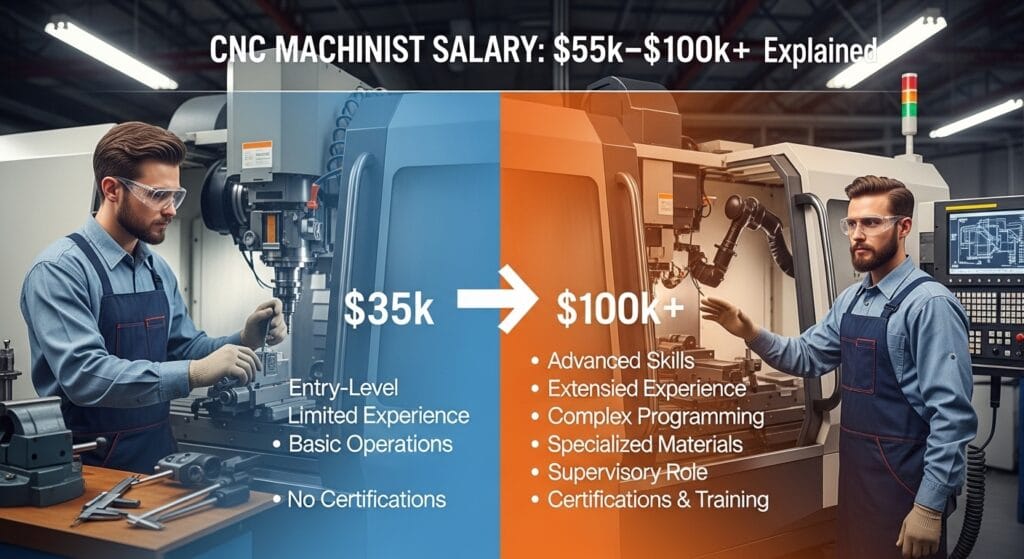
I’ve trained a lot of people in my career. Good people, smart people. And I’ve watched some of them get stuck at $38,000 for five straight years while others who started at the same time jumped to $75,000 in three. The difference wasn’t talent. It wasn’t even how hard they worked. It was whether or not they committed to climbing the technical ladder — or whether they settled for just loading parts.
Let me show you exactly what that ladder looks like in 2026:
| Tier | What You Actually Do | 2026 Annual Pay |
|---|---|---|
| CNC Operator (“Button Pusher”) | Load raw stock, press cycle start, remove finished parts, deburr, basic measurement with a micrometer. You run a proven program someone else wrote. You do not touch the code. | $35,460 – $42,000 |
| Setup Machinist | Mount and indicate workholding fixtures, select and install cutting tools, call out work offsets, edit G-code at the controller to dial in tolerances, troubleshoot chatter and tool wear, hit tolerances to ±.001″ and tighter. You own the machine during setup. | $48,000 – $62,000 |
| CNC Programmer / CAM Specialist | Design full machining strategies in Mastercam, Fusion 360, or Siemens NX. Write and simulate toolpaths for 3-axis mills, 4th-axis indexers, full 5-axis simultaneous milling, Swiss screw machines, and mill-turn lathes. Post-process G-code, prove out programs, write setup sheets. In aerospace and medical, you often work directly from SolidWorks or CATIA models. | $74,380 – $105,000+ |
Why Button Pushers Get Stuck — and How to Get Unstuck
I’m not going to sugarcoat this. If you walk into a shop, load a pallet of aluminum blanks, hit the green button 200 times a shift, and go home — you are replaceable. Not by a robot (more on that in a minute), but by the next person who will do it for $1.00 less per hour. Operators are a necessary part of high-volume production, but without the technical knowledge to back it up, the market treats the role as a commodity.
The guys who double their salary in this trade do one thing: they learn the why behind the machine. Why is that chatter happening? Because the tool’s sticking out too far — shorten it up or drop the RPM and increase the feed. Why did that part come out .003″ oversized? Because the material grew from heat and your tool wear compensation isn’t dialed. Why is the surface finish garbage on that aluminum pocket? Because you’re running conventional milling instead of climb milling, and the cutter is rubbing instead of cutting.
That knowledge — earned by reading blueprints, studying GD&T, doing the trig by hand before you trust the CAM software — is what separates a $53,000 setup machinist from a $37,000 operator. And then writing the code yourself, in Mastercam, proving the toolpath in the simulation before you ever touch a real spindle? That’s what gets you to $85,000 and beyond.
The math in this trade is not optional. I’ve seen guys with zero college who became elite programmers because they mastered right-triangle trigonometry and obsessed over speeds and feeds. A single misplaced decimal in a G-code file — say, a Z-axis rapid that drives your $3,000 carbide endmill straight into a $50,000 titanium workpiece at full rapid — and you’ve just crashed the spindle, potentially destroyed the spindle cartridge on a machine that costs $500,000 to replace. That’s not a metaphor. I’ve seen it happen. The sound is something you don’t forget: a sharp, violent crack followed by absolute silence in the shop. Everyone stops. Everyone looks. You learn fast in this trade that precision is not a preference — it’s survival.
Best States for CNC Machinists (Aerospace & Auto Hubs)
Geography matters enormously in machining. A setup machinist in rural Mississippi and a setup machinist outside Hartford, Connecticut are doing similar work, but the Connecticut machinist is likely earning 25–30% more. Why? Because the defense and aerospace supply chain clusters in specific regions, and those industries pay a premium for tight-tolerance work.
| State | Median Annual Salary | Why It Pays |
|---|---|---|
| Washington | $66,230+ | Boeing’s commercial and defense programs anchor one of the deepest aerospace supply chains in the world. |
| Massachusetts | $64,810+ | Dense concentration of defense contractors, Raytheon/RTX facilities, and precision medical device manufacturers. |
| Connecticut | $62,900+ | Home to Electric Boat (submarine manufacturing) and Sikorsky (military helicopters). Submarine work is some of the tightest-tolerance machining in existence. |
| Maryland | $61,500+ | Proximity to major DoD contracts, military aviation, and federal aerospace programs drives premium pay. |
| Ohio | $58,300+ | The volume leader — massive automotive and heavy industrial machining base. Lower per-unit pay than aerospace, but enormous opportunity volume. |
If you’re early in your career and have the flexibility to relocate, targeting Connecticut or Washington specifically for aerospace work is one of the highest-ROI career moves you can make. The work is harder. The tolerances are tighter. But the pay — and more importantly, the skill development — is unmatched.
CNC Machinist vs. Tool & Die Maker: Where Do You Fit?
| Trade | Median Annual | BLS Code | Primary Challenge | Environment |
|---|---|---|---|---|
| Welder | $48,940 | 51-4121 | Physical toll — fumes, burns, heat, noise | Hot, loud, physically brutal |
| CNC Machinist | $53,450 | 51-4041 | Mental fatigue — zero error tolerance, micro-inch precision | Clean, climate-controlled (usually) |
| Tool & Die Maker | $61,230 | 51-4111 | Extreme complexity — you’re building the molds and fixtures that produce everything else | Quiet, high-skill, low-volume |
Tool & Die is where machining gets genuinely elite. If a CNC programmer writes code to make a part, a Tool & Die Maker engineers the fixture that holds that part, the die that stamps it, or the mold that injects it. It’s the foundation layer of all manufacturing. But the entry ramp is steep — 4 to 5 years of apprenticeship minimum — and the job count is smaller. CNC Machining offers broader employment volume with a faster path to solid wages.
Calculate Your Take-Home Pay With Overtime
Paycheck Calculator
Calculate your Weekly, Monthly & Yearly Take-Home Pay
⚠️ These are estimates for a single filer using 2026 tax rates (IRS Rev. Proc. 2025-32). Results do not include local taxes, pre-tax deductions (401k, health insurance), or tax credits. Consult a tax professional for personalized advice.
Use this to model your real earnings: Take your hourly rate, factor in your standard 40-hour week, then add your typical overtime hours at 1.5x. A Setup Machinist at $25.70/hr working 8 hours of weekly OT earns roughly $58,500–$60,000 annually before taxes. A Programmer at $38/hr doing the same OT schedule clears close to $88,000.
FAQ
Can a CNC machinist make $100,000?
Yes — and it’s more achievable than it was five years ago. But it requires a specific path. You need to move fully into CNC programming, specifically for complex geometries: 5-axis simultaneous milling, mill-turn lathes with live tooling, Swiss-style screw machining, or Wire EDM programming.
The industries that pay $100K+ are aerospace (commercial and defense), medical device manufacturing (bone implants, surgical instruments), and high-end automotive racing components. If you’re programming those parts and you’re fast and accurate, six figures is the floor, not the ceiling.
Is CNC machining hard to learn?
Operating? Honestly, no. A motivated person can learn to load parts and run a proven cycle in a few weeks. But that’s also why operator wages have stagnated. Machining — the real thing, where you’re setting up the machine from scratch, indicating a vise to within .0002″, selecting cutting tools, writing offsets, and troubleshooting a part that’s coming out wrong — takes two to four years of serious, attentive shop time.
Programming in Mastercam or Fusion 360 to write efficient, collision-free toolpaths for complex geometry takes another two to three years on top of that. Blueprint reading and GD&T are prerequisites you need to master early. This is not a trade where you can fake it — the machine always tells the truth.
Will AI and automation take CNC machinist jobs?
I’ve been hearing this question since at least 2015, and here’s my honest answer: automation has already taken the pure button-pushing jobs at high-volume, lights-out production facilities. That’s real. If your only skill is loading parts and pressing cycle start, that job market is shrinking.
But here’s what the “automation will take everything” crowd consistently misunderstands: someone has to set up the automation. Someone has to write the program that the robot runs. Someone has to indicate the fixture, prove the first part, certify the dimensions on a CMM, and sign off that the machine is making good parts before you walk away and let it run lights-out.
That someone is a skilled Setup Machinist or Programmer — and there is a genuine, documented shortage of those people right now. Shops are desperately trying to hire experienced machinists and programmers and cannot find them. The BLS projects steady employment for machinists through 2033. Automation creates complexity, and complexity requires skilled humans to manage it. Learn the whole trade. Learn to program. You will not be automated away.
CNC operator vs. CNC machinist salary — what’s the real difference?
About $5,000 to $15,000 per year at the median level, and potentially $30,000+ at the specialist level. The operator runs programs. The machinist owns the machine. The programmer owns the process. Each step up requires deeper technical knowledge and carries higher accountability — and the market pays accordingly. The smell of coolant is the same at every level. The paycheck is very different.
Sources
All salary data in this guide is sourced from the U.S. Bureau of Labor Statistics Occupational Employment and Wage Statistics (OEWS) survey, May 2024 release — the most current official benchmark available for 2026 compensation planning:
- BLS OES 51-4041 — Machinists: bls.gov/oes/current/oes514041.htm
- BLS OES 51-9161 — Computer Numerically Controlled Tool Operators: bls.gov/oes/current/oes519161.htm
Market-rate premium figures for CAM specialists and aerospace programmers reflect current job posting analysis and represent compensation above the BLS 90th percentile benchmark.
Whether you’re an Operator deciding whether the setup training is worth the time investment, or a Programmer weighing a relocation offer to Washington State, use this calculator to run your real numbers — base hourly, overtime, and annual total — so you can make an informed career decision.
Last Updated: February 2026 | Salary data: BLS OES May 2024 | Written by a 20-year veteran of aerospace and precision manufacturing
If you are looking for Trades & Blue Collar jobs, check out our guides on [Ironworker] and [Wind Turbine].