Crane Operator Salary 2026: Earn $95/hr Tower Pay
Crane Operator Salary
The construction industry has always stratified workers by skill and risk. At the top of that hierarchy sits the crane operator — not metaphorically, but literally. Tower crane operators work 400 feet above street level, managing loads that can crush an entire floor of workers if a calculation goes wrong. Mobile crane operators navigate complex ground conditions, assembly logistics, and load charts that would overwhelm most engineers. This isn’t a career path you stumble into. It’s one you earn through certification, apprenticeship, and the willingness to accept a job description that most people would refuse on day one. The compensation reflects every bit of that reality.
Quick Crane Salary Summary (2026 Update)
Union journey-level crane operators in major metro markets earn at the top of all blue-collar trades. Tower crane operators average $60–$90/hr nationally, with NYC Local 14 reaching $95–$115/hr. Mobile crane operators (lattice/crawler) command $38–$55/hr, while hydraulic mobile operators average $32–$45/hr. Overhead and gantry crane operators earn $22–$30/hr in industrial settings. Total union compensation packages — including pension, annuity, and employer-paid healthcare — regularly exceed $130/hr in top-tier markets.
Operator Pay Calculator
Calculate your Weekly, Monthly & Yearly Take-Home Pay
⚠️ These are estimates for a single filer using 2026 tax rates (IRS Rev. Proc. 2025-32).
Results do not include local taxes, pre-tax deductions (401k, health insurance), or tax credits.
Consult a tax professional for personalized advice.Paycheck Calculator
The High Life: Why Tower Operators Earn the Most
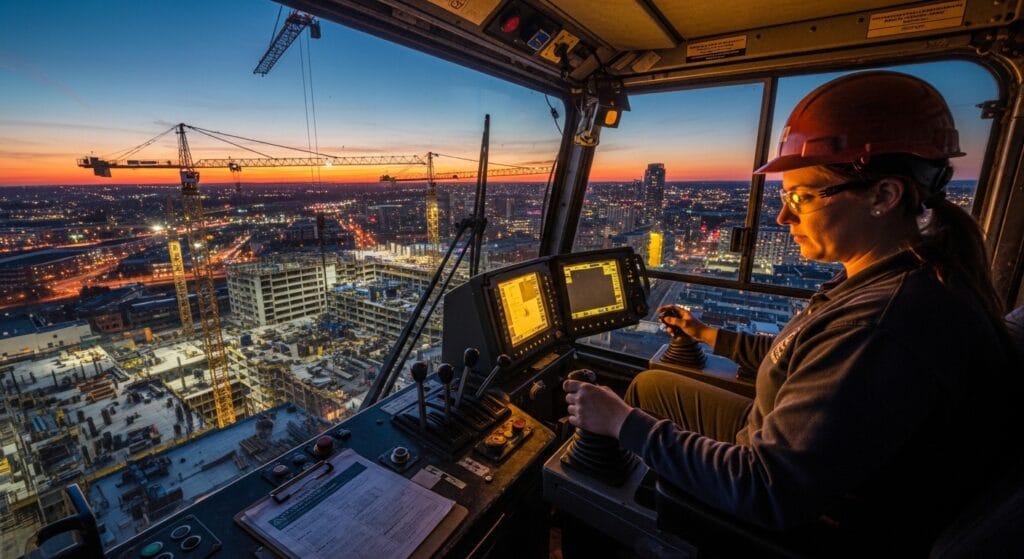
Tower crane operation exists in its own compensation category because the job demands a combination of physical endurance, psychological discipline, and technical precision that no other heavy equipment role replicates. You’re not driving a bulldozer across a grade. You’re managing suspended loads over active work zones, public sidewalks, and occupied buildings — from a cab the size of a walk-in closet — for ten to twelve consecutive hours.
The technical demands begin before the crane ever moves. Tower operators must interpret multi-page load charts that account for boom radius, configuration, wind speed, and load weight simultaneously. They monitor Load Moment Indicator (LMI) systems that warn of approaching structural limits and make real-time decisions about whether a lift proceeds or halts. According to IUOE local contracts in NYC and Chicago, tower operators receive additional boom length premiums — typically +$2.00/hr for configurations over 200 feet and +$5.00/hr for booms exceeding 300 feet — specifically because these configurations require exponentially more complex stability calculations.
The physical environment amplifies every demand. A tower crane is engineered to sway — the mast is designed with flex tolerances that allow movement under load and wind pressure. When you pick up several tons at full radius, the entire cab bends forward. In high winds, you feel every gust through the structure. Experienced operators consistently note that new operators spend weeks mentally adjusting to the sensation before it becomes routine. Depth perception at height is a critical and underrated skill; operators who misjudge load clearances at 300 feet cause accidents that close job sites and end careers.
Then there’s the question every civilian asks the moment they learn what this job involves.
The bathroom situation: You don’t come down. Descending from a tower crane takes 20 minutes minimum, shuts down lifting operations for the entire site, and forces ironworkers, laborers, and concrete crews to stand idle. That costs the project real money. The reality — unglamorous, but universal — is that tower operators use empty water bottles for liquid waste and specialized disposal bags for solid waste, sealed and removed at the end of the shift. It’s the detail that outsiders find shocking and operators treat as an unremarkable part of the job. The wage premium partly compensates for exactly this kind of sacrifice. You are paid to stay in that cab, in that chair, managing that lift, without interruption.
The psychological isolation factor is equally significant. Tower operators communicate exclusively via radio. Their only human contact for an entire shift is the signal person on the ground and occasional radio check-ins from the foreman. Operators who need constant social interaction don’t last. Those who are comfortable with solitude — who can maintain focus and composure through hours of repetitive, high-stakes lifting — thrive.
Salary by City: Construction Hotspots
Geographic location functions as a wage multiplier in crane operation. The density of high-rise construction, union presence, and local licensing requirements all compound to create dramatic regional wage differences. A certified operator in Manhattan earns more than twice what the same credentials command in rural markets.
| City | Tower Crane (Hr) | Mobile Crane (Hr) | Overhead Crane (Hr) | Total Union Package |
|---|---|---|---|---|
| New York City (Local 14) | $95.00 – $115.00 | $85.00 – $100.00 | $45.00 – $55.00 | $130.00+/hr |
| Seattle, WA (Local 302) | $66.00 – $70.00 | $60.00 – $68.00 | $38.00 – $44.00 | $105.00+/hr |
| Chicago, IL (Local 150) | $58.00 – $65.00 | $55.00 – $62.00 | $38.00 – $44.00 | $95.00+/hr |
| Los Angeles, CA (Local 12) | $55.00 – $62.00 | $50.00 – $58.00 | $35.00 – $42.00 | $90.00+/hr |
| Boston, MA | $52.00 – $60.00 | $48.00 – $55.00 | $34.00 – $40.00 | $88.00+/hr |
New York City’s position at the top of this table reflects decades of union contract leverage and the sheer scale of vertical construction in the five boroughs. Local 14 operators who work consistent overtime — a realistic expectation during active construction seasons — clear $300,000 annually. Seattle’s strong showing reflects the tech-sector construction boom that has driven crane demand across the Puget Sound region for the better part of a decade. Chicago’s overtime culture pushes effective earnings well above base rates, particularly during the summer months when projects routinely run six and seven-day weeks.
The non-union national baseline tells a different story: tower operators in open-shop markets earn $38.00–$48.00/hr with minimal benefit structures, no pension contributions, and no annuity. The hourly gap between union and non-union looks manageable. The total compensation gap — factoring in pension, annuity, and employer-paid healthcare — often exceeds $40-$50/hr in equivalent value.
State-by-State: Where the Real Money Lives
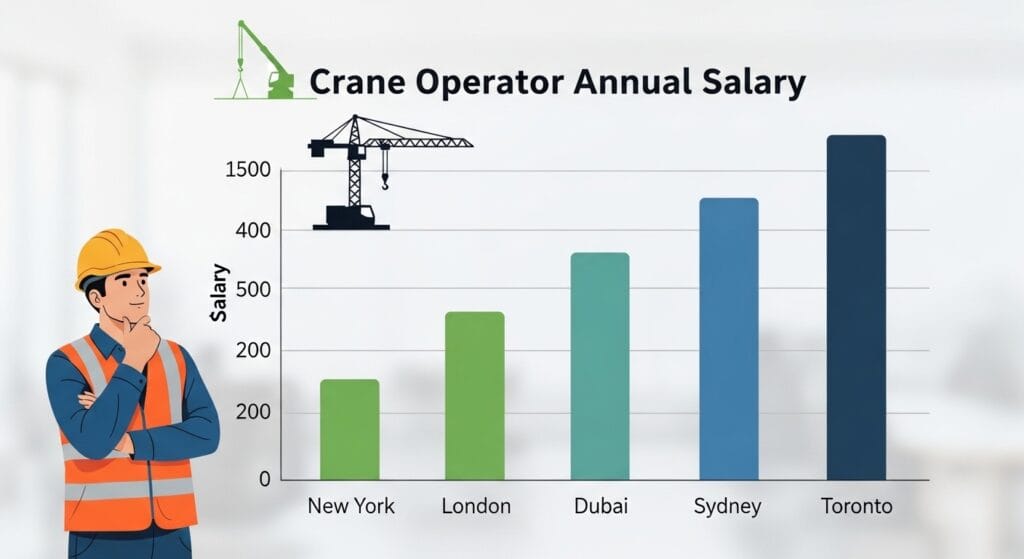
Annual salary potential breaks down sharply along geographic lines. New York leads the national rankings with average annual salaries of $110,000–$145,000, driven entirely by NYC’s vertical construction market, which represents the largest concentration of high-rise projects in the United States. Washington State follows at $95,000–$120,000, with Seattle’s tech-driven construction pipeline sustaining demand for certified operators at all crane types.
Hawaii ranks third at $98,000–$118,000 annually — a figure driven by the state’s high cost-of-living adjustments and significant port crane demand from shipping and logistics operations. Massachusetts and New Jersey round out the top five at $92,000–$115,000 and $90,000–$112,000 respectively, with the Boston metro area and New Jersey’s proximity to Port Newark creating sustained operator demand.
The lowest-paying markets sit in the Southeast and Great Plains, where tower crane density is minimal and union penetration is low. Mississippi operators average $45,000–$55,000 annually, with Arkansas and West Virginia slightly above that floor. These markets offer stable employment in overhead and mobile crane categories but lack the high-rise volume that drives top-tier tower wages.
NCCCO Certification: The Mandatory Entry Point
The National Commission for the Certification of Crane Operators credential — universally called “CCO” in the industry — functions as the mandatory baseline for any professional crane operator. Most insurance underwriters refuse to cover construction sites where crane operators lack current CCO certification, making the credential effectively mandatory regardless of what any individual employer states in a job posting.
The certification pathway involves two phases. Written examinations cover core knowledge applicable to all crane types plus specialty exams specific to your equipment category — Mobile Crane, Tower Crane, Overhead Crane, or Articulating Crane. Written testing runs $200–$300. Practical examinations require candidates to demonstrate competency on actual equipment, covering setup, lift execution, and shutdown procedures, at $250–$400.
Training programs represent the significant investment. Candidates who attempt NCCCO examinations without formal preparation fail at rates exceeding 40% on the practical exam, primarily because load chart interpretation and LMI system operation require structured instruction to learn correctly. Private crane schools charge $8,000–$12,000 for comprehensive programs that deliver certification in four to six weeks. The return on that investment is immediate: a single week of union crane work at $55/hr generates over $2,000 in wages, making the certification cost recoverable within two to three weeks of employment.
Union apprenticeship programs offer an alternative pathway. The IUOE’s 3–4 year apprenticeship structure begins operators on the ground as Oilers — equipment assistants who learn crane assembly, rigging, and maintenance before ever operating controls. The apprenticeship delivers certification, union membership, and documented experience simultaneously, and it costs apprentices nothing in direct tuition.
Frequently Asked Questions
How do you use the bathroom up there?
You don’t climb down. Tower crane operators descend for emergencies only — coming down takes 20 minutes, stops all lifting on the site, and idles every trade crew waiting on materials. The actual answer: operators use empty water bottles for liquid waste and sealed disposal bags for solid waste, removed at shift end. It’s an unglamorous truth that every tower operator accepts before the first shift. The compensation partially reflects this reality.
Is NCCCO certification required?
Functionally, yes. OSHA regulations under CFR 1926.1427 require crane operators to be either NCCCO certified or operating under an audited employer program. More practically, insurance companies will not underwrite sites with uncertified operators, which means any employer worth working for requires current CCO credentials. Cities including New York, Chicago, and Philadelphia add separate municipal licensing requirements on top of the federal baseline.
Is it windy up there?
Yes — significantly more than ground level, and the effect compounds with elevation. A job site with 15 mph surface winds may see 25-30 mph gusts at 300 feet of tower height. Union contracts and OSHA regulations set wind speed thresholds that halt lifting operations for safety. More importantly, wind affects load control — a load swinging in gusty conditions becomes extremely difficult to place precisely and dangerous to everyone below. Operators develop a feel for wind behavior through experience, learning to time picks and placements during lulls and compensating for drift with boom positioning. It is a skill that takes time to master and is part of what separates journeymen from newly certified operators.
Data Methodology
Wage figures in this guide draw from IUOE local contract disclosures for the 2025–2026 contract cycles, Bureau of Labor Statistics Occupational Employment and Wage Statistics data for Crane and Tower Operators (SOC 53-7021), NCCCO published examination fee schedules, and operator-reported compensation data from union halls in New York, Chicago, Seattle, and Los Angeles. State-level salary ranges represent the blend of union and non-union market rates across all crane types within each state.
Total compensation package figures include employer-paid pension, annuity, and healthcare contributions as reported in IUOE collective bargaining agreements. Non-union figures reflect open-shop market surveys from regional construction associations. All figures reflect 2026 projections based on contract escalations and BLS trend data. Individual earnings will vary based on crane type, tonnage rating, overtime hours, and specific collective bargaining agreements in effect.
If you are looking for Trades & Blue Collar jobs, check out our guides on [Electrical Lineman] and [Power Plant Operator].