Oil Rig Worker Salary 2026: $68k–$300k Real Pay
Oil Rig Worker Salary
I’ve spent over two decades in this industry—muddy boots, 12-hour nights, helicopter rides at 4 a.m., and paychecks that made it all worth it. Let me give you the real breakdown: no fluff, no recruiting spin, just the numbers and the truth.
In 2026, offshore drilling remains one of the last places on earth where a 22-year-old with no college degree can walk into a six-figure career trajectory. The catch? You earn every dollar of it. You live on a metal island for two weeks straight. You work 84-hour weeks. You miss holidays, birthdays, and the comfortable rhythms of normal life. But if that trade-off sounds like one you can make, read this carefully—because the money is absolutely real.
Quick Oil Rig Salary Summary (2026 Update)
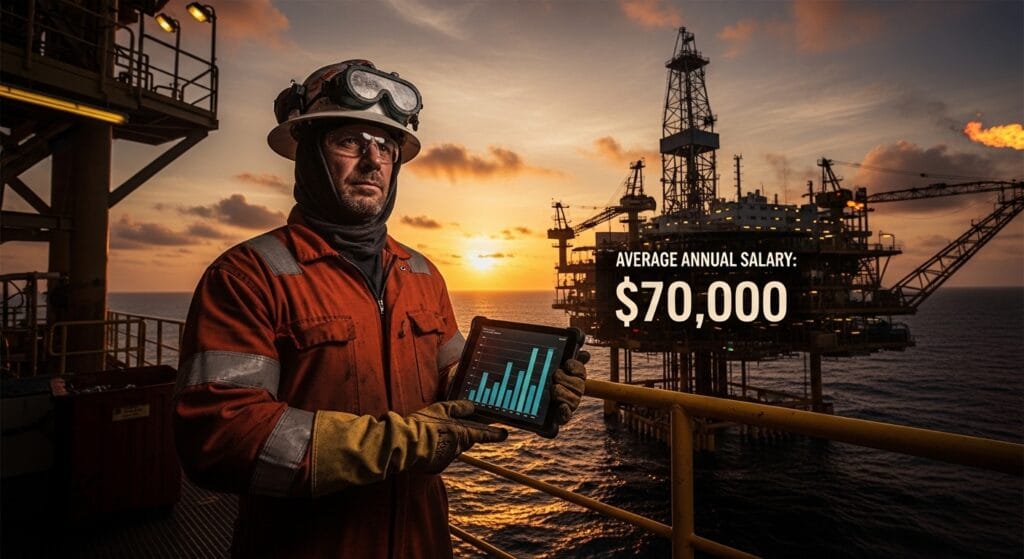
Roustabouts (entry-level) earn $68,000–$85,000 offshore with zero experience required. Roughnecks clear $90,000–$115,000 after six months of floor time. Derrickhands make $115,000–$140,000 managing mud systems and the monkeyboard. Drillers command $175,000–$220,000 offshore, and Toolpushers—the rig boss—earn $230,000–$300,000+ on deepwater operations. Offshore pays 20–30% more than land rigs across every position.
Offshore Pay Calculator
Calculate your Weekly, Monthly & Yearly Take-Home Pay
⚠️ These are estimates for a single filer using 2026 tax rates (IRS Rev. Proc. 2025-32).
Results do not include local taxes, pre-tax deductions (401k, health insurance), or tax credits.
Consult a tax professional for personalized advice.Paycheck Calculator
Climbing the Rig: From Cleaning Floors to Running the Show
The rig hierarchy is one of the most transparent career ladders in any industry. There is no politics, no favoritism based on your degree, and no ambiguity about what the next rung looks like. You either perform or you go home. Here is exactly what each level looks like in 2026.
Roustabout — Entry Level (You Start Here)
Onshore (Land Rig): $55,000 – $72,000
Offshore (Deepwater): $68,000 – $85,000
This is where everyone begins. No experience, no exceptions. Your job is physical labor: scrubbing the deck, hauling pipe, painting equipment, assisting the crane operator, and doing whatever the crew boss tells you to do without complaining. If you show up on time, follow safety protocols, and don’t quit when it’s raining at 2 a.m. and your back is screaming, you will be promoted to Roughneck inside six months.
Offshore roustabouts earn around $350–$450 per day. On a 14/14 rotation, that’s 14 days × $400 = $5,600 per hitch, or roughly $72,800 annually for 26 hitches. That’s more money than most four-year graduates start at, and you didn’t pay a dollar of tuition.
One non-negotiable: get your TWIC card (Transportation Worker Identification Credential) and your SafeGulf or BOSIET (helicopter survival) certification before you apply. These cost $1,200–$1,800 out of pocket, but they put you ahead of 90% of applicants who don’t have them. No certification, no offshore job. Full stop.
Roughneck (Floorhand) — Where the Real Work Begins
Onshore: $75,000 – $92,000
Offshore: $90,000 – $115,000
Roughnecks connect and disconnect drill pipe on the drill floor—the most physically demanding and statistically dangerous position on the rig. You are working with 30-foot stands of pipe weighing 500+ pounds, operating hydraulic tongs and iron roughnecks in tight quarters while the vessel pitches in Gulf swells.
The danger is real. The leading cause of serious injury on the drill floor isn’t explosions—it’s “caught in/between” incidents. If you stand in the wrong red zone when the tongs close, you lose a hand. Modern rigs are safety-obsessed, and you will sit through more safety meetings than you ever expected. That’s not bureaucracy—that’s what keeps experienced hands alive long enough to become drillers.
The paycheck reflects the risk. Offshore roughnecks earn $400–$550/day. Add quarterly safety bonuses ($500–$2,000 for zero Lost Time Incidents), and you’re clearing $100,000+ annually working six months a year.
Motorhand — The Maintenance Backbone
Onshore: $80,000 – $95,000
Offshore: $95,000 – $115,000
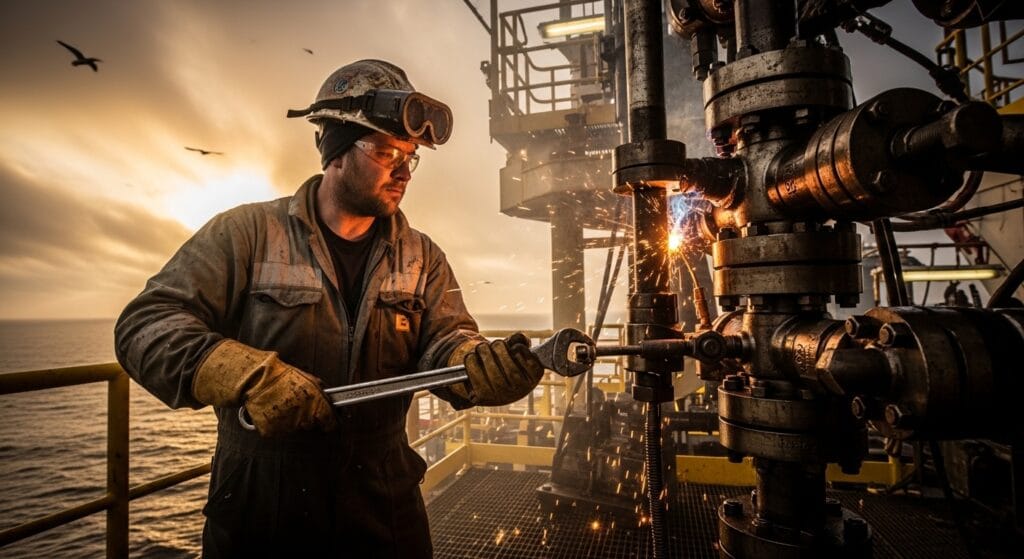
Motorhands maintain the rig’s mechanical systems: diesel engines, air compressors, hydraulic pumps, and mud pumps. This role demands mechanical aptitude and the nerve to diagnose a failing engine at 3 a.m. in the middle of an active drilling operation. When the power goes down, every eye on the rig looks at the motorhand.
This is an excellent sideways move for former military mechanics, diesel technicians, or anyone with industrial maintenance experience looking for a way onto the rig without starting as a roustabout.
Derrickhand — Height, Mud, and Six Figures
Onshore: $95,000 – $110,000
Offshore: $115,000 – $140,000
Derrickhands work 90 feet in the air on the monkeyboard, guiding drill pipe stands into the fingerboard during trips. They also manage the mud pits—the drilling fluid system that controls wellbore pressure and prevents blowouts. Screw up the mud weight and you can trigger a kick. Let a kick turn into a blowout and you’re looking at the worst day in the industry’s history books.
This role requires technical knowledge, physical courage (90 feet in the air on a moving vessel in the Gulf of Mexico), and enough experience to read the shakers and spot a formation change before the driller does. It’s the proving ground for future drillers. Workers who’ve held this position confirm it’s where you truly learn how a well breathes.
Driller — You Own the Drill Floor
Onshore: $130,000 – $160,000
Offshore: $175,000 – $220,000
The driller controls all drilling operations from the doghouse, supervises the floor crew, and is directly responsible for wellbore integrity. On a deepwater well costing $50–$150 million to drill, the driller is the last line of defense between a successful operation and a catastrophic incident. The weight of that responsibility is real, and so is the compensation.
Offshore drillers in the Gulf of Mexico earn $800–$1,100 per day. Completion bonuses for finishing a six-month campaign without incidents can add 5–10% on top. International contracts in the North Sea, Guyana, or West Africa push compensation even further, with Foreign Earned Income Exclusion (FEIE) potentially sheltering up to $126,500 from U.S. federal taxes—an effective 20% raise for qualifying expats.
Toolpusher — The Rig Boss
Onshore: $160,000 – $200,000+
Offshore: $230,000 – $300,000+
The toolpusher manages the entire rig operation, serves as the primary liaison between the drilling crew and the company man (the client’s representative), and is accountable for safety, efficiency, and budget. On major deepwater rigs, senior toolpushers can push $300,000+ when bonuses, international premiums, and day rate structures are factored in.
Recruitment trends for 2026 indicate a shortage of experienced toolpushers and drillers as a wave of veteran hands retires. This is your opportunity. The pipeline from roustabout to driller typically takes five to eight years of consistent performance. It’s not fast, but there’s no ceiling and no one can take the experience away from you.
Salary by Region: Gulf of Mexico vs. Land Rigs
Where you work matters as much as what you do. The pay spread between a Permian Basin land rig and a deepwater Gulf of Mexico drillship can be 30–40% for the same position. Here’s how the top regions stack up in 2026:
| Rank | Region | Environment | Pay Tier | Notes |
|---|---|---|---|---|
| 1 | Gulf of Mexico (Deepwater) | Offshore | Highest | The “Golden Triangle.” Deepwater premiums, guaranteed OT, free galley. |
| 2 | North Slope, Alaska | Onshore | High | Extreme cold weather pay, 3-week rotations, remote location premium. |
| 3 | Bakken Shale, North Dakota | Onshore | High | Remote location premium — nobody lines up to live in Williston in January. |
| 4 | Permian Basin, West Texas | Onshore | Moderate | High job volume but pay suppressed by labor supply. Best for entry-level. |
| 5 | Marcellus Shale, PA/OH | Onshore | Moderate | Natural gas heavy; closer to civilization but lower pay reflects that. |
| 6 | North Sea (International) | Offshore | Very High | 28/28 rotations, significant completion bonuses, FEIE tax advantages. |
| 7 | Guyana / West Africa | Offshore | Very High | Frontier deepwater boom markets in 2026. Highest hardship premiums. |
The offshore multiplier is straightforward: you are paid a premium because you cannot leave. The Gulf of Mexico deepwater sector operates on a principle similar to hazard pay — you’re on a floating steel city with no exits for two weeks, and the industry compensates you accordingly.
The Hidden Money: Allowances, Bonuses, and Tax Advantages
Your day rate is the headline number. Here’s what sits underneath it:
Safety Bonuses: Crews that go 90 consecutive days without a Lost Time Incident often receive quarterly bonuses of $500–$2,000 per person. On a good year with a solid crew, that’s $4,000–$8,000 on top of your base.
Completion Bonuses: Contractors regularly pay 5–10% of your annual day rate upon completing a drilling campaign without walkouts or major incidents. This exists to keep experienced hands from jumping to a competitor mid-job. On a $90,000/year roughneck salary, that’s a $4,500–$9,000 check when the well is TD’d.
Per Diem (Onshore Only): Land rig workers typically receive $45–$60/day in tax-free meal allowances. Offshore workers receive free galley meals instead (more on that below).
PPE and Boot Allowances: Approximately $200–$300/year for safety gear replacement.
Foreign Earned Income Exclusion: If you work international offshore rotations and qualify as a bona fide resident abroad, you can exclude up to $126,500 (2026 limit) from U.S. federal taxes. For a driller earning $220,000, this is a life-changing tax advantage.
The 14/14 Schedule: Why Rig Workers Don’t Talk About “Vacation Days”
The rotation schedule is the most misunderstood part of this career. You don’t accrue vacation days. You don’t negotiate time off. The schedule is built into the job structure.
14/14 Rotation (Most Common — Gulf of Mexico): Work 14 consecutive days on 12-hour shifts (84-hour weeks). Then go home for 14 consecutive days, completely off, fully paid for your hitch. This means you work approximately 182 days per year—exactly six months.
28/28 Rotation (International/Deepwater): Work 28 days, home 28 days. Common on rigs in the North Sea, West Africa, and Brazil. These rotations typically come with higher completion bonuses because of the extended isolation.
Workers confirm the 14/14 schedule is the biggest perk this industry offers—when you factor it in correctly. You have 26 weeks of completely free time annually. Many experienced hands use their off weeks to travel internationally, run side businesses, or live in low cost-of-living areas (rural Southeast, Southeast Asia, Central America) while earning Gulf of Mexico wages. The effective lifestyle arbitrage is enormous.
The flip side is real: you miss half your kids’ birthdays. You miss anniversaries. You miss the small moments that accumulate into a life. That’s not a small trade, and the divorce rate in this industry reflects it. Go in with eyes open.
The Boom-or-Bust Warning Every Recruiter Skips
Oil is a commodity. Commodities are cyclical. In 2026, oil is stable in the $75–$85/barrel range, rig counts are rising, and companies are hiring aggressively. The money is flowing.
When oil crashes to $40/barrel—and at some point, it will—layoffs happen within weeks. Day rates drop. Bonuses evaporate. Completion checks disappear because there are no completions. In 2020, the offshore sector shed 30% of its workforce in under six months.
The workers who survive downturns are the ones contractors call first when prices recover: the reliable, safety-conscious, technically skilled hands who made an impression during boom times. Build that reputation in your first two years, and you’ll have job security that outlasts the cycle. Spend your hitch checks as fast as they come in, and a $40 oil price will feel like a personal catastrophe.
Save aggressively. Target six to twelve months of living expenses in liquid savings before you call yourself financially secure in this industry.
Frequently Asked Questions
How do I get a job on an oil rig with no experience?
Apply for Roustabout positions directly through company career pages—Nabors, Patterson-UTI, and Precision Drilling for land rigs; Transocean, Valaris, Noble, and Seadrill for offshore. Do not use job boards; openings are often filled before the board updates.
Before applying, secure your TWIC card (required for all offshore access), complete a SafeGulf or BOSIET helicopter survival course, and get your H2S certification. This costs $1,200–$1,800 but separates you from 90% of cold applicants. Show up drug-free (zero tolerance, hair follicle testing), pass your physical, and be prepared to relocate. The Permian Basin and Gulf Coast have the highest entry-level volume.
Do not apply for Roughneck or Floorhand positions without drill floor experience. You will not get the job, and you will burn the relationship with the recruiter.
What is the schedule? Do I really work only six months a year?
Yes. The standard Gulf of Mexico rotation is 14 days on, 14 days off. You work 12-hour shifts every day of your hitch—84 hours per week while onboard. You are paid for those 14 working days plus travel time. During your 14 days off, you are not paid, but the high day rate is structured to compensate for this.
Across a full year, this works out to approximately 182 working days—six months of active work. International rigs often run 28/28 rotations, extending both the time away and the time home.
Is the food really free offshore? What’s the galley like?
Yes—and it’s surprisingly good. Offshore operators learned decades ago that food is the cheapest morale tool available. A miserable crew makes mistakes; a well-fed crew shows up sharp.
Offshore galleys typically serve four meals per day: breakfast, lunch, dinner, and a midnight meal for the night shift crew. Steak nights, crab legs, and unlimited desserts are standard on major deepwater rigs, not exceptions. Everything is all-you-can-eat, around the clock, at no cost to you.
Fair warning: many new roustabouts gain what the industry calls the “Offshore 20″—20 pounds of extra weight accumulated when 4,000-calorie days become your new normal and a gym membership costs zero. The rig has a gym. Use it.
Data Methodology
The salary figures in this guide reflect 2026 total compensation projections based on offshore and onshore industry compensation data, including base day rates, guaranteed overtime structures, regional pay premiums, and verified bonus structures from active drilling contractors in the Gulf of Mexico, Permian Basin, North Sea, and emerging deepwater markets including Guyana and West Africa.
Day rate figures are sourced from contractor hiring data and represent the full-year equivalent for workers completing standard 14/14 and 28/28 rotations. Figures represent gross annual compensation before federal income tax and do not account for the Foreign Earned Income Exclusion, which may significantly reduce effective tax rates for qualifying international workers.
Recruitment trends for 2026 indicate a shortage of entry-level hands in the deepwater Gulf sector and a more significant structural shortage of experienced drillers and toolpushers as the industry’s senior workforce reaches retirement age. Position-level figures have been validated against active postings and recruiter compensation benchmarks current as of Q1 2026.
All salary ranges represent total compensation including base pay, overtime, per diem where applicable, and average bonus structures. Individual results vary based on contractor, specific rig type, water depth classification, geographic location, and individual performance history.
If you are looking for Trades & Blue Collar jobs, check out our guides on [Crane Operator] and [Power Plant Operator].