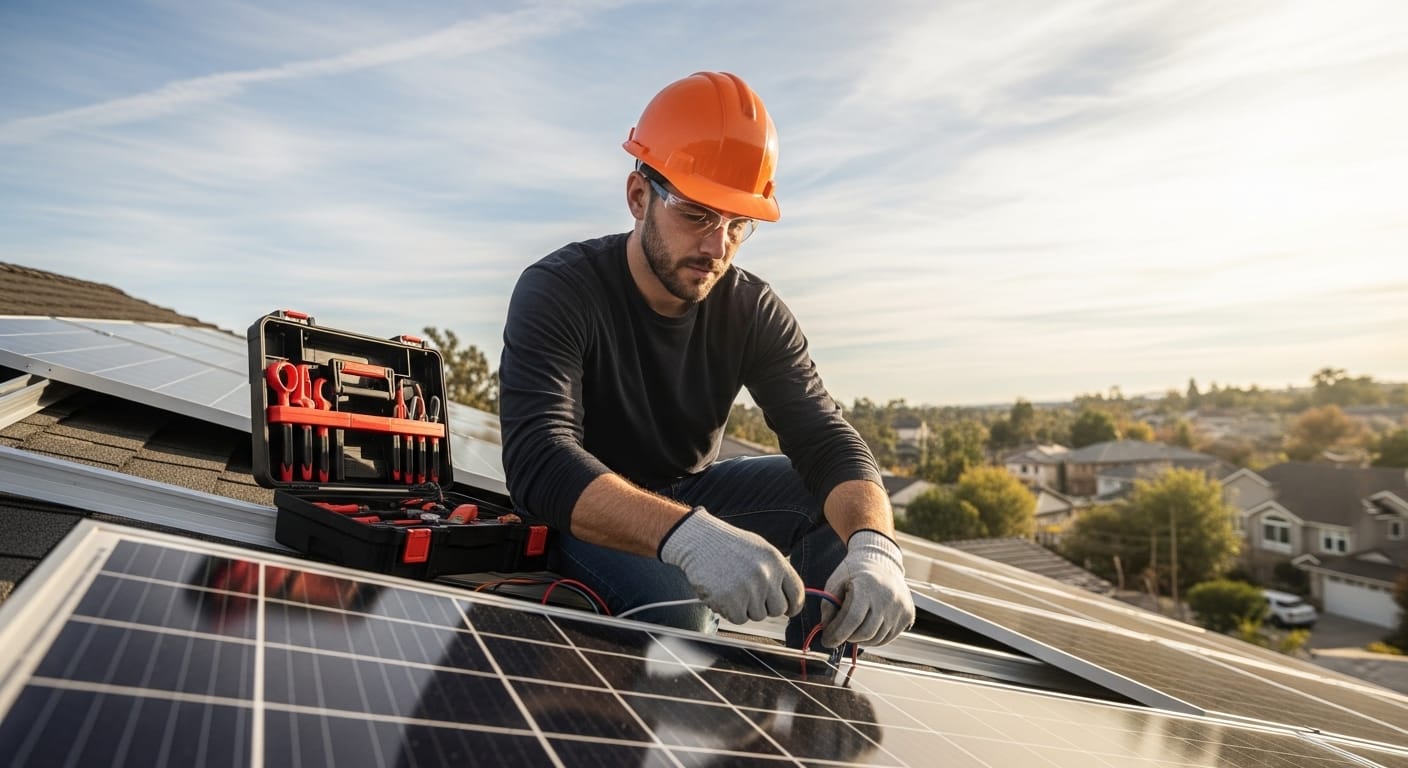
Solar Installer Salary 2026: $39K–$80K+ Real Pay
The Answer Box: What Solar Installers Actually Make in 2026
Let’s cut straight to it. If you’re thinking about getting into solar, or you’re already on a crew and wondering if you’re being underpaid, here’s the number that matters: the median solar installer in the United States earns $51,860 per year, or about $24.93 an hour, according to the Bureau of Labor Statistics (OES Code: 47-2231, May 2024 release — the most current benchmark for 2026 planning).
But that median number is a floor, not a ceiling. Where you live, how long you’ve been doing it, and whether you’ve got an electrical license in your back pocket will determine whether you’re scraping $39,000 or banking over $80,000. The spread in this trade is enormous — and understanding why is the whole game.
Table 1: Quick Overview — Solar Installer Salary 2026
| Role / Tier | Percentile | Annual Salary | Hourly Wage |
|---|---|---|---|
| Helper (Entry-Level) | Bottom 10% | $39,070 | ~$18.78 |
| Lead Installer | Median (50%) | $51,860 | $24.93 |
| Solar Electrician | Top 90% | $80,150+ | $38.53+ |
The takeaway: solar is not a flat-pay trade. It’s a ladder — and the rungs are real. The jump from lead installer to solar electrician isn’t just a title change; it’s a $28,000-per-year raise baked into the data.
Helper to Solar Electrician: The Experience Ladder
Here’s how I describe this trade to people who’ve never done it: It’s roofing with voltage. You need to be comfortable on a pitch, you need to know how to work in the heat, and eventually, you need to understand what happens when you wire a 400V string of panels the wrong way. It’s a trade that rewards people who grow into it — not people who show up and expect to max out in year one.
The Three-Tier Breakdown
| Experience Level | Annual Salary | Key Responsibilities |
|---|---|---|
| Helper / Laborer (0–2 years) | $39,070 – $44,000 | Panel carrying, racking assembly, basic installs under supervision |
| Lead Installer (2–5 years) | $48,000 – $58,000 | Full system installs, crew coordination, customer site interaction |
| Solar Electrician (5+ years / Licensed) | $65,000 – $80,150+ | Inverter wiring, main panel connections, final inspections, AHJ sign-off |
Why an Electrical License Doubles Your Value
This is the part nobody tells you when you first get hired. You can spend five years as a great mechanical installer — fast on the roof, know the racking systems cold, can pull permits in your sleep — and you’ll cap out somewhere in the low-to-mid $50s. That’s a decent living. But you’ll watch licensed electricians walk onto your job site, spend two hours in the panel room, sign off on the interconnection, and leave. They’re billing more per hour than you make in a day.
Here’s why: in the vast majority of states, the final electrical connection — the moment the solar system ties into the home’s main breaker panel and syncs with the utility grid — requires a licensed Journeyman Electrician. That’s not a company policy. That’s state law. No license means you physically cannot complete the highest-value part of the installation.
The states with the strictest requirements (Connecticut, Massachusetts, Minnesota) go even further, requiring licensed electricians to have a meaningful presence throughout the installation process — not just at the final connection. On a commercial or utility-scale project, this ratio requirement can shape the entire crew composition and, by extension, the entire payroll structure.
Getting your Journeyman’s license typically takes four to five years of apprenticeship hours plus passing a state exam. That’s the investment. The return? The BLS data shows the top 10% of the solar trade earns $80,150+, and nearly every person in that bracket either holds an electrical license or runs a commission-based crew with skin in the deal. Pure mechanical installers almost never break $65,000 without sustained overtime or travel pay. The license isn’t just a credential — it’s a pay grade.
Best States for Solar: Where the Money Is
Geography matters in this trade more than almost any other. Solar installer pay is directly tied to two things: how aggressively a state mandates renewable energy adoption, and how expensive electricity already is. When electricity costs are high, homeowners and businesses have more incentive to go solar, which drives demand for installers, which tightens the labor market and pushes wages up. It’s a clean economic chain.
Top 5 Highest-Paying States for Solar Installers in 2026
| State | Median Annual Pay | Primary Pay Driver |
|---|---|---|
| California | $69,300+ | Mandatory solar on new homes (Title 24) |
| Hawaii | $65,350+ | Highest residential electricity rates in the U.S. |
| Massachusetts | $64,500+ | SMART Program incentives, strict licensing ratios |
| New York | $64,390+ | NYC/Long Island cost-of-living premiums |
| Washington | $62,500+ | High union density in electrical trades |
California is in its own league partly because of a state law that requires solar panels on virtually all new residential construction. That mandate doesn’t just create a spike in demand — it creates sustained, structural demand. Builders need solar crews the same way they need framers. It’s baked into the construction pipeline.
Hawaii is the sleeper pick that most people outside the industry overlook. The average Hawaii resident pays more per kilowatt-hour than anyone else in the country. That makes solar ROI extremely attractive, which keeps the installation pipeline full year-round, which keeps installer wages high. It’s supply, demand, and geography doing exactly what economics says they should.
Solar vs. Roofer: The Trade Comparison
People ask me all the time whether solar is “better” than roofing. My answer is always the same: it depends on what you mean by better. If you mean physically easier, solar wins on most days. If you mean higher earning ceiling, solar wins by a mile. If you mean simpler and more straightforward work, roofing wins in a landslide.
Here’s how the three core trades stack up:
Trade Comparison Table
| Trade | Median Annual Salary | BLS OES Code | Primary Pain Point |
|---|---|---|---|
| Roofer | $50,970 | 47-2181 | Physical danger (tar, steep pitches, fall risk) |
| Solar Installer | $51,860 | 47-2231 | Technical complexity (inverters, app commissioning) |
| Electrician | $62,350 | 47-2111 | Licensure barrier (4–5 years of apprenticeship) |
The solar installer sits almost exactly at the median between a roofer and a licensed electrician — which makes sense, because solar installation is literally a hybrid of both trades. You’re doing roof work when you’re mounting the racking. You’re doing electrical work when you’re running conduit and wiring the inverter. The job touches both disciplines without (in most cases) requiring full mastery of either.
The critical insight here: solar is a cleaner pathway to an electrical license than traditional residential or commercial electrical work. Many solar companies actively support their installers through apprenticeship programs, and the hands-on inverter and wiring experience you get on solar projects translates directly into the competency hours you need for Journeyman qualification. You’re essentially getting paid to work toward a credential that will put you in the $62,000–$80,000+ salary range.
That’s not something roofing offers.
Calculate Your Travel Pay
Calculate your Weekly, Monthly & Yearly Take-Home Pay
⚠️ These are estimates for a single filer using 2026 tax rates (IRS Rev. Proc. 2025-32).
Results do not include local taxes, pre-tax deductions (401k, health insurance), or tax credits.
Consult a tax professional for personalized advice.Paycheck Calculator
Use the calculator above to model what your actual take-home looks like as a traveling utility-scale installer. The numbers get interesting fast — and the next section explains exactly why.
FAQ
Is solar installation a good career in 2026?
Yes — with eyes open. The Bureau of Labor Statistics projects 42% job growth for solar installers between 2024 and 2034. That’s not a typo. For context, “average” job growth is around 4–5%. The solar installer projection is labeled “Much Faster Than Average” in BLS language, and it reflects massive federal investment in domestic clean energy infrastructure, aggressive state-level renewable portfolio standards, and the ongoing electrification of everything from homes to commercial fleets.
The honest counterpoint: the physical demands are real. Hauling 40-pound panels up extension ladders in July heat is not a desk job. Turnover in this trade is higher than the growth numbers might suggest, because heat exhaustion, physical fatigue, and summer scheduling lead to burnout for workers who weren’t fully prepared for the conditions. The growth is real. The grind is also real. Know what you’re signing up for.
Do you need to be an electrician to install solar?
It depends on the state and the specific task. Mechanical installation — bolting rails to roof joists, clicking panels into the racking system — typically does not require an electrical license. General laborers can and do perform this work across most of the country.
The line gets drawn at the electrical connections. Wiring the inverter, running the DC and AC conduit runs, and making the final connection to the main breaker panel almost universally require a licensed Journeyman Electrician. Connecticut, Massachusetts, and Minnesota have the strictest requirements, mandating licensed electrician involvement throughout the installation process, not just at the final hook-up.
Bottom line: you can get started without a license. You cannot reach the top of the pay scale without one.
What’s the deal with travel pay? Can you really clear $90,000 as a $25/hour installer?
Yes — and this is one of the most underappreciated financial opportunities in the skilled trades. Utility-scale solar projects (large ground-mount farms, commercial rooftops, municipal installations) are often built in areas with limited local labor pools. Companies need to bring in crews from other regions, and they compensate for that with two mechanisms: overtime and per diem.
Per diem on utility-scale solar projects typically runs $100 to $150 per day, tax-free, to cover food and lodging for traveling workers. That tax-free status is what makes the math so compelling.
Run the numbers: a $25/hour installer working 60-hour weeks (standard on travel projects) earns $25 × 40 hours + $37.50 × 20 hours (overtime) = $1,750 per week in wages. Add $125/day × 5 days = $625 per week in tax-free per diem. Over a 48-week travel season, that’s $84,000 in wages + $30,000 in tax-free per diem = over $114,000 in total compensation — from a base rate that looks modest on paper.
The trade-off is real. You’re living out of a hotel or a company-arranged housing unit for months at a time. You’re away from family. The work is physically intense and the hours are long. But for single workers or those in a financial sprint — paying off debt, building savings, or funding a license program — the travel path is one of the most powerful income accelerators in the skilled trades.
Sources
All salary data referenced in this article is drawn from the Bureau of Labor Statistics Occupational Employment and Wage Statistics (OEWS) program:
- BLS OES Code 47-2231 — Solar Photovoltaic Installers
- Reference Period: May 2024 (Latest Official Release, used for 2026 planning benchmarks)
- BLS OES Code 47-2181 — Roofers (comparison data)
- BLS OES Code 47-2111 — Electricians (comparison data)
- BLS Occupational Outlook Handbook — Solar PV Installer projection: 42% growth, 2024–2034
State-level pay data reflects BLS state occupational estimates cross-referenced with state-specific policy drivers including California Title 24 solar mandate, Hawaii HECO rate data, Massachusetts SMART Program documentation, and New York NYSERDA workforce reporting.
Whether you’re a helper trying to figure out when you’ll hit median pay, a lead installer deciding whether to pursue your Journeyman’s license, or a road warrior calculating whether the travel lifestyle pencils out — use the calculator above to model your specific situation. The averages tell you what the market looks like. Your individual numbers tell you what your career looks like.
The green energy boom is real, the growth projections are among the strongest of any trade in the country, and the earning ceiling — for those willing to get licensed and put in the time — is genuinely compelling. The roof is the starting line, not the finish line.
If you are looking for Trades & Blue Collar jobs, check out our guides on [Pipefitter] and [Construction Manager].