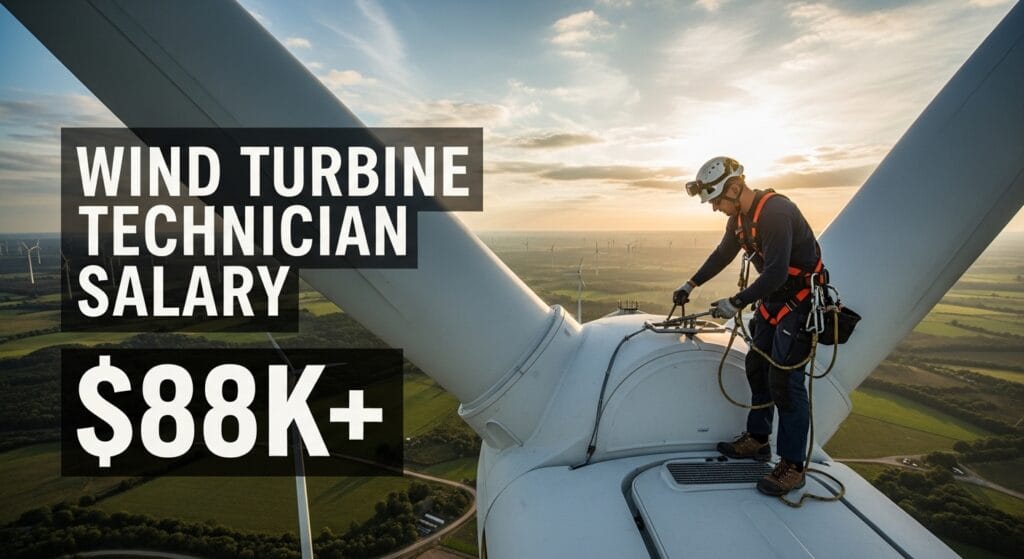
Wind Turbine Technician Salary 2026: $88K+
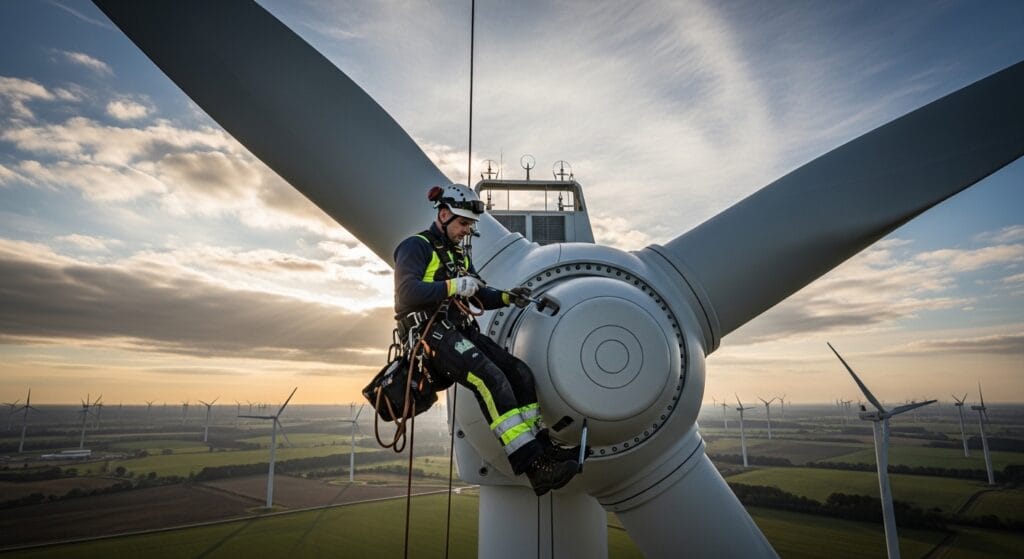
Your office is a nacelle 300 feet in the air, swaying in 25-mph crosswinds, with nothing but a harness between you and a soybean field in western Kansas. Your coworker is on the radio, the gearbox is screaming, and your hotel checkout is at 11am — six states from where you grew up. Welcome to the life. Welcome to the best-paying skilled trade most people have never heard of.
I’ve been a traveling wind tech for going on seven years now. I’ve climbed towers in February ice storms in Wyoming. I’ve eaten gas station sushi in Iowa because the nearest town with a restaurant was 40 miles out. I’ve also cashed paychecks that would make my college-educated cousins do a double take — and I did it without a single student loan. If you’re reading this trying to figure out whether wind tech money is real or just YouTube-recruiter hype, let me break it down for you properly, state by state, tier by tier, and per diem dollar by per diem dollar.
Quick Answer: What Do Wind Turbine Technicians Make in 2026?
According to BLS OES Code 49-9081 (May 2024, the latest official release), wind turbine service technicians earn a median salary of $62,580 per year, or about $30.09 an hour. But that number alone is almost useless for understanding what this trade actually pays — because it doesn’t account for the tax-free per diem that traveling troubleshooters collect on top of their base wage. The real story is in the full package.
Table 1: Wind Turbine Technician Salary — Quick Overview (2026)
| Role / Tier | Percentile | Annual Salary | Hourly Wage |
|---|---|---|---|
| Tech I (Entry-Level) | Bottom 10% | $49,110 | ~$23.61 |
| Tech II (Mid-Level) | Median (50%) | $62,580 | $30.09 |
| Tech III / Traveling Troubleshooter | Top 90% | $88,090+ | $42.35+ |
Source: Bureau of Labor Statistics, OES 49-9081, May 2024
That top-90% number is where it gets interesting — and where BLS data starts to fall short of reality. More on that in a minute.
Tech I to Troubleshooter: The Career Ladder Nobody Shows You in Trade School
Wind tech isn’t a flat trade. There’s a real progression, and each rung of the ladder comes with more money, more responsibility, and — if you’re traveling — a bigger per diem check rolling in tax-free.
Table 2: Experience Level Salary Breakdown with Full Travel Package
| Tier | Experience | Base Salary | Per Diem (Annual Est.) | Truck Allowance | True Annual Equivalent |
|---|---|---|---|---|---|
| Tech I | 0–2 years | $45,000–$52,000 | $0–$12,000 | $0–$3,600 | $45,000–$67,600 |
| Tech II | 2–5 years | $57,000–$72,000 | $18,000–$30,000 | $3,600–$6,000 | $78,600–$108,000 |
| Tech III / Troubleshooter | 5+ years | $75,000–$95,000 | $30,000–$48,000 | $6,000–$9,000 | $111,000–$152,000 |
The Travel Premium — This Is the Real Conversation
Here’s what nobody in a BLS spreadsheet is going to tell you: the money in this trade isn’t just the wage. It’s the structure of how you get paid when you’re on the road.
When you’re a traveling troubleshooter on a 6-weeks-on, 1-week-off rotation, your employer covers your hotel, or they pay you a daily tax-free per diem instead — typically pegged to the GSA rate for whatever county you’re working in. That rate runs $100 to $160 per day. Work 300 days in a year — which isn’t unusual when you’re moving from commissioning project to commissioning project — and you’re looking at $30,000 to $48,000 in untaxed income sitting on top of your base wage.
Think about what “untaxed” means in practice. If you’re in the 22% federal bracket, $30,000 in per diem is worth the equivalent of about $38,500 in taxable wages. Add in a truck allowance (some companies pay $300–$500/month to use your personal vehicle on-site, or they hand you a company truck), and suddenly a $72,000 base salary for a Tech II troubleshooter translates to well over $100,000 in actual take-home purchasing power.
I’ve met techs in their late 20s who are maxing their 401k, buying cash cars, and paying off their house — all because they understood the per diem math before they signed their first travel contract.
Calculate Your Own Travel Package:
Want to know what your actual take-home looks like with per diem factored in?
Paycheck Calculator
Calculate your Weekly, Monthly & Yearly Take-Home Pay
$✓ Rate automatically detected from page titleYearly Net Pay (Take Home) $0.00Monthly Pay $0.00Weekly Pay $0.00Gross Annual Income: $0.00Standard Deduction (2026): -$16,100.00Federal Tax (Est.): -$0.00State Tax (Est.): -$0.00FICA (7.65%): -$0.00⚠️ These are estimates for a single filer using 2026 tax rates (IRS Rev. Proc. 2025-32). Results do not include local taxes, pre-tax deductions (401k, health insurance), or tax credits. Consult a tax professional for personalized advice.
Best States for Wind: Where the Money and the Jobs Actually Are
People always assume the coasts pay best. And sure, Massachusetts or California might post higher base wages because their cost of living forces it. But if you’re a traveling tech — and you’re living out of a hotel that your company is paying for anyway — then cost of living is almost irrelevant. What matters is job volume, state investment in wind, and wage rates. That points you squarely at the Wind Corridor.
Table 3: Top 5 States for Wind Turbine Technicians (2026)
| State | Avg. Annual Salary | Why It’s Worth It |
|---|---|---|
| Wyoming | $74,640+ | Remote terrain = extreme weather premium; less competition for site lead roles |
| Kansas | $73,220+ | Massive wind yield, high demand for senior techs and troubleshooters |
| Iowa | $63,200+ | Wind generates 60%+ of state electricity; steady year-round work volume |
| Texas | $61,500+ | Unmatched turbine count, especially West Texas; best market for Tech I entry |
| Oklahoma | $60,800+ | Year-over-year utility-scale growth; solid base for newer techs building hours |
Wyoming is where I made some of my best money and had my worst days simultaneously. Climbing a 300-foot tower in January when it’s -15°F and the wind is howling at 40 mph — that’s not metaphorical hardship, that’s a physical test every single shift. But the remote-site premium and the per diem in Converse County made it worth every frozen bolt.
Wind Tech vs. Millwright: How Does the Money Compare?
Wind techs get compared to millwrights constantly, and it’s a fair comparison — both trades involve mechanical systems, precision alignment, and industrial equipment. But the trades diverge sharply on lifestyle, risk profile, and long-term job security.
Table 4: Wind Tech vs. Comparable Trades (2026)
| Trade | BLS Code | Median Annual Salary | Primary Challenge | Job Growth Outlook |
|---|---|---|---|---|
| Wind Turbine Technician | 49-9081 | $62,580 | Heights, travel, isolation | 50%+ (Fastest in U.S.) |
| Telecom Tower Climber | 49-9100 | $63,570 | Open-air lattice exposure, weather | Moderate |
| Millwright | 49-9044 | $63,510 | Physical load, machinery alignment | Stable |
The median wages are remarkably close. So what separates wind tech as a career choice? Two things: trajectory and tax-free income.
Millwrights are largely plant-based. You go to the same facility, punch the same clock. Great stability, limited ceiling. Telecom tower climbing has a similar pay range but the open-air climb on a lattice structure in all weather — no enclosed tower, no interior ladder — carries its own brutal risk profile.
Wind techs get the enclosed tower climb, the mechanical complexity of a millwright, and the travel income stack that neither of the other trades can match at scale. And with 50%+ projected job growth, you’re not betting on a dying industry. You’re betting on the fastest-growing skilled trade in the country.
FAQ
What about the fear of heights? Is it a dealbreaker?
I get this question more than any other. The honest answer: it’s not about whether you’re afraid of heights today. It’s about whether you can manage that fear under load — when you’re already tired, when the tower is moving, when something has gone wrong above you and someone is waiting on the ground for your diagnosis.
Most people discover pretty quickly whether this trade is for them. Many programs include a climb assessment in the first week. You don’t have to be fearless. You have to be functional at altitude. There’s a difference.
What is the physical climb test, and how do I pass it?
Most entry-level wind positions require you to pass a GWO Basic Safety Training certification, which includes a climb component. You’ll typically climb a fixed structure and demonstrate you can work comfortably at height with a full harness, SRL (self-retracting lanyard), and fall arrest gear. Cardiovascular fitness matters more than raw strength. The climb itself is rhythmic and steady — it’s not a sprint. People who struggle tend to have poor grip endurance or haven’t built the aerobic base for continuous exertion at altitude.
Train your grip. Do your cardio. Don’t ignore your shoulders — you’ll be overhead for hours when you’re working in the nacelle.
What happens if you drop a tool?
You don’t. That’s the mentality, and there are systems in place to enforce it. Every tool that goes up a tower has a tether — a lanyard attached to your wrist or your tool bag, rated to catch the weight of the tool if it slips. Tool bags are zipped and staged. Loose materials don’t go to the top. The protocols exist because a wrench dropped from 300 feet doesn’t just fall — it becomes a projectile. The culture around dropped object prevention is serious, and it should be.
Can I make six figures as a wind tech?
Yes, but you need to be honest about how. A Tech I sitting in one location on straight time is not making six figures. A Tech III troubleshooter on a travel contract, working 300 days and collecting per diem on top of a $80,000+ base? That is absolutely a six-figure equivalent income, often with a significant tax advantage compared to someone earning $100,000 in a traditional job.
What’s the lifestyle actually like?
Hotels. Lots of hotels. Extended stay properties, mostly. You learn to cook in a kitchenette, you learn which chains have the best laundry rooms, and you learn to be comfortable alone. I’ve had stretches where I didn’t sleep in my own bed for 11 weeks. I’ve also had weeks where I was home and couldn’t figure out what to do with myself because I’d gotten used to the structure of the road. It’s not for everyone. If you have a partner, you need a partner who is genuinely independent and can manage the household solo for extended periods. The divorce rate in this trade is not a rumor — it’s something you need to think about before you sign a travel contract.
But here’s the other side of it: you are never bored. Every site is different. Every turbine has its own personality. You troubleshoot in real time, in real conditions, with real stakes. There’s a reason guys like me who’ve done this for years still love the work itself, even when the road gets old.
Sources & Verification
All salary data in this article is drawn from:
Bureau of Labor Statistics | Occupational Employment and Wage Statistics OES Code: 49-9081 — Wind Turbine Service Technicians Reference Period: May 2024 (Most Recent Official Release) bls.gov/oes
State-level salary figures reflect BLS state wage estimates and regional labor market data. Per diem ranges are based on published GSA per diem rates for the relevant counties within the Wind Corridor. Job growth projections reflect BLS Occupational Outlook Handbook figures for the 2022–2032 projection period.
Wind turbine service technician is BLS’s fastest-growing occupation in the United States. If you’re willing to climb, travel, and do the work, the ceiling on this trade — financially speaking — is a lot higher than 300 feet.
If you are looking for Trades & Blue Collar jobs, check out our guides on [Roofer] and [Locomotive Engineer].