Pipefitter Salary 2026: $70/hr Real Take-Home Pay
Pipefitter Salary
A UA Journeyman’s Guide to What the Trade Actually Pays
Written from the field — not from a career website that’s never touched a pipe wrench.
Let me be straight with you before we get into numbers. I’ve been carrying my UA book for over a decade. I’ve worked power plants in the Midwest, refinery turnarounds on the Gulf Coast, and pharmaceutical clean rooms in the Northeast. The salary figures you find on most websites are technically accurate and practically useless — because they blend the guy hanging residential gas lines with the steamfitter torquing 900-degree, 600-PSI steam flanges on a combined-cycle turbine. Those are not the same job. They should not be the same number.
This guide uses BLS OES Code 47-2152 as the official benchmark — and then explains exactly why the real money sits well above that benchmark, who earns it, and how to get there.
The Answer Box: What Do Pipefitters Actually Earn in 2026?
Here is your direct answer: a working UA journeyman steamfitter in a major industrial market — Chicago, New York, Houston, the Gulf Coast, the Pacific Northwest — is realistically clearing $118,000 to $150,000 per year in base wages alone before overtime, shutdown premiums, shift differentials, or per diem. When you stack a 10-week refinery turnaround on top of a steady local book, $180,000 in a calendar year is not a fantasy. I’ve seen journeymen hit it. I’ve hit close to it myself.
The BLS median looks lower. That’s not a lie — it’s a math problem. The occupational code pulls in every tier of the trade. When you understand where you sit in that range, the number makes sense.
Table 1: Pipefitter / Steamfitter Salary — Quick Overview (2026)
| Role / Tier | Percentile | Annual Salary | Hourly Wage |
|---|---|---|---|
| Apprentice — Entry Level | Bottom 10% | $40,670 | ~$19.55/hr |
| Journeyman Pipefitter | Median (50th) | $62,970 | $30.27/hr |
| Steamfitter — Industrial Union | Top 90th | $105,150+ | $50.55+/hr |
| UA Journeyman — Chicago / New York | Local CBA Scale | $118,000–$145,000+ | $57.00–$70.00/hr |
Source: BLS OES 47-2152, May 2024 data — most current official release, applied to 2026 planning. UA Local rates reflect current collective bargaining agreements for Local 597 (Chicago) and Local 638 (New York).
The critical analyst note here: BLS groups residential plumbers and industrial pipefitters into the same code. The median is dragged down by lower-pressure, lower-stakes residential work. Industrial pipefitters and UA steamfitters don’t live at the median. We live at the 75th percentile and above, and in strong union markets, we blow past the 90th.
Apprentice to Steamfitter: Experience Level Breakdown
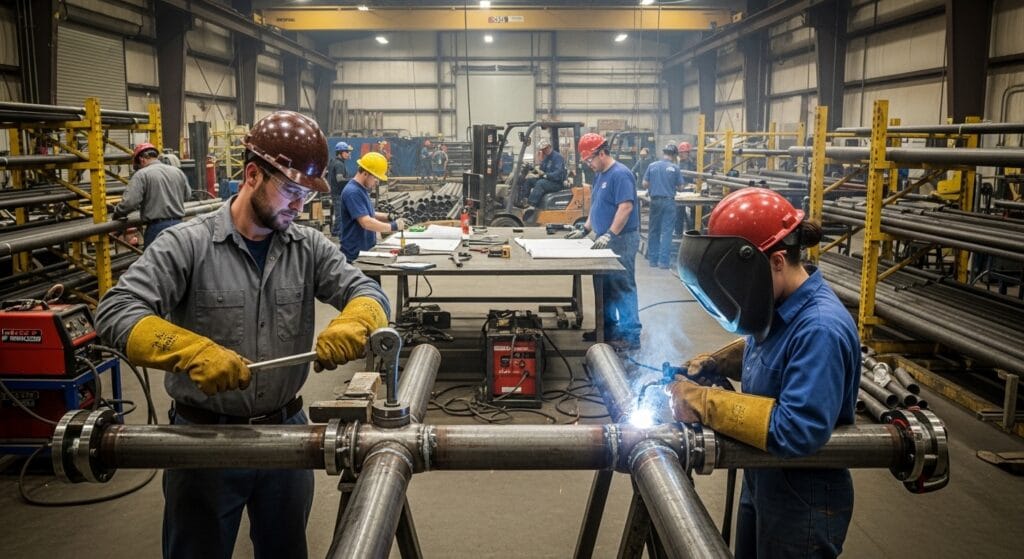
The UA apprenticeship is five years. That is not padding — that is the minimum time required to competently handle the full scope of industrial piping work across multiple systems, materials, and pressure classifications. By your final year, you’ve touched steam, hydrocarbon, cryogenic, high-purity, and hydraulic systems. You understand ASME B31.1 and B31.3. You’ve read isometrics until they make sense in three dimensions in your head before you’ve touched a fitting.
Every year of the apprenticeship moves your wage up as a percentage of the journeyman scale — typically structured from 45–50% in year one, climbing to 85–90% in year five. Here is what that looks like in real numbers across the progression.
Table 2: Pipefitter Pay by Experience Level (2026)
| Experience Level | Hourly Wage Range | Annual Estimate |
|---|---|---|
| 1st–2nd Year Apprentice | $19.55 – $30.00/hr | $40,000 – $62,000 |
| 3rd–4th Year Apprentice | $30.00 – $45.00/hr | $62,000 – $93,000 |
| Journeyman Pipefitter (Non-Union / Market) | $30.27 – $52.00/hr | $63,000 – $108,000 |
| Journeyman Steamfitter (UA Scale, Major Market) | $57.00 – $70.00/hr | $118,000 – $145,000 |
| Foreman / General Foreman (UA) | $65.00 – $82.00+/hr | $135,000 – $170,000+ |
Fitting Pipe vs Welding Pipe — Why Combo Hands Earn More
This distinction matters enormously for your earning potential, and most people outside the trade don’t understand it.
Fitting pipe is the geometry work. You’re reading the isometric drawing, calculating your rolling offsets in three dimensions, scribing your cut marks on Schedule 80 carbon steel, squaring your flange faces to within 1/16 of an inch on the bolt circle, and presenting a joint that is plumb, level, square, and correctly spooled to the P&ID. It is precision spatial mathematics executed in a hot, loud, industrial environment while wearing full PPE. A good fitter is worth his weight in gold to a contractor running a tight schedule, because a bad fit-up costs hours of rework and delays weld inspection.
Welding pipe — specifically, certified pressure welding — means you can close that joint yourself. A 6G certification in carbon steel is the industry standard for pressure piping. Add a stainless procedure, a chrome-moly (P91 or P22) procedure, or a nickel alloy qualification, and you are now a specialist that contractors compete for on shutdown work.
A combo hand — a journeyman who lays out the job AND burns the root and cap himself — eliminates the scheduling gap between the fitter and the welder. On a refinery turnaround running around the clock with 600 open work orders, that efficiency is worth real money. Contractors pay a welder’s premium of $3.00 to $8.00 per hour above journeyman scale for certified welders working in that capacity. Over a 10-week turnaround at 60-hour weeks, that premium alone adds $10,000 to $20,000 to your take-home.
If you are in your apprenticeship and you are not pursuing your 6G certification as aggressively as possible — you are voluntarily leaving money on the table. Get in the certification booth. Burn rod until you pass it.
Calculate Your Shutdown / Turnaround Pay
How much could you realistically earn on your next turnaround? Run the numbers below.
Calculate your Weekly, Monthly & Yearly Take-Home Pay
⚠️ These are estimates for a single filer using 2026 tax rates (IRS Rev. Proc. 2025-32).
Results do not include local taxes, pre-tax deductions (401k, health insurance), or tax credits.
Consult a tax professional for personalized advice.Paycheck Calculator
Best States for Pipefitters: Location Is Leverage
Industrial density and union strength are the two variables that drive geographic pay differentials. You want to be near refineries, power generation facilities, chemical processing plants, pharmaceutical manufacturing, semiconductor fabrication, or major district energy infrastructure. Here is where those environments concentrate — and what they pay.
Table 3: Top 5 Highest-Paying States for Pipefitters / Steamfitters (2026)
| Rank | State | Mean Annual Wage | Primary Industrial Driver |
|---|---|---|---|
| 1 | Illinois | $96,200+ | Chicago industrial corridor, UA Local 597, refinery & power work |
| 2 | New York | $93,650+ | Manhattan district steam system, commercial infrastructure, Local 638 |
| 3 | Oregon | $93,110+ | Intel semiconductor fab construction, high-purity process piping |
| 4 | Massachusetts | $90,580+ | Biotech and pharmaceutical manufacturing, clean room piping demand |
| 5 | Alaska | $83,090+ | North Slope oil infrastructure, remote camp differentials, pipeline work |
Source: BLS State OES Estimates, May 2024.
Illinois leads because UA Local 597 is one of the strongest industrial pipefitter locals in the country. The jurisdiction covers Chicago’s industrial belt — refineries, power plants, chemical facilities, and major industrial construction projects that run continuously. The CBA scale is among the highest in the nation, and the work density means a journeyman can stay busy on local calls without traveling.
New York’s situation is unique. Manhattan sits on top of one of the largest district steam distribution networks in the Western Hemisphere — Consolidated Edison’s steam system serves thousands of buildings through miles of high-pressure mains running under the city streets. That infrastructure requires constant maintenance, upgrades, and emergency response from steamfitters who understand the system intimately. Local 638 journeymen working that system are doing real high-pressure steamfitting every single day, and the CBA reflects it.
Oregon’s rise is recent and driven by semiconductor fabrication. Intel and other chip manufacturers building and expanding fabs in the Portland metro area demand ultra-high-purity piping systems — electropolished stainless, orbital welding, systems spec’d to contamination tolerances measured in parts per billion. A single particulate in the wrong place ruins a wafer batch worth millions of dollars. That precision carries a price premium, and skilled UA pipefitters qualified in UHP work are earning accordingly.
Alaska deserves a separate breakdown. The base wage listed by BLS doesn’t tell the full story. Remote camp work on the North Slope adds per diem, room and board, and travel pay on top of already-elevated wages. A journeyman working a North Slope rotation and living in camp essentially eliminates his personal living expenses for the duration — every dollar of base pay banks. The total annual compensation for disciplined travel hands in Alaska regularly exceeds $130,000.
Pipefitter vs. Plumber — The Industrial vs. Residential Divide
We get this comparison constantly. Let me address it clearly and then move on.
Table 4: Pipefitter vs. Plumber — Industrial vs. Residential
| Category | Industrial Pipefitter / Steamfitter | Residential / Commercial Plumber |
|---|---|---|
| Primary Systems | Steam, acids, chemicals, hydraulics, cryogenics | Sanitary water, drain/waste/vent, domestic gas |
| Operating Pressure | Up to 600+ PSI; some systems exceed 1,500 PSI | Typically under 150 PSI domestic; rarely over 300 PSI |
| Primary Materials | Carbon steel, stainless, Inconel, chrome-moly, duplex | PVC, copper, PEX, CPVC, cast iron |
| Failure Mode | Explosion, chemical release, plant-wide shutdown | Water damage, sewage backup, gas leak |
| BLS Median (OES 47-2152) | $62,970 (blended, includes all tiers) | $61,550 (blended) |
| UA Journeyman Scale — Top Markets | $57.00 – $70.00+/hr | $45.00 – $60.00/hr |
| Danger Premium | High — high-pressure, high-temperature, toxic process media | Moderate |
| Work Environment | Refineries, power plants, pharma, nuclear, chemical | Residential construction, commercial buildings, hospitals |
| Licensing Focus | ASME codes, pressure testing, NDE requirements | State plumbing license, code compliance |
Pipefitters earn 15–20% more than plumbers at comparable experience levels — and that gap widens significantly at the union journeyman scale in industrial markets. The driver is straightforward: danger premium. When you’re breaking into a line that carried sulfuric acid at 400 PSI, the stakes of an improper isolation, a missed lockout, or a failed gasket are not a wet floor. They are a critical incident, a plant evacuation, and potentially a fatality. High-consequence work commands high-consequence pay. That’s not negotiation — it’s industrial economics.
And to situate the pipefitter in the broader industrial hierarchy:
| Trade | BLS OES Code | Median Annual Salary | Primary Challenge |
|---|---|---|---|
| Welder | 51-4121 | $48,940 | Monotony — hood down, burning rod all day |
| Pipefitter | 47-2152 | $62,970 | Geometry — calculating angles and offsets for fit-up |
| Boilermaker | 47-2011 | $73,340 | Claustrophobia — working inside tanks, drums, and vessels |
Boilermakers carry a higher BLS median due to extreme travel requirements and confined space danger. But pipefitters have broader industry access — pharma, food processing, oil and gas, nuclear, power generation, semiconductor — and more consistent local maintenance contract work. A boilermaker may travel 40 weeks a year. A UA pipefitter in a strong local can work steady, local, union calls 12 months a year and still hit six figures.
FAQ
What does the UA “total package” actually mean — and why does it matter?
en a union contractor advertises a “total package” of $95 or $100 per hour, your take-home check will not reflect that number. Here is a realistic breakdown of what that figure contains in a strong industrial market:
$58–$62/hr — Base wage (this hits your paycheck)
$18–$22/hr — Pension contribution (defined benefit; your money at retirement)
$12–$16/hr — Health and welfare (family medical, dental, vision)
$3–$6/hr — Annuity fund, training, industry promotion
The pension contribution alone — running $15 to $22 per hour in cities like Chicago, Philadelphia, and Boston — is building a defined-benefit retirement asset that is essentially extinct in the private sector. A non-union pipefitter earning $48/hr with no pension is not beating a UA journeyman earning $60/hr on the check with a $20/hr pension contribution going into a defined-benefit plan. Over a 30-year career, that pension contribution compounds into a retirement income that lets steamfitters retire earlier and more securely than almost any other blue-collar trade.
What is the travel-for-shutdowns lifestyle actually like?
Let me be direct: it is financially lucrative, physically demanding, and hard on family life. Those three things are simultaneously true, and anyone who tells you otherwise hasn’t done it long enough.
A refinery or power plant turnaround runs on a compressed schedule — the facility is offline, losing revenue every day, and the contractor has hundreds of open work orders to close in a fixed window. That means 12-hour shifts, mandatory overtime, 7-day weeks, and a pace that doesn’t stop because you’re tired. In exchange, you are earning your journeyman scale PLUS overtime premium PLUS any applicable shift differential PLUS per diem covering your hotel and food.
A journeyman running double-time on a turnaround can clear $3,500 to $5,000 in a single week. His living expenses are covered by per diem. If he is disciplined — and the veterans who travel consistently are extremely disciplined about banking money — the majority of each check goes straight to savings or investments. I have worked alongside journeymen who banked $80,000 in a single 12-week turnaround season. I’ve done it myself.
The tradeoff is real. You’re away from home for weeks at a stretch. The industrial environment is unforgiving — chemical exposure, heat stress, working at elevation, confined space entry, high-pressure systems being energized and de-energized around you. The physical wear accumulates: the fitter’s knee is not a metaphor. Years of kneeling to bolt flanges at ground level, position pipe on stands, and weld out-of-position joints deteriorates the cartilage. Back problems from maneuvering heavy spools and valves in confined spaces are common. Respiratory discipline — proper APF respirators, air monitoring, knowing when the atmosphere requires supplied air — is how the veterans who are still working at 55 protect themselves.
The lifestyle suits some people perfectly. Others burn out after two or three turnaround seasons and decide steady local work at a slightly lower rate is the smarter long-term play. Both are valid choices. The UA gives you access to both options through the same book.
Is pipefitting hard on your body, and what do you do about it?
Yes. It is a heavy industrial trade, and anyone who recruits into it by minimizing the physical demands is not doing you a favor. The honest breakdown:
The fitter’s knee develops from sustained kneeling on concrete and steel grating to fit up ground-level joints, weld in-position roots, and torque flange bolts to specification. Knee pads help. They don’t eliminate the cumulative stress. Guys who’ve been in the trade 25 years have the X-rays to prove it.
Respiratory risk is real and is your responsibility to manage. Welding fumes from carbon steel contain hexavalent chromium — a known carcinogen. Cutting or disturbing old insulation in legacy facilities can mean asbestos exposure. Working inside process vessels that previously contained hydrocarbons or chemicals means atmospheric monitoring before entry and respiratory protection rated to the hazard. The UA’s training program addresses this. Pay attention to it. The pipefitters who blow off PPE at 25 are the ones dealing with occupational lung disease at 55.
Lifting and rigging — a 10-foot section of 6-inch Schedule 80 carbon steel pipe weighs over 100 pounds. An 8-inch gate valve can go 200 pounds or more. You use chain falls, come-alongs, pipe rollers, and rigging gear — but you are still positioning that load manually at the connection point. Core strength, proper lifting mechanics, and knowing when to call for a second hand or a different piece of rigging equipment keeps you working long-term.
The journeymen who last 30 years in this trade are not the toughest guys. They’re the smartest ones — the ones who use the right tools, demand proper hazard controls, and treat their bodies like the long-term asset that allows them to collect a pension.
Sources
Primary Data Source: United States Bureau of Labor Statistics — Occupational Employment and Wage Statistics (OEWS) Program OES Code: 47-2152 — Plumbers, Pipefitters, and Steamfitters Reference Period: May 2024 (Latest official release; applied to 2026 planning benchmarks) Direct reference: https://www.bls.gov/oes/current/oes472152.htm
Additional OES References:
- OES 51-4121 — Welders, Cutters, Solderers, and Brazers (Median: $48,940)
- OES 47-2011 — Boilermakers (Median: $73,340)
Union Scale References: United Association of Journeymen and Apprentices of the Plumbing and Pipe Fitting Industry of the United States and Canada (UA)
- UA Local 597 — Chicago, IL (Collective Bargaining Agreement, 2024–2026)
- UA Local 638 — New York, NY (Collective Bargaining Agreement, 2024–2026)
State-Level Data: BLS State and Metropolitan Area OES Estimates, May 2024 release.
Methodology Note: BLS OES 47-2152 aggregates residential plumbers, commercial plumbers, and industrial pipefitters and steamfitters into a single occupational code. This aggregation compresses the reported median. Industrial pipefitters and steamfitters — particularly UA members working high-pressure steam, refinery, power generation, pharmaceutical, and semiconductor systems — consistently operate at the 75th to 90th BLS percentile and above. Local union scale in major industrial markets (Chicago, New York, Boston, Houston) regularly exceeds the BLS-reported 90th percentile national figure of $105,150.
Bottom line for 2026: if you are a journeyman steamfitter carrying your UA book in a strong industrial jurisdiction, holding your pressure welding certifications current, and willing to work turnarounds when the calls come in — six figures is your floor, not your ceiling. This trade rewards precision, experience, and the willingness to work in environments that demand both. It always has. That’s not changing in 2026.
If you are looking for Trades & Blue Collar jobs, check out our guides on [Plumber] and [Welder].