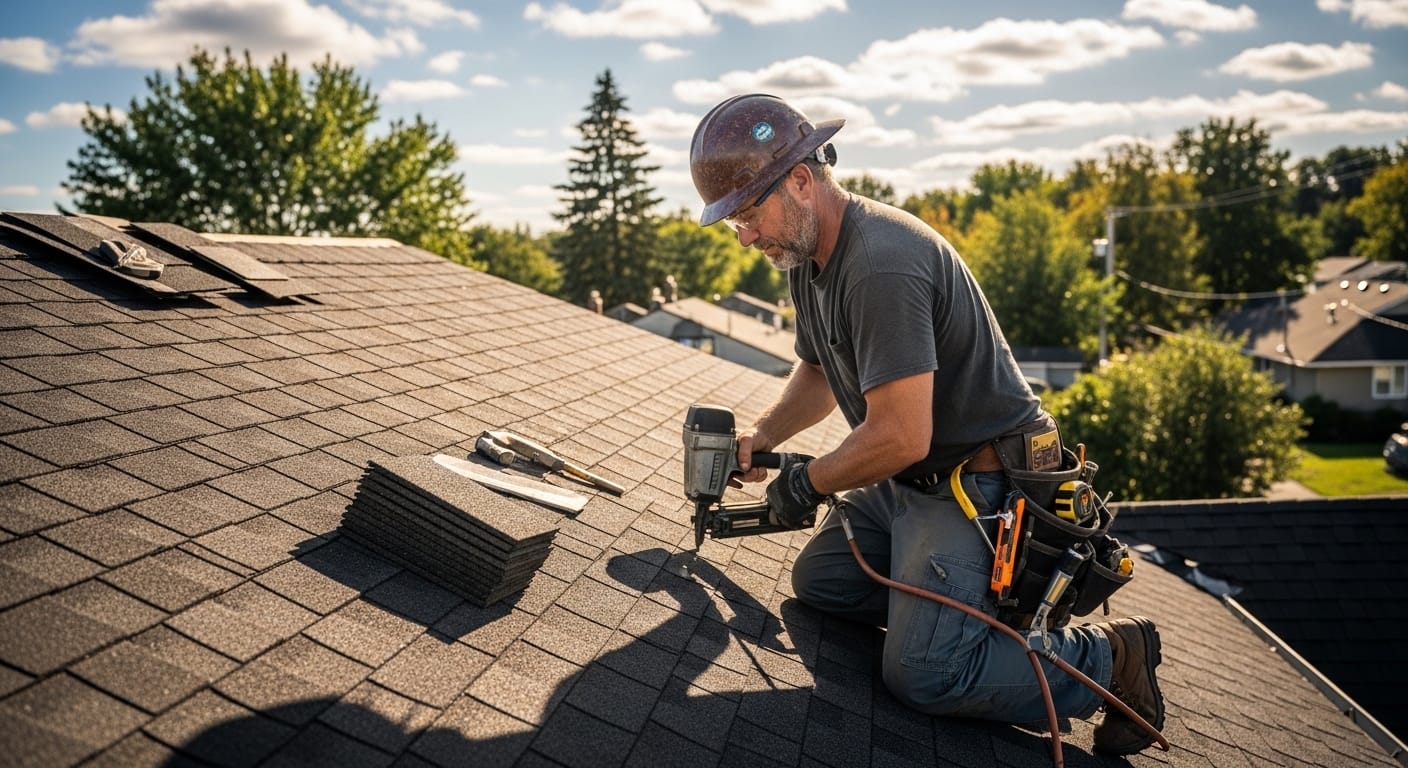
Roofer Salary 2026: $25/hr Labor vs. $100k+ Sales
The Answer Box: What Roofers Actually Earn in 2026 “Roofer Salary”
Let me give it to you straight before we get into the weeds. If you’re standing on a 10:12 pitch in Phoenix in July, sweating through your shirt before 9 a.m., you deserve a straight answer — not a paragraph of hedging from someone who’s never held a roofing hammer in their life.
In 2026, the median roofer in the United States earns $50,970 per year, which works out to roughly $24.51 per hour, according to the Bureau of Labor Statistics (OES Code 47-2181, May 2024 release — the most current benchmark for 2026 planning). That number sounds decent on paper. But there’s a massive gap between the guy hauling bundles up a ladder for $17 an hour and the commercial foreman in a union state pulling $80,000+ with benefits. And then there’s the sales rep driving a leased truck, closing storm jobs on commission, and netting $150,000 in a good year without touching a single shingle.
This guide breaks all of it down — the labor, the upside, and the exit ramp that most roofers never take.
Table 1: Quick Overview — Roofer Pay in 2026
| Role / Tier | Percentile | Annual Salary | Hourly Wage |
|---|---|---|---|
| Laborer / Tear-Off Crew | Bottom 10% | $37,060 | ~$17.82 |
| Shingler (Residential Installer) | Median (50%) | $50,970 | $24.51 |
| Commercial Roofer / Foreman | Top 90% | $80,780+ | $38.84+ |
| Roofing Sales Rep (Commission) | Uncapped | $80,000–$200,000+ | N/A |
Source: BLS OES 47-2181 | May 2024 data, applied to 2026 market conditions.
Estimate Your Weekly Piece-Rate Earnings
Paycheck Calculator
Calculate your Weekly, Monthly & Yearly Take-Home Pay
⚠️ These are estimates for a single filer using 2026 tax rates (IRS Rev. Proc. 2025-32). Results do not include local taxes, pre-tax deductions (401k, health insurance), or tax credits. Consult a tax professional for personalized advice.
Laborer to Commercial Pro: The Experience Level Breakdown
Here’s what nobody tells you when you’re 19 years old and someone hands you a shovel and says “start tearing.” The roofing wage ladder is real, but it’s not a gentle slope — it’s a steep pitch, just like the roofs you’ll be working on.
Table 2: Pay by Experience Level
| Experience Level | Pay Structure | Realistic Annual Earnings |
|---|---|---|
| 0–1 Year (Laborer / Tear-Off) | Hourly: $17–$20/hr | $35,000–$42,000 |
| 2–4 Years (Shingler / Installer) | Hourly or Piece Rate | $45,000–$58,000 |
| 5–10 Years (Lead / Foreman) | Hourly + Overtime | $58,000–$75,000 |
| 10+ Years (Commercial / Union) | Hourly + Benefits | $75,000–$90,000+ |
The Piece-Rate System — What It Is and Why It Matters
Once you get past the laborer stage, many residential roofing companies switch you from hourly to piece rate, which means you’re paid per square of roofing installed — not by the hour. A “square” is 100 square feet of roof surface. Rates vary by region, material, and pitch, but a typical piece-rate structure might look like this: $45–$75 per square for standard 3-tab or architectural shingles on a walkable pitch. A fast, experienced two-man crew can install 25–35 squares per day. Do that math — a productive crew on piece rate on a good day out-earns their hourly counterparts by a significant margin.
The flip side? Piece rate is unforgiving. Rain cancels your day and your pay simultaneously. A complicated roof with valleys, skylights, and multiple penetrations slows you down and eats into your square count. Material delays, callbacks, and warranty work? You’re often eating that time for free. Piece rate rewards speed and punishes everything that slows it down.
It’s the hardest $25/hr you’ll ever earn. But understanding piece rate is also your first lesson in entrepreneurial thinking — and that mental shift is what eventually leads the best roofers straight into sales.
The “Rain Day” Problem
This is the hidden tax on roofing wages that BLS data doesn’t capture. A roofer earning $30/hr sounds competitive until you realize the average roofing market in most of the country produces only 1,500 to 1,700 billable hours per year, compared to 2,080 for an indoor trade worker. Rain, snow, high wind, and extreme heat all shut down production. In northern states, you might be completely off the tools from November through March. That $30/hr rate with 1,600 hours of actual work equals $48,000 — not the $62,400 you’d calculate on paper.
Where Geography Shifts the Entire Equation
The five highest-paying states for roofers in 2026 are driven by a combination of union density, prevailing wage laws, and brutal seasonal conditions that require higher hourly premiums to attract labor. Minnesota tops the list at $77,730+, driven by freeze-thaw damage cycles that keep demand high year-round. New Jersey follows at $73,410+, heavily influenced by union strength and the NYC metro wage market. Massachusetts ($72,360+), Illinois ($68,220+ — home of Chicago Local 11), and Alaska ($67,880+, with hazard and remote logistics premiums) round out the top five. If you’re in a right-to-work state in the South, those numbers will look very different.
Why Roofing Sales Reps Earn $100k+: The Sales Pivot
I’ve watched it happen dozens of times in my own company. A guy comes in as a laborer, learns the trade in a year or two, develops an eye for damage and a way with people — and then someone puts him in a truck with a sample case and a lead sheet. Six months later, he’s making more money than the foreman he used to work under.
Roofing sales — especially storm restoration sales — is one of the most accessible six-figure career paths in the skilled trades world. Here’s why.
The Commission Model
Most residential roofing sales reps work on straight commission. The standard structure is either a percentage of the total job value (typically 8–12%) or a split of the gross profit (30–50% of what’s left after material and labor costs). On a $15,000 residential reroof, a rep earning 10% takes home $1,500 from that one job. Close three jobs in a week — which a competent storm canvasser absolutely can do — and you’ve earned $4,500 in five days. Annualize a consistent pace like that and you’re looking at $80,000–$120,000 without breaking a sweat on a hot roof.
Top performers who move into commercial contracts — schools, apartment complexes, flat-roof industrial buildings — can push $200,000+ in a single strong year, especially following a major hail or hurricane event that floods a market with insurance claims.
The “Storm Chasing” Reality
After a major hail event, roofing sales reps from across the country descend on affected neighborhoods like a gold rush. They knock doors, write estimates, file insurance claims, and close contracts at a pace that a normal residential market never produces. Elite storm chasers — the ones who follow the weather maps and deploy to Texas, Colorado, or the Carolinas after big storms — can bank $2,000–$4,000 in a single week, cash-heavy and fast. It’s not stable work, and it requires a thick skin for rejection and a tolerance for living out of hotels. But for a roofer with hustle and people skills, it’s the fastest path to real money this industry offers.
Why the Trade Skills Matter in Sales
The best roofing sales reps aren’t slick-talking strangers — they’re former installers who can get on a roof, identify wind uplift damage from a hail bruise, and explain the insurance process to a nervous homeowner in plain language. That credibility closes deals. If you’ve spent three years on a crew, you already know more about roofing than 90% of the sales reps in your market. That knowledge is worth money — you just have to stop trading it for an hourly rate.
Roofer vs Carpenter: The Trade Comparison
People ask me all the time whether their kid should go into roofing or carpentry. My answer is always the same: carpentry is the better long-term body investment. Roofing is the faster short-term cash play — and the better launchpad into sales.
Table 3: Roofer vs Carpenter — Head-to-Head
| Factor | Roofer (BLS 47-2181) | Carpenter (BLS 47-2031) |
|---|---|---|
| Median Annual Salary | $50,970 | $59,310 |
| Top 10% Earnings | $80,780+ | $95,000+ |
| Physical Toll | Extreme (heat, heights, impact on joints) | High (repetitive motion, lifting) |
| Year-Round Workability | No (weather dependent) | More consistent |
| Sales Transition Potential | Very High (storm restoration) | Moderate |
| Union Pathway | Strong in northern states | Broad, more industries |
| Learning Curve | Moderate (1–2 years to proficiency) | Steep (2–4 years apprenticeship) |
Carpentry has a higher median and more year-round stability, but roofing has the more explosive upside — particularly through the sales channel. A master carpenter earning $75,000 after a decade in the trade is doing well. A roofing sales rep who learned the trade for three years and then picked up a clipboard can match that number in year one of selling.
How to use it: Enter your squares-per-day production rate, your piece-rate per square, and your number of working days in the week. The calculator adjusts for pitch difficulty and material type to give you a realistic weekly earnings estimate — including what you’d earn on a straight hourly basis for comparison.

FAQ
Do roofers make good money?
The hourly rate is genuinely competitive — but the annual income picture is complicated by weather. A roofer billing $30/hr in a northern state might only accumulate 1,600 billable hours in a year due to rain days, snow shutdowns, and slow seasons. That brings annual income down to around $48,000 — solid, but not what the hourly rate implies on paper. The real money in roofing flows two directions: into union commercial work with consistent hours and benefits, or into sales with an uncapped commission structure. Pure installation work at the residential level is a competitive income but a hard one to grow beyond a ceiling.
Is roofing the hardest job in construction?
Physically, it consistently ranks number one in industry surveys — and I can tell you from personal experience, the data is right. The surface temperature of a dark asphalt shingle roof on a 90°F day can exceed 140°F. You’re not just hot — you’re working on a surface that’s radiating heat up through your boots and baking you from below while the sun hits you from above. Add the constant movement on sloped surfaces — which destroys ankles, knees, and lower backs at a rate you won’t fully feel until your mid-thirties — and you’ve got a trade that takes a serious physical toll on its workforce. Falls are the leading cause of construction fatalities in the United States, and roofers are among the most exposed workers in that category. This is not a career to enter without proper fall protection training, the right harness systems, and a company that enforces safety culture. The risk is real.
What’s the difference between roofing sales salary and installer pay?
The installer has stability and a floor. The median residential installer earns around $51,000 per year — predictable, physical, and capped by how many squares a crew can physically install in a day. The sales rep has no floor and no ceiling. A bad month in sales means zero. A great month means $20,000+. Most storm restoration sales reps working on 100% commission earn between $80,000 and $150,000 in their first full productive year, with top performers landing commercial accounts pushing $200,000+. The transition from installer to sales rep is the most financially significant career move available in the roofing industry — and most guys who’ve done both will tell you the selling is easier on the body, even if it’s harder on the ego at first.
Do roofers get benefits?
In residential, non-union shops — which make up the majority of the roofing market — benefits are inconsistent. Many piece-rate workers are 1099 subcontractors, which means no health insurance, no retirement contribution, and no workers’ comp coverage through the company. Union commercial roofers in states like Illinois, Minnesota, and New Jersey have full benefits packages that substantially change the total compensation picture. If benefits matter to you, union commercial roofing or a company-employed W2 sales role are the paths that provide them.
How dangerous is roofing compared to other trades?
Roofing has one of the highest fatality rates per capita in construction. Falls from height, heat stroke, and struck-by incidents are the primary risks. The financial reward of the trade reflects that risk — but so does the long-term physical cost. Proper harness systems, ridge anchors, roof jacks, and hydration protocols aren’t optional extras; they’re the difference between a long career and a permanent injury. If a contractor you work for doesn’t enforce fall protection, leave. No paycheck is worth it.
Sources
Bureau of Labor Statistics — Occupational Employment and Wage Statistics OES Code: 47-2181 (Roofers) Data Release: May 2024 | Applied to 2026 labor market planning URL: bls.gov/oes
All salary figures in this article are derived from or benchmarked against BLS OES 47-2181 data (May 2024, the most current official release as of this writing), cross-referenced with regional market rates from union scale agreements in Minnesota (SMWIA Local 110), Illinois (Local 11 Chicago), and New Jersey prevailing wage schedules. Commission structures and piece-rate ranges reflect field-reported averages from active residential and storm restoration contractors.
How to use it: This calculator goes beyond the weekly estimate. Input your pay structure (hourly, piece rate, or commission), your state, your average billable hours per year (accounting for weather shutdowns), and your experience tier. The output gives you a realistic annual income projection — plus a side-by-side comparison showing what you’d earn if you transitioned into roofing sales at a standard 10% commission rate on your market’s average job size. Use it to see exactly what the sales pivot is worth in your specific market.
This article was written from the perspective of a working roofing contractor. The numbers are real. The warnings are real. And the opportunity — if you’re willing to put in the work on both the roof and the sales side — is as real as it gets in the skilled trades.
If you are looking for Trades & Blue Collar jobs, check out our guides on [Solar Installer] and [Pipefitter].